


What Double 11 is and why U.S. shoppers watch it
Double 11 began as a November 11 shopping event in China and has grown into one of the country's major shopping festivals. During the event, Chinese ecommerce platforms such as Taobao, Tmall, and JD.com often concentrate store offers, platform coupons, cross-store incentives, and limited-time prices. That concentration makes the selection and discounts worth watching. However, the 2026 schedule, thresholds, eligible listings, and stacking rules must come from each platform's live event and checkout pages, not from last year's terms.
For U.S. shoppers, Double 11 can be a useful window for comparing Chinese-market products, event prices, and combinations of purchases. A low listing price is not the final landed cost: domestic shipping within China, international freight, possible import charges, and return difficulty still matter.
Cainiao consolidation is not an automatic export route for every order from a Chinese marketplace. This workflow applies only when the seller or platform accepts the mainland China warehouse address currently assigned to your own Cainiao account and the exact item meets warehouse intake requirements and the rules of a current U.S. route. Domestic delivery to the China warehouse does not guarantee onward eligibility to the United States.
Before Double 11 starts, the best use of your time is therefore not refreshing prices. It is resolving the questions that can slow you down once a sale opens and become expensive to fix after you pay.
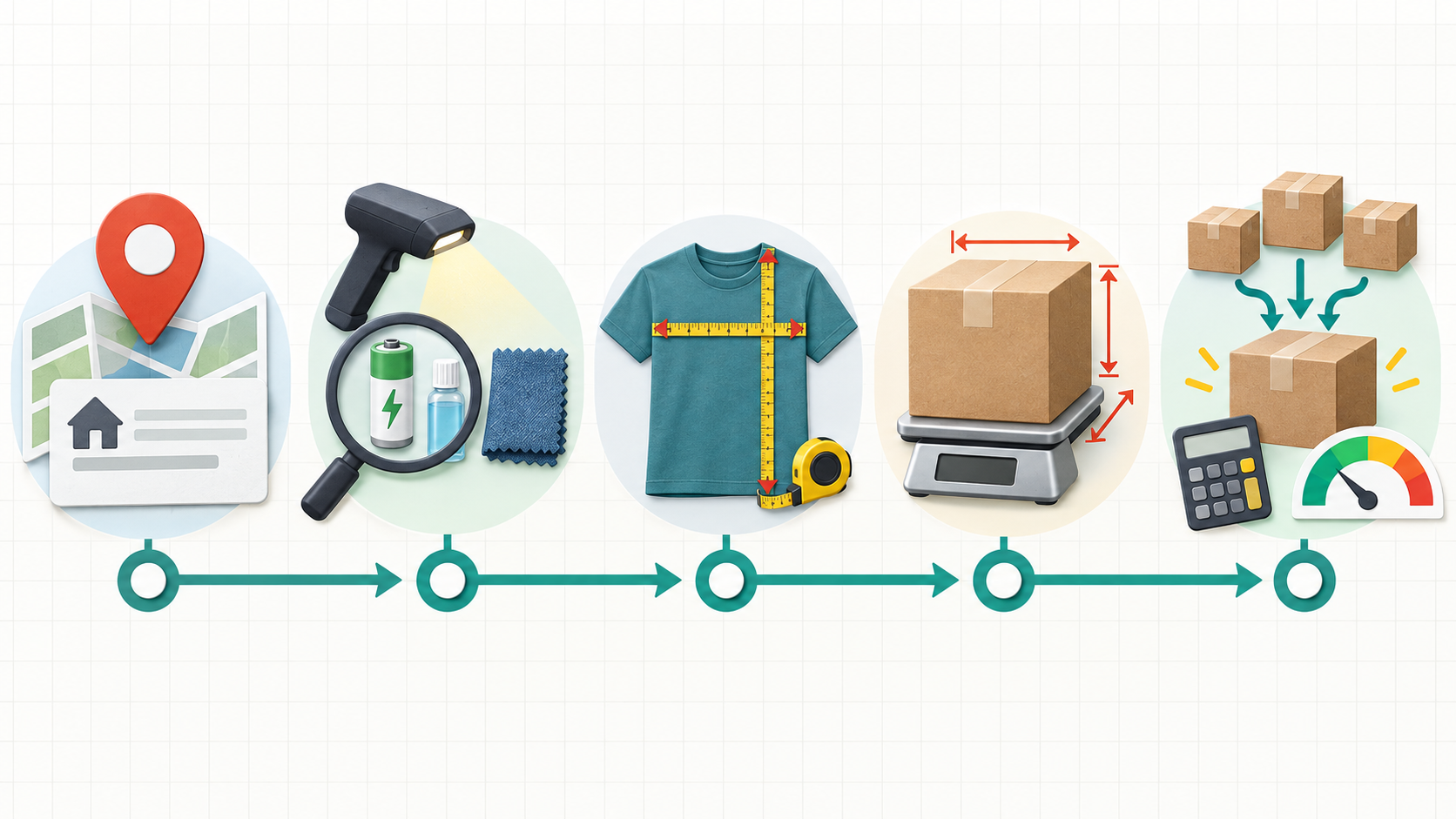
Using a Taobao cart as the working example, this guide does not predict this year's spending thresholds, cover presale deposits, or repeat the Double 11-versus-Black Friday comparison. It asks one narrower question: Is this cart ready for U.S. consolidation? Each of the five checks needs evidence and ends in a clear go/no-go decision.

Build a before-you-order checklist in 10 minutes
Do not scatter the evidence across favorites, seller chats, and two apps. For each checkpoint, answer only three questions: What did I obtain? Where is the evidence? What will I do if it is missing?
| Checkpoint | What to obtain before ordering | Ready when | If it is not ready |
|---|---|---|---|
| Warehouse address | The current address from your own account | Every field matches between Taobao and Cainiao | Copy it again; do not pay |
| Shipping restrictions | Materials, contents, and special attributes for every SKU | The result is clear, or support has answered in writing | Pause that SKU |
| Size | Your measurements or a well-fitting garment, plus the current size chart | Specific centimeters support the selected size | Ask the seller; do not guess from S/M/L |
| Weight | Packed gross weight plus length, width, and height | All four values have a source, or a missing value has a conservative upper bound and removal rule | Remove it if you cannot set an upper bound |
| Consolidation budget | International-shipping ceiling, uncertainty buffer, and stop line | You already know what to remove if the total is too high | Do not add items just to lower the average shipping cost |
1. Warehouse address: copy only the version in your account now
Open the Cainiao app, confirm that the destination is the United States, and copy the China warehouse address assigned to your account from the consolidation section. Do not use an old screenshot, a group chat, a tutorial example, or another person's order.
After adding it to your Taobao address book, compare every field:
- recipient name;
- phone number;
- province, city, and district;
- detailed street address;
- any account-specific identifier supplied by the system.
If that identifier is omitted, truncated, or placed in the wrong field, the warehouse may need extra work to match the parcel to your account. The simplest record is two screenshots: the current warehouse-address page in Cainiao and the final delivery address selected at Taobao checkout.
Ready when: every field matches and the Taobao checkout page is actually using that address. The live address inside your own account remains authoritative.
2. Shipping restrictions: check each SKU, not a broad category
“Clothing can ship” and “household goods can ship” are too broad to make a decision. Variants on one listing can include different accessories, and a gift set can combine an ordinary item with an ingredient or component that needs separate review.
Add one row for every SKU you intend to buy and record at least:
- primary materials or ingredients;
- batteries, circuitry, or magnetic components;
- liquids, powders, aerosols, pastes, or pressurized containers;
- food, medicine, cosmetics, or another category that needs additional confirmation;
- exactly what the set includes and in what quantity.
Then use Cainiao's restricted-item lookup with the specific product and U.S. destination. If the result is unclear, send the listing URL, selected variant, materials or ingredients, quantity, and relevant specifications to Cainiao customer support. Save the written reply.
A seller can tell you what is inside the product. A seller's statement that an item “can ship” does not replace the international route's actual screening. Domestic delivery to the China warehouse does not guarantee onward eligibility to the United States.
Ready when: every SKU has either an unambiguous lookup result or a written Cainiao support response tied to that product and the U.S. destination. Otherwise, remove it from the cart for now. This completes only the before-you-order screening; it is not a final shipping guarantee. Recheck eligibility against the current U.S. route before paying for consolidation.
3. Size: save the centimeters and the chart's measurement method
Inventory and seller support can both get busier during Double 11. Waiting until the sale starts to ask, “I usually wear M; what should I choose?” is slow, and the question does not provide enough evidence.
Prepare two sets of data for apparel:
- your body measurements or the flat measurements of a garment that fits well;
- the size chart for the exact listing and SKU.
For a top, record shoulder width, chest circumference or flat chest width, garment length, and sleeve length. For pants, record waist and hip circumference, trouser length, and front and back rise, focusing on the measurements that actually determine fit. For shoes, record at least foot length and width, then follow the listing's stated conversion method.
The chart's measurement method matters. Some charts show body measurements; others show finished-garment measurements. A chest value may be a full circumference or a flat one-side width. Also note stretch, cut, and possible manual-measurement error. Save a screenshot of the chart, selected color and variant, and any seller clarification so a sale-day listing change does not erase your evidence.
Ready when: at least two relevant measurements in centimeters explain your choice, and you know whether the chart describes the body or the garment. A lone S, M, or L is not enough.
4. Weight: ask for packed gross weight and all three dimensions
Net product weight tells you what the item itself weighs. It does not tell you which measurements will drive international shipping. Before ordering, ask the seller for:
- packed gross weight;
- the longest, second-longest, and shortest packed dimensions;
- any shoe box, gift box, rigid case, or non-compressible component;
- whether multiple units ship separately or in one outer carton.
Label the source of each number: a seller measurement, a product-page specification, or your estimate. If exact values are unavailable, use the Cainiao package-size and price calculator for screening, but treat the result as an estimate, not a final quote. Large, light items need a conservative budget because package volume may affect billable weight.
You do not need to guess a permanently valid dimensional divisor before ordering. The useful preparation is to obtain the four inputs and then compare them with the warehouse data and current route terms after arrival. For a deeper explanation of actual, dimensional, and billable weight and packaging choices, see the parcel weight and consolidation-packaging guide.
Ready when: every item has a packed gross weight and three dimensions. If the seller genuinely cannot provide them, mark the item “unknown, high risk,” set conservative upper bounds for weight and volume, and define the threshold that removes it from the order. Proceed only if those upper bounds still fit the budget. Never convert an unknown into zero.
5. Consolidation budget: write the stop line before choosing quantity
A consolidation budget is not a precise shipping prediction. It is a decision made in advance: How much are you willing to reserve for international shipping and uncertainty, and what will you do if the real total exceeds it?
Split the cart into three groups:
- Group A: core list. Size, eligibility, and packaging data are reasonably clear, and you would still buy these items as a smaller order.
- Group B: volume risk. Bulky, rigid-boxed, or poorly documented items that could materially increase the parcel's billable weight or cost.
- Group C: pending confirmation. Eligibility, accessories, materials, or route questions remain unresolved; do not pay for these yet.
Then use one currency for all four lines:
Known cost of merchandise and domestic shipping within China: ____
International-shipping budget ceiling: ____
Buffer for duties, packing, insurance, and other unknowns: ____
Maximum all-in cost (the sum of the three lines above): ____
Before paying on Taobao, fill the sheet with conservative estimates. After warehouse check-in, replace the estimates with the warehouse data and Cainiao checkout quote, then compare the result with your maximum all-in cost.
Finish with one operating rule, such as: “If the total exceeds the ceiling, first remove the largest Group B item; if it is still too high, compare splitting the shipment, returning the item where permitted, or buying a U.S. alternative.” Splitting is not always cheaper, and consolidating is not automatically the lowest-cost option. The point is to have a predetermined response when the real data appears instead of increasing the budget simply because the goods are already at the warehouse.
Leave USAVE savings out of the advance budget.
Ready when: the budget has a ceiling, a buffer for unknowns, and an order of operations if the total is too high. “As cheap as possible” is not a budget.
The 60-second go/no-go check before the sale opens
- Taobao checkout is using the current Cainiao warehouse address from your own account.
- Every SKU has been checked for the U.S. destination.
- Every size choice is supported by centimeters and the current listing's size chart.
- Every item has packed gross weight and three dimensions, or a missing value has a conservative upper bound and removal rule; no unknown has been treated as zero.
- Your consolidation budget has a stop line, and you know which item leaves first if the total is too high.
If any answer is still “I will figure it out after buying,” pause that item. Double 11 terms and prices can change. Your warehouse address, eligibility evidence, fit evidence, packaging data, and budget boundary can all be prepared now.
New to Cainiao consolidation?
If you are not yet familiar with ordering from Taobao, entering the warehouse address, waiting for check-in, consolidating parcels, and paying for international shipping, start with How to Buy from Taobao in the USA: Complete 8-Step Guide. Then return here and apply the five go/no-go checks to this cart.
Cainiao U.S. promo code USAVE
Only after confirming that the exact item and current U.S. route are eligible should you enter the Cainiao U.S. promo code USAVE at international-shipping checkout. Count it only when checkout visibly applies the code and lowers the final amount due. Eligibility and the actual reduction depend on your live checkout.
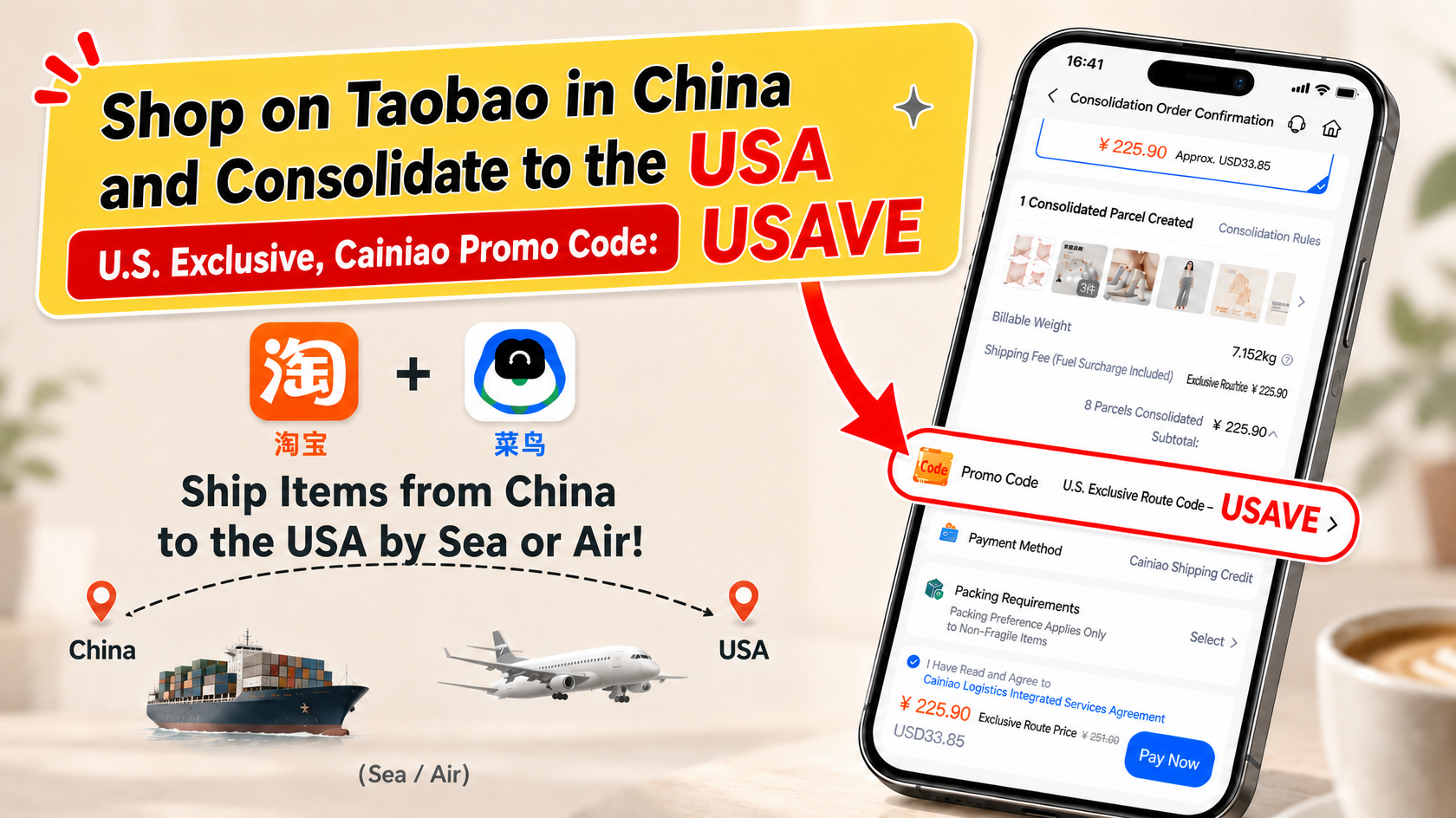
Open Cainiao, confirm the item and U.S. route, then try USAVE at international-shipping checkout
This article contains USAVE promotional information. A promo code does not change route eligibility and cannot guarantee delivery timing, import treatment, or an after-sales result.