
National Geographic Photo of the Day: Bait Ball, August 5
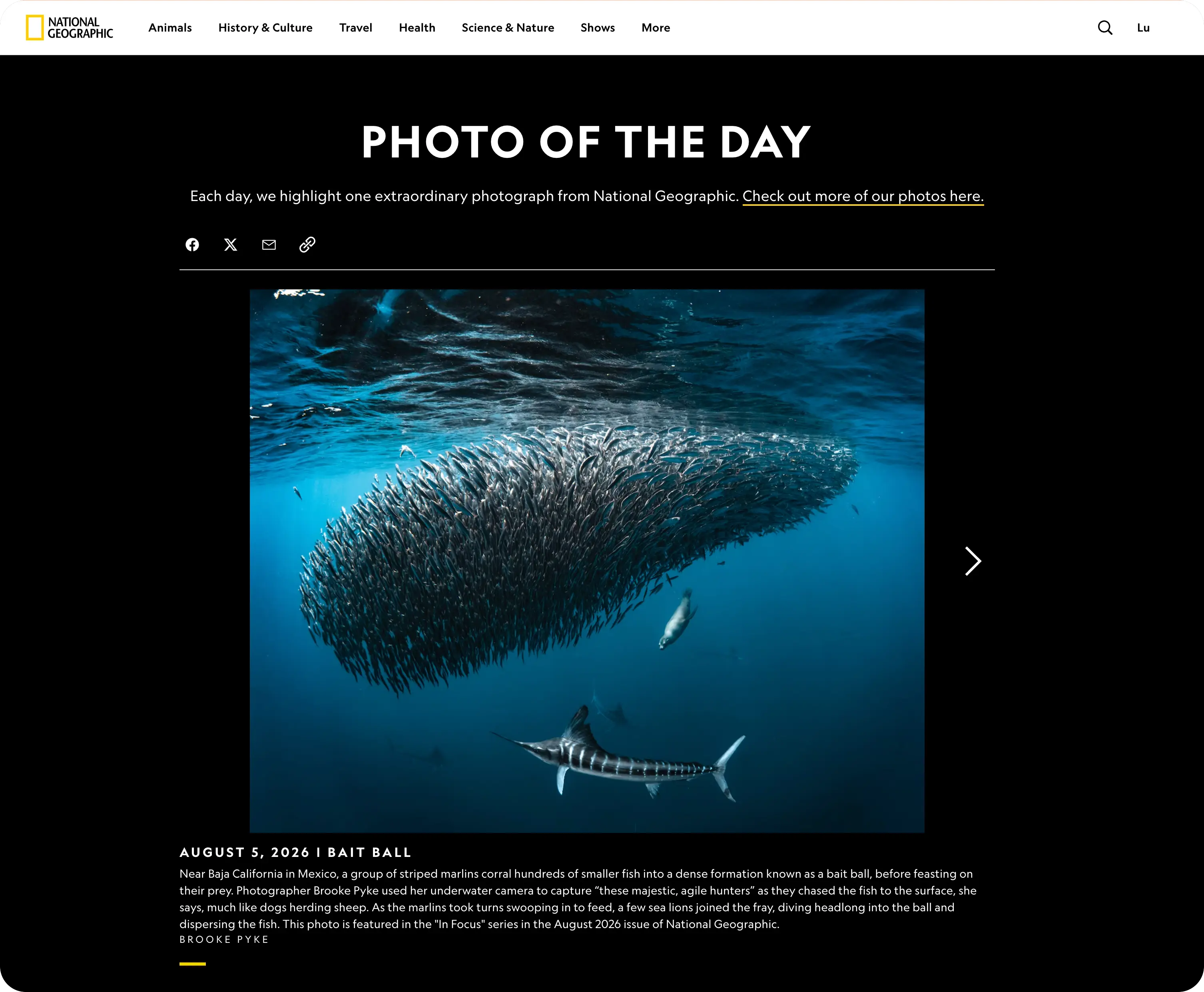
Image: National Geographic Photo of the Day · Bait Ball · Photograph by Brooke Pyke (National Geographic August 2026 "In Focus" feature) · Original page.
A mass of silver fish compressed into a tight, impenetrable ball—its edges so dense that individual bodies disappear, leaving only a stippled sheet of reflected light off their scales. Beside the ball, a sleek, stripe-sided predator glides past without hurry.
This is the Pacific Ocean off Mexico's Baja California Peninsula. The person behind the shutter is Australian photographer Brooke Pyke. The hunter in the frame is a striped marlin; the besieged are sardines. In English, the formation is called a bait ball. Pyke says watching these hunters herd the fish toward the surface is "very much like watching sheepdogs herd sheep."
The sheepdog analogy is apt, but the herded party isn't nearly as cooperative as a flock. That ball looks like a carefully organized collective defense—but in reality, it's the sum of hundreds of selfish calculations.
The ball isn't a shield—it's a crush toward the center
In 1971, evolutionary biologist W. D. Hamilton published a paper in the Journal of Theoretical Biology that has since been cited countless times. Its title: "Geometry for the Selfish Herd."
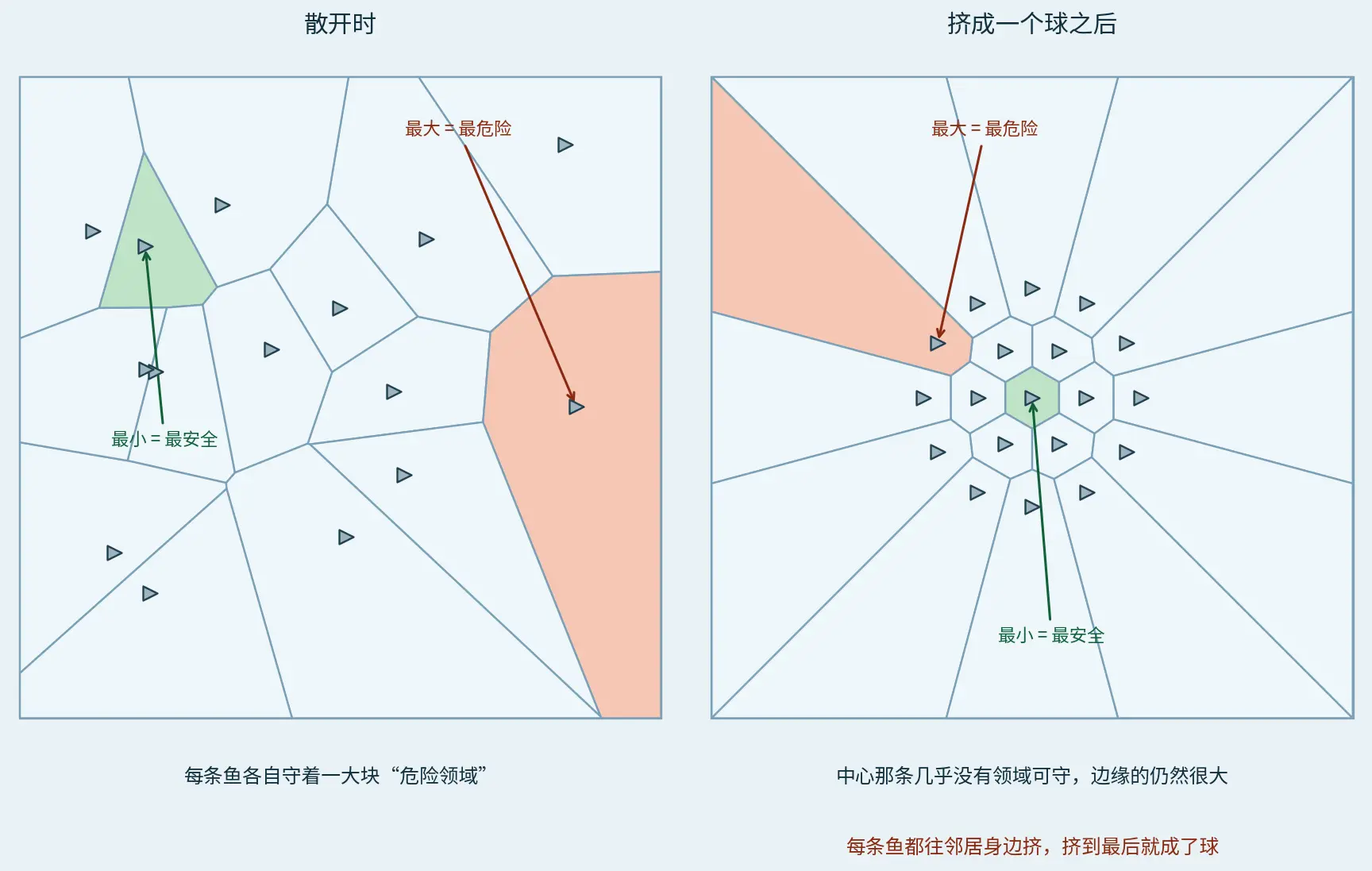
His premise was extremely simple. Assume a predator can appear from any random position. Each prey animal then has its own "domain of danger"—the area closest to it, meaning that if a predator lands there, it will be the first to die. The easiest way to shrink your domain of danger isn't to become stronger or to flee—it's to squeeze closer to your neighbor: shove someone else between you and the predator, and your zone gets smaller.
The key is that every individual executes this rule simultaneously. So the group automatically contracts inward, packing tighter and tighter, until it collapses into a ball. The center is safest; the edge is most dangerous—researchers call the high mortality on the periphery "marginal predation."
So that ball in the photograph is essentially a stampede directed inward. Hundreds of fish are all doing the same thing: putting other fish between themselves and that pointed bill.
So does packing into a ball actually work?
It does—and the effect is surprisingly powerful.
A classic 1986 experiment used largemouth bass hunting silvery minnows: when a minnow was alone, the bass snatched it in one strike. But when minnows were grouped in schools of eight or more, the bass attacked repeatedly and still couldn't catch one—it was essentially stuck. This is the "confusion effect"—locking onto a single target among many identical ones and tracking it continuously is simply too costly for the eyes and brain.
The most ruthless twist in the experiment was this: when one or two fish dyed blue were placed among the group of eight, the bass's success rate immediately rebounded. Not only was the blue fish easier to catch, but the normal fish nearby also suffered—because the group was no longer an indistinguishable sheet of silver. Yet when the school was expanded to fifteen, the disruptive effect of those oddball fish was swamped again.
For a small fish, a cold rule of survival lurks here: in the school, never be the one that looks different. The near-obsessive uniformity of a fish school—the angle of their flash, the timing of their turns, all synchronized—isn't aesthetics. It's survival. Whoever is half a beat behind becomes the blue fish.
The hunters' countermove: turn signals
The large fish in this image is Kajikia audax, commonly known as the striped marlin. It has a long, pointed bill that can stun small fish with a lateral swipe, and it's one of the fastest swimmers in the ocean.
When hunting a bait ball, the biggest risk these marlin face isn't actually the prey—it's each other. Imagine several high-speed hunters wielding long spears crowded around the same ball. Without some system of who goes when, the first casualty would be friendly fire. Their solution is to take turns: one charges in while the others wait outside.
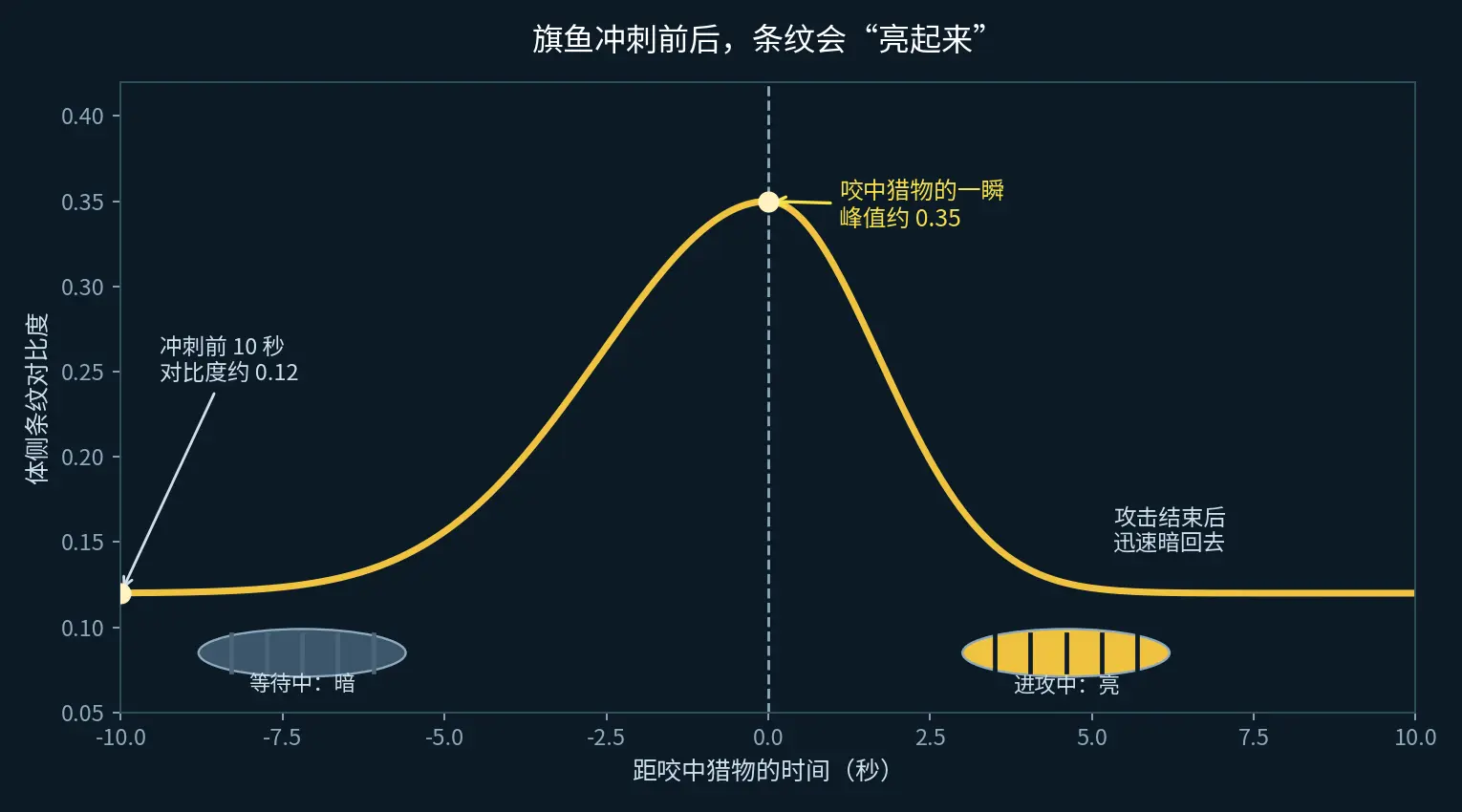
But how does a marlin tell its companions "my turn"? A study published in Current Biology in February 2024 provided an elegant answer. Alicia Burns and Jens Krause's team at Humboldt University of Berlin used drones to film hunts off Magdalena Bay, quantifying the contrast of each marlin's lateral stripes second by second. The result: the one about to attack would rapidly "light up" before its charge—average contrast around 0.12 ten seconds before contact with the prey, spiking to a peak of about 0.35 at the moment of the strike, then quickly fading back afterward. Companions not participating in that round showed no such change. The researchers' description: the attacking fish "lit up," visibly brighter than its companions.
The hardware for color change is embedded in the skin—cells called iridophores. Crystals inside these cells reflect light, allowing a blue-gray body to instantly flash high-contrast stripes—like a backlit sign switched to maximum brightness.
Interestingly, fishermen have long known that marlin change color, but it was always dismissed as a physiological response to excitement or stress—the same logic as a human blushing. This study was the first to link color change to division of labor in cooperative hunting: it's not blushing. It's a turn signal. The one that lights up goes in; everyone else yields.
Why this stretch of ocean, why this season
The Baja California Peninsula sits at the junction of two currents: the cold, nutrient-rich California Current flows south and collides with warmer Pacific water, generating upwelling near the continental shelf that pushes deep nutrients to the surface. Phytoplankton bloom, sardines and mackerel swarm in to feed, and marlin follow the sardines.
Pacific sardines spawn off Magdalena Bay roughly from mid-October through late December. So every late autumn to early winter, these waters stage a feast sometimes called the "Mexican sardine run"—reportedly second in scale only to South Africa's—and it's this window that draws underwater photographers from around the world.
National Geographic's caption also includes a sequel beyond the frame: while the marlin were taking turns feeding, a group of sea lions arrived, plunging headlong into the bait ball and blowing it apart. Sea lions observe none of the marlin's turn-taking etiquette—pure brute force. A ball that hundreds of fish spent ages squeezing into existence vanished in seconds.
The person behind the shutter
Brooke Pyke is Australian, currently living in Exmouth, Western Australia, right by Ningaloo Reef. The irony: she was afraid of water as a child, refusing to go in until age seven, when her father half-pushed, half-dragged her onto a boogie board and then took her snorkeling. She didn't pick up a camera until she was 21. In 2022, she won the Blancpain Fifty Fathoms Women's Photography Prize.
On her website she once wrote a line that serves as a better caption for this image than any popular science explanation: she worries that future generations "will never get to see striped marlin hunting a bait ball." This photograph is exactly what she's doing—capturing it while it can still be seen.
This image and yesterday's Father and Son from Malta appear together in the "In Focus" feature of National Geographic's August 2026 issue.
If you want to see it for yourself, the season and location are clear: mid-October through December (peak from late October to December), Pacific side of the Baja California Peninsula, with most trips launching from Puerto San Carlos. Most tours are snorkeling or freediving—no dive certification required. The first step in finding the fish isn't underwater but on the surface: look for circling seabirds. A caveat, though: these are wild animals, and no trip to sea can guarantee a sighting.
There's also a cheaper, immediately available option: go to any aquarium with a cylindrical tank of schooling sardines or anchovies, press your face to the glass, pick out a single fish, and try to track it with your eyes for ten seconds. You will almost certainly lose it. The moment you do, you've experienced the confusion effect firsthand—and you'll understand why that little fish dyed blue was the one that died.
Sources: National Geographic Photo of the Day original page, Photographer's website, Current Biology: Rapid color change in striped marlin during group hunting, IGB: Color change and group hunting study explainer, EurekAlert: Researcher interview, Landeau & Terborgh 1986: Oddity and the confusion effect experiment, eLife: The selfish herd and individual predation risk, Divernet: Striped marlin and sardine season off Baja California, DAN Alert Diver: Brooke Pyke interview