
Before going to space, you first have to practice working in a place where you can't even stretch your arms out, wearing a suit that weighs fourteen kilograms.
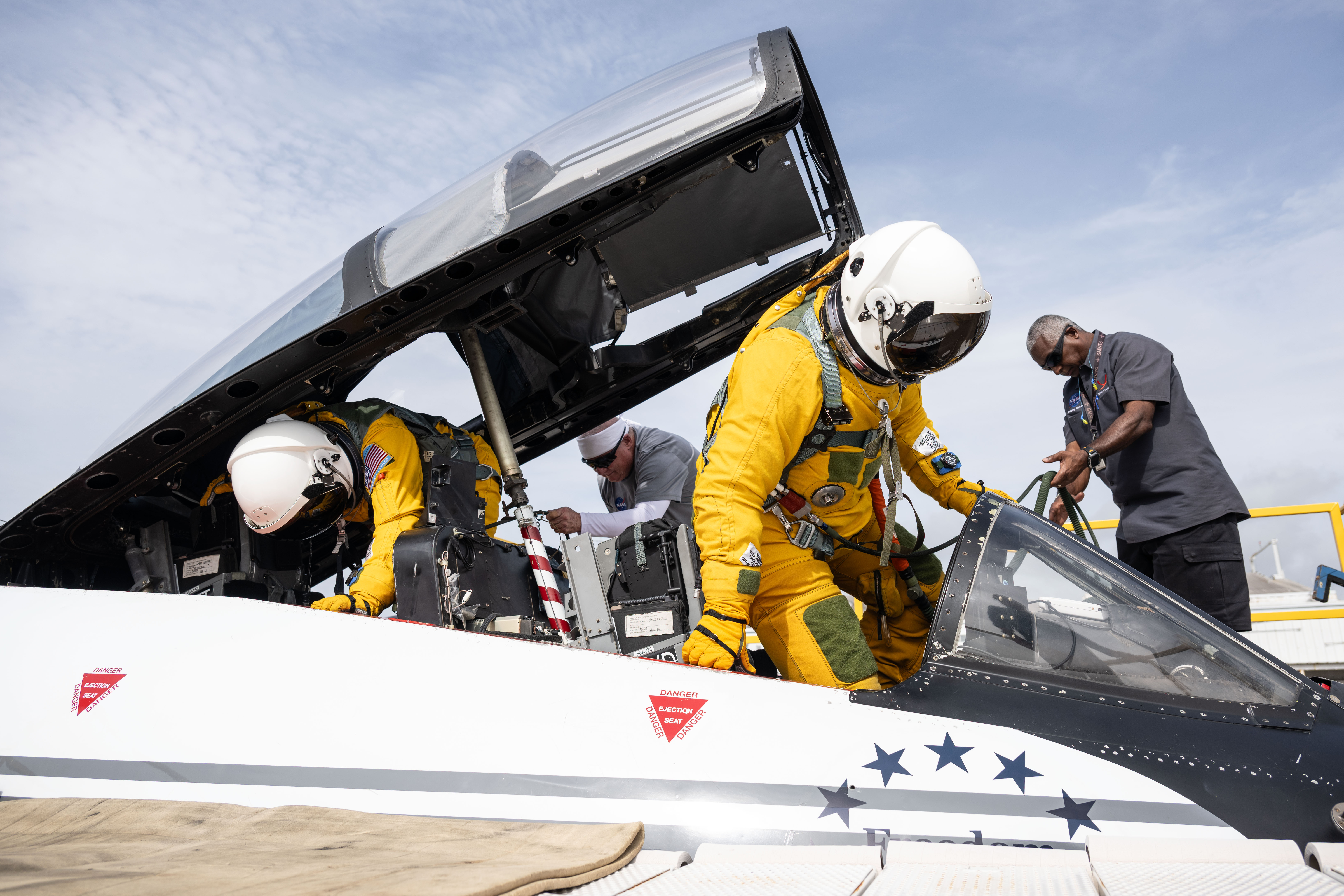
Image: NASA Image of the Day · Image credit: NASA/Josh Valcarcel · Image page
NASA's Image of the Day is titled Taking Flight to Prepare for Space.
The picture shows two people in form-fitting yellow flight suits and white helmets climbing into an aircraft. A circle of technicians surrounds them. The one on the right in yellow is astronaut Adam Fuhrmann. The photo was taken on Thursday, July 16.
That yellow outfit isn't a jumpsuit. It's a full pressure suit—the same principle as the ones Space Shuttle–era astronauts wore during launch and reentry.
The aircraft they're climbing into is called a WB-57.
An aircraft older than the astronauts
The WB-57 is based at Ellington Field in Houston, right next to NASA's Johnson Space Center. NASA has three of them, and they've been flying research missions since the early 1970s—still flying today.
Its airframe traces back to a 1950s bomber-reconnaissance design, with long straight wings that don't look particularly impressive. But it has one capability very few aircraft can match: it can climb from sea level to above 63,000 feet—that's 19.2 kilometers—and stay there for a long time.
A single mission can last six and a half hours, carrying nearly three tons of equipment. The nose section houses two separate cockpits arranged front to back: the pilot sits in front, and a "sensor equipment operator" sits behind, running all the instruments onboard. The missions it has flown are all over the map: chasing hurricanes, collecting high-altitude samples, taking high-resolution photographs of objects in the sky, and hauling prototype technologies up to altitude for testing.
And 19.2 kilometers is not an arbitrary number.
There's a line that was identified in 1947
About 19 kilometers above the ground, there's an invisible line.
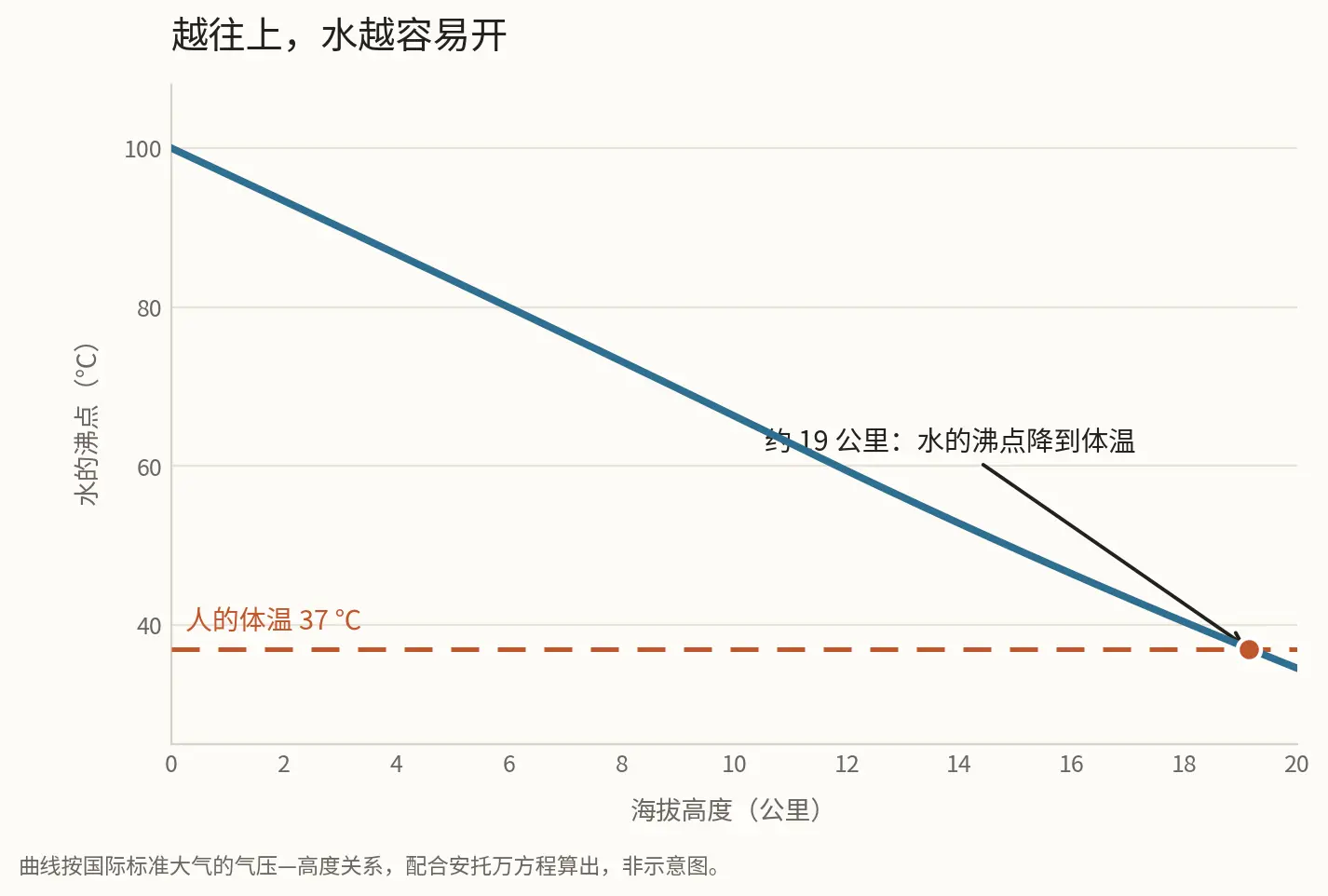
Above it, atmospheric pressure drops to just 6.3 kilopascals—roughly one-sixteenth of sea-level pressure. At this pressure, the boiling point of water falls all the way down to 37 degrees Celsius.
And 37 degrees Celsius happens to be human body temperature.
This line is called the Armstrong limit, named after U.S. Air Force flight surgeon Harry Armstrong. In 1947 he established the Air Force's Department of Space Medicine, and he was the first to grasp how deadly this fact was: above this line, an unprotected person's exposed body fluids will spontaneously begin to boil—saliva, tears, and the thin wet film lining the lung alveoli.
A clarification is necessary here, because this gets mangled constantly: blood inside the vessels does not boil. Blood is held under pressure by the vessels and the heart—enough pressure to keep it liquid. What actually vaporizes are the fluids in direct contact with the air.
But that's already fatal. Once the water in the alveoli turns to vapor, the lungs stop working. Above this line, a person loses consciousness within tens of seconds, and if pressure isn't restored quickly, what follows is death.
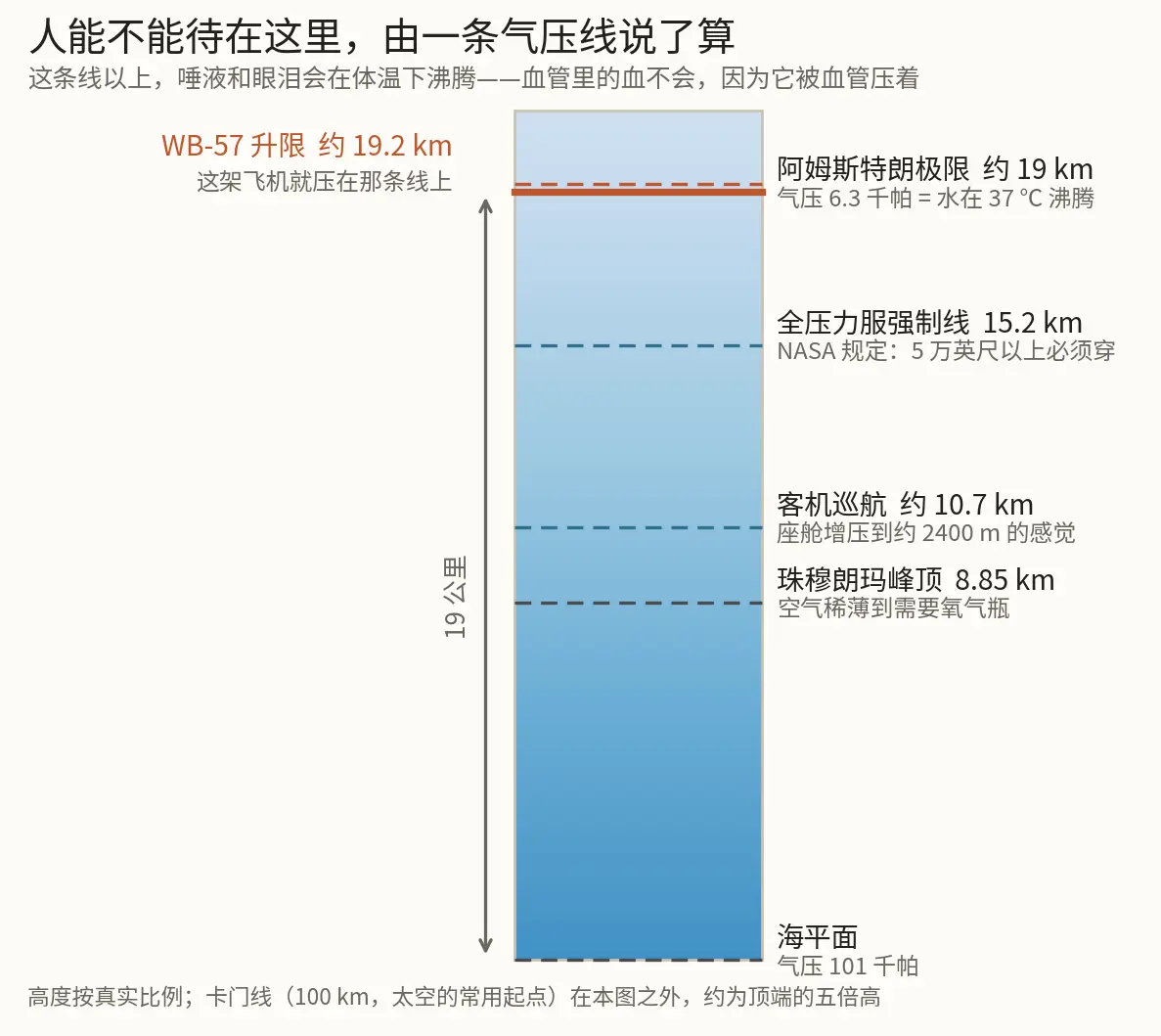
Here's the interesting part: the WB-57's service ceiling sits precisely on this line—even slightly above it.
That's not a coincidence. The whole reason aircraft like this exist is to carry people to the highest point the atmosphere can offer—any higher, and the wings have no air left to grab.
9 to 12 seconds
The cockpit is pressurized, of course. The pressure suit isn't for normal flight—it's for "what if": cabin depressurization, canopy breach, or the pilot having to eject at altitude.
NASA's flight rules are unambiguous: above 50,000 feet (15.2 kilometers), all crew members must wear a full pressure suit. The suit weighs 31 pounds—about 14 kilograms—and is normally soft, inflating and going rigid only when cabin pressure is lost above 35,000 feet. It also carries two backup systems; if the primary fails, the secondary takes over automatically at 37,000 feet.
Why are the rules written this rigidly? One number makes it clear.
In aerospace medicine there's a concept called "time of useful consciousness"—the window between losing your oxygen supply and losing your ability to take meaningful action. Above 10,000 feet, an unprotected person already begins to suffer hypoxia. At 60,000 feet, NASA's stated time of useful consciousness is:
9 to 12 seconds.
Nine seconds. Enough to finish a sentence, not enough to figure out what's happening. So the pressure suit must be on before anything goes wrong—the crew spends at least an hour before each mission putting it on and running checks.
Incidentally, the temperature up there is close to minus 57 degrees Celsius.
So what does this have to do with going to space
The explanation in NASA's caption is straightforward: this kind of high-altitude flight trains three things—working in an extremely confined environment, operating aircraft systems while wearing a pressure suit, and getting accustomed to the entire procedure. All in preparation for future missions to the International Space Station, the Moon, or beyond.
In plain terms: the hardest part of space is often not the spectacular part—it's "pressing the right small button while wearing a bulky suit."
Turning a knob in pressurized gloves versus turning it bare-handed are two completely different things. Coordinating with another person in a cockpit where you can barely turn around is not something you can practice in an office. And there's a layer of psychological training: you have to get used to the fact that your life depends on this equipment—used to it to the point where it no longer distracts you.
As for Fuhrmann in the photo—his background is worth a few words.
The man climbing in
Adam Fuhrmann is a U.S. Air Force major. He was selected as a NASA astronaut candidate in 2025, reported that September, and has two years of initial training ahead of him.
His flight record: more than 2,100 hours across 27 aircraft types, including 400 combat flight hours. Strung together, 2,100 hours is the equivalent of 87 days in the air without eating or sleeping.
He graduated from MIT in 2011 with a degree in aerospace engineering and a minor in political science. He later earned a master's in flight test engineering from the U.S. Air Force Test Pilot School and a master's in systems engineering from Purdue University. During his years as a test pilot at Edwards Air Force Base, he tested the F-16 and F-35. At the time of his NASA selection, he was the operations director of a flight test unit.
His personal section notes: born in Brandywine, Pennsylvania; considers Leesburg, Virginia, his hometown; his wife Shauna is a veteran and now a small-animal veterinarian; they have three children. Hobbies listed: camping, hiking, skiing, hunting, leatherworking, and classic car restoration.
A person who restores classic cars going on to work on a spacecraft somehow makes sense.
In closing
When we usually talk about spaceflight, we talk about ignition, liftoff, landing—the moments with background music.
Today's photo captures something else: a person who hasn't been to space yet, wearing a fourteen-kilogram suit, on the ground, climbing into an aircraft designed fifty years ago. A circle of people around him checking every connector. He'll fly to the top of the atmosphere, spend a few hours near the line where body fluids boil, then land, take off the suit, and go home for dinner.
Days like this will be his life for the next two years.
Next time you're on a plane, glance at the little screen on the seatback in front of you. It shows your current altitude—usually around 10,000 meters. Double that number, and you're at the altitude in today's photo.
The air pressure there is one-sixteenth of what it is on the ground.
Sources: NASA Image of the Day entry for August 6, 2026, Taking Flight to Prepare for Space; NASA Johnson Space Center WB-57 High Altitude Research Program page and life-support system documentation; NASA Airborne Science Program WB-57 aircraft specifications; NASA astronaut candidate Adam Fuhrmann's biographical page; Armstrong limit pressure and boiling-point data per the International Standard Atmosphere and related aerospace medicine references.fig-iotd-20260806-armstrong.pngfig-iotd-20260806-boiling.png