
There is a kind of laboratory that humans cannot build—it can only be found in the sky.
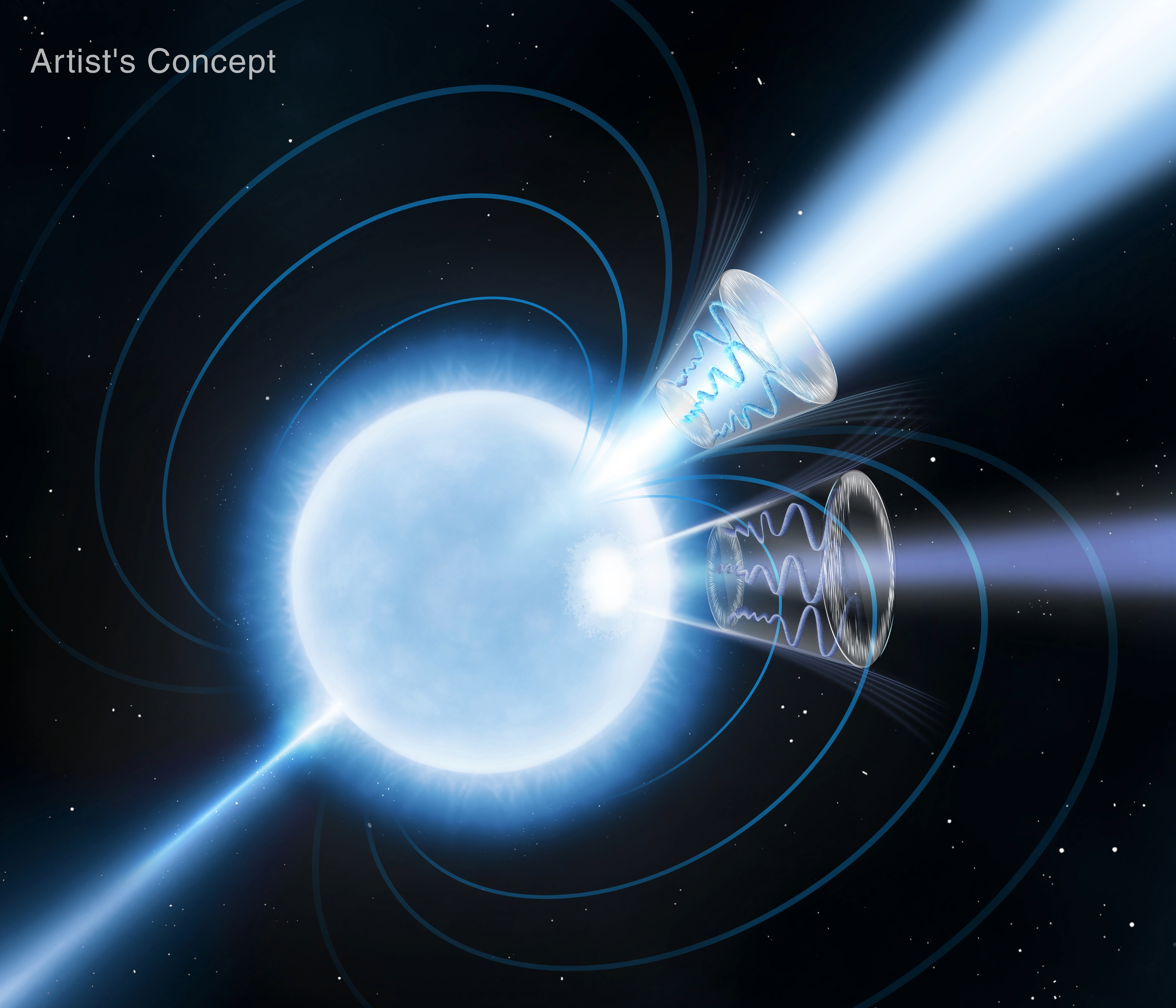
Image: NASA Image of the Day · Image credit: NASA/Pablo Garcia · Image page
Today's NASA Image of the Day isn't a photograph—it's a painting.
It's not that there was nothing to photograph. It's that the subject simply can't be photographed: a dead star more than ten thousand light-years away, no bigger than a city. The painting was released on August 5; the same day, a Wednesday, Nature published a paper about it. NASA's characterization of this measurement: it may have captured something physicists predicted 90 years ago but have never directly observed—"empty" vacuum, filtering light all by itself.
Let me be clear up front: the word "may" in that sentence is not a formality. By the time you reach the end, you'll understand that those two letters are precisely where science is at its most compelling.
(NASA's Image of the Day feature updates only on U.S. business days; this is the image for Friday, August 7, Eastern Time—the last of the week. Readers in Beijing will already be seeing this on the 8th.)
First, learn to read this painting
The bright blue sphere at the center is the magnetar itself. The rings of blue arcs streaming from its poles are magnetic field lines.
The real information is in those two cones. They represent the star's two "loudspeakers": the light blue cone is aligned with the magnetic axis and broadcasts radio waves; the dark blue cone is offset below it, broadcasting X-rays. The two cones are not aligned—and that misalignment is itself one of the discoveries here: the X-rays don't come from directly above the magnetic pole, but from a "hot spot" offset from the magnetic axis.
According to NASA's description, each cone is also labeled with a number: 40% and 80%. These are the X-ray polarization degrees measured this time, and they are the two numbers the entire painting most wants you to remember. They are abnormally high—so abnormally high that they require a 90-year-old physics prediction to explain.
Subject profile: a dead star with quite a story
This star is called 1E 1547.0−5408. It is a magnetar.
Let's unpack that. When a massive star burns through its fuel and explodes as a supernova, it leaves behind a core called a neutron star: matter heavier than the Sun, compressed into the size of a city. A magnetar is the subset of neutron stars with the strongest magnetic fields—according to NASA, their magnetic fields are the strongest in the observable universe, roughly a trillion times stronger than the most powerful permanent magnet humans have ever made.
This particular one has quite the résumé. In 1980, the Einstein Observatory logged it as an ordinary X-ray source; it wasn't identified as a magnetar candidate until 2007, the same year Australia's 64-meter Parkes radio telescope picked up its radio pulses—at that point, only two magnetars in the world were known to "speak" in radio, and it was the second.
It rotates roughly once every 2.1 seconds. A ball heavier than the Sun, spinning once every two seconds—a point on its equator travels more than thirty kilometers per second. Its surface magnetic field is approximately 2.2×10¹⁴ gauss, or around 22 billion tesla. Judging from its spin-down rate, it is only about fourteen hundred years old—among stellar corpses, practically a newborn.
It also has a temper: in January 2009 it had a major outburst; its 2022 outburst was even stranger—22 days before the X-ray burst was detected, its radio signal quietly vanished, then returned on its own two weeks later. To this day, no one can explain why.
As a side note, astronomers haven't even agreed on exactly how far away it is: different methods yield answers ranging from about 13,000 to nearly 30,000 light-years.
Polarization in one minute
Before we get to the discovery, we need to understand what was actually measured.
Think of light as a rope being shaken. The rope can shake up and down, or side to side—this "direction of shaking" is polarization. A polarizing filter is like a fence with only vertical slits: waves shaking up and down pass through; those shaking side to side get blocked.
You've almost certainly already used one. Polarized sunglasses eliminate glare from water and road surfaces because that reflected light mostly shakes in the horizontal direction, while the lenses only let vertically-shaking light through.
IXPE—launched on December 9, 2021, aboard a Falcon 9 rocket, a joint space telescope from NASA and the Italian Space Agency—is the first space mission in history dedicated to measuring X-ray polarization. Other telescopes ask a celestial object "how bright are you?"; IXPE's question is: "which direction does your light shake?"
Three telescopes watching one star
From March to April 2025, IXPE observed this magnetar for a cumulative total of over 140 hours. It wasn't working alone: NASA's NICER telescope, mounted on the International Space Station, simultaneously monitored the X-rays, while on the ground, Australia's 64-meter Parkes radio telescope handled the radio polarization—the same telescope that first heard this star speak 18 years ago. It now has a Wiradjuri name, Murriyang, meaning "Skyworld."
According to NASA, this was the first time in history that simultaneous radio and X-ray polarization measurements were made of a magnetar.
The results came in, and so did the problems: the measured polarization degree was nearly three times that of comparable objects. Even more troubling, given the geometry of this star's magnetic field, at certain rotational phases the polarization should have been close to zero; conventional surface emission models also couldn't account for values this high.
In other words: something, after the light left this star and before it reached Earth, had been "tidying it up" along the way.
A 90-year-old IOU
In 1936, quantum mechanics pioneer Werner Heisenberg and his colleague Hans Euler, working from Dirac's positron theory, calculated something strange.
In what would later be called the framework of quantum electrodynamics, the vacuum is not empty: it is a seething broth of "virtual particles"—electrons and positrons flickering into existence in pairs and annihilating, too fast to ever be caught in the act. Heisenberg and Euler showed that if the magnetic field reaches a certain critical strength, this invisible particle soup gets aligned by the field—and the vacuum itself begins behaving like a lens or prism, filtering light according to its direction of propagation. This is vacuum birefringence.
In plain language: when light leaves from various points on the star's surface, its shaking directions are jumbled every which way, and mixed together they should largely cancel out—measured polarization should be low. But if the vacuum along the way is magnetized, it acts like a comb, straightening all those misaligned vibrations into one direction—so that by the time the light reaches us, the polarization hasn't canceled out at all, but is anomalously high.
What combed the light into alignment was not any material substance. It was the "nothing at all" inside a magnetic field.
The catch is that critical threshold: 4.41×10¹³ gauss, or 4.41 billion tesla. The strongest steady-state magnet in a human laboratory produces about 45 tesla—nearly a hundred million times too weak. Physicists have spent decades searching in laboratories with rotating magnets and ultra-sensitive optical cavities (Italy's PVLAS experiment being among the most tenacious), and to this day have not achieved direct confirmation.

This magnetar's surface field is about 5 times the critical value. And unlike a laboratory pulse device that fires for a nanosecond, it is always on.
The universe has been running an experimental apparatus that humans cannot build, free of charge, for over a thousand years—just waiting for someone to come read the dial.
Why the word "may" remains
There was actually a dress rehearsal back in late 2016. A team of astronomers used the European Southern Observatory's Very Large Telescope to measure the visible-light polarization of RX J1856.5−3754—a quiet neutron star about 400 light-years away (one of the seven isolated neutron stars nicknamed "The Magnificent Seven")—and found roughly 16%, which was promptly called the first observational evidence of vacuum birefringence. But that measurement had a statistical significance of only about 2.4σ, relied heavily on models, and has been debated ever since.
This time carries different weight: the waveband shifted to X-rays, much closer to the star; the polarization degree is 40% to 80%; and it varies smoothly and coherently with the 2.1-second rotation period. Co-lead author Hoa Dinh Thi, a postdoctoral researcher at Rice University, explained that the team's simulations show that to reproduce these X-ray polarization features while simultaneously satisfying constraints from the radio observations, vacuum birefringence must be present. NASA's wording: this is the clearest vacuum birefringence signal to date—and it may be the first time this effect has been directly observed anywhere.
Movingly, the first author of this Nature paper, Rachael Stewart, is still a doctoral student at George Washington University. She said that the information read from this distant stellar core also tells us about the texture of the fabric of "reality" itself.
So why does "may" still appear in the headline? Because physics works this way: a single measurement is not a conclusion, no matter how beautiful it is. IXPE will return to this star; it will observe other magnetars—with each additional consistent reading, that word fades a little more. A prediction that has waited from 1936 to 2026—90 years—doesn't mind waiting a few more observing seasons.
A polarization experiment you can do tonight
Here's a hands-on experiment you can actually try—tonight.
Find a pair of polarized sunglasses (the lenses usually say "polarized" on them) and hold them up to an LCD screen—a computer monitor works best. Then slowly rotate the lens 90 degrees: at a certain angle, the screen will darken before your eyes, going nearly black. The light emitted by an LCD is already polarized; the lens you're rotating is that "fence."
What you just reproduced with your own hands is the same type of measurement IXPE performs in orbit. The only difference: its "screen" is a dead star more than ten thousand light-years away, and the filter it's trying to identify is the vacuum itself.
Sources: NASA Image of the Day: NASA's IXPE Studies Magnetar, NASA: IXPE May Have Proven 90-Year-Old Theory, Nature paper page, Camilo et al. 2007: 1E 1547.0−5408, a radio magnetar with a 2-second spin period, 2022 outburst and radio "vanishing act" (ApJ 2023), Mignani et al. 2017: Optical polarization evidence from RX J1856.5−3754, PVLAS experiment: searching for vacuum magnetic birefringence in the laboratory, CSIRO: Parkes telescope receives name Murriyang, NASA IXPE mission page