
A bridge built as only "half a symbol," a figure 8 lying on its side, and a philosopher dispensing free advice on a New York sidewalk.

Image: Bing Daily Wallpaper · Infinity Bridge, Stockton-on-Tees, England (© Bahadir Yeniceri/Shutterstock) · View original image
Today Bing's homepage titles this wallpaper "A step towards infinity." The photo shows a pedestrian bridge in the small northeastern English town of Stockton, spanning the River Tees. Its official name is simply the Infinity Bridge.
Let's start with something easy to overlook: only half the name was actually built.
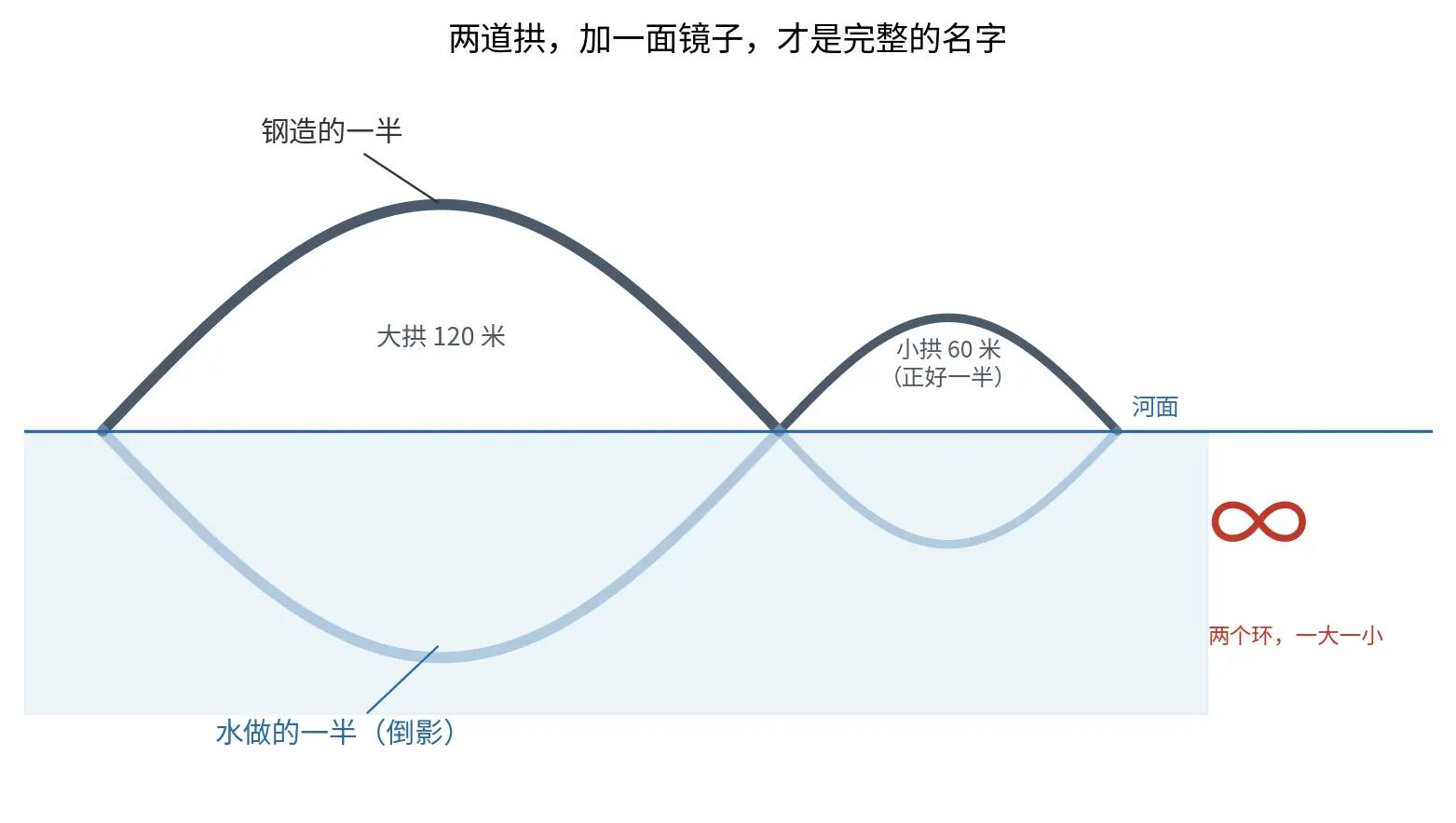
The ∞ symbol—its top half is made of steel; its bottom half is made of water. Two steel arches handle the part that hangs in the air; the remaining half must wait for the river to go still, conjured fresh each day by reflections. On windy days, the symbol never comes together.
One Large, One Small—Exactly a Factor of Two
Look at the image. Two white steel arches spring from the dark river surface—one tall, one short—joined without a break into a single continuous curve.
These arches weren't sketched on a whim. The larger arch spans 120 metres with its crown 40 metres above the water—roughly thirteen storeys; the smaller arch spans 60 metres and rises 16 metres, exactly half the larger one in both length and height. According to the design team, no other bridge in the world shares precisely this form.
Why one large and one small? The answer lies in the water: a rowing course runs along the river, so the central pier couldn't be placed in the middle and had to be shifted to one side. Once the pier was off-centre, the two spans became unequal—and the arches unequal with them. The first sketch of this shape was drawn by the designer on a train ride back from the site.
In 2003 an international competition was held for the bridge, attracting over two hundred entries; the winning design was this "asymmetry." During construction it was still called the "North Shore Pedestrian Bridge." The official name was later chosen from public submissions—because someone noticed that on a windless evening, the two arches plus their reflections in the water form a perfect ∞.
The Arch Wants to Push the Banks Apart; the Tie Holds Its Feet
The bridge is beautiful, but what truly won awards for the engineers is hidden beneath the deck you walk on.
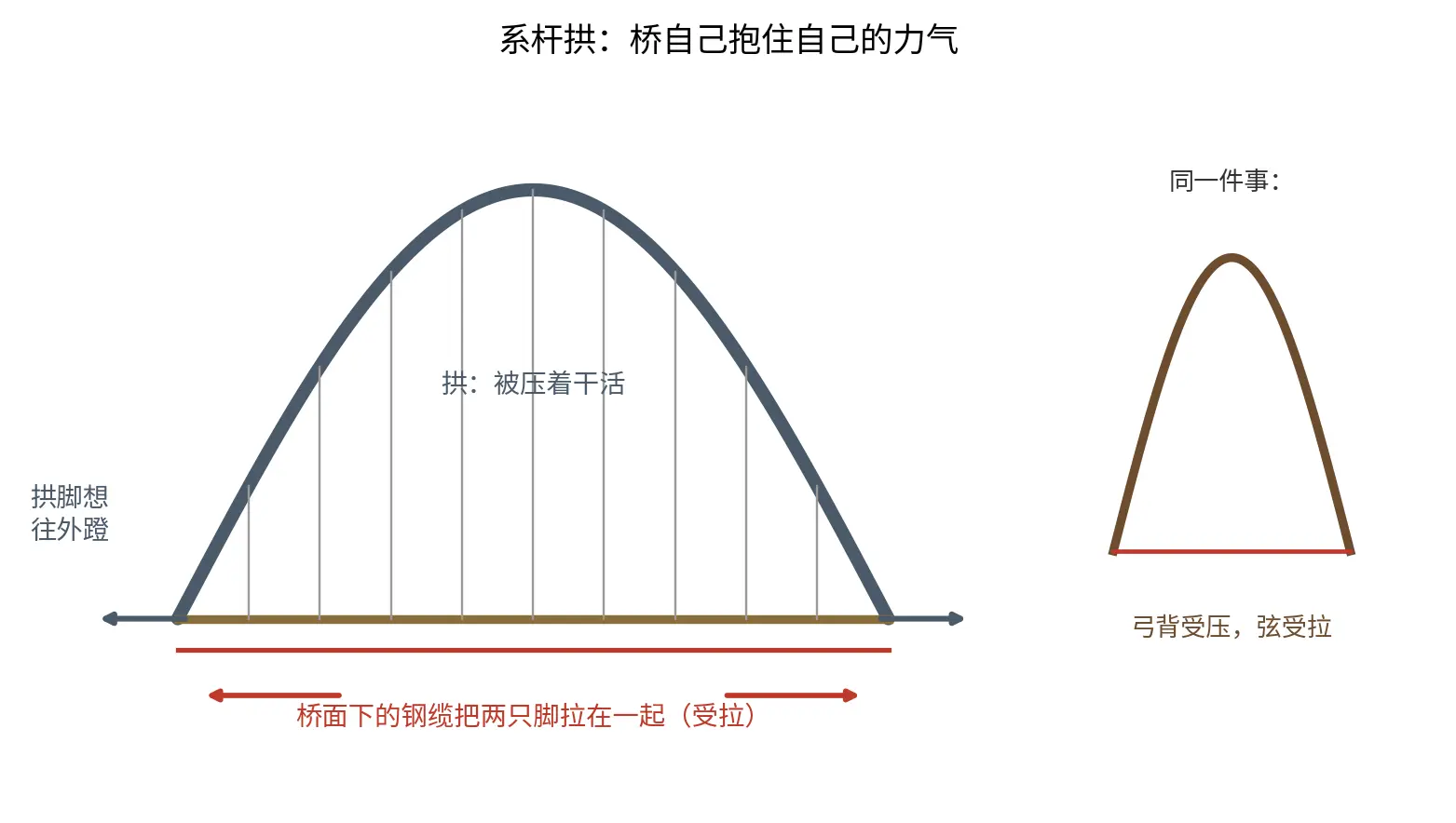
An arch works by being compressed: it channels the weight above it along its curve down to its two feet, while simultaneously pushing outward—like doing a back-bend with your hands and feet on the ground, where they constantly want to slide apart. Conventional arch bridges need massive abutments on each bank to resist that outward thrust.
The Infinity Bridge uses a different trick. Concealed on either side of the deck are four tensioned steel cables—the thicker pair 9 centimetres in diameter—pulling the arch's two feet together from below. Think of a bow: the bow's back strains to straighten, but the string holds it. In engineering this is called a tied arch, or a bowstring bridge. The bridge thus contains its own forces internally, leaving the riverbanks undisturbed.
There's a second piece of cleverness. The two spans are joined as one continuous structure at the central pier, like a seesaw: if one side tries to sag, it must lift the other. Each arch acts as a counterweight to its partner—neither can droop alone.
The material savings are visible to the naked eye: at its thinnest the deck is just 12.5 centimetres—the thickness of a hefty dictionary—making it one of the thinnest bridge decks in the world. The price of such slenderness is a tendency to sway, so seven tuned mass dampers weighing a total of 5 tonnes hang beneath the deck, absorbing the vibrations induced by pedestrians—equipment only required by a very slender bridge.
One Hundred and Seventy Tonnes of Steel, Lifted in a Single Go
Construction took just 18 months—from June 2007 to December 2008—on schedule and on budget. Those two things occurring together on a major engineering project is not especially common.
The most dramatic day was 5 September 2008. The final section of the main arch—four steel pieces welded together on site into a single unit roughly 90 metres long and weighing 170 tonnes—had to be lifted into place in one operation. The crane that did the job was the largest mobile crane in Britain at the time: 80 metres tall, requiring 45 lorries to deliver and three days just to assemble.
The entire bridge consumed 450 tonnes of steel, 1.5 kilometres of cable, 780 lights, and 5,472 bolts, with 530 workers involved. On opening night—14 May 2009—twenty thousand people lined the banks as parkour athletes carrying flares climbed to the top of the arch. That same year, the bridge won the Supreme Award from the Institution of Structural Engineers.
At Night, the Bridge Gives You a "Comet Tail"
After dark, the Infinity Bridge has another trick up its sleeve.
The lighting was designed by Speirs & Major—the team that illuminated the Burj Al Arab in Dubai. Blue and white LEDs are embedded in the stainless-steel handrails: normally the entire bridge is bathed in a deep blue; when you step onto it, sensors turn the lights at your feet white, then slowly fade them back to blue after you pass. So every person crossing the bridge trails a gradually dimming tail of light behind them—the design documents liken it to the tail of a comet.
It is also at night, provided the water is calm, that the glowing twin arches and their reflections assemble into a complete ∞. The name was born from this very moment.
Why Today
8 August. Lay an 8 on its side—and you get ∞.
This day is called International Infinity Day. According to several commemorative-day archives, it was established in 1987 by Jean-Pierre Ady Fenyo—a man who at the time set up a stand on a New York sidewalk offering free life advice to passers-by. The New Yorker covered him; he became known as "the original Free Advice Man." His purpose in creating the day was simple: to encourage everyone, not just scholars, to think freely about boundless questions. The link for today's Bing wallpaper references precisely this holiday.
As for the ∞ symbol itself: in 1655 the English mathematician John Wallis first used it in a mathematical work—371 years ago this year. He never explained why he chose the shape. Some speculate it derives from an old way of writing the Roman numeral for one thousand; others suggest it comes from the Greek letter ω. In mathematics the curve has an elegant name—the lemniscate—a word whose root means "ribbon."
An old industrial town naming its most expensive piece of public infrastructure "Infinity," and a street philosopher dedicating 8 August to "questions that never end"—today's wallpaper layers both stories onto the same river.
Tonight, Make a Path That Never Ends
This article's exit point for exploration doesn't require leaving home—you can do it at your desk.
Cut a strip of paper two or three centimetres wide, give one end a half-twist, then tape it to the other end—you've made a Möbius strip. Draw a line along the surface without lifting your pen: you'll pass unknowingly over the "back" and return to where you started. The strip has only one side—a path that never ends. In 1858 the German mathematicians Möbius and Listing discovered it almost simultaneously; the recycling symbol you see every day—those three arrows chasing each other—is a Möbius strip.
Once you've made one, try another step: cut the whole strip open along its centre line, and guess what you'll get. Hint—it won't be two loops.
∞ has only been written down for 371 years, but what it describes has been here far longer. The paper strip in your hands tonight is a small piece of it.
Sources: Bing Daily Wallpaper, Wikipedia: Infinity Bridge, Expedition Engineering: Infinity Bridge project page, Ingenia: Infinity crosses the Tees (design team interview), Structurae: Infinity Bridge, SteelConstruction.info: Infinity Footbridge, Bridges on the Tyne: Infinity Bridge, National Day Calendar: International Infinity Day, Bill Petro: History of Infinity Day, Awareness Days: International Infinity Day (Wallis and the ∞ symbol), Peapix Bing wallpaper archive