
The flag was approved by a vote on August 11, 1947. Only three days later was there a country in which to raise it.
Open Google in Pakistan today and the familiar colored logo above the search box looks different.
According to local media descriptions, Pakistan's green-and-white flag is flying while the letters in "Google" float as clouds in the sky behind it, making the flag appear to fly above the clouds. Clicking it leads to search results for Pakistan Independence Day.
One point needs to be clear: most readers probably cannot see this Doodle. Reports from The Express Tribune, Daily Pakistan and TechJuice say it is shown mainly to IP addresses in Pakistan, and possibly in places with large Pakistani communities abroad. Bol News alone called it a "global Doodle," without citing any statement from Google. Google's national-day Doodles have historically appeared by region, so the more defensible description is: this is Pakistan's homepage today.
There is another limitation to disclose. At the time of writing, this Doodle had not appeared in the official doodles.google archive, whose latest entry was still from July. The description here therefore comes entirely from Pakistani media reports, not Google's official copy. Those reports differ slightly: some describe a clear blue sky, others a cloudy one, while most say the letters themselves form clouds in a blue sky. Google generally does not name an artist for this kind of flag Doodle, and none of the reports identified one here.
Today Is the 79th
Pakistan became independent on August 14, 1947. In 2026, the country is marking its 79th Independence Day; "79th" is the wording used consistently by the government and leading media. In Urdu, the day is called Youm-e-Azadi (یومِ آزادی), the Day of Freedom.
Today's observances include a 31-gun salute in Islamabad and 21-gun salutes in each provincial capital, flag-raising across the country, and a changing-of-the-guard ceremony at Mazar-e-Quaid in Karachi.
The Mystery of a One-Day Difference
There is a detail almost everyone notices but few accounts explain clearly:
Pakistan's Independence Day is August 14. India's is August 15. The partition was one event under one act, so why are the dates different?
Legally, they were not different. Wikipedia's account of independence says British rule ended at the close of midnight on August 14, 1947 - the instant between August 14 and 15, the same moment for both countries.
What differed was the ceremony. Lord Mountbatten chose August 15 for the transfer of power to India because it was the second anniversary of Japan's surrender in the Second World War. He scheduled the ceremony for Pakistan on August 14 for a practical reason: he wanted to attend both, and one person could not be in Karachi and Delhi at the same time. Jinnah took the oath in Karachi on the 14th; Mountbatten then flew to Delhi for the following day's ceremony.
The cleanest version is this: the law had one midnight, but the ceremonies occupied two days because there was only one governor-general.
The story has a more complicated layer, one Pakistanis still debate. In a Dawn article titled "August 15 - Pakistan's Independence Day," Akhtar Balouch assembled a chain of evidence. Section 1 of the Indian Independence Act 1947 says that "as from the fifteenth day of August, nineteen hundred and forty-seven, two independent Dominions shall be set up." Historian K.K. Aziz argued in The Murder of History that the transfer ceremony on the 14th did not itself create independence; only the act did. Former prime minister Chaudhry Muhammad Ali's memoir says Jinnah and his cabinet were sworn in on the morning of the 15th. In his inaugural address on Radio Pakistan, Jinnah himself called August 15 "the birthday of the independent and sovereign state of Pakistan." And Pakistan's first commemorative stamps, issued in July 1948, marked Independence Day as August 15.
The Express Tribune covered the same question in 2016, adding that the Indian Independence Act received royal assent on July 18, 1947, and that an official Department of Information series likewise treated the 15th as the first Independence Day. Veteran journalist Shahida Kazi has suggested that leaders later wanted a day distinct from India's, while acknowledging that she did not know how the official decision was made. The Express Tribune reached the honest conclusion: there is no definitive explanation.
No government gazette, cabinet resolution or dated announcement was found stating when or by whom August 14 was formally established. The trail has to stop there. History often works this way: a country's most important date may depend on minutes from a meeting no one preserved properly.
There is one other frequently mentioned coincidence. The night of August 14-15, 1947, was the night of Ramadan 27, 1366 AH, considered sacred by Muslims. The coincidence is documented, but there is no evidence that the date was chosen to produce it.
The Flag Is Three Days Older Than the Country
Return to the flag in the Doodle. Its history contains a lovely interval.
On August 11, 1947, the Constituent Assembly approved its design. On August 14, it became the flag of a new country. The flag was born three days before the country - created first, then given land on which to fly.
In Urdu it is called Parcham-e-Sitāra-o-Hilāl, literally the "Flag of the Crescent and Star." It was designed by a team led by Syed Amir-uddin Kedwaii. The record of his precise personal role is thin; even Wikipedia's claim that he "designed the flag" has no citation, so it is more accurate to describe him as the team's leader.
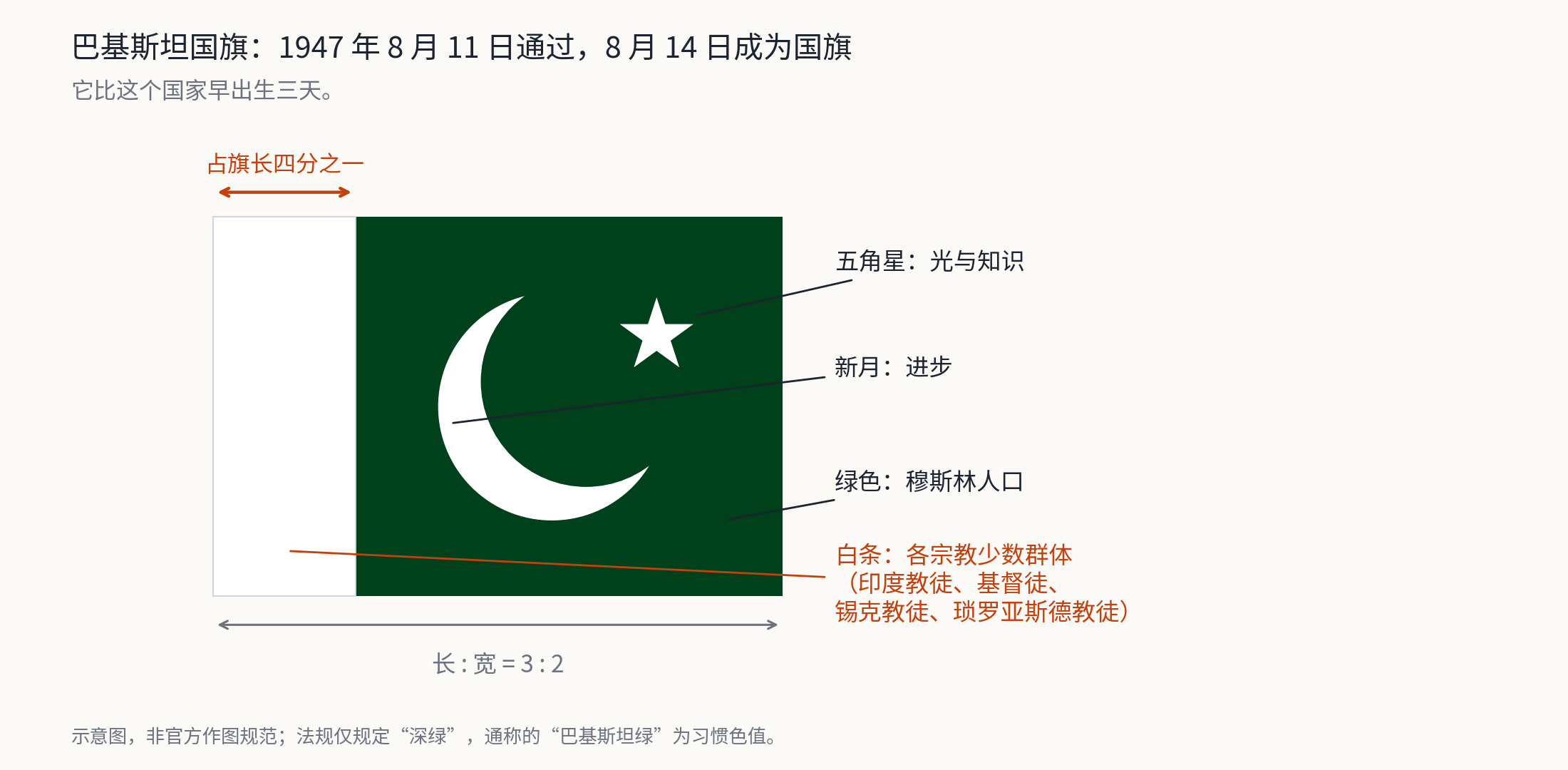
The construction follows rules. Its length-to-width ratio is 3:2. A vertical white stripe at the hoist occupies one quarter of the flag's length, while the remaining three quarters are green. Even the crescent and star are specified through geometric construction: two circles and a diagonal define the crescent, and a third circle sets the size of the five-pointed star. The law specifies only "dark green." The commonly used "Pakistan green" (#00401A) is convention, not a statutory color value.
Each element has a direct meaning:
Green represents the Muslim population. The white stripe represents religious minorities, including Hindus, Christians, Sikhs and Zoroastrians. The crescent stands for progress, and the five-pointed star for light and knowledge.
One quarter of the flag's area is set aside for people who are "not us." That design choice is easier to explain to a child than any declaration of independence.
Move the View Down: What Is Beneath the Clouds?
The flag in the Doodle flies above the clouds. The most revealing part of the picture, however, lies below them.
Look down from Pakistan's northern edge and something geographically rare comes into view: the Hindu Kush, Pamirs, Karakoram and Himalayas - four of Asia's great mountain ranges - converge here. The Snow Leopard Foundation uses that description of its survey area in Pakistan. It is an invitation to open a map in a single sentence.
Among those mountains stands K2, 8,611 meters high, the second-highest mountain on Earth, on the border between Pakistan and China. In 1953, climber George Bell described it with the phrase that became its nickname: "a savage mountain that tries to kill you." Italians Achille Compagnoni and Lino Lacedelli made the first ascent on July 31, 1954. By August 2023, there had been about 800 summits and 96 deaths during attempts; before 2021, there was roughly one death for every four successful climbers. In January 2021, K2 became the last of the world's 14 eight-thousanders to be climbed in winter, by a Nepali team led by Nirmal Purja. It happened within our own generation.
Below K2 lies the Baltoro Glacier. The peaks along it sound almost imaginary when read as a list: K2 at 8,611 meters, second in the world; Gasherbrum I at 8,080 meters, 11th; Broad Peak at 8,047 meters, 12th; Gasherbrum II at 8,035 meters, 13th; followed by Chogolisa, Masherbrum and the sheer Trango Towers. Four peaks above 8,000 meters stand along one glacier.
One confluence is called Concordia, at an elevation of 4,691 meters, where the Baltoro and Godwin-Austen glaciers meet near the gateway to K2 Base Camp. Aleister Crowley named it during the 1902 attempt on K2, borrowing the name of a glacial junction in the Swiss Alps.
How many glaciers does Pakistan have? A widely cited 2016 figure was 7,253. In 2024, an inventory completed by Pakistan's Ministry of Climate Change in cooperation with Italy's EvK2CNR revised the number to 13,032. The glaciers had not multiplied; satellites had learned to see them more clearly, and improved mapping found nearly twice as many in the same mountains. One common claim also needs correction: reliable sources say Pakistan may hold the greatest volume of ice outside the polar regions, not the greatest number of glaciers. Those are different measures.
From Eight Thousand Meters to a Dolphin That Hears Its Way Through a River
Here is the line that ties the story together.
Meltwater from the Baltoro Glacier forms the Braldo River. The Braldo joins the Shigar, and the Shigar joins the Indus. Water leaving the foot of K2 therefore enters the Indus River.
More than a thousand kilometers downstream, in muddy water, lives the Indus river dolphin (Platanista minor).
It has no lens in its eye. It is not eyeless, but without a lens it cannot form images and can detect only the strength and direction of light. Vision is of little use in a river like liquid mud, so the dolphin navigates and hunts through echolocation. It "sees" the river by hearing it.
It also swims on its side, which researchers believe helps it move efficiently through shallow water during the dry season. It was the first cetacean discovered to swim sideways.
Its position is precarious. In its 2022-2023 assessment, the IUCN listed the species as Endangered and called it the world's second most endangered cetacean. Its historical range covered about 3,400 kilometers; only about 690 kilometers remain, an 80% decline since 1870. Five small subpopulations survive in Pakistan, separated by irrigation barrages. Like roads in the previous story, infrastructure has divided one population into fragments.
Sources differ slightly on abundance. A 2017 survey estimated about 1,800 animals; WWF's global site gives 1,816. WWF-Pakistan gives about 1,960 without a date. A fair summary is roughly 1,800 to 2,000 animals in recent surveys.
The figure from India is the most sobering in this story. India's first nationwide river-dolphin survey, released in March 2025, recorded 6,327 river dolphins in all. Only 3 were Indus river dolphins, living in the Beas River in Punjab.
Three.
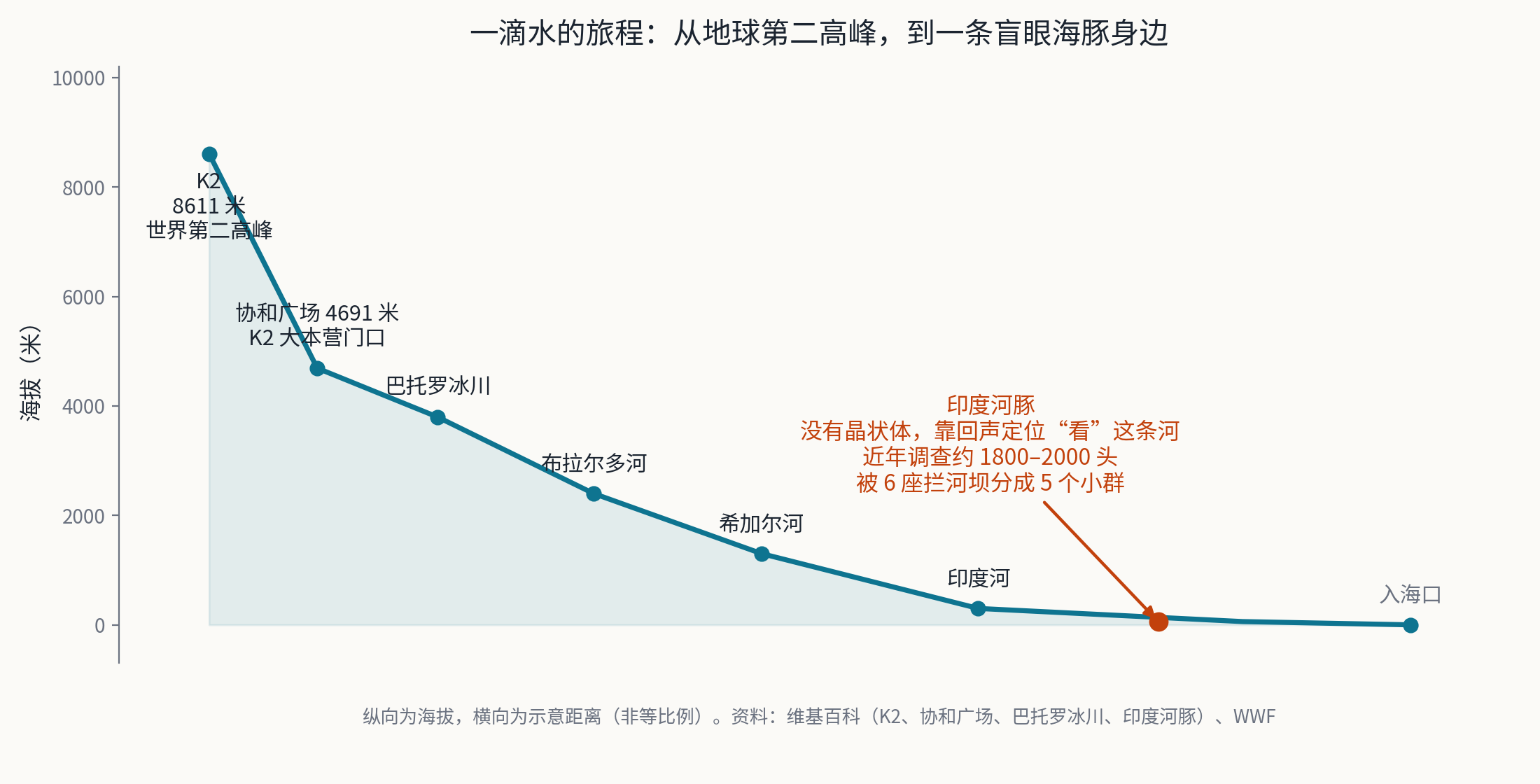
Snowmelt from the world's second-highest mountain eventually reaches an almost blind dolphin that swims by listening to the river. They are the two ends of the same country, the same water and the same map.
Snow Leopards and a Census Just Completed
Pakistan's first nationwide snow leopard population assessment was released only in September 2025.
The survey covered work conducted from 2010 to 2023, and its two methods produced two figures. Camera traps deployed from 2010 to 2019 - 828 infrared cameras covering about 39% of the northern range and identifying 53 individuals - produced an estimate of 155. Genetics work from 2017 to 2023, using scat samples and SNP genotyping to identify 56 individuals, produced an estimate of 167, with a 95% confidence interval of 128 to 220.
Reports saying Pakistan has 155 snow leopards and those saying 167 are therefore not contradictory. They are two algorithms applied within the same study. The Snow Leopard Foundation led the work with partners including Quaid-i-Azam University, the University of St Andrews, the University of Massachusetts and Stanford University. The data are public on Dryad.
Pakistan's national animal is the markhor. Saeed Abbas of IUCN Pakistan and Syed Altaf Shah of Khyber Pakhtunkhwa's wildlife department told Anadolu Agency that 3,500 to 5,000 now survive. In 1994 there were fewer than 2,500 and the species was classified as Endangered. Once the mature population exceeded 2,500 in 2014, the IUCN moved it to Near Threatened. Markhor live chiefly in the mountains of Chitral, Kohistan and Kalam, as well as Gilgit-Baltistan and southwestern Balochistan.
A national animal climbed from Endangered to Near Threatened in 20 years. That does not happen often, and it is worth recording.
This Year, the Mountain Let No One Reach the Top
K2 summits normally cluster from late July into early August, because its latitude leaves only a narrow window of good weather. Last year, 2025, produced a date almost identical to this one. After weeks of poor weather, a short, stable window opened on August 11, and about 41 climbers reached K2's summit that day. Many teams had already left base camp and missed it.
This year was different. According to a July 24 report by mountaineering chronicler Alan Arnette, the season had produced no K2 summit. About 50 climbers were on the mountain, fixed ropes had reached roughly 7,000 meters, and high winds kept blocking attempts. During the same period, climbers reached Nanga Parbat between June 30 and July 3, Gasherbrum II on July 21, and Broad Peak on July 19. Broad Peak then suffered a serious accident in late July.
That is where this part of the story must stop. Some years, the mountain lets no one through. That, too, is part of the mountain.
Sources: The Express Tribune (coverage of the Doodle and the 79th Independence Day, and its 2016 article "Was Pakistan Created on August 14 or 15?"); Daily Pakistan; TechJuice; Bol News; Pakistan Observer; Akhtar Balouch's Dawn article "August 15 - Pakistan's Independence Day"; Wikipedia entries on Pakistan Independence Day, the national flag of Pakistan, K2, Concordia, the Baltoro Glacier, Pakistan's glaciers and the Indus river dolphin; WWF's global site and WWF-Pakistan's Indus river dolphin page; DD News coverage of India's nationwide river-dolphin survey; the Snow Leopard Foundation's "First National Snow Leopard Census of Pakistan" (September 2025) and its Dryad dataset; Anadolu Agency's reporting on the markhor; Alan Arnette's reporting on the 2026 K2 season; Lacrux's report on the August 11, 2025, K2 summits.