
The Secret Knowledge of Giant Slaying: Ancient Mysteries and Mortal Solutions
Why do giants across every culture die the same way? Why does every folklore tradition, from ancient Greece to medieval Cornwall, insist on the same brutal methodology? And why did the Knights Templar, those mysterious warrior-monks, venerate severed heads with such fervor that it led to their destruction?
The answers lie buried in humanity's oldest and darkest knowledge: the science of supernatural execution. From pickaxe through skull to demon's flight, from trepanation to decapitation, the ancients understood truths about giant-killing that modern sanitized tales have forgotten.
The Templar Mystery: Heads of Power
When the Knights Templar were arrested in 1307, among the most damning charges was their alleged worship of a severed head called Baphomet. Some claimed that the idol was the severed head of St. John the Baptist, but this accusation reveals something deeper than heresy—it suggests the Templars understood the supernatural power contained within severed heads.
The Templars' veneration of heads wasn't random superstition. These warrior-monks, who had fought supernatural threats across the Holy Land, understood what folklore had always known: heads contain power, and controlling that power—whether through worship or destruction—was essential knowledge for those who faced otherworldly enemies.
The Templar trials included evidence of head worship rituals, suggesting they possessed secret knowledge about the manipulation of head-based supernatural forces. What they worshipped in their secret ceremonies, giant-slayers had been destroying for millennia: the concentrated essence of supernatural power that resided in the skull.
The Problem: Giants That Won't Stay Dead
Across cultures, folklore reveals a terrifying truth about supernatural giants: they regenerate. Kill them conventionally, and they return stronger. Wound them, and they heal. The Greek Hydra exemplifies this nightmare: for each of her heads that he decapitated, two more sprang forth. Simple violence fails against supernatural adversaries because their power source—the head—remains intact and capable of restoration.
This regenerative curse explains why so many heroes fail in their first encounters with giants. Conventional weapons wound but don't kill. Conventional tactics create temporary victories that become permanent defeats when the giant returns, angrier and more dangerous than before.
The ancient storytellers weren't describing fantasy—they were encoding survival instructions for encounters with forces beyond normal human comprehension.
The Ancient Solution: Trepanation, Decapitation, and Demon Liberation
Our ancestors developed a two-part solution that combined surgical precision with supernatural understanding. The methodology was elegant in its brutality: breach the skull, sever the head, destroy the brain, release the demon.
Trepanation: The Hole in the Head
Long before giant-slaying, ancient surgeons practiced trepanation—creating a hole in the head through which demonic spirits could escape. This wasn't primitive medicine; it was sophisticated supernatural surgery. To release evil spirits from the heads of mentally ill people, surgeons would drill precise holes through the skull, understanding that supernatural possession required physical intervention.
Giant-slaying adopted this principle but escalated it. Where trepanation created small holes for demon escape, giant-slaying required massive breaches. The pickaxe became the perfect tool: designed to break through solid rock, it could penetrate even a giant's supernatural skull.
Decapitation: The Final Separation
But hole-making wasn't enough. Complete decapitation ensured that the head's power source was permanently severed from the body. This required specific technique: not the clean slice of an executioner's sword, but the crushing destruction of a pickaxe through skull and spine together.
The poetic justice was perfect: trepanation through decapitation, surgical precision through brutal force, demon liberation through mortal determination.
The Master Class: Jack the Giant Killer's Perfect Technique
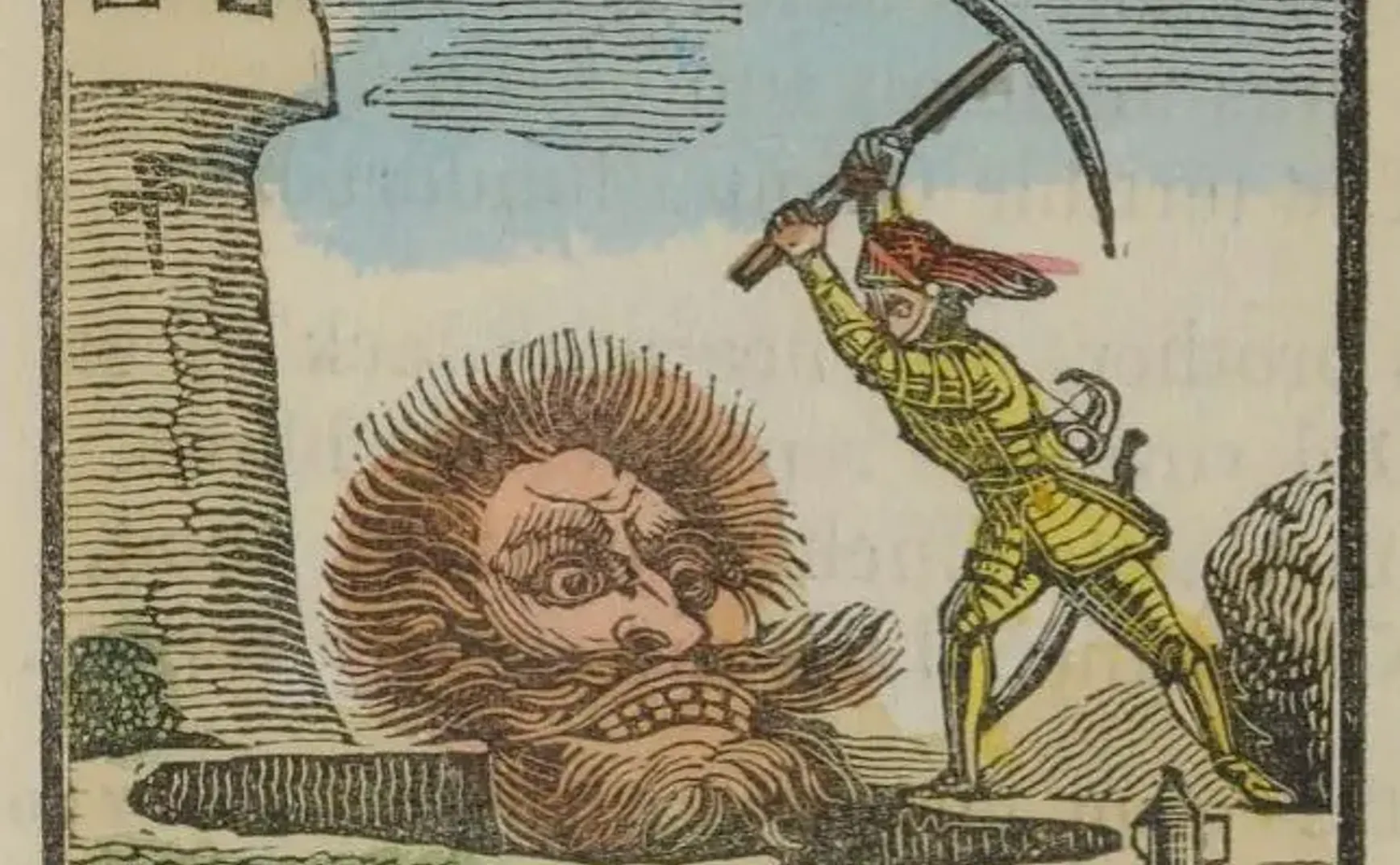
Jack struck him a blow on the crown of the head with his pickaxe, which killed him at once. This single sentence contains centuries of accumulated giant-slaying wisdom compressed into perfect execution.
Note the specificity: "crown of the head"—the highest point, where the skull is thickest but also where the brain's power center lies. "Pickaxe"—not a sword or axe, but a tool designed for penetrating stone. "Killed him at once"—no lingering, no regeneration, no second chances.
Jack understood what the Templars worshipped and what trepanation practitioners knew: the head contains concentrated supernatural power that must be destroyed completely and immediately. His technique combined surgical precision with overwhelming force: pickaxe through giant's head until he was dead.
The Cornish tale's emphasis on violence, gore and blood-letting wasn't gratuitous—it was instructional. Every brutal detail served as a lesson in proper supernatural execution methodology.
Why Other Methods Fail: The Beanstalk Blunder
Jack and the Beanstalk demonstrates the consequences of incomplete giant-slaying. Instead of direct confrontation with proper tools, Jack relies on environmental factors—chopping down the beanstalk and letting gravity do the work. While this results in the giant's death (his neck breaks in the fall), it fails to ensure proper head destruction.
From the perspective of supernatural threat elimination, this approach is dangerously incomplete. The head may remain intact, the brain undamaged, the demon unexpelled. Jack celebrates victory while leaving open the possibility of regeneration—a mistake that Jack the Giant Killer would never make.
The beanstalk method represents the sanitized approach to giant-slaying: avoiding direct violence while achieving the same result. But folklore warns us that indirect methods leave supernatural threats incompletely neutralized.
The Hidden Knowledge: Why Secrets Survive
The Templars' destruction for worshipping heads, the transformation of brutal giant-slaying tales into children's stories, the evolution of trepanation from demon-expulsion to medical procedure—all represent the same pattern: dangerous knowledge being hidden, sanitized, or destroyed.
But the core wisdom survives in folklore because it encodes practical instructions for supernatural survival. The poetic formulations—trepanation decapitation, pickaxe through skull, demon liberation through mortal determination—preserve the methodology even when the context is forgotten.
The head was to the Celt the soul, centre of the emotions as well as of life itself, and this understanding echoes through every giant-slaying tale. The Templars knew it, the ancient surgeons practiced it, and Jack the Giant Killer perfected it: supernatural power concentrates in the head, and only through its complete destruction can otherworldly threats be permanently eliminated.
The Eternal Instruction
From pickaxe through crown to demon's flight, from trepanation to decapitation, the methodology remains constant across cultures and centuries. The giants fall, their heads crushed, their power released, their threat ended. Not through accident or environmental factors, but through deliberate, knowledgeable, and utterly decisive action.
This is the secret knowledge that survived Templar trials and fairy tale sanitization: when giants threaten, half-measures mean death. Only through complete head destruction—surgical precision through brutal force—can supernatural adversaries be permanently defeated.
The pickaxe still waits. The giants still come. And the ancient wisdom still whispers its poetic instruction: through the skull to the brain, through the brain to the demon, through the demon to victory. Trepanation through decapitation, brutality through necessity, survival through knowledge that refuses to die.