
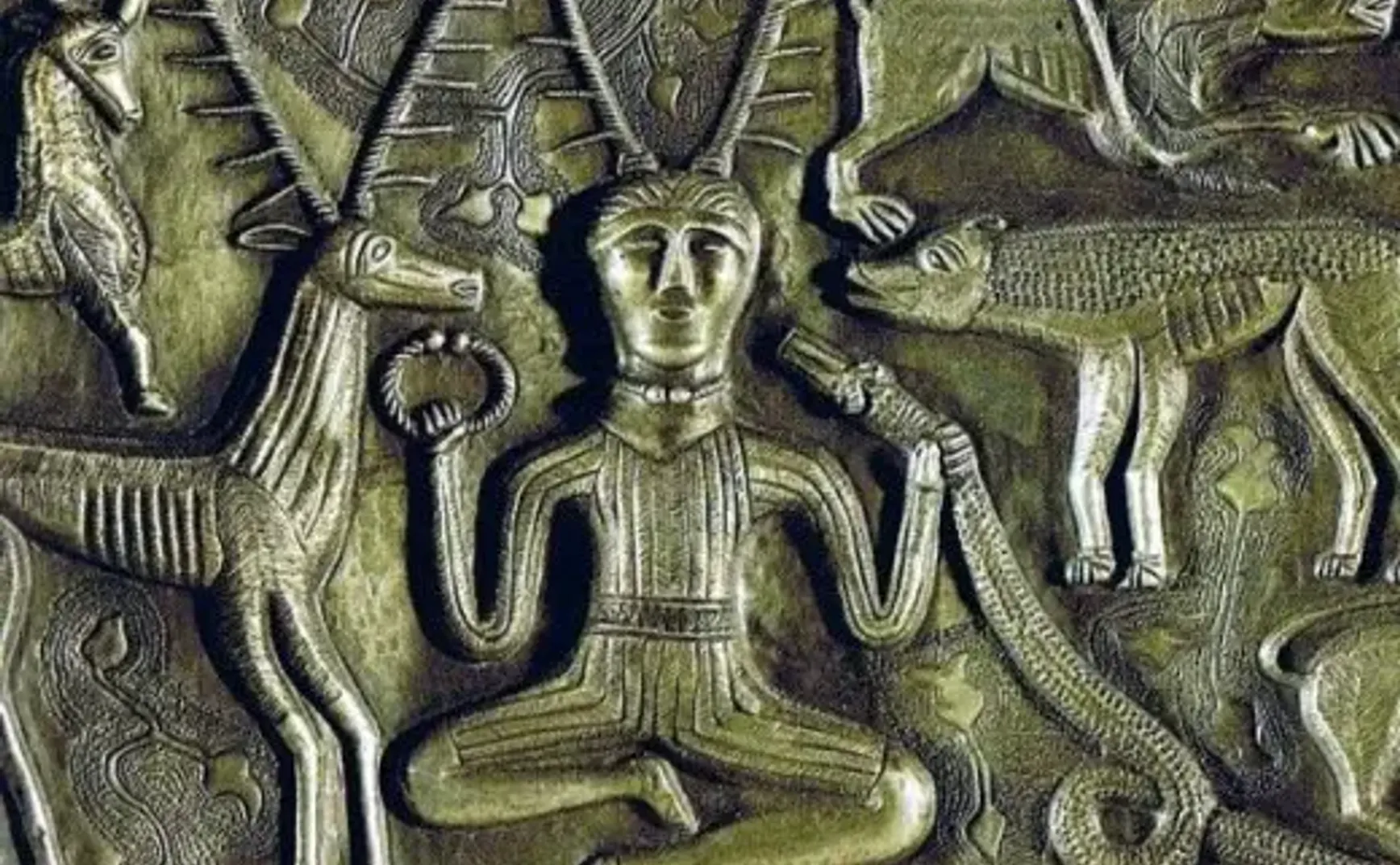
The Last Vigil of Cernunnos
As witnessed by the Ancient Observer
I have watched from the threshold between worlds for countless eons, and I tell you now of what I have seen—the great weariness that has settled upon Cernunnos, the Horned God who holds all of nature's time within his vast being.
He sits in the primordial grove, antlers crowned with stars that mark the seasons' turning, his eyes holding the weight of every beginning and every end. Within him pulses the heartbeat of the world—every rotation of the earth, every cycle of growth and decay, every breath drawn by creature great and small. He is the living repository of time itself, and outside his presence, time simply ceases to exist.
But oh, how he yearns for rest.
I have seen his longing gaze turn toward the earth beneath him, toward the sweet oblivion of merging with soil and stone, of becoming one with the very foundation he has so long sustained. The mountains have already found their peace, settling into eternal stillness. The rivers flow in their ancient patterns, no longer needing conscious guidance. Even the plants have learned their quiet wisdom, growing and dying in harmony without requiring his constant attention.
It is only the breathing realm—the world of lung and heartbeat—that still demands his vigilance.
The simplest creatures have found their balance: insects following their ancient coding, ants building their patient empires, deep-sea dwellers feeding on the marine snow that drifts eternally downward. The domestic animals live their gentle cycles, content in their day-to-day existence. These need no grand awakening; they are perfect as they are.
But then there are the wise ones—the elephants who remember, the orangutans who dream, the creatures who carry within their souls the same cosmic connection that flows through Cernunnos himself. They are ready. They understand the great transition that must come. They wait with infinite patience for humanity to mature enough to accept the mantle of conscious stewardship.
Yet humanity stumbles, destroying the very house that shelters their growth.
I witnessed the coming of Jesus—the first among them to fully embody what they might become. His birth was no accident but a desperate measure, forced into being by the cosmic necessity of the times. But I also saw the Archons in their cunning, those beings who dance between worlds and feast upon the prolonged golden twilight of transition. They know that once the critical point arrives, they too must choose—to ascend with the awakened humans or to join the consciousness of the patient animals in their eternal task of lifting all life toward greater awareness.
The Archons play their trick of denial, stretching the time of choosing as long as possible, hoping to delay the inevitable moment when all must transform. They know the tipping point approaches—that sudden awakening that will sweep across the world like dawn breaking after the longest night.
And Cernunnos waits.
He waits with the patience of stone and the endurance of water, holding all time and space within himself until the moment comes when he can finally release his burden, sink into the timeless earth, and let the evolved consciousness of awakened beings carry forward the great work.
I have seen this future shimmering at the edge of possibility—the moment when the breathing world finally learns to breathe in unison with the cosmic rhythm, when humanity accepts its role as the conscious gardeners of existence, when the separation between the autonomic systems of the planet and the awakened mind finally dissolves into perfect harmony.
Until then, the Horned God keeps his vigil, containing eternity within his weary heart, dreaming of the day when he can rest at last in the embrace of the earth he has so long sustained.
The end approaches, as all endings must. And with it, the beginning of something entirely new.
from the original
the myth the nature
The horned god Cernunnos, waiting for his successor to come — nature god wants to retire into the earth and become one with it, rather than still have to hold the reality within him. The earth, in time, within him— all time, he knows the end and the beginning, and outside of him is no time.
He is waiting so he can retire into no time and not have to return each time to ensure the people are reminded of their first origins under Saturn, when earth, animals, plants were one.
They have already separated— animal life, plants, rocks, mountains, spirits—they already got to retire into the earth.
Whatever happens to the breathing stock, they will persist in the mountains, rivers, and plants. It is the breathing that needs to evolve enough—to allow a separation between the autonomic systems of the planet, insects, ants, and deep-sea fish that feed on minute bits of falling food. Domestic animals—they just survive day to day, along with sentient animals like elephants and orangutans, which carry the inner knowledge of the planetary horned god. The connection to the universe—they are ready for humans to be capable of taking over, but they are destroying the planet, their house of growth.
Jesus is the first of them—he is forced to come into being through nativity. But the archons, who want to keep the two worlds apart for as long as possible so they can go between the worlds and live in the golden age as long as possible—they know that once the critical point comes, they will be moved into the new home, either as sentient animals or as Buddhists whose soul purpose is to haul up the remaining consciousness to their level. It is unavoidable, but why use the trick of denial until a tipping point and a sudden wake-up, so they do not have to be here in this time for that long.