
In high school, my history-loving father encouraged me to pick up history as a core subject. I refused vehemently. At the time, I was genuinely convinced that if I studied a single minute of that subject, it would cause my brain muscles to atrophy. But in his sales pitch for me to pursue the study of the past, he said something quite profound: “One must understand the past to have a greater appreciation of the present.” I had an inkling of a thought to blurt out something cheeky, but I knew better. Since that conversation, I have reflected a bit, and I must admit he has a point. Learning the history of a concept is the first step towards fully appreciating or understanding it. So, before we begin to dive into what is Bitcoin, DeFi, NFTs, etc., come take a random walk down Wall Street with me and let's glimpse into money's history, understand why it came about, the problems it is addressing, and the flaws within the current system.
Money's evolution was a progressive series of steps which has lead us to where we are today. Money could be thought as a intangible system of value that facilitates the exchange of goods and services. Similarly to humanity's own evolution money didn't start out as the coins or paper we have to our disposal today but more so as a crucial dependency for human survival.
The prehistoric man was a simple creature. Eating, sleeping, and surviving all describe the daily routine of our cave dwelling brethren. It is with this simplistic design that we start our ascent into what money is today.
In the past there really was no need for an established type of money since most humans during that period were hunter-gathers. These types of people raid and they didn't save either. Their entire premise was to consume food as soon as they found it.
They therefore had no need for money. What instead happened was that of an exchange. Men of then would provide both food and security to the women and children. In return women would provide sex and the necessary nurturing of their off spring.
In a post-cave dwelling era it is often cited that humans then turned to bartering as a form of exchange, a system where willing participants within a transaction directly exchange goods and services for other goods and services without using an exchange. This however, has never been proven by any ethnographic study where no present or past society has ever used barter without any other medium of exchange or measurement.
Research from anthropologists also state that there isn't evidence that money emerged from bartering. Regardless, this never stopped Adam Smith, the father of economics, to use the bartering system as the reason for the emergence of money.
To give you an idea of what of what a barter would look like lets use an example, you go to make stew one afternoon and realize you are out of vegetables. You make your way to the local market, spot your favorite produce seller and notice he's accepting 100W bulbs for a pound of mixed vegetables. “What a deal”, you whisper to yourself and it was a good thing you brought a pack of 125W florescent light bulbs with you today.
You haggle for a while and get 2lbs of mixed vegetable for only 3 bulbs today. After the successful exchange, you scurry home to make some great stew.
The extract above paints a perfect pictures of what that would bartering entail. As you can figure, there are some glaring flaws within this system. What would have happened if no one wanted your light bulbs? What if there was someone who had veggies but didn’t want to accept light bulbs in exchange?
The main flaws of bartering tend follow this:
- There was never a common measure of value - Goods were arbitrarily pegged to the value of other goods. One tin sausage is worth 2 haircuts, 1 goat and so on
- The need for a double coincidence of wants - Finding the exact right person who wants exactly the same goods you are offering similarly in our vegetable stew example above
- Indivisibility of certain goods - Lets say you had one cow and needed a few pots but you only need a single pot. What is the next step? Its not possible to separate the cow since you'll kill it
- No standards for deferred payments - for credit transactions there were disputes regarding the quality of the good used to settle the debt
- Storage issues - there was issues in storage of say, food, such as fish since they were perishable goods
We would then need a system where the commodity in question used to facilitate trade can overcome the many disadvantages of bartering. This system would have to be a medium of exchange recognized by all that is a unit of account, which facilitates valuation and calculation; and a store of value, which allows economic transactions to be conducted over long periods as well as geographical distances.
To be able to perform these functions, optimally, the system in question would need to available, affordable, durable, fungible, portable and reliable.
Solving all of these issues was our next step in money's evolution, commodity money. Metals such as gold, silver, bronze etc. where considered the ideal monetary raw material.
There was value in the material that the money was made out of. Meaning there was intrinsic value or the material it was made out of had value on its own.
Metallic money (coins) are a form of commodity which had its origin from the Lydia Kingdom in Turkey at about 600BC. The adoption of coins happened almost overnight as the use of coins throughout Athens, the city’s capital, spread like wildfire. There was usage of commodity money in other parts of the world as well, some being:
- Cattle in India
- Tobacco in Virginia
- Rice in Carolina
- Cowry Shells in Africa
- Sugar in Brazil
- Tea in Mongolia
This system was a much needed upgrade to bartering however it still posed some issues such as: - Storage problems - Cowry shells from Africa were extremely fragile leading them to be stored and transported with the utmost care
- Difficulty to transport over long distances
- No universal acceptability - Butter made good commodity money in cold countries but was useless when trading with hot countries
- Perishability - Cattle, fish, and some food items (rice, tobacco, sugar, etc.), deteriorated over time and eventually lose value.
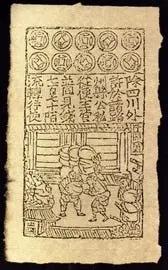
This image above takes us into money's next evolutionary step, paper money. The image is known as a Jiaozi or what we would call a banknote today.
These “Jiaozi” were the pioneers of paper money. They worked as promissory notes that were issued by select merchant companies which came about as a need for merchants to not have to walk around with a large amount of coins, save on gas and an overall lack of coins.
The lack of coins stemmed from 10th and 11th century China seeing a great increase in urbanization, commerce and region integration under the Song dynasty, which required vast amounts of money needing to be used by everyone (especially for the government to fund their army).
There was eventual standardization of the banknotes being distributed by the merchant companies by the then Chinese government. This is an introduction to a centralized system of money management.
With the government’s takeover they began backing the notes with “real” money but in the grand scheme of things the share of backed paper money among the total sum of circulating money was always negligible, and it was impossible to control the gradual devaluating paper money as more was being printed to supply to satiate the ever-growing demand of people.
I could go on and really delve into more of money’s timeline, but for the sake of brevity, I’ll cease here. Further in the timeline of money are additions to the system like the dawn of debt/credit cards, the gold standard and major catastrophes such as the financial market crash of ‘08.
Governments don’t handle money as they did in previous years like they did with the Jiaozi. They offset this role to a nation’s financial organization. In Jamaica we have the Bank Of Jamaica (BOJ), in the US there is the Federal Reserve.
They control their country’s money availability, supply and rate of interest to attain objectives oriented towards the growth and stability of the economy. This is what we know as monetary policy.
This - as you can figure - can lead to disastrous results. The recent US Inflation Reduction Act is a prefect example. The US government injected $780 billion dollars in their economy to lower inflation and help with climate change. Let’s think rationally about it. If everyone could find diamonds in their backyard, would they still be classified as precious gems?
No. In the same light, if the Fed prints 700 billion more dollars in the US economy, the money supply becomes relatively abundant, thus causing the money to lose value. This is akin to giving a diabetic more sugar, expecting their sugar levels to go down. It makes little sense.
So, we live in societies where the money supply is determined by individuals who think giving a hypertensive patient more salt is a grand idea. I’d argue what we need then is a complete overhaul to the system.
A system where the money in question is deflationary - meaning its purchasing power increases overtime, the transaction can’t be accessed by anyone besides he who owns it and there is no disillusioned governing body who is far out of touch with reality altering the money supply. This transformational system is none other than Bitcoin and the technology behind of it. It’s the perfect fit to our ever growing puzzle of how to deal with the current system that govern money.
The discussion of Bitcoin however, is outside the scope of this issue. Up next we are going to talk about Bitcoin.
What is it and the technology turning its wheels.
Connect with me on Twitter and lets talk DeFi or BJJ.