
Have you ever wondered how big a bubble can be blown?
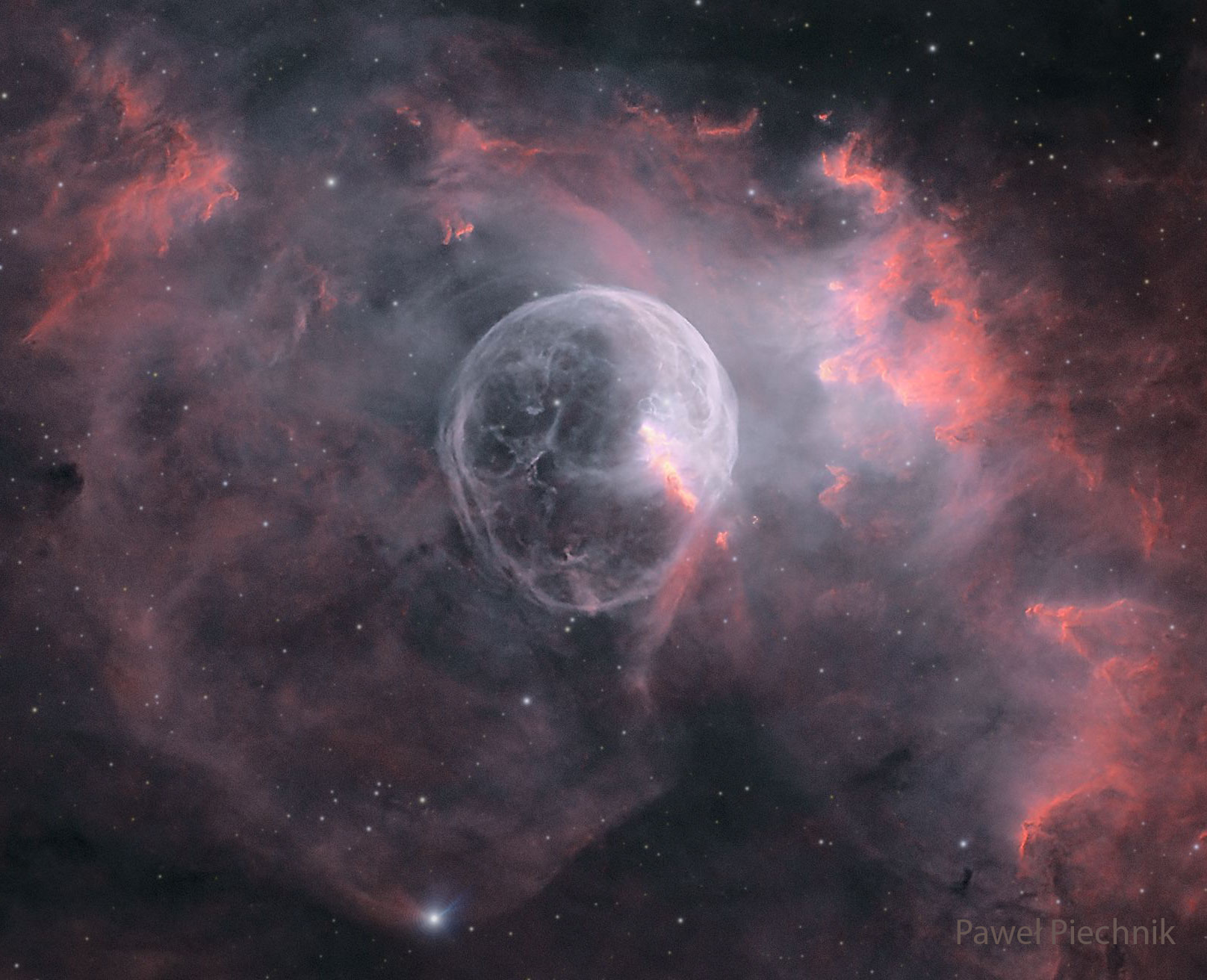
Image source: NASA Astronomy Picture of the Day (APOD) · Image Credit & Copyright: Paweł Piechnik · Today's page
Today's NASA Astronomy Picture of the Day (APOD) offers an outrageous answer: ten light-years across. It takes light a full ten years to travel from one side of the bubble to the other. It's called the Bubble Nebula, catalogued as NGC 7635, hanging in the direction of the constellation Cassiopeia, about eleven thousand light-years from us—when the light you see tonight first set out on its journey, humanity had not yet invented writing.
The Star That "Blows the Bubble"
In the photograph, a nearly perfectly round, translucent bubble floats amid dense clouds of gas, as if it could pop at any moment. According to APOD, embedded slightly off-centre to the right sits a bright, extremely hot star with roughly 10 to 20 times the mass of the Sun. It is this star's ferocious stellar wind and radiation that forcibly "blow" the surrounding gas outward, carving out this enormous cavity; meanwhile, a denser molecular cloud on the periphery acts like a cupping hand, halting the bubble's expansion while itself glowing in the star's light. The most delicate-looking things are often born from the most violent processes.
Someone Spotted It Over Two Hundred Years Ago
In November 1787, astronomer William Herschel first recorded this object. Through a telescope it appeared exceedingly faint—according to Wikipedia, even today with a small telescope it shows up as nothing more than the faintest shell encircling that star. Only with modern long-exposure photography could people finally see that it truly is a "bubble" 🫧. In 2016, the Hubble Space Telescope took a dedicated portrait of it to celebrate its own 26th anniversary in orbit. As for its home constellation, Cassiopeia: in Greek mythology, the queen boasted of her beauty and offended the sea nymphs, and was punished by being bound to her throne, circling the north celestial pole for eternity—today's APOD couldn't resist quipping that this is a constellation known for "boasting." A boastful constellation hosting a blown bubble—rather fitting, all things considered.
Looking Out from Kraków
This photograph was taken by astrophotographer Paweł Piechnik in Kraków, Poland, using long-exposure imaging to tease out the fine details of the bubble and its surrounding nebulosity. Today's APOD has no anniversary to mark and no big news to announce; the reason for its selection is refreshingly simple: it's a stunning photograph.
Astronomers widely agree that a star of this magnitude will one day exit the stage in a supernova explosion, and the bubble will dissipate with it. Fortunately, that day lies far in the future. Tonight, if the skies are clear, take a moment to consider: somewhere overhead, a bubble ten light-years wide is being gently blown by a single star.
Sources: APOD (NASA/GSFC and Michigan Technological University), Wikipedia entry on "Bubble Nebula"