
Today's image has no people, no animals, not even a hint of weather. Just leaves.
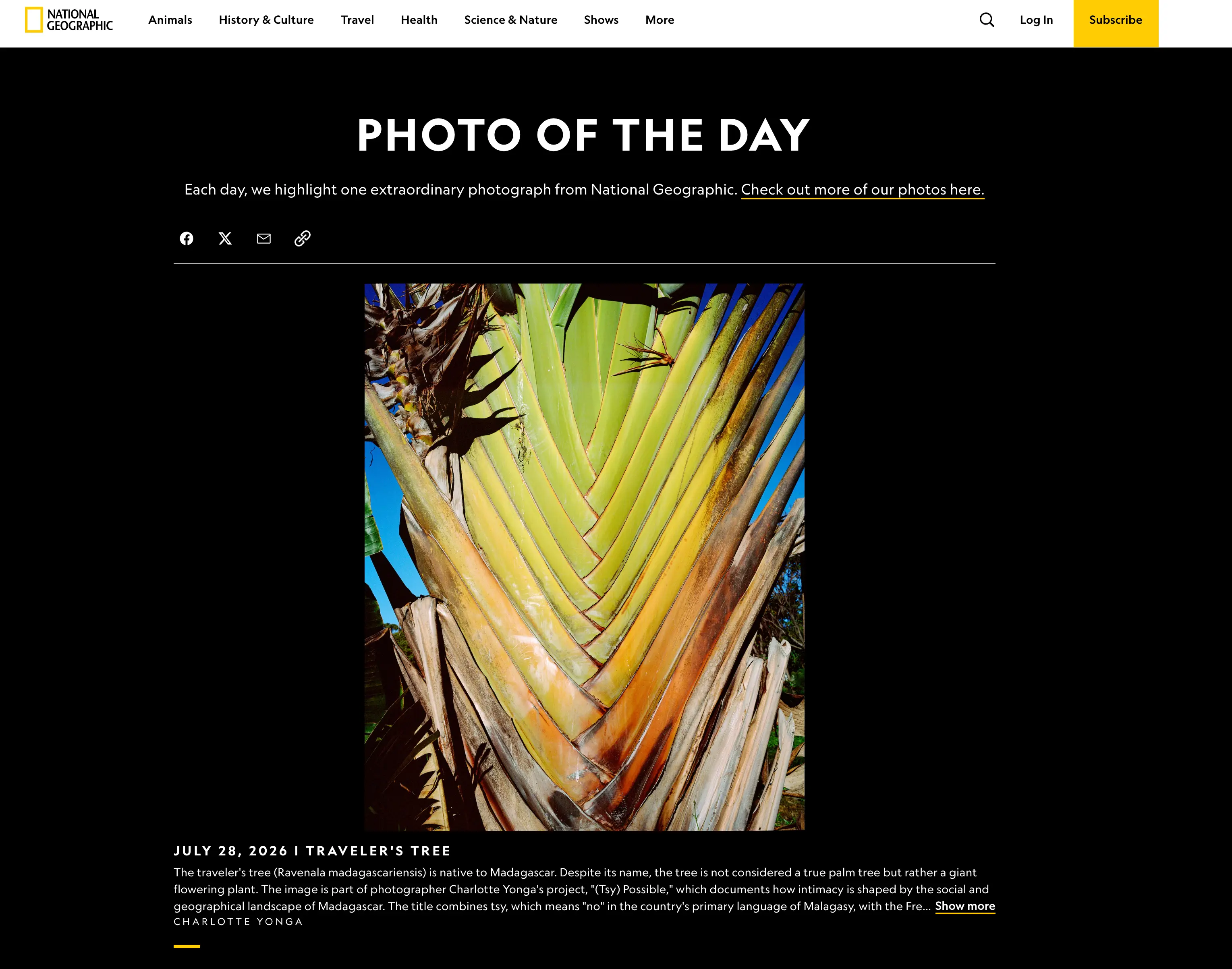
Image: Nat Geo Photo of the Day · Photography by Charlotte Yonga · Original page Traveler's Tree | Nat Geo Photo of the Day. National Geographic has the strictest image copyright policies; this article does not reproduce the image. Please click the link to view the original on the National Geographic website.
Today's Nat Geo Photo of the Day offers unusually little. The official caption describes the scene in a single line: the leaves of a tree, pale green tinged with yellow.
The photo has a name and an address: Traveler's Tree, taken in 2024 in the small highland town of Ampefy, Madagascar, by photographer Charlotte Yonga.
A fan stuck in the ground
The traveler's tree (Ravenala madagascariensis) has an unforgettable silhouette: all its leaves are arranged in a single plane, splaying out to either side like a giant folding fan planted in the earth. A single leaf can be two and a half to four meters long—longer than an adult lying down; the petiole supporting it adds another three to six meters; the whole thing can shoot up to twenty meters, the height of a six- or seven-story building.
It looks so much like a palm that English simply calls it the traveller's palm. But it isn't a palm. It belongs to the family Strelitziaceae, a close relative of the pointy-beaked "bird of paradise" sold in flower shops—essentially a giant herbaceous flower that has grown into a tree. The Malagasy call it ravinala. It grows only on this island and has become the island's emblem.
Where the word "traveler" comes from
There are two explanations.
The first: the leaf bases wrap around the stem in layers, forming a row of small troughs that can hold rainwater. A desperately thirsty traveler, the story goes, could scoop a mouthful from here. Even Wikipedia feels obliged to flag that "the story goes."
The second: the fan tends to spread along an east–west axis, serving as a rough compass. Oddly, this version is the most widely repeated yet almost impossible to back up with data—at least one botanical writer went looking for evidence and came up empty.
The name was given by people. The tree itself has never taken a single step.
It flowers at midnight, waiting for a lemur
What really interests botanists isn't the leaves—it's the flowers.
A traveler's tree takes about ten years to bloom for the first time. The flowers appear below the leaf crown, low enough to climb to; they're wrapped in stiff, boat-shaped bracts that require some strength to pry open; the style is thick and sturdy, able to withstand rough handling; nectar production is copious, primarily sucrose, peaking in the middle of the night.
Put these traits together and the answer is practically written on the flower: it is waiting for a sizeable, tree-climbing mammal with dexterous hands.
In 1994, botanist John Kress and colleagues turned this into a paper, its title ending with a question mark: could this be an ancient system of coevolution? In the field they observed black-and-white ruffed lemurs (Varecia variegata) visiting almost exclusively the flowers of the traveler's tree, prying open the bracts to lap up nectar, picking up pollen on their fur, and carrying it to the next bloom—all without damaging the flower. Another study conducted at Lokobe recorded black lemurs (Eulemur macaco): in September 1994, traveler's tree nectar accounted for nearly a tenth of their daytime feeding time.
After pollination, the woody fruit splits open, revealing brown seeds wrapped in a vivid blue aril. Blue is already rare in the plant world; this splash of color lands right in front of a bird's beak.
Behind the photo is a story called (Im)possible
Charlotte Yonga is a French-Cameroonian photographer. In 2024, during a residency at Fondation H in the capital Antananarivo, she began shooting a series called (Tsy) Possible. Tsy is the Malagasy negation; paired with the French possible, it gives "(im)possible"—a title that also borrows from a love song everyone on the island knows.
What she encountered on the island was another kind of impossibility: deep-rooted caste hierarchies, family pressure over marriage. In an interview with the French magazine Fisheye, she mentioned a couple unrecognized by their families who might be denied entry to the family tomb—the heaviest punishment of all.
Her method is not candid photography. The images are negotiated, even bargained over, with her subjects, then staged together—mixing the feel of family albums, graphic novels, and sitcoms. The series is currently on show at the Rencontres d'Arles photography festival in France (57th edition, Louis Roederer Discovery Award section), where this Traveler's Tree is printed on fabric, on view until October 4.
And so today's photograph carries a little extra weight: an immovable tree, placed inside a story about roads that lead nowhere. It stores rainwater at the base of its leaves, saving it for whoever passes by; it stands in place, waiting for a lemur to climb up in the middle of the night.
Tomorrow the homepage will show a different picture. But if one day you happen upon this big green fan in some courtyard or hotel entrance, you might as well check one thing: are the leaves really all arranged in a single plane?
Sources: Kress et al., American Journal of Botany (1994), on pollination of the traveler's tree by black-and-white ruffed lemurs; the paper "Pollination of Ravenala madagascariensis and Parkia madagascariensis by Eulemur macaco in Madagascar"; Wikipedia entries for Ravenala madagascariensis and Ampefy; University of Florida IFAS tree fact sheet ST-565; Useful Tropical Plants database; reporting and interviews on Charlotte Yonga's (Tsy) Possible from PhMuseum, Fisheye, Blind Magazine, and DER GREIF.