
Today's NASA Astronomy Picture of the Day (APOD): Barnard's Loop over Twin Volcanoes

Image: NASA Astronomy Picture of the Day (APOD) · Image Credit & Copyright: Gonzalo Laserna Vargas · Today's page
Today's NASA Astronomy Picture of the Day looks at first glance like a carefully staged photograph: two snow-capped volcanic cones stand side by side on the horizon, and overhead a crimson arc of light sweeps from one summit to the other—like a bridge, or a ceremonial scarf tossed into the night sky by some unseen hand, landing perfectly so as to link the two mountains together.
The one on the left is called Parinacota; the one on the right is Pomerape. They stand on the border between Chile and Bolivia, both rising above 6,200 meters. In the local Aymara language they are called "Payachata"—meaning "twins."
In legend, they are a pair of lovers
According to APOD, in ancient local legend these two volcanoes are a prince and a princess who, because of a forbidden love, were turned into snow-capped mountains, gazing at each other forever across a valley. The name Parinacota itself is gentle: in Aymara it means "flamingo lake"—and to this day, flamingos still wade in Lake Chungará at its foot.
The geologists' version is far more dispassionate: the two mountains do not share a connected magma chamber underground, and neither has erupted in the past thousand years. They aren't even true twins—Pomerape was born in the Pleistocene, far older than the younger Parinacota. Twins in appearance; not on their birth certificates.
So on the ground, nothing connects them. The only thing that can draw a line between them is the sky.
A long-premeditated "matchmaking"
The red arc bridging the two peaks is Barnard's Loop—a vast arc of glowing hydrogen gas in the direction of Orion. Around 1894, astrophotography pioneer Edward Emerson Barnard first revealed it on a photographic plate through long exposure. At the center of the frame sits the Great Orion Nebula; the orange-red bright star to the right is Betelgeuse; and in the upper right corner is the Rosette Nebula.
According to APOD, this photograph was taken by photographer Gonzalo Laserna Vargas in mid-April of this year from the Bolivian side: a series of exposures from the same day and the same position, combined with precise calculations of timing and location, allowed Barnard's Loop to fall "just so" between the two summits. What you see is not coincidence—it is inevitability, patiently waited for.
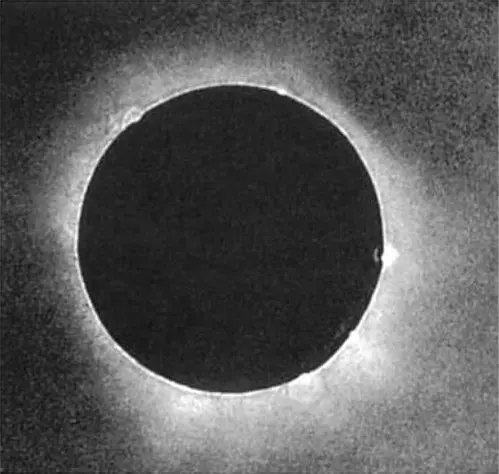
Wikimedia Commons. On July 28, 1851, Johann Julius Friedrich Berkowski, at the Royal Observatory in Königsberg, Prussia (now Kaliningrad, Russia), took the first successful photograph of a solar eclipse using the daguerreotype process. Berkowski was a local daguerreotypist who conducted observations at the Royal Observatory. He attached a small 6 cm refracting telescope to a 15.8 cm Fraunhofer heliometer and made an 84-second exposure shortly after the onset of totality.
As it happens, 175 years ago today—July 28, 1851—photographer Berkowski captured humanity's first successful photograph of a total solar eclipse, preserving the corona on a photographic plate for the very first time. From that day to this one, astrophotography has really been doing the same thing all along: recording for the naked eye all those romances too faint, too slow, too distant to see.
Legend never reunited the prince and princess. But at least on this April night, someone drew a bridge across the sky for them.