
A canal dug for ships, a stretch of water made clean again, and a sun missing eighty percent of itself tomorrow evening.

Image: Bing Daily Wallpaper · Colorful houses along the Nyhavn canal, Capital Region, Denmark (© emicristea/Getty Images) · Official full-resolution image
Open Bing today and the homepage shows a row of houses crammed together. Ochre red next to bright yellow, bright yellow next to sky blue, gable after gable cutting the sky into a jagged edge. At the feet of the houses runs a dead-straight channel of water.
This is Nyhavn in Copenhagen—Danish for "new harbor," literally "the new port." It is Denmark's most photographed stretch of waterfront, and the most frequently postcard-printed Danish landscape in the world. But there's an easily overlooked word in that name—new. A place called "new harbor" means it wasn't always there.
This Isn't a Harbor—It's a Road Built for Ships
Nyhavn is indeed not natural. It was dug out.
In the 1670s, King Christian V of Denmark ordered a gap cut through the city wall, a channel excavated all the way from the sea into the King's New Square at the heart of the city. Half the diggers were Danish soldiers; the other half were Swedish prisoners of war captured during the Dano-Swedish War of 1658–1660.
Why go to all that trouble to dig a ditch? The answer is in Bing's official caption for the photo: to let ships unload cargo directly inside the city.
That is the entire secret of Nyhavn, and the single most efficient sentence for understanding it: It isn't a harbor—it's a road built for ships. In an age without trucks, hauling a shipload of timber, whale oil, or salt from a quay outside the walls to a warehouse inside was painfully slow and expensive. The smartest solution wasn't to build a better road but to dig the sea straight into the city, so ships could sail right up to the warehouse door. That dead-straight channel you see in the photo is, at its core, a seventeenth-century logistics artery.
The two sides of this road were divided from the start. The north bank—the row of colorful houses in the photo—consists of timber, brick, and plastered row houses; No. 9, built in 1681, is the oldest on the street, turning exactly 345 this year. The south bank was lined with grander mansions. As for the street's reputation back then, it can be summed up in a phrase: beer, sailors, and red lights. This was a sailor's first stop ashore, and the place where he spent every last coin of his wages.
A Man Writing Fairy Tales on a Sailors' Tavern Street
It was on this very street that a 29-year-old man rented a room on the second floor of No. 20.
The date was September 1, 1834. His landlady was a ship captain's widow named Karen Sophie Larsen. The tenant's name was Hans Christian Andersen.
The following May, his first collection of fairy tales was published—a slim volume of just four stories: The Tinderbox, Little Claus and Big Claus, The Princess and the Pea, and Little Ida's Flowers. In other words, the story that would later travel the world—about a princess who could feel a single pea through twenty mattresses—was written on the second floor of a sailors' tavern street. Andersen lived in that room until December 1, 1838, during which time he also finished his novel The Improvisatore there.
He came back twice more: he lived at No. 67 from 1845 to 1864, and at No. 18 from 1871 to 1875. Three different addresses on Nyhavn, each home to his writing desk.
The street's later story is the story of a city gradually ceding industry to life. In 1951, a massive anchor was erected by the canal to commemorate the more than 1,700 Danish naval personnel who perished in World War II. In 1977, Nyhavn was officially designated a mooring for heritage ships and museum vessels. In 1980, cars were cleared from the cobblestones, and the entire quayside became a pedestrian street.
The cargo ships left. The people stayed.
What Cleaned This Water Wasn't a Filter—It Was a "Stomach"
Yet the most remarkable thing in the photo may not be that row of houses but the water at their feet.
If you had stood here in 1995, you wouldn't have wanted to dip your hand in. That year, Copenhagen had 93 overflow outlets dumping sewage directly into the harbor and the surrounding sea. This wasn't because Danes were unhygienic—it was because of a design problem no old city can escape: legacy sewers typically collect rainwater and household wastewater in the same pipe. On dry days the treatment plant can handle it; but when a downpour hits, the volume in the pipe multiplies in an instant and the plant simply can't swallow it all—the excess has to find the nearest exit and gush into the nearest body of water.
So the real problem was never "too much filth." It was "for those few hours of heavy rain, the pipes can't hold it all."
Copenhagen's solution, therefore, was not to install bigger filters but to give the sewer system a stomach: underground retention basins and transfer tunnels that store the surge during a downpour, then slowly feed it to the treatment plant once the rain stops and capacity frees up. Combined with plant expansions, 55 of the 93 overflow outlets were shut down; the remainder activate only during extreme storms—which rarely happen in summer.
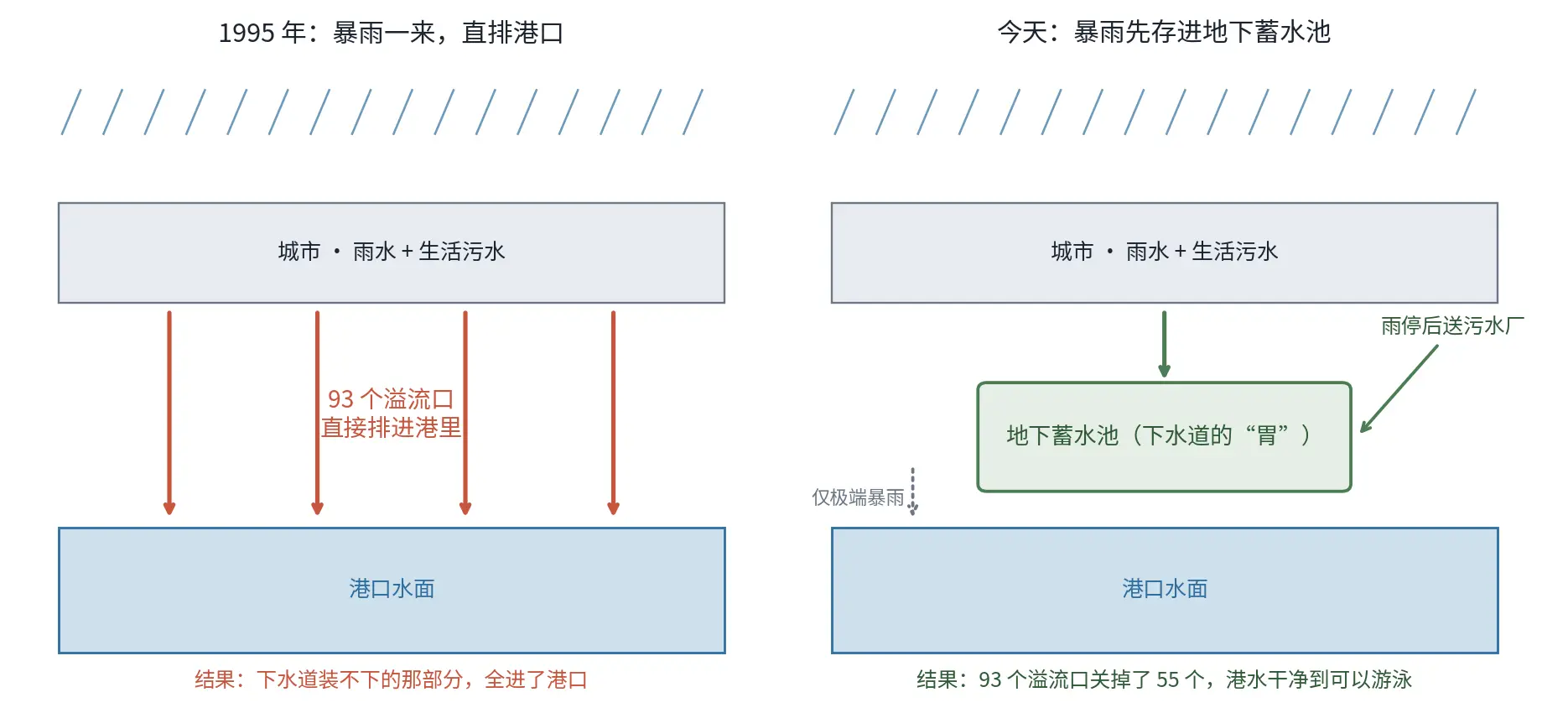
The result is something many cities still can't imagine: in 2002, Copenhagen opened its first harbor bath at Islands Brygge, right in the city's port—swimming in the middle of downtown. The bath was later redesigned by JDS Architects and Bjarke Ingels Group, completed in 2003, and now has five pools, two of them 50 meters long. Three more followed: the Fisketorvet bath at Vesterbro (locals call it "Copencabana"), Svanemølle Beach which opened on June 20, 2010, and the Sluseholmen bath which opened on December 16, 2011. Wikipedia's verdict on this water is blunt: the harbor is now as clean as the Øresund strait. It doesn't always pass muster, of course—after heavy rain, E. coli occasionally shows up and the baths close for a day or two until the tide flushes the water through. The city built an online early-warning system for this, calculating water quality in real time and shutting the gates when standards aren't met.
A channel dug to move cargo first became an open sewer, then became water you can swim in again. Three hundred and fifty-some years, full circle.
Why Today? Bing Offers No Occasion—but Tomorrow Evening Does
To be honest, there's no occasion today.
Bing's official description mentions no holiday; the "why today" copyright link points only to "Nyhavn canal, Copenhagen" itself; and we found no anniversary tied to August 11 and Nyhavn or Copenhagen. Sometimes a daily wallpaper is just a daily wallpaper.
But flip the calendar one day forward, and things get interesting. Tomorrow, Wednesday, August 12, 2026, in the early evening, the sun above that row of colorful houses will have eighty percent of itself bitten away.
A total solar eclipse will occur that day. The moon's shadow will sweep from the Arctic across Greenland, Iceland, and the Atlantic, finally touching down on a small patch of northern Spain and northeastern Portugal. The last time a total solar eclipse crossed mainland Europe was March 29, 2006—twenty years ago.
Here's a mechanism worth explaining clearly to a child. The shadow the moon casts on Earth isn't one blob but two nested ones: the small inner one is the umbra, where the sun is completely blocked; the much larger ring around it is the penumbra, where the sun is only partially covered. In this eclipse, the umbra on the ground is only about 294 kilometers wide—a thin stripe on Earth's surface. Anyone standing inside that stripe will see the sun vanish entirely, for up to 2 minutes and 18 seconds at the point of greatest eclipse, located in the Denmark Strait 45 kilometers west of Iceland.
Copenhagen is not inside that stripe. It falls in the penumbra beside it, so people there will see a sun missing about eighty percent of its disk—not a sun that disappears.
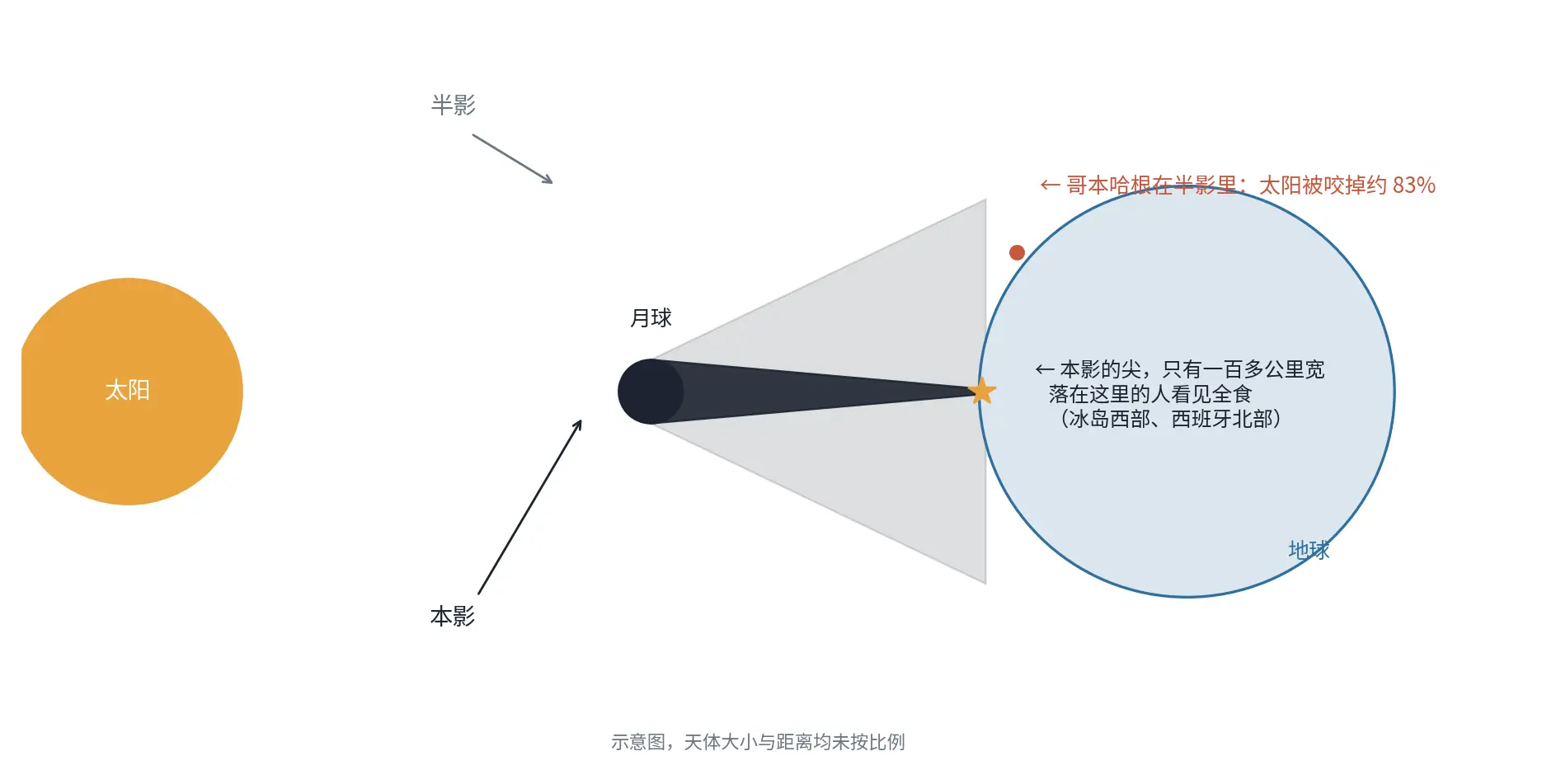
The shadow where the sun is completely blocked is only about 294 km wide when it hits the ground; Copenhagen just misses it, so the sun there only loses eighty percent.
Copenhagen's partial eclipse has an extra dramatic twist: it happens as the sun is about to sink into the sea. Maximum eclipse occurs around 8:00 PM local time, when the sun is only five or six degrees above the horizon—roughly the height of three fingers held together at arm's length above the skyline. Local sunset is around 8:52 PM, meaning the eclipse hasn't even ended when the sun, still bearing its bite mark, slips below the horizon. To watch this, you need a view completely open to the northwest. On this day, that row of colorful houses happens to be facing the wrong direction.
How to Watch (August 12)
- Path of totality: the Arctic, Greenland, Iceland, the Atlantic, and a small area of northern Spain and northeastern Portugal (per NASA).
- Reykjavik (Iceland): totality 17:48–17:49 (local time).
- León (Spain): totality 20:28–20:30 (local time), with only about an hour until sunset.
- Copenhagen: partial eclipse, maximum obscuration ~83%, greatest eclipse around 20:00 local time, sun altitude only five to six degrees; different sources differ by a minute or two, so plan around the round hour.
- Not visible from China—the entire event takes place on the other side of the globe.
- Official livestream: NASA will stream at nasa.gov/live, starting 13:15 U.S. Eastern Time on August 12, which is 1:15 AM Beijing Time on August 13.
- Safety: except for the brief two minutes of totality inside the eclipse path, you must always use eclipse glasses or professional solar filters meeting ISO 12312-2; never look at the sun directly through a telescope, camera, or phone.
Same New Moon: Blocking the Sun by Day, Revealing Meteors by Night
One more thing worth connecting across these two days.
A solar eclipse can only happen at the moment of a new moon—because that's the only time the moon sits directly between the sun and Earth. So August 12 is both eclipse day and new moon day. And what does a new moon mean? It means the entire night sky is free of moonlight.
This coincides precisely with the peak of the Perseid meteor shower. The International Meteor Organization gives a peak window from 21:00 GMT on August 12 to 09:00 GMT on August 13—that is, 5:00 AM to 5:00 PM Beijing Time on August 13; the strongest two hours fall between 10:00 AM and noon Beijing Time on August 13—daytime for Chinese observers.
So the best windows for China are these two: the predawn hours of August 13 (catching the start of the peak window), and late night August 13 through predawn August 14. Both nights are virtually moonless. This year's modeled zenithal hourly rate caps at about 43, so you may not hit the legendary hundred per hour, but such a clean dark sky is rare in itself—the next time a new moon falls right on August 12 won't be until 2045.
Closing
The easiest thing to overlook in today's photo is the water.
It took the people of Copenhagen decades to turn a harbor no one dared touch back into water you can jump into. The most moving part of that story is that they didn't move the city away, nor did they fill in the port—they simply built a few extra basins underground so that a few hours of heavy rain would no longer ruin an entire waterway.
So there are two things you can do today. One is to look up the nearest river, lake, or stretch of coast to where you live and check what the latest water-quality bulletin says—many cities publish these numbers; it's just that nobody reads them. The other is even simpler: tomorrow, August 12, after dark, find a spot beyond the reach of streetlights, lie down, turn off your phone screen, and let your eyes adjust for twenty minutes. There will be no moon that night. The same new moon that blocked the sun over Europe by day will hand the entire sky over to the meteors by night.
Sources: Bing Daily Wallpaper official API and homepage description, Wikipedia entries for "Nyhavn," "Nyhavn 20," "Copenhagen Harbour Baths," "Solar eclipse of August 12, 2026"; State of Green, "The Copenhagen Harbour: from cesspool to bustling, recreational and sustainable city area"; NASA Total Solar Eclipse of August 12, 2026 page; The Sun Today technical page for this eclipse; Absolute Eclipse and Telescope Advisor Copenhagen-specific calculations; Star Walk Perseid Meteor Shower 2026 guide.