
A cluster of buildings that look like scaffolding, a system that uses sea wind as air conditioning, and a reconciliation sealed with the gift of a name.

Image: Bing Daily Wallpaper · Jean-Marie Tjibaou Cultural Center, New Caledonia (© Fabien Astre/Alamy) · View original image
The cluster of buildings on today's Bing homepage looks a bit strange at first glance: curved wooden towers emerge from dense greenery, timber slats fanning skyward one by one, like ribs—or like a ship's hull before the skin has been stretched over it. You'd probably think: are these buildings unfinished?
Unfinished—exactly right. It's intentional.
This is French New Caledonia, in the South Pacific east of Australia. The complex is called the Tjibaou Cultural Center, standing on a narrow peninsula surrounded by water on three sides just outside the capital Nouméa. It is the home of the indigenous Kanak people's culture. Today's story is about why it looks this way, why it bears this name, and why it appears on the homepage today.
"Making" Is as Important as "Being Made"
Its designer is no minor figure: Renzo Piano, co-designer of the Centre Pompidou in Paris. In 1998, the same year this center was inaugurated, he went to the White House to collect the Pritzker Prize—architecture's highest honor.
By convention, when a world-class architect is tasked with "building a house for an ancient culture," the easiest approach is replication: take the Kanak people's traditional great house—the tall conical thatched dwelling of chiefs—scale it up several times, rebuild it in concrete, and call it done.
Piano didn't do that. Together with anthropologist Alban Bensa, he first studied how Kanak people actually build and inhabit their structures—and discovered something. He later explained it in the center's official literature: one of the most fundamental characteristics of Kanak architecture is the building site itself—in this culture, "making" is as important as "being made." So he made a bold decision: to design the entire complex as a place that always looks like it's under construction.
Ten wooden towers, in three sizes, are grouped into three "villages": one houses exhibition halls, another contains a library, research rooms, and offices, and the third holds studios for music, dance, painting, and sculpture, all linked by pathways and trees. The tallest tower reaches 28 meters—roughly nine stories. The top of each one is left open, curved wooden ribs reaching toward the sky, never sealed, never capped.
So what you're seeing isn't unfinished—it's a statement built into architecture: This culture is not complete. It is still alive. It is still growing.
Buildings That Don't Block the Wind
Look again at those curves—they're not just beautiful. They're working.
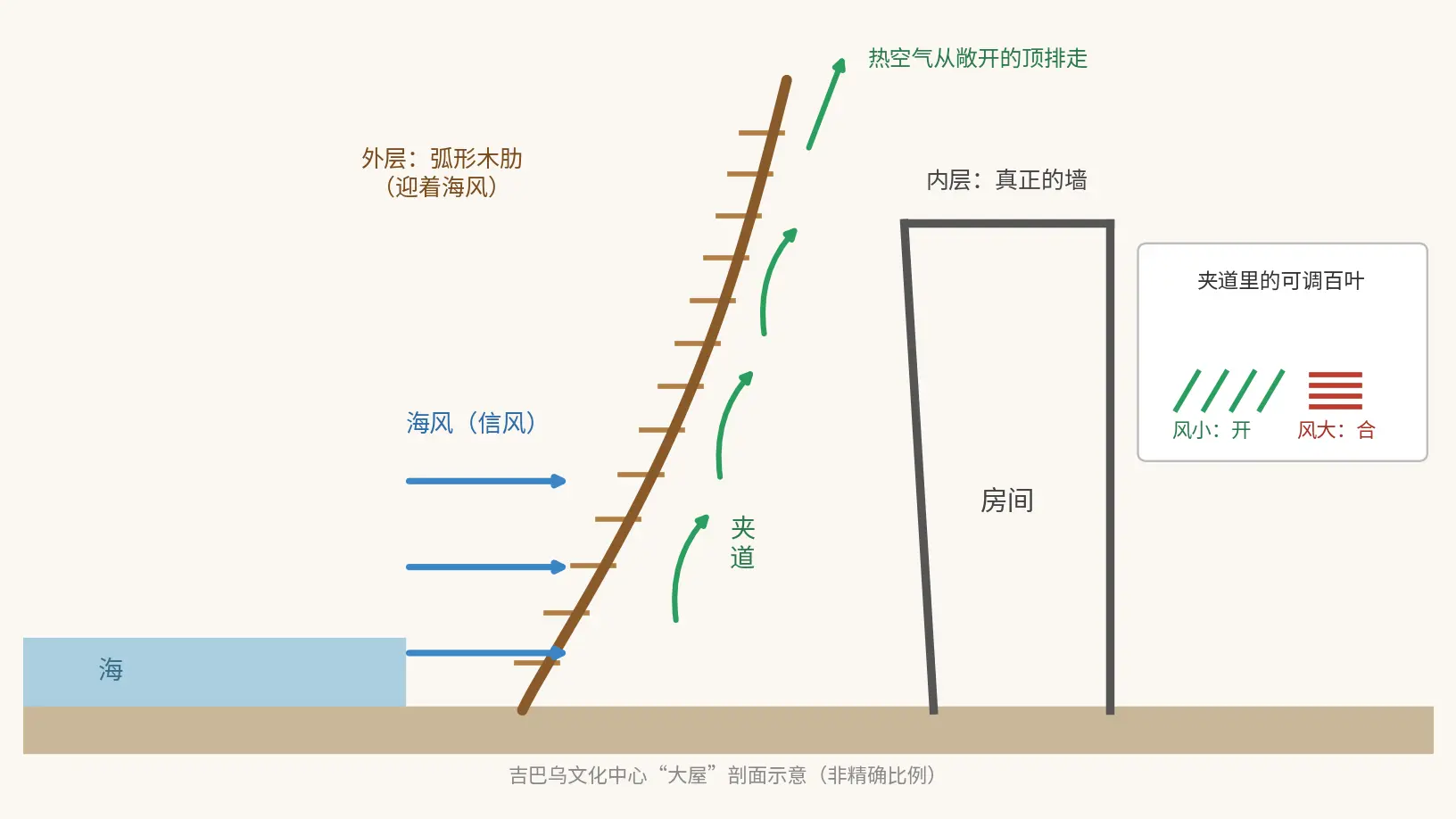
The curved face of each wooden tower faces the sea—the direction from which the local trade winds blow. Each tower has a double skin: the outer layer consists of massive curved ribs and slats of iroko—an African hardwood extremely resistant to insects and moisture—while the inner layer forms the actual walls enclosing the rooms. When the sea wind hits, it first enters the gap between the two skins and rides upward along the curve. Inside the gap are adjustable louvers: when the wind is light, the louvers open to let air flow through and cool the interior; when gales or cyclones strike, the louvers close, and the inside stays calm.
This geometry wasn't sketched on a whim—it was tested again and again in wind tunnels. The result: in the subtropical heat and humidity, these buildings barely need air conditioning.
One line sums it up: These towers don't block the wind—they use it. They stand facing the sea breeze like sails, turning wind into their own air conditioning.
People who write about the center often mention one more detail: when wind passes through the wooden ribs, the buildings make sound. Locals say they "sing."
First Came a Festival, Then Came a Building
This land has memory.
In September 1975, a Kanak man named Jean-Marie Tjibaou and his companions organized a festival on this very ground, called "Melanesia 2000." According to the center's official archives, two thousand representatives from tribes across the main island and the Loyalty Islands gathered here, staging the Kanak creation myth—the story of Téa Kanaké, the first man—as a grand spectacle of sound and light. Throughout the colonial era before this, Kanak culture had long been treated as something that rightly belonged to "the past"; this was the first time it was presented on a large scale, proudly, in the open.
Tjibaou himself deserves a few more words. Born in 1936 in a tribal community in the northern mountains of the main island, he began Catholic theological training at age nine and was ordained a priest in 1965. Later he left the priesthood, went to France to study, returned to devote himself to cultural and social activism, and eventually became the leader of the Kanak independence movement.
In the 1980s, New Caledonia slid toward bloodshed—kidnappings, ambushes, armed assaults, deaths on both sides. On June 26, 1988, brokered by French Prime Minister Rocard, Tjibaou shook hands with anti-independence leader Jacques Lafleur in Paris and signed the Matignon Accords: ten years of peace in exchange for a referendum, with a commitment to developing Kanak culture—including the institution Tjibaou himself had proposed, the Agency for the Development of Kanak Culture.
Less than a year later, on May 4, 1989, while attending a commemorative ceremony on Ouvéa Island, Tjibaou was shot dead by a Kanak militant who opposed the accords. He was 53.
He wasn't killed by an enemy on the other side. He was killed by one of his own people who thought he had reconciled too readily with the enemy.
The Date Was Chosen Deliberately
The French government then decided to turn the cultural project Tjibaou had proposed in his lifetime into an actual building, funded by the state, placed on President Mitterrand's "Grands Travaux" list—a roster that included the Louvre's glass pyramid and the Grande Arche at La Défense, almost all built in Paris. This one was built more than sixteen thousand kilometers away in the South Pacific, on the very land where the festival had been held.
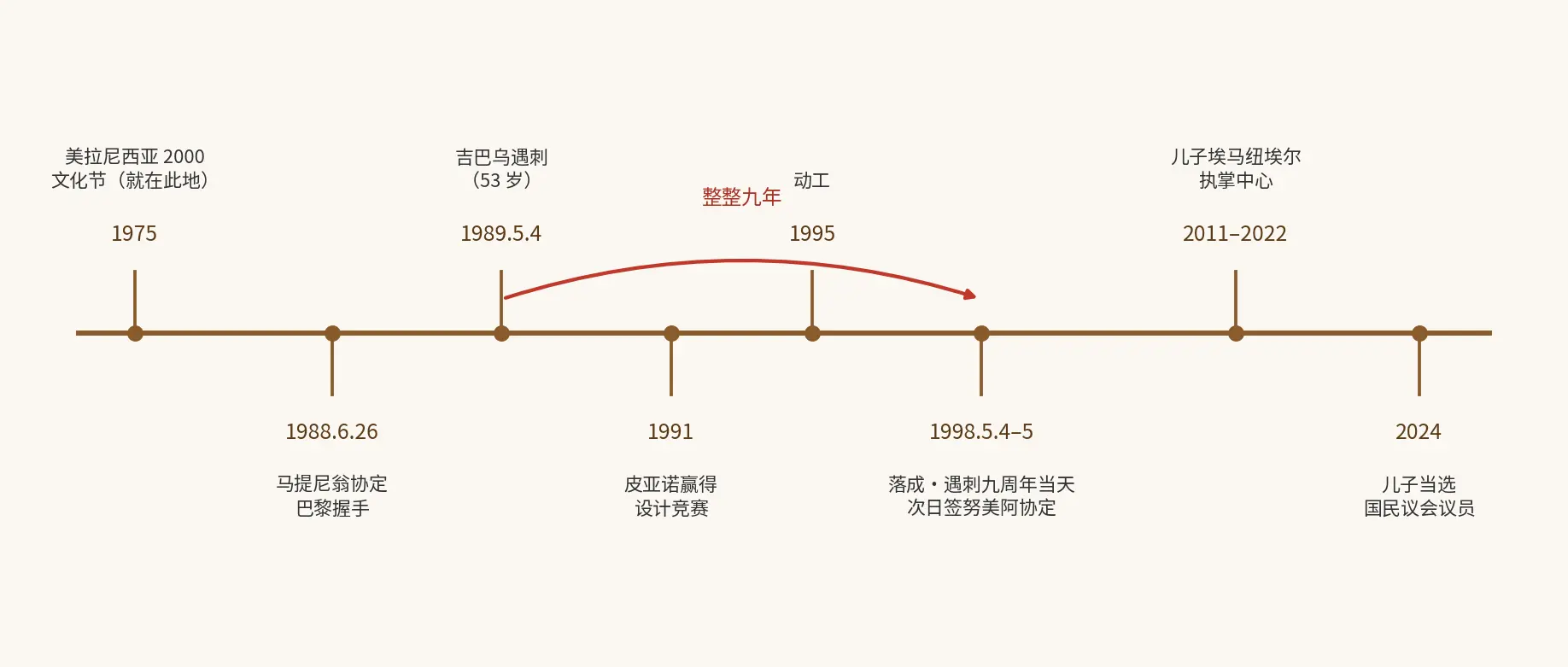
The city of Nouméa granted 8 hectares of peninsula land to the project free of charge. Piano won the design competition in 1991, construction began in 1995, and the budget was 320 million francs. The inauguration date was chosen with great weight: May 4, 1998—exactly nine years to the day after Tjibaou's assassination. French Prime Minister Jospin presided over the ceremony. The very next day, May 5, the new Nouméa Accord was signed on the island, pushing peace another step forward.
There was also a ceremony at the inauguration easily overlooked by outsiders. The Tjibaou family, following traditional custom, formally bestowed the name "Tjibaou" upon the center—in Kanak custom, a name is not casually attached; it is a gift solemnly given. That is why its official name has always been simply "Tjibaou Cultural Center." The chiefs explained this specifically at the inauguration: what was given was the family's name itself.
The Building Has Aged with Use; the Story Continues
Since opening to the public on June 15, 1998, twenty-eight years have passed, and this center has never been merely a museum. In May 2018, just before the first independence referendum, French President Macron stood here and formally handed over to the local government the original 1853 document by which France declared "possession" of New Caledonia—a moment heavy with symbolism, and the venue was chosen deliberately. Important words must be spoken inside this building.
There is also a near-novelistic cycle: from 2011 to 2022, the person running the center and the Agency for the Development of Kanak Culture was Emmanuel Tjibaou—Jean-Marie's son. He worked for eleven years in the building named after his own family, then in 2024 was elected to the French National Assembly, becoming the first Kanak pro-independence member of parliament since 1986.
The father didn't live to see the building completed. The son wore the building in with use, then continued down the road his father had walked. And New Caledonia's political future remains on the negotiating table to this day. This "forever under construction" building—its metaphor has not yet expired.
Why Today
August 9 is the United Nations International Day of the World's Indigenous Peoples.
The date has a specific origin: on August 9, 1982, the UN Working Group on Indigenous Populations held its first meeting in Geneva—the group that would eventually draft the United Nations Declaration on the Rights of Indigenous Peoples, adopted in 2007. On December 23, 1994, the General Assembly, by Resolution 49/214, designated this day as an annual observance.
According to UN data, there are approximately 476 million indigenous people worldwide, spread across 90 countries. They make up less than 6% of the global population, yet speak the vast majority of the world's roughly 7,000 languages and represent some 5,000 distinct cultures. The UN also notes that they steward most of the planet's remaining biodiversity.
Bing's choice to feature this building today is well made: it is perhaps the world's most famous attempt to use a major contemporary building to solemnly tell an indigenous culture: you are not the past—you are the present, and you have a future.
Go Find an "Unplugged Air Conditioner"
One last small thing you can do today.
The system Piano reinvented in the South Pacific with steel and wood—inviting wind to cool a building—already exists in the old houses near where you live. Next time you pass through an old quarter or a village's ancestral homes, look for three things: why doors and windows are often aligned front to back (that's a path left for cross-ventilation); why eaves extend so deep (in summer, the high sun can't reach inside, but in winter, the low sun still gets in); and in houses with courtyards, why the courtyard sits in the center (hot air rises out through it, drawing cool air in through the doors).
In the era before air conditioning, people everywhere independently figured out how to strike deals with the wind. Piano simply built one of those deals up to 28 meters tall.
Sources: Bing Daily Wallpaper, Renzo Piano Building Workshop: Project Page, Renzo Piano Foundation, Working Process: Piano on "the Unfinished Building Site", Arch2o: Double Skin and Adjustable Louvers, French Wikipedia: Tjibaou Cultural Center, English Wikipedia: Jean-Marie Tjibaou Cultural Centre, English Wikipedia: Jean-Marie Tjibaou, ADCK Official: History of the Center and Melanesia 2000, Places Journal: Center Built on the Festival's Original Site, Waddell, Jean-Marie Tjibaou, Kanak Witness to the World: Book Review, New Caledonia Tourism: Tjibaou Cultural Centre, ANABF: Restoration of the Tjibaou Cultural Center, Outremers360: Emmanuel Tjibaou Elected, NC la 1ère: New MP Portrait, United Nations: International Day of the World's Indigenous Peoples