
Two Perseid meteors skim the edges of the frame. Between them sits a constellation almost everyone knows.
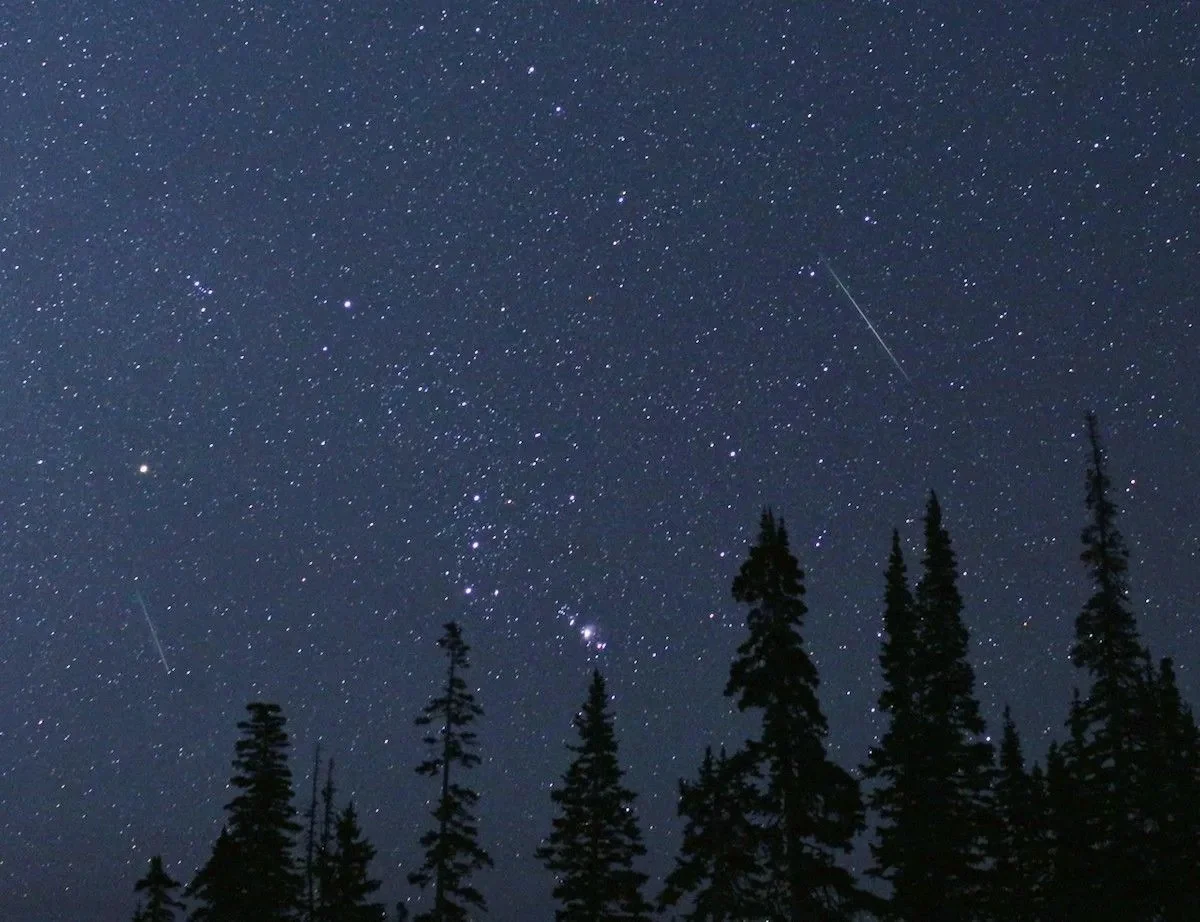
Image: NASA Image of the Day | Image credit: NASA/Bill Dunford | Image page
NASA posted this photograph as an Image of the Day under the title "Perseids Meteor Shower." Its caption is only one sentence: Orion is framed by two Perseid meteors in this image from August 12, 2018, at Cedar Breaks National Monument in Utah.
But NASA named the image file perseidsorion - Perseids, Orion.
The main character made it into the filename, if not the title.
Why Bring Back an Eight-Year-Old Photograph?
First, something NASA does not say but the evidence makes clear: this is an archival image.
Its photographer, Bill Dunford, is a NASA science writer who covers solar-system exploration and the Cassini mission to Saturn, as well as an amateur astrophotographer. NASA has used work from his August 2018 session at Cedar Breaks at least twice. On August 14, 2018, it published another frame from the same night, titled "A Meteor Among the Stars," showing only a meteor. Eight years later, an editor returned to the same batch and chose the frame with Orion in it.
That choice is a comment in itself.
The moment when the photograph was taken also provides the first piece of this story. A calculation for Cedar Breaks on August 12, 2018, puts the three stars of Orion's Belt above the horizon at about 3:45 a.m.; astronomical twilight began shortly after 5. The photograph could therefore have been taken only during the roughly 70 minutes between about 3:50 and 5 a.m.
In August, Orion shows its face only briefly before dawn.
Four Minutes Earlier Each Day, One Full Turn of the Clock Each Year
Now for the mechanism at the center of this story.
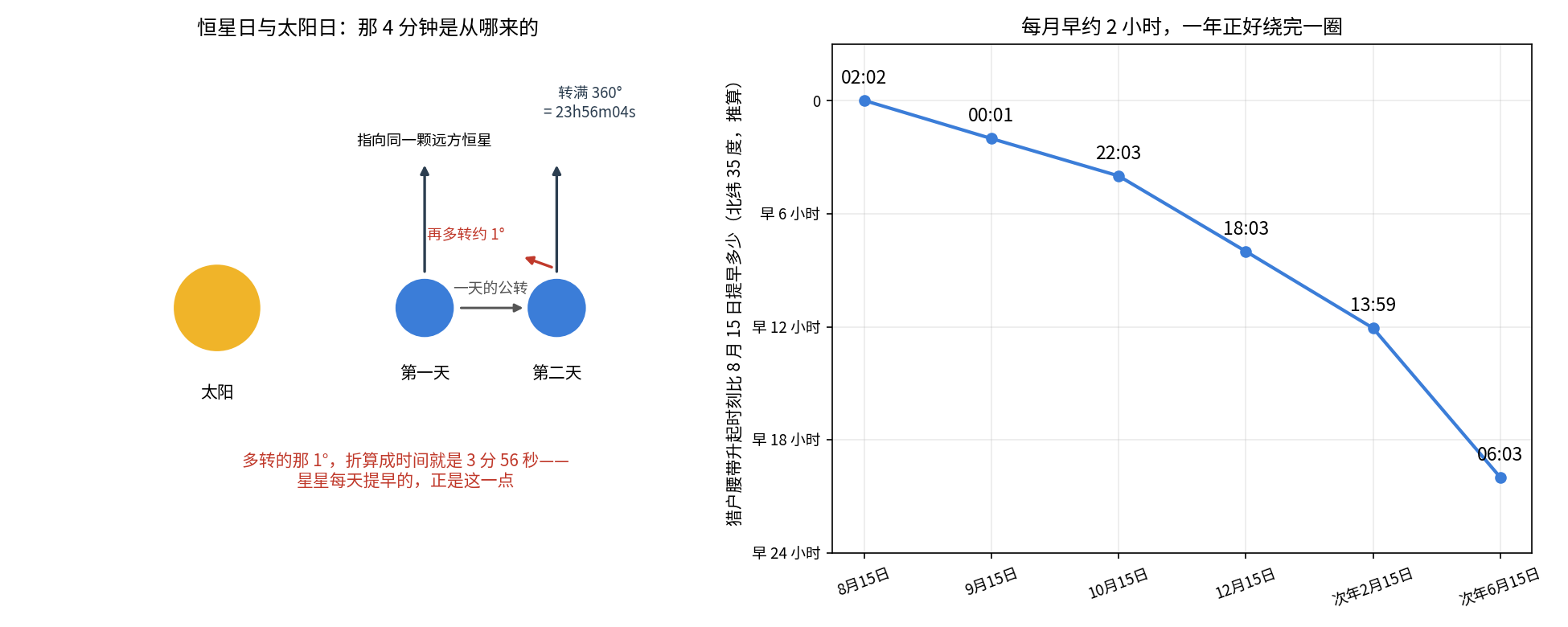
One complete rotation of Earth - 360 degrees relative to the distant stars - takes not 24 hours but 23 hours, 56 minutes and 4.09 seconds. That is a sidereal day.
Where did the missing 3 minutes 56 seconds go? Into Earth's orbit. While Earth rotates, it is also moving around the Sun. By the time it has turned 360 degrees, the direction of the Sun has shifted by about 1 degree. Earth must rotate that extra degree before the Sun returns to due south. Our clocks follow the Sun, so their day lasts 24 hours. The stars follow their own clock, so the same star rises about four minutes earlier each day.
This is not merely a loose approximation. Calculate the rise times of the Belt stars at 35 degrees north and the day-to-day difference remains 3 minutes 56 seconds, without varying by a second. Those four minutes are simply the time equivalent of the extra degree Earth must turn each day.
Let the four minutes accumulate:
- One month: about 2 hours earlier
- One year: about 24 hours earlier - a full turn back to the starting point
That is how we get a seasonal sky. At 35 degrees north, using local mean time, the rise of Orion's Belt moves through the clock like this:
- August 15: 2:02 a.m.
- September 15: 12:01 a.m.
- October 15: 10:03 p.m.
- December 15: 6:03 p.m. (around sunset - the entire reason Orion is called a "winter constellation")
- February 15 of the following year: 1:59 p.m. (it rises in daylight, leaving only the evening portion visible)
- June 15 of the following year: 6:03 a.m. (it rises with the Sun and disappears completely)
Orion is not really a winter constellation. It is there all year; for half of it, sunlight simply hides it. A "winter sky" describes not the sky itself, but the hours when we are awake to see it.
Shen and Shang Never Meet - an Idiom You Can Test with a Stopwatch
As Orion rises in the east this August, another star is setting in the west.
That star is Antares (Alpha Scorpii). Ancient Chinese observers called it the Great Fire, or Chen. The first year of Duke Zhao in the Zuo Zhuan tells of two sons of the legendary ruler Gaoxin. The brothers were always fighting, so the divine ruler separated them: the elder, Ebo, was sent to Shangqiu to oversee Chen, while the younger, Shichen, was sent to Daxia to oversee Shen. Shen is Orion; the three stars of its Belt form the Chinese asterism known as the Shen mansion.
Du Fu was invoking this pair when he wrote, "In life, friends seldom meet, like Shen and Shang in the sky."
The legend can be checked. Solve the horizon geometry with the stars' present-day right ascension and declination: in China north of 31 degrees latitude - most of the country north of Shanghai - the three Belt stars and Antares are never above the horizon at the same time on any of the year's 365 nights. At their closest approach to sharing the sky, at 35 degrees north, Antares rises 18 minutes after the Belt has set. In Beijing the gap is 35 minutes; measured the other way, from the setting of Antares to the rise of the Belt, it is nearly 3 hours.
The three-thousand-year-old story of two brothers who "never meet" is literally true in the sky, to stopwatch precision. The reason they do not meet is written on the same clock face traced by those four minutes each day: their right ascensions differ by nearly 11 hours, putting them almost opposite one another.
Three qualifications are essential:
- Betelgeuse is an exception. The star known in Chinese as Shen 4 stands more than 8 degrees above the Belt and sets later, so at low and middle latitudes it can briefly share the sky with Antares. Strictly speaking, it is the three Belt stars and Antares that occupy different skies.
- These calculations use the stars' present-day coordinates and do not reconstruct their epoch three thousand years ago. Precession changes the exact values, but not the direction of the conclusion.
- Stars near the horizon are already lost in twilight. The interval in which both could actually be seen is even shorter than the geometric calculation, strengthening the practical conclusion.
"Fire Drifts in the Seventh Month" Means Cooler Weather Is Coming
Antares also appears in one of the most persistently misused phrases in Chinese.
The China Meteorological Administration explains it plainly. In qiyue liuhuo, "Fire" is the name of a star, the Great Fire, or Antares. "Drifts" describes how, at dusk in the seventh lunar month, the star moves progressively westward from its highest position, signaling that the weather is cooling and autumn is approaching. Reading the phrase as "July is scorching" confuses an astronomical phenomenon with a meteorological one, as well as the lunar calendar with the Gregorian calendar. The next line, "In the ninth month, hand out the winter clothes," supplies its own proof: colder weather is coming.
A calculation gives the ancient verse a checkup. Viewed from Beijing each night at 8:30 p.m., Antares reaches its highest point in mid-July, nearly due south and about 23 degrees above the horizon. By mid-August it has passed south and begun to drift west; by mid-September it has dropped below 9 degrees; in early October it sinks beneath the horizon.
It really does drift. An observation made three thousand years ago remains correct when someone looks up with the same eyes at the same hour today. Precession has shifted the exact dates, but not the pattern.
There is also a coincidence that needs no embellishment: August 13, 2026, was the first day of the seventh lunar month. On the very day NASA published this photograph, the calendar had literally entered the season of "Fire drifting in the seventh month."
Across the world, ancient Egyptians did something similar. They waited for the first predawn appearance of Sirius, which occurred around the first signs of the Nile flood. An ancient Egyptian name for Sirius simply meant "year." But stars move. Because of precession, the heliacal rising of Sirius fell around the summer solstice five thousand years ago; today it has drifted to early August. Use the stars as a calendar and the stars will eventually invalidate it. This may have been one of humanity's first lessons in calibration.
The Place in the Photograph Has the Same Shape as Today's Bing Wallpaper
Cedar Breaks National Monument stands in Utah. The rim is about 3,155 meters above sea level, surrounding a natural amphitheater roughly half a mile deep and 5 kilometers wide. President Franklin D. Roosevelt established it on August 22, 1933, through Proclamation 2054.
The plateau is also filled with hoodoos - pillars that closely resemble the capped columns in New Mexico on today's Bing wallpaper.
But entirely different chisels shaped them. Cedar Breaks is made of Eocene lakebed limestone, and the National Park Service describes two tools working together. Summer rain mixes with carbon dioxide to form a weak acid that slowly dissolves the limestone. In winter, water enters cracks, freezes and expands by about 9%, working like a geological pry bar. Neighboring Bryce Canyon crosses above and below freezing on more than 170 nights each year. That figure is Bryce's; Cedar Breaks stands higher and can only experience more.
New Mexico's much lower desert, by contrast, hardly freezes. Its rocks are 75-million-year-old mudstone and sandstone, shaped by a different set of tools, chiefly sheetwash from sudden storms. No official source was found comparing the two sites directly; that comparison is an inference. But the underlying conclusion is sound:
A pillar is not a kind of rock but a set of circumstances: a hard cap over a soft body. The tools can freeze, dissolve or wash. If the softer material leaves first, a column remains.
Why the Stars Are So Clear There
On March 2, 2017, Cedar Breaks was certified as an International Dark Sky Park, the 16th site in the US National Park System to receive that status. Its measured darkness is substantial: annual averages across nine sites range from 21.42 to 21.48 magnitudes per square arcsecond. Since certification, most individual readings have fallen between 21.44 and 21.71, with higher numbers indicating darker skies. One reading of 20.22 came with a note that obvious skyglow from a nearby ski town was visible that night.
There are three reasons: an elevation above 3,000 meters leaves less atmosphere overhead; the semiarid Colorado Plateau has little moisture; and no large city is nearby.
The effects of certification were recorded as well. In the following year, attendance at the park's Saturday star parties rose from 1,088 to 2,065, while attendance at its astronomy festival increased from 975 to 2,891. Protecting darkness is not only an ideal. It can be counted.
Sources: NASA Image of the Day page for August 13, 2026; NASA's 2018 "A Meteor Among the Stars" resource page; the Planetary Society profile of Bill Dunford; Swinburne University's COSMOS astronomy encyclopedia and the University of Nebraska-Lincoln NAAP laboratory entry on the sidereal day; the Royal Observatory Greenwich guide to sidereal time; the first year of Duke Zhao in the Zuo Zhuan; China Meteorological Administration, "On the Misunderstanding of 'Fire Drifts in the Seventh Month'"; the Metropolitan Museum of Art, "Telling Time in Ancient Egypt"; National Park Service pages on Cedar Breaks geology and night-sky viewing and its Dark Sky Park announcement; the National Park Service page on Bryce Canyon hoodoos; DarkSky International's Cedar Breaks listing and 2018 annual report; DarkSky International announcements on the certifications of Huanglong and Xichong in Shenzhen; EarthSky's July 2026 update to "Orion Returns"; NASA Hubble's Messier catalog entry for M42.