
A good meteor shower begins with the Moon having somewhere else to be.
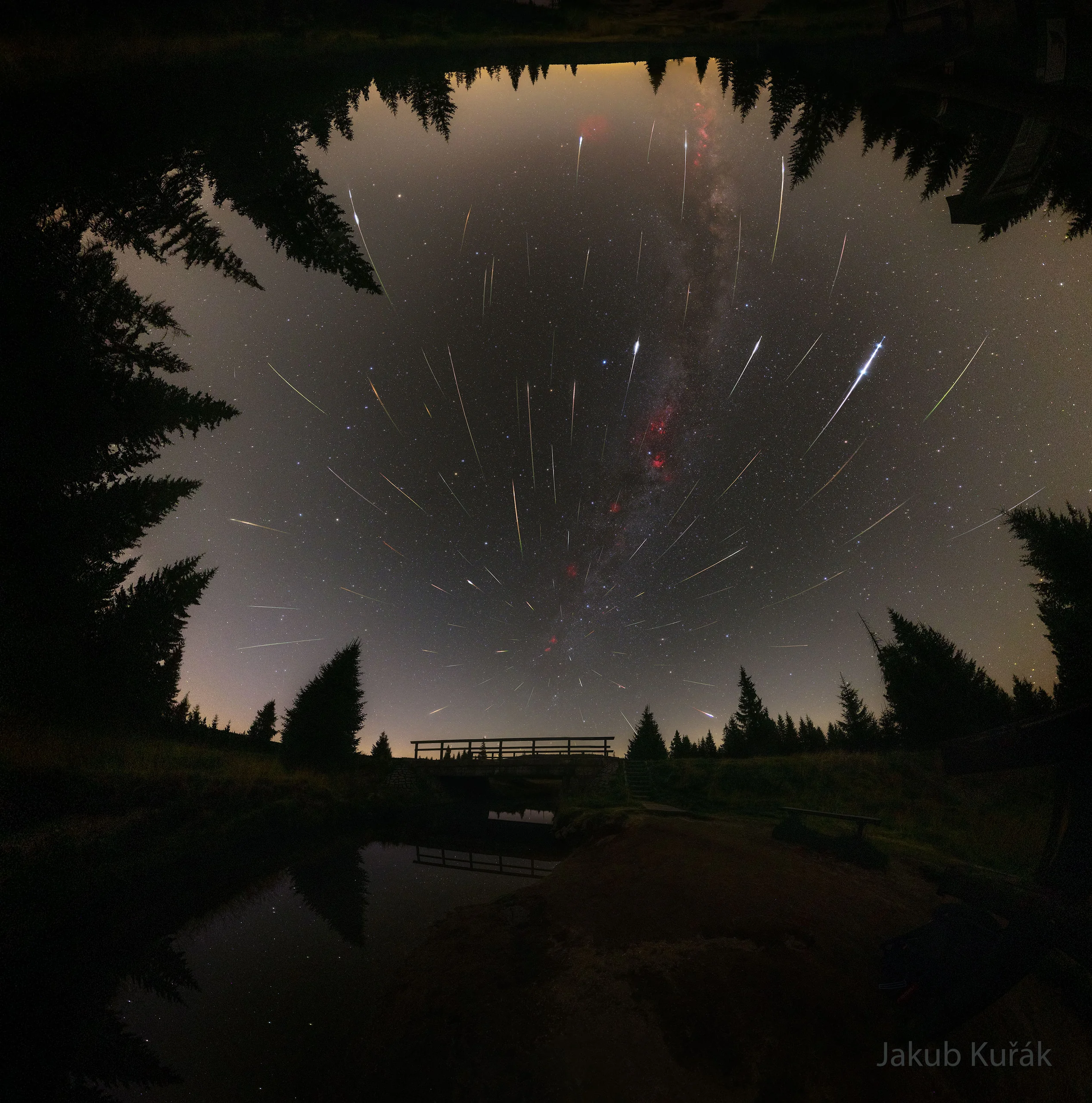
Image: NASA Astronomy Picture of the Day (APOD) · Image Credit & Copyright: Jakub Kuřák · Today's page
Today's NASA Astronomy Picture of the Day fills the sky with slender white lines. They did not all fall on the same night. Photographer Jakub Kuřák spent several nights shooting from Jizerka in northern Czechia, aligned each frame against the background stars, then combined those containing meteors. Every trail now points toward the same place in the sky: Perseus.
This is the 2026 Perseid meteor shower. APOD puts this year's absence of moonlight rather neatly: the Moon was busy visiting the Sun.
The Moon's Two Jobs Are the Same Job
On August 12, the Moon passed directly in front of the Sun, casting a total solar eclipse across Greenland and Spain. That same position made the following nights some of the darkest of the year.
The two events necessarily coincide because they describe the same geometry: a solar eclipse can occur only at new moon. NASA defines new moon as the moment when the Moon and Sun have the same geocentric longitude. Put more simply, they rise and set at almost the same time. The Moon hangs near the Sun by day and is absent from the night sky. A solar eclipse is therefore a guarantee of a moonless night.
How much is that worth? Someone has measured it. With a full Moon overhead, sky brightness at the zenith is about 18.0 magnitudes per square arcsecond, the same value an astrophotographer measured under a moonless sky near downtown Boston. In effect, a full Moon can do to the night sky what moving you and your telescope into the center of a major city would do. The International Meteor Organization (IMO) gives the consequence more directly: a full Moon can reduce the number of meteors you count by roughly a factor of ten. Within five days on either side of new moon, moonlight can be ignored.
Why, then, is there not an eclipse at every new moon? The Moon's orbit is inclined by an average of 5.145 degrees to Earth's orbital plane, so at most new moons its shadow passes above or below Earth. Only a new moon near an orbital node sends the shadow onto the ground. This rhythm has an elegant consequence. Each eclipse season lasts about 34.5 days, longer than one 29.53-day synodic month, so every eclipse season necessarily contains both a solar and a lunar eclipse, roughly two weeks apart. After the total solar eclipse on August 12, the same eclipse season will bring a partial lunar eclipse on August 28, visible in full from the Americas.
What Does "One Hundred an Hour" Actually Mean?
Now for the real subject of this story.
Every August, forecasts say that the Perseids can produce 100 meteors an hour. That number has a name: the ZHR, or zenithal hourly rate. The IMO defines it as the number of meteors a single observer might count in one hour under perfect sky conditions, with the radiant at the zenith.
Read every condition in that definition. You are unlikely to satisfy even two at once.
"Perfect sky conditions" means a limiting magnitude of 6.5: stars as faint as magnitude 6.5 are visible to the naked eye. That is dark-sky-reserve territory. A suburban sky may reach only about magnitude 5, a city 4, and a city center less than 4. In the IMO formula, this produces a discount. At a limiting magnitude of 5.0, the meteor count falls to less than one-third of the quoted rate.
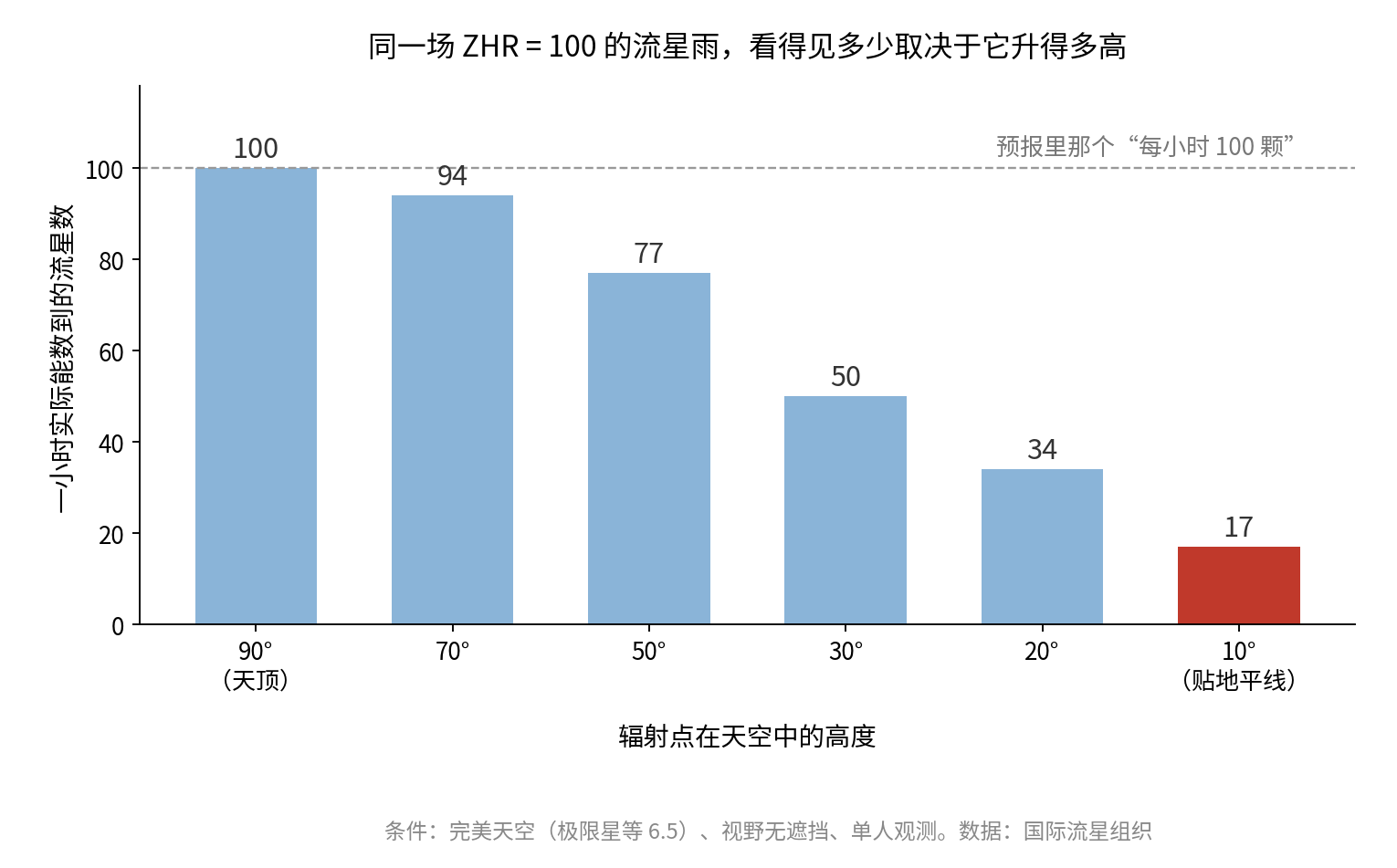
"Radiant at the zenith" is stricter still. It means the apparent source of the shower lies directly overhead. The IMO has calculated the actual count for a ZHR 100 shower at different radiant altitudes, assuming a limiting magnitude of 6.5 and an unobstructed view. At the zenith, the rate is 100 meteors an hour. At 70 degrees it is 94; at 50 degrees, 77; at 30 degrees, only half, or 50; and at 20 degrees, 34. When the radiant is just 10 degrees above the horizon, the rate is 17 per hour.
Not one meteor has vanished, and the sky has not grown worse. Merely keeping the radiant near the horizon turns 100 into 17. That is why every observing guide tells you to wait until the second half of the night, when Perseus climbs higher. The IMO notes that by about 4 a.m., with the radiant roughly two-thirds of the way up the sky, about 90% of Perseid meteors become visible.
Then comes a third discount: the share of your view blocked by trees, buildings or clouds. Multiply the three together and a dark site late at night may yield a few dozen meteors an hour, while a suburban site before midnight may yield only a dozen or so. In this year's Perseid guide, the IMO calculates a peak of close to 40 meteors an hour for its readers and says explicitly that this is far below many public forecasts.
This is not meant to spoil the show. On the contrary: once you know how the 100 was calculated, you will not assume that you were unlucky, or that the forecast lied, when you see your eighth meteor. Every one you count has made it through an openly priced table of discounts.
The Darkness in the Photograph Is Protected
Kuřák did not choose Jizerka by accident.
The valley lies in the Izera Dark-Sky Park, established on November 4, 2009, as an International Year of Astronomy project. The official Czech wording is careful and worth preserving: it was the world's first international, cross-border dark-sky park of its kind. It straddles the Czech-Polish border, with half in each country, and covers almost 75 square kilometers. Other countries already had dark-sky preserves; "first" refers to its international character. The small settlement of Jizerka lies inside it.
How dark is the sky? English-language sources rate it Bortle class 4, reaching class 3 in excellent conditions. Czechia's national tourism portal offers an easier comparison: about one hundred times as many stars are visible here as in a light-polluted city center, roughly 2,000 instead of 20.
That contrast is worsening. A 2023 study in Science, based on more than 50,000 naked-eye observations submitted by citizen scientists from 2011 to 2022, calculated that night-sky brightness in Europe and North America is increasing by 9.6% each year, far faster than the growth in surface lighting detected by satellites. The researchers translated that rate into a quieter but more unsettling example: a child born where 250 stars are visible would see only about 100 there by age 18.
The 2016 New World Atlas of Artificial Night Sky Brightness described the existing loss: the Milky Way is already hidden from more than one-third of humanity, including 60% of Europeans and nearly 80% of North Americans.
The most precious thing in this photograph may not be the white trails. It may be the sky behind them, still dark enough to see.
One Last Note
China has six sites listed in the World List of Dark Sky Protected Areas: Ngari and Nagqu in Tibet, the first two added in 2018; Yeludang in Dafeng, Yancheng, Jiangsu; Taihang Honggu in Qinshui, Jincheng, Shanxi; and Geyuan and Zhaojin in Hengfeng, Jiangxi. Yeludang is the first on China's coast. Officials say its 26-square-kilometer area has no light pollution and averages 238 observable nights a year, making it the nearest stretch of dark sky for many readers in the Yangtze River Delta. In 2023, Xichong in Dapeng, Shenzhen, became China's first International Dark Sky Community. Retrofitting its streetlights brought some of the stars back, proof that even beside a city of 20 million people, darkness can be recovered.
The next major date is December 14: the Geminids.
Sources: NASA Astronomy Picture of the Day for August 18, 2026; NASA's Watch the Skies blog; the International Meteor Organization's observing-methods page, 2026 Meteor Shower Calendar and 2026 Perseid observing page; the Czech Ministry of the Environment memorandum on the Izera Dark-Sky Park; the Czech Astronomical Society at astro.cz; the Czech national tourism portal Kudy z nudy; the original Sky & Telescope Bortle scale article and measurements of moonlit sky brightness; the US National Park Service night-sky quality index; Falchi et al., The New World Atlas of Artificial Night Sky Brightness (2016); Kyba et al. in Science (2023) and the NOIRLab release; NASA pages on eclipse geometry and eclipse-season cycles; a Chinese Science News report on the World List of Dark Sky Protected Areas; notices from the Shenzhen Meteorological Bureau and the Guangdong provincial government on the Xichong Dark Sky Community; and lunar phases and moonset times calculated with PyEphem using the DE ephemeris.