
A city built so that every inch of its walls could be seen
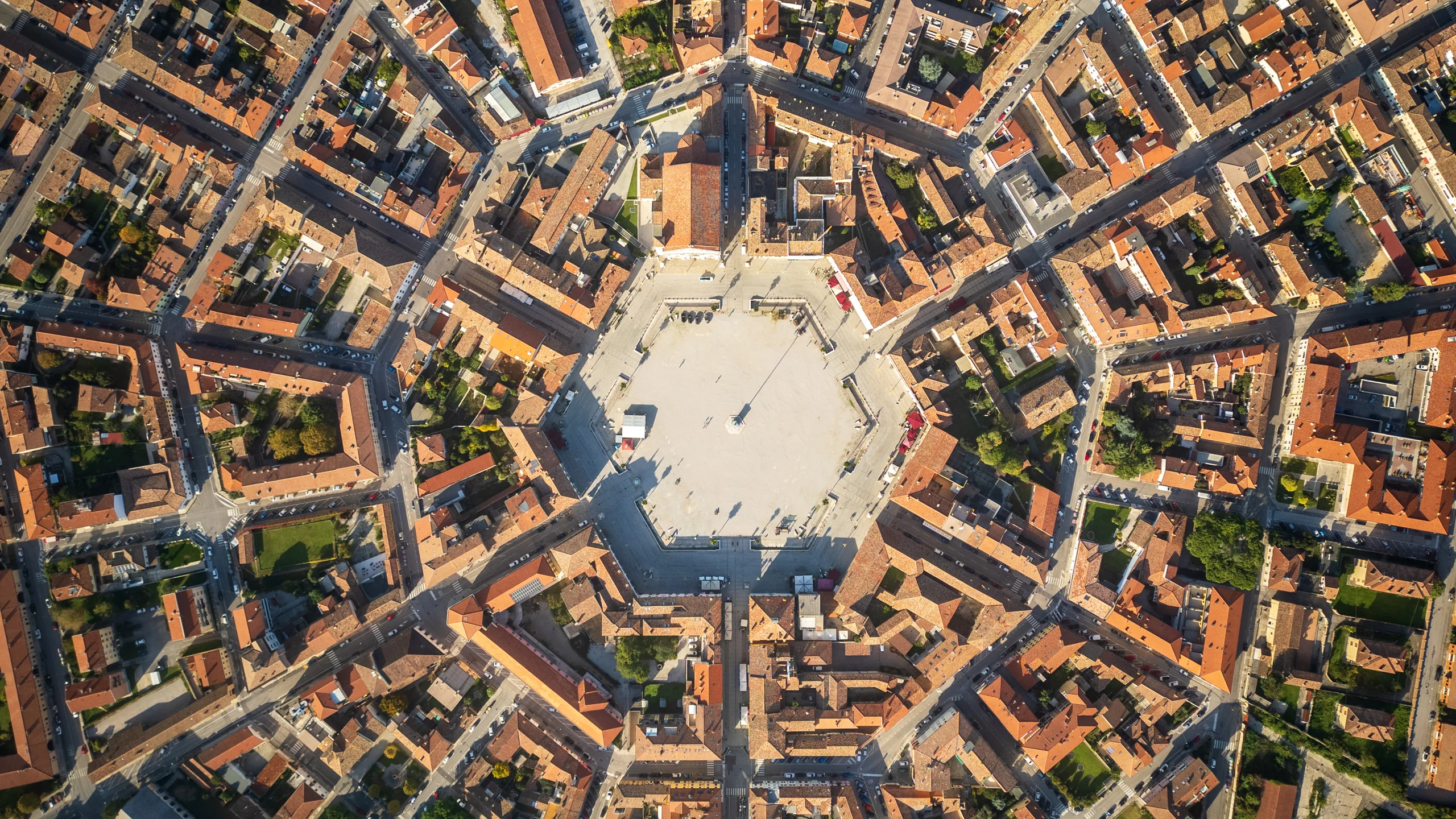
Image: Bing Daily Wallpaper · Aerial view of the fortress city of Palmanova in Friuli, Italy (© Riccardo Saponi/Getty Images)
Open Bing today and you will see a star.
Not one in the sky. This one lies flat on the plain of northeastern Italy, with nine points thrust outward. At its center is an orderly hexagonal square, with straight streets radiating from it like spokes. It might look like a monument, or an enormous flower bed. It is neither. It is a city called Palmanova, and more than 5,300 people still live there.
This star was drawn for the enemy.
A City Decided in a Single Day
On October 7, 1593, the Republic of Venice laid the first stone in this empty field. The date was carefully chosen. Twenty-two years earlier to the day, Venice had helped defeat the Ottoman fleet at the Battle of Lepanto. It was also the feast day of Saint Justina, who became the new city's patron saint.
Venice needed it. A treaty signed in 1521 had broken the borders of the Friuli region into a leopard-skin pattern of scattered territories, leaving the republic's northeastern gateway exposed to Ottoman raids on one side and Habsburg pressure on the other. Rather than repair an old town, Venice chose to build a new one on open ground, designed for artillery from its very first line.
The fortress was the work of a team, not one man. Treccani, Italy's authoritative encyclopedia, attributes the military geometry to the fortification experts Giulio Savorgnan, Bonaiuto Lorini and Marcantonio Martinengo. The confirmed contributions of the celebrated architect Vincenzo Scamozzi are the three gates and the cathedral. English-language popular accounts often credit the whole city to Scamozzi, but that is a widely repeated simplification.
Cannons Made Round Towers Obsolete
To understand the nine points, first consider what they replaced.
Medieval defenses grew upward: tall, straight masonry walls, with round or square towers. Artillery shattered that logic. A stone wall square to a cannon's muzzle could crumble after only a few salvos. After the walls of Constantinople fell in 1453, European fortification designers changed direction. Instead of building higher, they dug lower and piled thicker. Walls became low, broad and packed with earth. A wide, deep ditch went in front, followed by a gently sloping bank that gave enemy cannon almost no vertical surface to hit directly.
But the fatal problem was not height. It was visibility.
Imagine standing atop a round tower and trying to look down at the foot of the wall beneath you. You cannot. The curve carries your line of sight, along with your arrows and bullets, away from the base. Attackers who reached that part of the wall entered a place no defender could hit. They could dig, plant explosives and work undisturbed. Fortification designers called it dead ground. A round tower created dead ground directly in front of itself.
The bastion answered that problem. Fold the wall outward into a point, and each side of the point gains a short wall. Those short walls do not face the distant enemy. They run almost parallel to the neighboring curtain walls so that defenders can fire along their bases. Adjacent bastions cover each other: mine protects the foot of your wall, and yours protects mine. No part of the perimeter is left without a defender looking at it from the side. As a bonus, the projecting points eliminate recesses where attackers might hide.
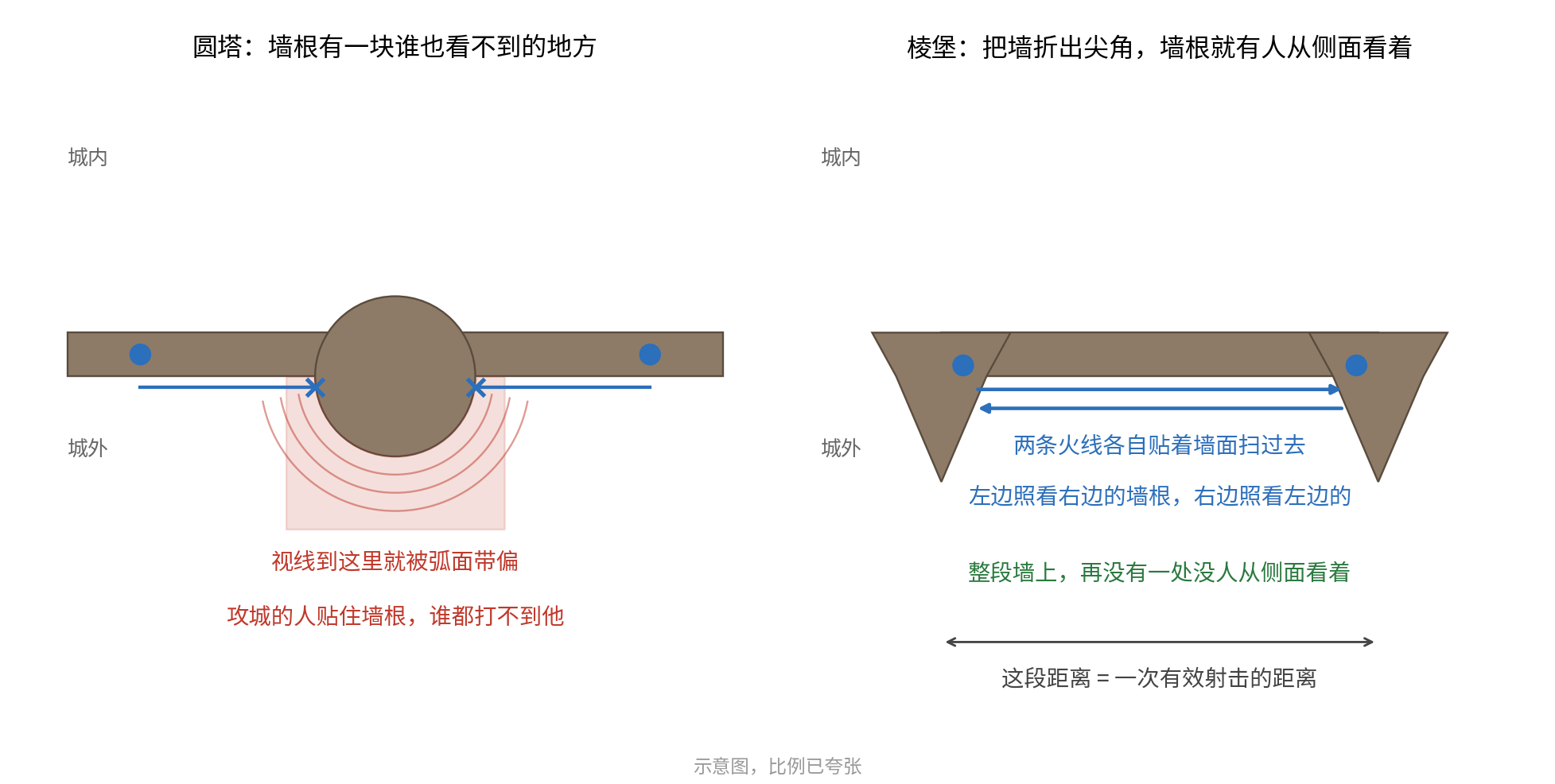
How Long Should a Wall Be? One Shot
The most elegant part of this geometry is that it turns the length of a wall into something that can be calculated.
The rule was simple: the outer tip of a bastion had to lie within one musket shot of each of the flanks protecting it. Any farther, and the point itself would sit beyond help. Eighteenth-century fortification manuals defined a musket shot as 300 yards, a little over 270 meters. Practical estimates often used 240 to 250 yards, but designers calculating mutual support worked with 300.
That is why different systems of fortification arrived at wall lengths on the same scale. Antoine de Ville fixed each side of the inner polygon at about 270 meters. Blaise François Pagan offered three grades, at roughly 310, 350 and 390 meters. Palmanova's curtain wall between two bastions is about 340 meters long.
In other words, the city's dimensions on a satellite image were determined not by aesthetics, but by how far a musket could fire. The city was measured out in range.
UNESCO added Palmanova to the World Heritage List in 2017, as one of six sites across Italy, Croatia and Montenegro in Venetian Works of Defence between the 16th and 17th Centuries: Stato da Terra - Western Stato da Mar, under criteria iii and iv. Its official assessment puts the connection plainly: these bastioned defenses were created in response to changes brought about by the increased use of firearms. Institutional documents rarely bind a shape to a technology so directly.
"Both Sides Look Straight Along the Foot of the Wall"
Here is a striking parallel.
Early in the Southern Song dynasty, Chen Gui, who had defended De'an, recorded the established design of projecting wall towers known as ma mian in his Shoucheng lu. The passage is only a few dozen characters long:
By the old system, one ma mian is placed every sixty paces. It must project no less than two zhang beyond the wall; its width varies with the terrain. From both sides, one looks straight along the foot of the wall.
Three sentences, three essentials, and precisely the logic of a European bastion. "One every sixty paces" sets a standard interval. "Project no less than two zhang beyond the wall" says that the tower must extend outward or it serves no purpose. Most important is the final sentence: "From both sides, one looks straight along the foot of the wall." From either flank of the tower, defenders can see, and fire at, the base of the adjoining wall.
That is the solution to dead ground, written in Chinese more than four centuries before Palmanova's foundation stone was laid.
The Ming walls of Xi'an still demonstrate the same principle. Along their 13.74-kilometer perimeter stand 98 projecting towers, each extending 12 meters from the wall, 20 meters wide and level with the rampart. Adjacent towers are 120 meters apart. The figure is deliberate: half of 120 meters is 60 meters, within effective bow and crossbow range. Every point on the wall therefore lies within range of a tower on either side.
On one side, a musket range of 274 meters; on the other, a bow range of 60. The weapon changed, but the formula did not: the length of a wall is the distance across which its defenders can support one another.
Was It Ever Attacked? Yes, and Geometry Was Not What Failed
A city this geometrically perfect is easy to imagine as an untested model on paper. The opposite is true.
In 1797, an Austrian major captured the fortress by deception; French forces then took control. Napoleon incorporated it into the Kingdom of Italy and personally oversaw the addition of the outermost ring of nine detached forts. Palmanova endured a siege lasting more than a month from April to May 1809. From October 26, 1813, to April 19, 1814, it was besieged again for nearly half a year under heavy bombardment. In 1848, it joined the uprisings in Milan and Venice, held out for three months, and surrendered under artillery fire.
The point is worth noting: on the two occasions it was lost, the causes were deception and more powerful siege guns. Neither failure meant that the geometry of the bastions had stopped working.
What finally made that geometry obsolete arrived much later, and weighed very little. On April 6, 1916, an Austro-Hungarian aircraft flew over the nine-pointed city whose low, earth-filled walls had been built to evade horizontal fire. It dropped bombs, killing four people, two soldiers and two civilians. Three centuries of design were bypassed at once by something from above.
One last detail about the "ideal city." Palmanova's geometric harmony places it in the Renaissance tradition of ideal-city planning, and it was designed for a population of 20,000. But no one wanted to move there. Records say Venice had to offer free building plots and tax incentives, and even pardons for minor offenses, to attract residents. Today the population is a little over 5,300. The first problem faced by one of history's most geometrically perfect cities was filling the vacancies.
Sources: Treccani's Enciclopedia Italiana entry on Palmanova; the official history page at palmanova.it; the Friuli Venezia Giulia regional landscape archive; UNESCO World Heritage List entries 1533 and 1283; thevenetianfortresses.com; visitpalmanova.it; the Encyclopaedia Britannica entry on bastions; "The Geometry of Magnetic Lines in Bastioned Fortifications," npj Heritage Science (2025); the University of North Texas thesis Fortification Renaissance; "How Far Is Musket-Shot?" in the Journal of the American Revolution; Chen Gui's Shoucheng lu: Shoucheng jiyao; and the Chinese Wikipedia entry on the Xi'an City Wall.