
Two cities answered the same problem in two ways: one made flight visible, and the other made it audible.
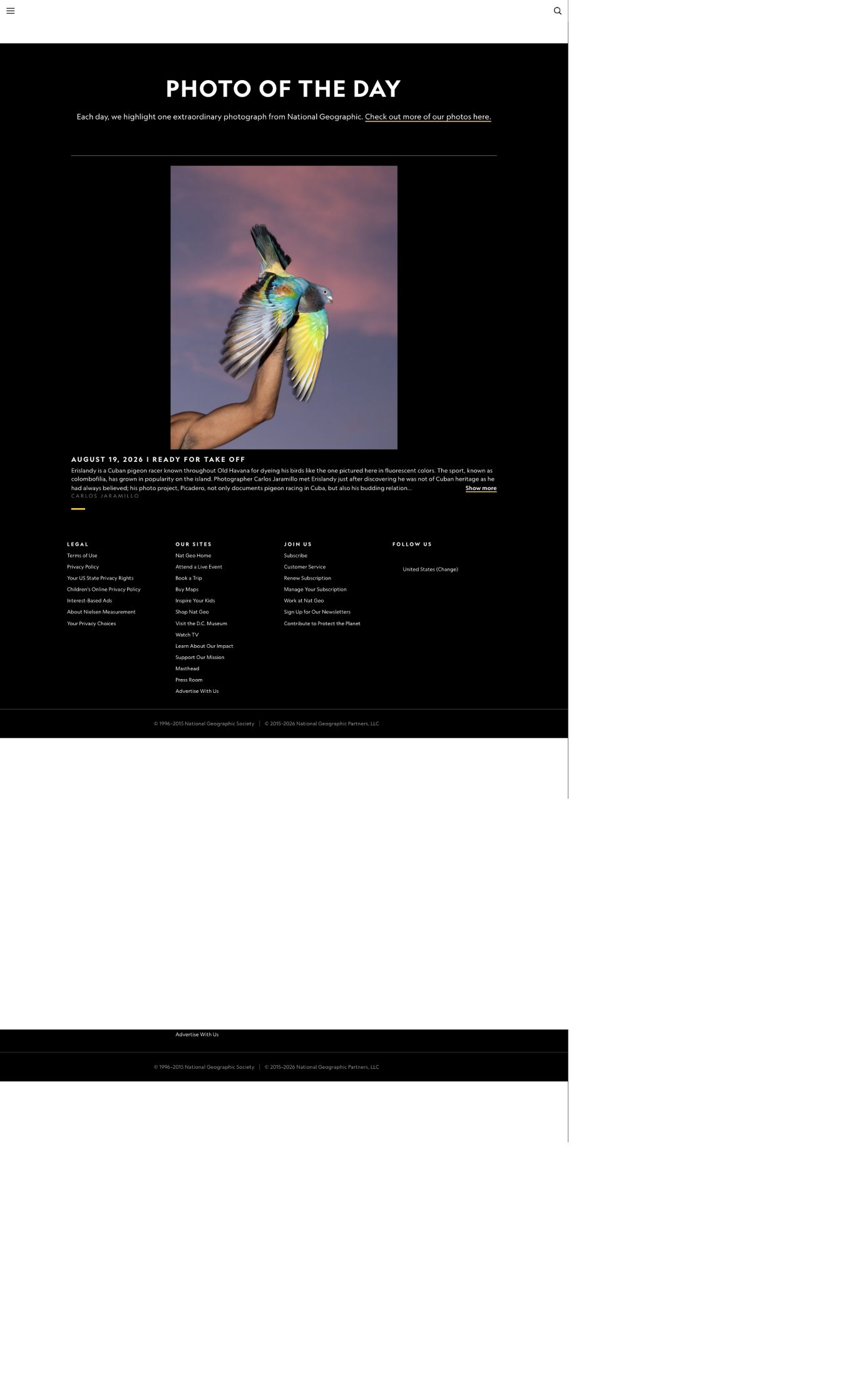
Screenshot: National Geographic Photo of the Day | Photograph: Carlos Jaramillo | Original page
Today's National Geographic Photo of the Day is titled "Ready for Take Off."
The caption tells us this much. Erislandy is a Cuban pigeon keeper known around Old Havana for dyeing his birds neon colors, including the one in the photograph. The sport is locally called colombofilia and is growing more popular on the island. Photographer Carlos Jaramillo met Erislandy soon after learning that he did not have Cuban ancestry, as he had always believed. His project Picadero records both Cuban pigeon racing and the relationship developing between the two men.
The word worth following from the caption is dye.
Why Color a Bird?
Dyeing pigeons vivid colors is not a Cuban eccentricity, nor is it done only for appearance.
The strongest evidence comes from an unexpected place: Spanish law.
Article 3.1 of Law 10/2002 on the protection of pigeon breeding and sporting pigeons requires sporting birds to carry brightly colored markings on both wings so they can be identified at a distance.
This is not advice. It is a legal requirement alongside the compulsory leg band.
The rules become still more precise in the Balearic Islands, where a competition called coloms de pica sends about 100 male pigeons after one female for two hours. Color beneath the wings identifies the owner; color above the wings identifies the individual bird. Two judges observe from the ground, one on a terrace and another in the field, and must track every bird in the flock.
One hundred pigeons climb, scatter, gather, and dive for two hours. If they were all gray, there could be no verdict.
The colors exist because this is a competition judged by watching the sky.
An Associated Press report in Spanish described a Cuban male nicknamed "the Mexican," its two wings colored red and blue. Reliable primary documentation for Cuba's own written rules, or for Erislandy's particular reason, could not be found, so neither is supplied here.
A Necessary Distinction
National Geographic's caption calls the sport colombofilia. Across the Spanish-speaking world, however, that term generally means long-distance racing: pigeons are crated, transported hundreds of kilometers, and released, with leg bands and clocks determining the winner. The decisive instrument is a stopwatch, not the eye.
The evidence for colored wings belongs to a different branch, colombicultura, or what Cubans call palomas de conquista: rooftop courtship and capture contests judged on flight, elegance, and the ability to lure a female into the owner's loft. Judges watch from rooftops.
Cuban independent media divide the island's pigeon competitions into three types: exhibition contests for form and bearing, distance races for the farthest flight, and "conquest" or "theft" contests. The third has its own vocabulary. Gifted luring males are called "thieves" or "killers." A stolen pigeon can be reclaimed only after payment of a "fine." The season runs from January through July. A meet may gather as many as 400 keepers, each bringing up to 20 birds.
Erislandy therefore stands where two traditions overlap. The caption is not simply wrong; two kinds of sport really do share the same rooftops.
The formal racing tradition contains a telling detail of its own. The predecessor of Cuba's pigeon federation, the Havana Pigeon Club, was founded in 1900. Today there are about 6,000 members and 108 associations. The longest course can reach 920 kilometers; one owner's bird flew that distance in rain in 13 hours 25 minutes. Judges use stopwatches to record the arrival of the three fastest birds. The mechanical racing clocks came over from the Canary Islands, hundreds at a time, carried by pigeon fanciers. Every one was an old clock no longer used in Europe.
Machinery discarded in Europe became the basic infrastructure of competition in Havana. The detail carries its own history.
The cost is substantial. About one-third of the pigeons fail to return from each race. Raptors and weather account for some losses, but not all.
Beijing Solved the Same Problem with Sound
Move 10,000 kilometers away, above Beijing's hutongs.
Beijingers addressed the problem of losing track of a flock in flight through another sense: the pigeon whistle.
The tiny whistle is made from bamboo, reed, or gourd. It is tied at the base of the four central tail feathers, about one centimeter from their tips, and secured with cotton thread and steel wire.
Even a large, lacquered whistle weighs no more than 8 grams.
As the pigeon circles, air passing the opening excites the column of air inside. The general principle resembles blowing across the mouth of a bottle. This is only an analogy; no research found here explicitly identifies the pigeon whistle as a Helmholtz resonator, so it should not be presented as an established classification. Different forms produce different voices: cylindrical whistles sound bright, while gourd-shaped ones sound low. When the whole flock circles, dozens of whistles merge above the lanes. Older listeners describe them as clear and subtle, broad and powerful, high and bracing, or distant and lingering.
The craft is governed by seasons. Bamboo should be cut during the coldest period of winter, and gourds selected when they ripen in the hottest days of summer. The steps include peeling, cutting the tube, removing its core, forming the opening, polishing, and lacquering. One whistle takes two or three days. The Yong-style pigeon-whistle craft entered Beijing's municipal intangible cultural heritage list in 2013 or 2014; two sources give different years, so a range is used here. He Yongjiang is its fourth-generation inheritor.
The two cities now form a clear pair:
Once a flock rises into the sky, the people below lose every hold on it. Havana colors the birds red and blue to make flight visible. Beijing ties on whistles weighing less than eight grams to make flight audible.
One problem, two senses, two answers.
A contemporary fact provides the right ending to the whistle's story. In a 2025 Xinhua report, an older pigeon keeper said quietly that Beijing still has 60,000 to 70,000 pigeons, but their whistles are normally kept silent to avoid disturbing neighbors. The birds released at Tiananmen Square during national celebrations belong to pigeon keepers.
The whistles have not vanished. They have been put away. The pigeons repeatedly seen rising from Tiananmen came from some hutong or rooftop.
Both Traditions Depend on One Thing
Dyed wings and whistles share an unstated assumption: the bird will return.
If it does not, the color is for someone else to see and the whistle sounds only for the sky. Two cities, four centuries, and innumerable rooftops depend on that one fact.
How does a pigeon come home?
Human beings formally framed the problem in 1950. German zoologist Gustav Kramer supplied the structure still underlying the discussion: map and compass.
A pigeon transported in a crate and released at an unfamiliar site 700 kilometers away needs both. The compass says where north is. The map says where the bird is in relation to home. A compass alone is like a navigator with a needle but no chart: north is known, but the useful direction is not.
Seventy-five years later, the evidence has filled in parts of both systems.
The First Half of the Compass: Sun and an Internal Clock
Pigeons read the sun. But the sun moves about 360 degrees across the sky each day, or roughly 15 degrees an hour. Its position is useful only if the bird also knows the time and can subtract the sun's motion.
A pigeon carries a clock and uses it to correct the sun.
The classic evidence is one of the most elegant experiments in animal behavior: the clock-shift experiment. Pigeons are kept under artificial light that advances or delays their biological clocks by six hours, then released. If their orientation combines solar position with an internal clock, the calculation should fail by a predictable amount: 6 hours x 15 degrees per hour = 90 degrees.
Their headings did shift, but the real result was more interesting than the textbook version.
A 1994 study based on 103 releases found that clock shifts usually altered initial orientation significantly, yet in half the cases the actual deflection was much smaller than the sun-compass hypothesis predicted. Only inexperienced young pigeons shifted as expected. Experienced adults turned, on average, only a little more than half the predicted angle.
The more experience a pigeon has, the less exclusively it relies on the sun. Several systems cross-check and cover for one another. Mislead its clock, and something else begins to compensate.
The Second Half of the Compass: Science Changed Its Mind Three Times
Pigeons also possess a magnetic compass. Behavioral evidence that they sense Earth's magnetic field is firm.
Where the receptor lies and what structure performs the sensing remain unsettled. The search provides an unusually clear lesson in scientific correction.
First correction: not in the beak.
For years, the standard account located six specific sites beneath the skin at the front of a pigeon's beak, containing magnetite-bearing fibers connected to the trigeminal nerve. Behavioral biologists and physicists cited the claim widely.
On April 11, 2012, a paper in Nature reported three-dimensional localization using magnetic resonance imaging and CT, ultrastructural analysis, and tests for colocalization between the iron-bearing cells and immune-system antigen-presenting molecules. Its conclusion: the cells were macrophages, immune cells, not magnetoreceptive neurons. Their number and distribution also varied widely among individuals, the opposite of what would be expected from a sensory organ.
The paper concluded that its findings made a renewed search for the true magnetite-dependent receptor in birds necessary.
One sentence - we have to search again - overturned decades of textbook certainty.
Second correction: not in that part of the inner ear either.
Another paper in Science that year proposed a structure in the inner ear called the lagena. In 2019, Current Biology published a paper whose title stated its result: "No Evidence for a Magnetite-Based Magnetoreceptor in the Lagena of Pigeons."
The third change has just occurred.
On November 20, 2025, Science published the result of a study that took about ten years. Using state-of-the-art microscopy, the team screened the entire pigeon brain to find regions producing a robust response to magnetic fields. The result pointed to the vestibular nuclei and to corresponding primary receptors: cells in the inner ear equipped with highly sensitive electrical sensors.
The proposed mechanism is electromagnetic induction, converting changes in the magnetic field into electrical signals. The institute's release offered a striking explanation: it uses the same physical principle as wireless phone charging.
Kramer posed the map-and-compass problem in 1950; this paper appeared 75 years later. It remains a new result awaiting independent replication.
It is therefore inaccurate to say that scientists have discovered how pigeons navigate. The compass is not in doubt. Its physical location may have acquired its strongest new clue only in the past year. A question can be investigated seriously for 75 years, survive two admissions of error, and still have only the outline of a third answer. That is not a failure of science. It is science at work.
The Map: A Story Almost Too Good to Believe
The harder half remains: how does the bird know where it is?
Several hypotheses compete, and none is settled.
The olfactory map was proposed by the Italian researcher Papi. Winds from different directions bring distinct odors, and pigeons may learn this smell-map while still in the loft. Forty years of experiments support the idea, most powerfully the loss of orientation in birds whose sense of smell has been blocked. The dispute continues: does the bird become lost because it can no longer smell the map, or because olfactory input acts as an on switch for the entire navigation system?
The infrasound map is the most dramatic hypothesis. Topography, especially steep slopes, may reflect infrasound horizontally and produce "infrasound beacons" that travel hundreds of kilometers, roughly matching the radius of a pigeon's homing range.
The hypothesis became famous because it offered an explanation for a disaster.
On Sunday, June 29, 1997, the Royal Pigeon Racing Association held its centenary race. Sixty thousand pigeons were released from Nantes, France, at 6:30 a.m. to cross the English Channel and return to homes across Britain.
Tens of thousands never returned.
There was no storm, headwind, or gale over the Channel that day.
The originator of the infrasound hypothesis proposed an explanation. Between 11:20 and 11:30 a.m., a Concorde crossed the flock's route. Its shock wave spread a sonic-boom carpet nearly 100 miles wide, erasing the birds' acoustic map and leaving them without direction.
The explanation is so elegant that it invites belief. National Geographic's own account remained disciplined: no experiment has demonstrated that pigeons hear infrasound; a Danish biologist argued that changes in atmospheric pressure, not sound, were responsible; and the article ended with the admission:
We simply do not know.
Science still refuses to call an almost perfect story true. That refusal matters more than the beauty of the story.
One Thing Is Known Clearly
Within familiar territory, pigeons follow roads.
A Current Biology paper published on July 27, 2004, analyzed 20 pigeons over three years, using more than 200 GPS tracks across routes of 20 to 80 kilometers to a loft near Rome.
The results showed that experienced pigeons were strongly attracted to highways and railways leading toward home. Some abandoned a direct line to detour along a road, then changed strategy at junctions. Road-following was strongest in the first and middle portions of the route; near home, the birds shifted to terrain features. Pigeons with more than three previous flights became progressively more likely to prefer roads.
The finest detail was their preference for the SS Aurelia, an ancient Roman coastal road built in 241 BCE, over a newer and broader highway beside it.
The authors described a remarkable ability to switch from one homing strategy to another.
Other work has found route stereotypy. Each bird repeatedly follows its own distinctive path, even when that path is not the shortest.
The pigeon is not solving an optimization problem. It is taking the road it knows.
The Numbers Restore the Bird's Scale
The fastest racing pigeon in Guinness World Records reached 177.14 kilometers per hour in Britain on May 8, 1965, in a field of 1,428 birds and with a strong south-southwesterly wind behind it.
The qualification on the same page is more useful than the record: in level flight without wind, no pigeon is likely to exceed 96 kilometers per hour.
Half the record belonged to the wind.
For the longest homing flight, Encyclopaedia Britannica cites a US Army Signal Corps record of 3,700 kilometers and calls flights on the order of 1,600 kilometers routine. The citation supplies neither a year nor verification details, so the figure should be read as reported.
For lifespan, the reliable maximum in captivity is 35 years. The frequently repeated claim that pigeons live only three to five years could not be traced to a reliable source.
For domestication, Britannica says the earliest record comes from Egypt's Fifth Dynasty, roughly 4,500 to 5,000 years ago. The entry's own chronology is internally inconsistent, so a range is used.
China Is Now the Sport's Largest Country
The Chinese Racing Pigeon Association was founded in Shanghai on December 6, 1984. By the end of 2021, it had more than 400,000 registered members and 93 member organizations. Associations and social groups held more than 20,000 races a year. The country had more than 500 one-loft racing centers, with five to six million pigeons entering those races annually. Three principal distances had emerged: 500, 1,000, and 1,500 kilometers. The association joined the Federation Colombophile Internationale in January 1997.
Belgium, the traditional heartland of the sport, has about 20,000 pigeon fanciers.
The cleanest comparison is this: China issued more than 25 million leg bands in 2020, over half the global total.
Of every two banded racing pigeons in the world, one is in China.
Another number follows. On November 15, 2020, a two-year-old hen sold at auction in Belgium for 1.6 million euros to a Chinese buyer. The world record still stands.
That pigeon and the one taking bread crumbs at a person's feet belong to the same species. The difference is whether someone records the time.
China's best-known pigeon legend requires care. The Anecdotes of Kaiyuan and Tianbao says that the young Zhang Jiuling kept a flock of pigeons and tied letters to their feet when corresponding with friends and relatives; the birds flew to the intended recipients, and Zhang called them "flying slaves."
But the book's author, Wang Renyu, lived during the Five Dynasties and died in 956, while Zhang died in 740. The account was written 216 years later in a collection of popular anecdotes. It is closer to a story about the Tang dynasty than an archival record from it.
Cher Ami and an Uncertain Record
The most famous military pigeon of World War I was Cher Ami. On October 4, 1918, a surrounded American unit later known as the Lost Battalion sent an appeal asking friendly forces to stop shelling its position. The text survives: "We are along the road parallel to 276.4. Our own artillery is dropping a barrage directly on us. For heavens sake stop it."
The pigeon carrying the message was hit by a bullet or shrapnel, breaking its right leg and wounding its breast, yet delivered the note. The Lost Battalion was rescued on the evening of October 7 after suffering casualties approaching 70 percent.
Cher Ami's mounted body is held by the Smithsonian's National Museum of American History. Its official fact sheet includes an unusually candid sentence:
Army records cannot determine which pigeon delivered the crucial message on the afternoon of October 4.
Only in the weeks and years that followed was the achievement assigned to Cher Ami. Recent DNA work has confirmed that the museum is correct to label the bird male; earlier publications used both sexes.
The message is real, the wound is real, and the encirclement is real. The one uncertain point is which bird reached its destination.
The United Kingdom's Dickin Medal is known as the animals' Victoria Cross. Established in 1943, it has been awarded 75 times: 38 dogs, 32 pigeons, 4 horses, and 1 cat. Every pigeon medal was awarded for World War II service.
Carlos Jaramillo's Story
Jaramillo traveled to Cuba through an organization that brought skateboards and art supplies to the island. He met Erislandy on an Old Havana rooftop. At 22 or 23, shortly before planning the trip, he learned that his father was Colombian, not Cuban. What he had imagined as a return home became something else.
He returned several times to see Erislandy and came to regard him as a father figure. The project became a photobook, PICADERO, in 2025.
He has said that the community of rooftop pigeon keepers felt like another world.
The title carries a minor mystery. The dictionary of the Royal Spanish Academy lists six senses for picadero: an equestrian training ground, an apartment used for private encounters, a timber used in carpentry, a hollow scraped by a deer, blocks in a shipyard, and a circus ring. None concerns pigeons. The publisher offers no definition, so it may be an undocumented piece of local usage. The coincidence that one word can mean both a training ground and a place for assignations nevertheless suits a project about rooftops.
The factual outline needs no embellishment: Jaramillo went looking for his roots and found they were not there. On someone else's rooftop, he found a man who treated him like a son and a flock of birds that knew how to find home.
The Last Question
Animal-welfare groups have raised concerns about applying dye to living birds: chemical risks from the dye itself, greater visibility to predators, and, in some cases, impaired flight. Those criticisms have primarily concerned pigeons dyed once for gender-reveal events in Europe and North America and then casually released. That is not the same context as wing markings required by sporting rules. The same act can carry different weight in different settings.
Whether the wings are colored red and blue or the tail carries an eight-gram gourd whistle, the human thought behind the act is the same:
The bird is going up. I want to know which one is mine.
It will come home. Why it can do so remains an open question.
Image: National Geographic Photo of the Day | Photograph by Carlos Jaramillo, Nat Geo Image Collection | Original page.
Sources
National Geographic Photo of the Day, August 19, 2026; Spain's official gazette, Ley 10/2002, de Protección de la Colombicultura y del Palomo Deportivo; Última Hora on Balearic coloms de pica; elTOQUE and DIARIO DE CUBA on Cuban rooftop pigeon competitions; Associated Press reporting on Cuban pigeon sport; Cuba's EcuRed entry on the national pigeon federation; Yorokobu on Cuban racing pigeons; Schmidt-Koenig et al., "The Sun Compass," in Orientation in Birds (1991); Wiltschko et al., Behavioral Ecology and Sociobiology (1994), on clock-shift experiments; Treiber et al., Nature 484:367-370 (2012); Wu and Dickman, Science (2012), and Current Biology (2019), on the lagena; Nordmann, Balay, Keays et al., Science, November 20, 2025, and the Vienna IMP release; Gagliardo, "Forty Years of Olfactory Navigation in Birds," Journal of Experimental Biology (2013); Hagstrum's infrasound-navigation hypothesis and National Geographic reporting on the 1997 centenary race; Lipp et al., "Pigeon Homing along Highways and Exits," Current Biology (2004); Meade, Biro, and Guilford, Proceedings of the Royal Society B (2005); Guinness World Records pages for the fastest and most expensive racing pigeons; Encyclopaedia Britannica on pigeon racing; the AnAge database; the Smithsonian National Museum of American History's Cher Ami fact sheet and the National Museum of the United States Army entry; PDSA's official Dickin Medal page; People's Daily Online and Sina Collecting on Yong-style pigeon-whistle craft; China Today on whistle forms and weights; Xinhua, February 2025, on Beijing pigeon keeping; The Anecdotes of Kaiyuan and Tianbao via Wikisource; The Beijing News and China's General Administration of Sport on the scale of the Chinese Racing Pigeon Association; The World of Chinese on China's racing-pigeon industry; Troje and Frost, Journal of Experimental Biology (2000); Cornell Lab of Ornithology and Stanford University on pigeon milk; Belguermi et al., Animal Cognition (2011); Watanabe et al., Journal of the Experimental Analysis of Behavior 63:165-174 (1995); BBC reporting on dyed pigeons; Matarile Ediciones and Dashwood Books on PICADERO; It's Nice That's 2016 interview with Carlos Jaramillo; UNESCO World Heritage property 204, "Old Havana and its Fortification System"; and the China Bird Report Center.