
First, to be clear: this is not a photograph. Hubble did not, and could not, photograph a collision twelve billion years ago. This is an illustration.
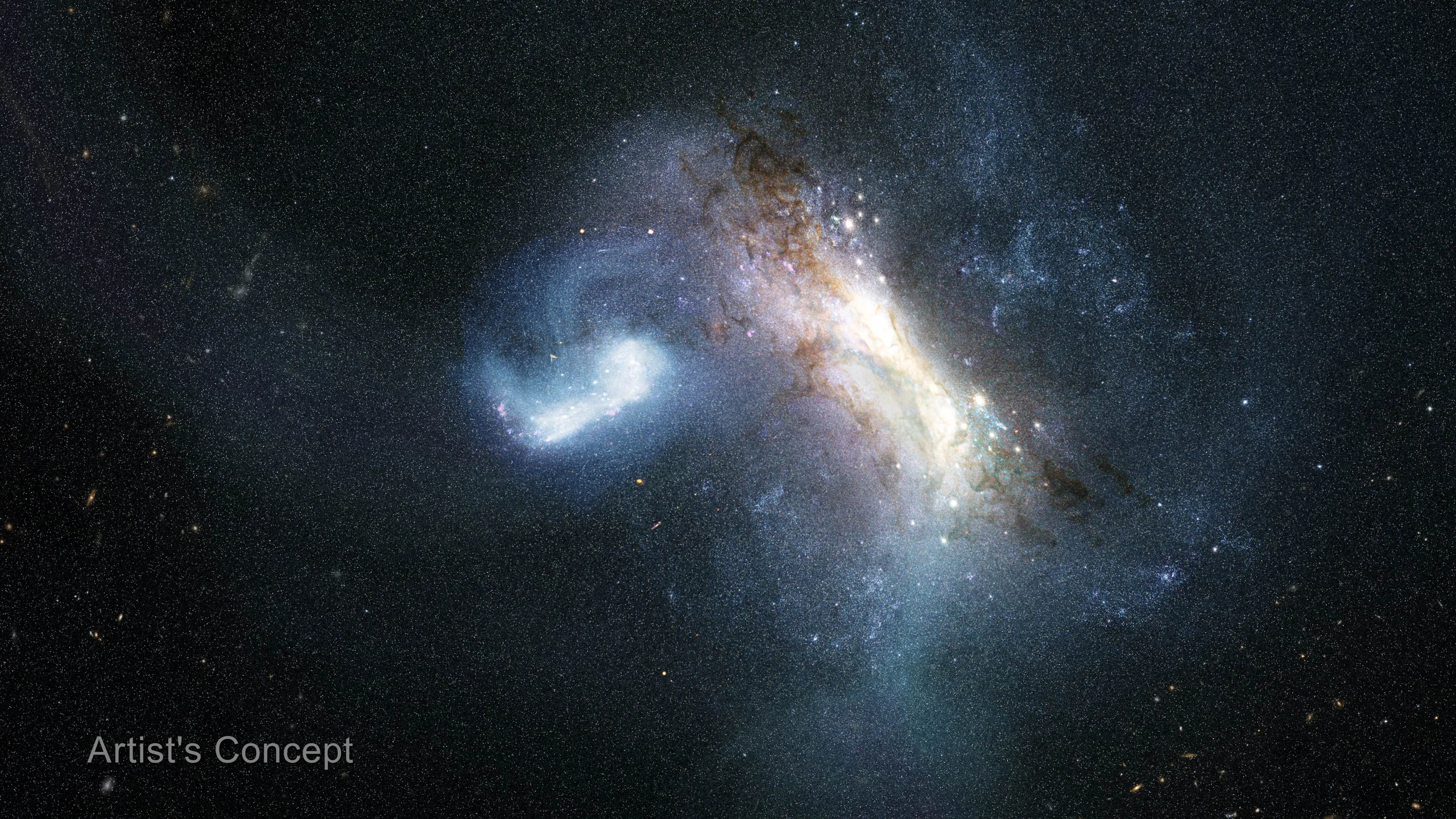
Image: NASA Image of the Day · Image credit: NASA, ESA, Joseph Olmsted (STScI) · Image page
NASA released this picture yesterday. It shows two galaxies colliding. The larger one lies diagonally across the right side, with a white-yellow core wrapped in brown dust lanes and pale blue spiral arms. The smaller blue-white galaxy on the left has already been pulled by gravity into a hook.
Astronomers call that hooked galaxy LKH. About twelve billion years ago, it crashed into the young Milky Way and never came out.
But this story is not really about the collision. It is about how astronomers know it happened.
First, the Picture Itself
Open the original in NASA's image library and you will notice two details that are easily lost as an image travels.
First, the words "Artist's Concept" are printed in the lower-left corner of the picture. They are not merely part of an external caption. They are embedded in the image.
Second, the credit line in NASA's image library reads "Illustration: NASA, ESA, Joseph Olmsted (STScI)." It says Illustration, not Image. By the time the picture reaches the Image of the Day page, the line has been shortened to "Image credit: ..."
The qualifier "Illustration" disappears at the first link in the distribution chain.
That may seem minor, but it demonstrates something larger: information wears away every time it passes from a scientific institution to the public, and qualifiers are often the first things lost.
How is such a picture made? NASA's Jet Propulsion Laboratory has described its process for exoplanet concepts in detail, and the logic is comparable. The people making the art are part of the safeguard. Robert Hurt at IPAC, for example, holds a doctorate in astrophysics; his partner Tim Pyle came from Hollywood visual effects. Their desks sit side by side so each can challenge the other's work. The image is constrained by data. For the TRAPPIST-1 system, the diameter and mass of each planet and its distance from the star all came from observations, allowing the amount of light reaching it to be calculated. Scientists also hold veto power. Hurt's first version of TRAPPIST-1d was rejected because he painted water too far into the planet's dayside.
In their own words:
Tim Pyle: "We're creating plausible illustrations of what it could look like, based on what we know so far."
NASA program scientist Douglas Hudgins: "These are educated guesses."
One qualification is needed. No published NASA or Space Telescope Science Institute rule has been found that specifically prescribes how an artist's concept must be labeled. What can be confirmed is that this image is labeled, NASA maintains a dedicated artist-concept category in its library, and the European Southern Observatory and ESA/Hubble systematically include "(artist's impression)" in titles. That is established practice, not a written regulation.
That settles the picture. Now for the real subject.
How a Galaxy Dead for Twelve Billion Years Left Evidence
The research appeared in Nature Astronomy on August 17, 2026. Its first author is Davide Massari of the Bologna Observatory at Italy's National Institute for Astrophysics. One co-author is especially notable: Amina Helmi, the astronomer who in 2018 discovered the Milky Way's previous major merger, Gaia-Enceladus.
Massari supplied the best opening line in the news release:
"Our home is the Milky Way, but we don't know how this house was built. In this paper, we found where the first important bricks came from: a dwarf galaxy we call LKH."
What can remain of a galaxy that was torn apart and mixed into the Milky Way twelve billion years ago?
Its globular clusters.
The One Thing That Did Not Get Mixed Away
A globular cluster is a dense sphere of hundreds of thousands of stars formed all at once from the same cloud of gas. Bound tightly by its own gravity, it can survive a galaxy's tidal forces for more than ten billion years.
That gives it two abilities no other object possesses in quite the same way.
First, it is an extraordinarily precise clock. Every star in a cluster has the same age and initial chemical composition. Instead of guessing from a single old star, with errors too large to be useful, astronomers can establish an age from the statistics of hundreds of thousands of stars.
Second, it has a good memory. A cluster is massive, from one hundred thousand to one million solar masses. Once accreted, it does not disperse as rapidly as individual stars. Its orbital energy and angular momentum remain approximately conserved over billions of years, so it retains the kinematic signature of the parent galaxy's arrival.
One sentence can summarize the discipline:
Archaeologists excavate things that do not rot: pottery, bones and layers of earth. Galactic archaeologists excavate globular clusters. In a galaxy that has mixed almost everything together, they are the one thing not fully mixed away.
Sven Buder of the Australian National University uses another elegant distinction: observations of distant young galaxies give us snapshots, while galactic archaeology gives us their fossils.
How many globular clusters does the Milky Way contain? The number is still rising. Classic catalogs contain roughly 150 to 170 well-characterized clusters; with candidates still awaiting spectroscopic confirmation, the total may exceed 200.
Three Rulers
How can anyone tell whether a globular cluster formed inside the Milky Way or was swallowed from outside?
The paper uses three rulers. The first underpins all the evidence.
Ruler one: the age-metallicity relation.
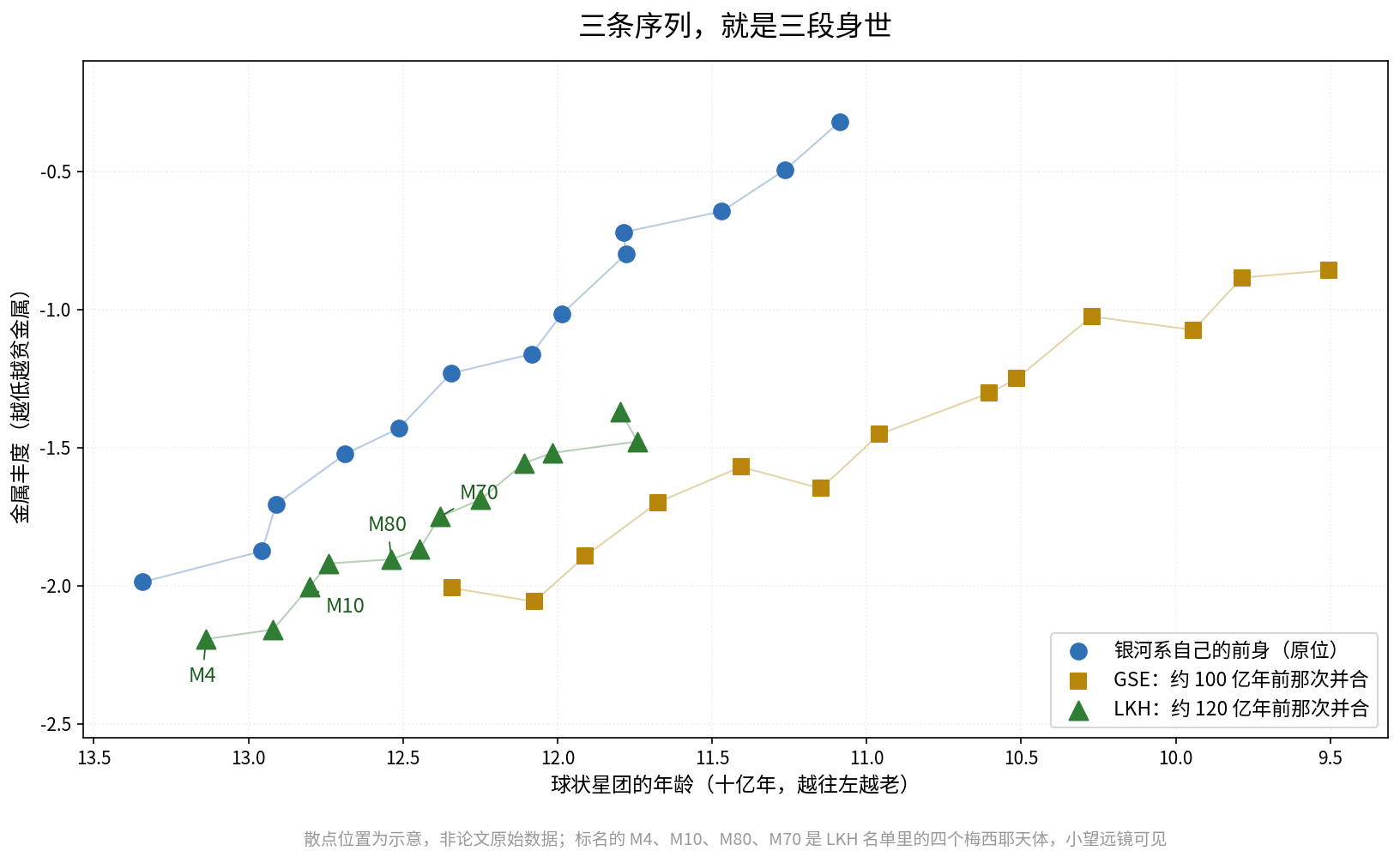
This is the step worth understanding in full. In astronomy, "metals" are all elements heavier than helium, every one made by stars. The rate at which a galaxy enriches itself is its fingerprint. Massive galaxies form stars quickly, produce more supernovae and accumulate metals rapidly, so their clusters trace a steep curve on an age-versus-metallicity plot. Small galaxies evolve chemically more slowly, producing a gentler curve.
Massari's team plotted 39 globular clusters and found that they separated into three distinct sequences:
- 12 clusters formed in situ in the Milky Way.
- 15 belonged to the Gaia-Sausage-Enceladus merger ten billion years ago.
- A third sequence of 12 lay between them and corresponded to an earlier merger.
That third sequence is LKH.
Ruler two: orbits. A technically honest detail deserves attention. The textbook approach is to plot orbital energy against angular momentum, an E-Lz diagram. This paper explicitly discarded energy E because the Milky Way has a rotating bar at its center, and energy is not conserved in that potential. It cannot serve as an integral of motion. The researchers instead used three quantities valid in a rotating reference frame. For every cluster, they integrated 200 possible orbits through a barred Milky Way mass model and averaged them to propagate the uncertainties.
That detail is a lesson in itself. Science is not finished when a formula has been applied. It must first ask whether the quantity in that formula is still valid here.
Ruler three: chemical-abundance patterns. The paper used chemical-evolution models to infer the parent galaxy's mass from the slope of the sequence. Its authors also state plainly that the modeling has "limited constraints for all chemical elements."
What Hubble Did, and What Gaia Did
This division of labor is easy to reverse, so it is worth stating clearly.
Hubble measured ages and metallicities. It took deep, high-resolution images of the clusters to construct color-magnitude diagrams, then fit isochrones to the main-sequence turnoff, the point where stars leave the main sequence and whose position directly indicates age. The team carried out a new, uniform analysis of 17 clusters and combined it with existing results for a total sample of 39, all within 20,000 light-years of the Galactic center. Typical age uncertainties are only a few hundred million years.
Gaia measured distance and proper motion, from which three-dimensional velocities and then orbits could be calculated.
The two telescopes had separate, indispensable jobs. Hubble answered, "How old is this cluster, and how metal-rich?" Gaia answered, "How is it moving?"
To decide whether there were three sequences rather than two or four, the team used Bayesian model comparison. A three-component model was decisively favored over two components and strongly favored over four. The result was calculated, not selected by eye.
The Origin of the Name LKH Is the Best Story in the Paper
LKH is not a newly coined root.
L, K and H are initials drawn from the names or labels in three earlier papers, each of which independently proposed another major merger early in the Milky Way's history.
- L = Low-energy group. In 2019, Massari, Koppelman and Helmi grouped the Milky Way's globular clusters by orbit. One set had low orbital energy and could not be assigned to any known merger, so it received the provisional name "low-energy group."
- K = Kraken. In 2020, Kruijssen and colleagues used simulations to reconstruct the Milky Way's family tree and proposed a merger earlier than Gaia-Enceladus, naming it Kraken.
- H = Heracles. In 2021, Horta and colleagues found stars near the Galactic center that looked chemically foreign and named the proposed source Heracles.
Three teams used three methods and three names. Their proposals did not align, and none convinced the others.
The significance of the new work is that one unified set of measurable evidence identifies those three previously separate candidates as the same real event.
The new name therefore joins the initials of all three old ones.
Astronomers issued an identity card to a galaxy dead for twelve billion years, and its name combines three hypotheses that once argued with one another.
Timeline
First, one numerical discrepancy needs to be acknowledged, because it is instructive in its own right.
The paper dates the event to about 12.3 billion years ago, roughly 1.5 billion years after the birth of the universe and at redshift z greater than 4. NASA and ESA news releases give about 11.8 billion years ago, roughly 2 billion years after the Big Bang. NASA's Image of the Day says "about 12 billion years ago."
The source of the difference can be traced. The two sides adopt slightly different reference ages for Gaia-Enceladus and then subtract the paper's measured interval of 1.8 billion years. "About twelve billion years ago" is therefore the most robust phrasing, and the small discrepancy offers a neat demonstration of how science news gets rounded.
Here is the Milky Way's family history in sequence:
| Event | Time | What it left behind |
|---|---|---|
| LKH | About 12 billion years ago, one to two billion years after the universe began | 12 globular clusters and most of its stars buried within 20,000 light-years of the Galactic center |
| Gaia-Sausage-Enceladus (GSE) | About 10 billion years ago | Most of the inner stellar halo, a dynamically thickened disk and 15 globular clusters |
| Sagittarius dwarf galaxy | Ongoing, after at least a billion years and roughly ten orbits | The Sagittarius Stream across the sky and at least 29 globular clusters |
| Large Magellanic Cloud | Future, in about 2.4 billion years | - |
Two notes on those final rows.
The Sagittarius dwarf galaxy was not discovered until 1994. Its mass is about one ten-thousandth of the Milky Way's. It is expected to cross the Galactic disk again within the next 100 million years and to lose its main body completely within about a billion years. Before our eyes, it is repeating what happened to LKH twelve billion years ago.
The Large Magellanic Cloud will merge with the Milky Way in about 2.4 billion years. A 2019 study estimated that the merger will increase the stellar halo's mass fivefold and the central black hole's mass by as much as eightfold.
There is also an old account many people still remember: the forecast for a Milky Way-Andromeda collision changed in 2025. Hubble's classic 2012 narrative predicted a head-on collision in 4 billion years and one elliptical galaxy after 6 billion. A 2025 paper in Nature Astronomy recalculated the future with 100,000 Monte Carlo simulations and 22 variables. It found only about a 50% chance of any collision in the next 10 billion years, and roughly a 2% chance of a head-on collision in 4 to 5 billion years. One crucial new factor was the Large Magellanic Cloud, whose pull shifts the Milky Way away from its earlier orbital plane and away from Andromeda.
There is a satisfying symmetry here. The more deeply we excavate past mergers, the more certain they become; the more carefully we calculate future mergers, the less certain they become. Astronomy is not a discipline in which everything only grows more definite.
Stars Have Two Kinds of Memory, With Different Shelf Lives
Return to the central point.
A galactic merger does not destroy stars. It scatters them into a slow rain, and every drop carries two factory marks: its chemistry remembers the kind of galaxy in which it formed, while its motion remembers how it was swept in.
But those two memories have different shelf lives.
Chemical memory is nearly permanent. For a star not yet in a late evolutionary stage, the elemental proportions in its atmosphere preserve the gas from which it formed and remain stable for billions of years.
Orbital memory degrades. Dynamical friction, disturbances from spiral arms and the bar, and changes in the gravitational potential slowly erase it. That is exactly why the paper abandoned energy E and used stricter quantities.
The accurate statement is therefore that astronomers must read both memories together to reconstruct a galaxy dead for twelve billion years. Even then, the conclusion is probabilistic. The paper labels each cluster with a "membership probability greater than 50%," not as a certain member.
The authors state two further reservations.
First, they cannot rule out other merger progenitors. Smaller dwarf galaxies that never contained globular clusters, or whose clusters were completely disrupted, are invisible to this method.
Second, the paper says "at least one merger." The intermediate sequence could combine more than one event.
A Collision With Almost No Collisions
One fact about colliding galaxies surprises nearly everyone on first hearing it: their stars almost never actually collide.
Galaxies are simply too empty.
The Sun's nearest neighbor, Proxima Centauri, is 4.24 light-years away. If the Sun were reduced to a grain of sand half a millimeter across, Proxima would be another grain fourteen kilometers away.

Even in the crowded core of a globular cluster, the average distance between two stars is about one-third of a light-year. At the same scale, the two grains would be only a little more than a kilometer apart.
But they would still be two grains of sand. A collision would remain almost impossible.
Gas is different. Interstellar gas clouds are millions of times larger than stars, so they inevitably collide. The clouds crash together, compress and collapse, and a merger ignites intense star formation.
Carme Gallart of the Institute of Astrophysics of the Canary Islands, a participant in the study, emphasized this point. The incoming galaxy's stars did not merely become part of us. The impact of the merger changed the Milky Way's structure and may even have triggered new star formation within it.
This was therefore a collision with almost no impacts. Stars passed through one another without touching, but the gas between them crashed together and lit new stars in the wreckage. The merger killed one galaxy and created a new generation of stars.
More Than Half the Milky Way's Halo Is Immigrant
The data in this section come from China.
In 2022, doctoral student Wu Wenbo and colleagues Zhao Gang and Xue Xiangxiang at the National Astronomical Observatories of the Chinese Academy of Sciences combined data from the Large Sky Area Multi-Object Fiber Spectroscopic Telescope (LAMOST) with cosmological simulations. Their paper in The Astronomical Journal found that the Gaia-Enceladus merger about eleven billion years ago substantially reshaped the stellar halo, giving it an onion-like structure flattened inside and round outside; more than half of the halo's stars came from the swallowed galaxy.
In other words, the Milky Way's halo did not grow entirely at home. More than half its residents are immigrants.
LAMOST occupies a more important place in this field than many people realize. Data Release 13, issued in March 2026, brought its cumulative total to 30.82 million spectra, the first survey release in the world to pass 30 million and the largest international total. Its catalog contained stellar atmospheric parameters for 12.94 million spectra. More than 1,900 users from 278 institutions had produced over 2,200 related high-level papers.
Beyond the halo's structure, two results belong naturally beside this story.
First, immigrant stars brought recipes as well as population. In May 2025, an international collaboration led by National Astronomical Observatories doctoral student Lin Yangming and adviser Li Haining reported in The Astrophysical Journal Letters the first actinide-enhanced star found in the accreted debris of Gaia-Enceladus, LAMOST J0804+5740, for which abundances of 48 elements were measured. The discovery indicates that magnetorotationally driven jet supernovae may also produce actinides, challenging the conventional view that binary neutron-star mergers are their only source. The research also found that roughly two-thirds of actinide-enhanced stars tend to have accreted origins. Dwarf galaxies swallowed by the Milky Way may be an important source of such stars.
Second, one star's chemical recipe revealed a giant that died at cosmic dawn. In June 2023, Xing Qianfan and Zhao Gang of the same observatory published a result in Nature. They screened five million LAMOST spectra for 5,000 candidates and ultimately identified LAMOST J1010+2358. Its chemical abundances closely matched theoretical calculations for a pair-instability supernova from a star 260 times the Sun's mass. It was the first observational confirmation that first-generation stars could reach hundreds of solar masses.
One conclusion often gets reversed: LAMOST research on the Galactic disk's warp did not find that a dwarf galaxy pulled it into shape. A 2020 paper in The Astrophysical Journal, using tens of millions of LAMOST spectra, found that the warp's amplitude decreases steadily with increasing stellar-population age and pointed with high confidence to a non-gravitational origin.
Looking ahead, the China Space Station Telescope (CSST) will have a 2-meter aperture, Hubble-class resolution and about 300 times Hubble's field of view. Its launch is planned for as early as the beginning of 2027, after several previous schedule changes. The method used here depends entirely on high-resolution, deep color-magnitude diagrams. CSST appears ideal for imaging a whole cluster at once while covering a large area of sky. That can only be described as reason for expectation, however, because no official document has been found that explicitly lists globular-cluster dating as one of its science goals.
Europe's Gaia mission, meanwhile, will release its fourth data set on December 2, 2026. Four months from now, the LKH conclusion will face an entirely new body of data.
The Part That Needs No Equipment
On an August evening around eight or nine, from a place without too much light pollution, look low toward the southeast. The Milky Way's broadest, brightest stretch rises from Sagittarius in the direction of the Galactic center.
All 12 LKH clusters in this study lie within 20,000 light-years of the Galactic center.
The brightest and most familiar-looking part of the Milky Way is therefore the place where the merger twelve billion years ago lies buried most deeply.
More specifically, find the "Teapot" in Sagittarius, six stars low in the southern sky. About two and a half degrees east and upward from the star at the top of its lid lies M22. Use averted vision rather than staring directly, and hold your gaze there for thirty seconds. Under a truly dark sky, you will see a small unresolved blur that does not look like a pointlike star.
It contains one hundred thousand stars. Every one is three times older than Earth.
Finally
Return to the illustration.
It is an educated guess depicting something no one witnessed and for which no photograph will ever exist. Behind it stand 39 globular clusters, 17 sets of deep Hubble images, a carefully tested orbital model and three papers that once disagreed with one another.
We do not have a photograph of the collision. We have a few dozen witnesses that survived it and are still flying through the sky.
And with a pair of binoculars costing a few hundred yuan, you can see two of them tonight.
Sources: NASA Image of the Day, "Ancient Milky Way Merger"; NASA science news release dated August 17, 2026; ESA/Hubble heic2611; Massari et al. (2026), Nature Astronomy (arXiv:2601.18896); Massari, Koppelman and Helmi (2019), Astronomy & Astrophysics; Kruijssen et al. (2020), Monthly Notices of the Royal Astronomical Society; Helmi et al. (2018), Nature; Belokurov et al. (2018), MNRAS; Sawala et al. (2025), Nature Astronomy; Cautun et al. (2019), MNRAS; the Harris catalog of globular clusters; NASA's Messier observing guide; the Institute of Astrophysics of the Canary Islands; NASA Jet Propulsion Laboratory's "The Art of Exoplanets"; the National Astronomical Observatories of the Chinese Academy of Sciences and LAMOST, including Wu Wenbo et al. (2022), AJ, Xing Qianfan et al. (2023), Nature, Lin Yangming et al. (2025), ApJL, and Wang Haifeng et al. (2020), ApJ; and the National Astronomical Data Center.