
The direction of a gas cloud's tail tells astronomers where the culprit is standing. It is one of the most useful windsocks in the universe.
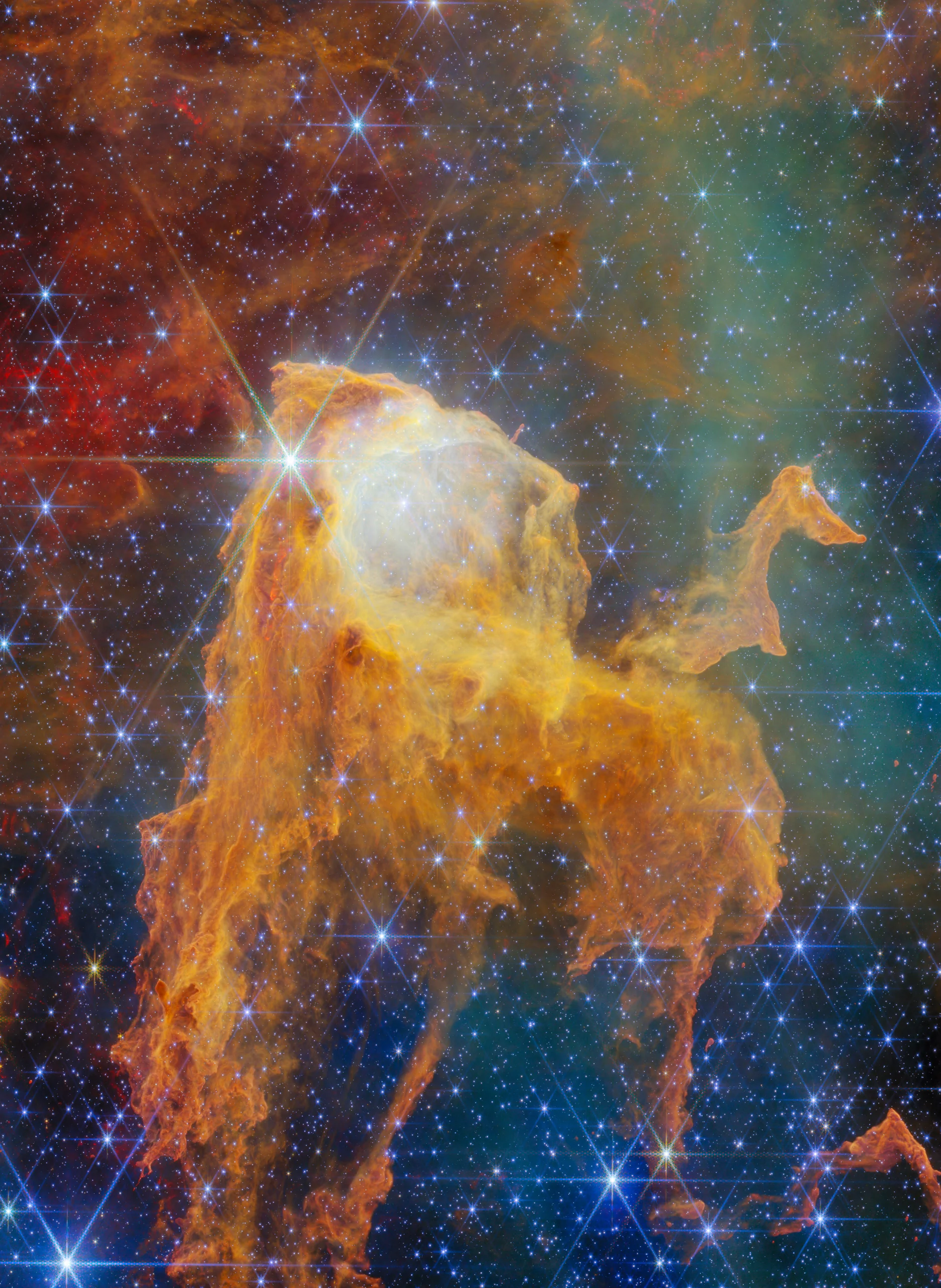
Image: NASA Image of the Day | Image credit: ESA/Webb, NASA & CSA, M. Reiter; Acknowledgement: M. H. Özsaraç | Image page
NASA Image of the Day updates only on US working days, so over a weekend the page continues to show Friday's selection. This is that Friday image: on August 21, 2026, NASA chose a cloud of gas that looks like a chest pried open.
It is called the Treasure Chest. NASA did not invent the name, and it did not appear in 2026. It is twenty-one years old. We will come to who coined it, and why the name is both apt and a little cruel. One point needs clearing up first: the European Space Agency's Webb team originally released this photograph on August 6 as its Image of the Month. NASA selected the same image for Image of the Day two weeks later. Both dates are correct.
What Is in the Picture
NASA's image page dates this infrared view to August 6, 2026, the day ESA/Webb published it. It shows a small part of the Carina Nebula, also home to the famous Cosmic Cliffs. The structure in the center is a cometary globule, an isolated cloud of gas and dust with a dense, dark head and a long tail swept to one side.
ESA/Webb's official image page gives the shape a more specific metaphor: a wooden chest with its lid open, its little cluster of young stars scattered like jewels inside. The agency says the cluster has about 70 members. The most massive is a rare O-type star about 19 times the mass of the Sun.
How far away is it? Here we meet the first discrepancy that needs to be acknowledged. ESA/Webb gives 7,500 light-years. The proposal for the Webb program that took this image uses 2.3 kiloparsecs, also 7,500 light-years, and the 2005 discovery paper adopted the same value. Those figures agree and come from the observing team. But Wikipedia's Carina Nebula entry gives 2,600 parsecs, or about 8,500 light-years, while ESA/Webb's 2022 release of the Cosmic Cliffs placed NGC 3324 in the same nebula at 7,600 light-years. Distances of several thousand light-years within the Milky Way naturally carry uncertainties of roughly ten percent. This article follows the observing team's value: 7,500 light-years.
As for size, the 2005 paper measured the blown-open cavity at the cluster's center as about 25 arcseconds in radius, corresponding to 0.3 parsecs, or roughly one light-year. A 2019 study put the mass of the entire globule at about 1,000 Suns.
One common misunderstanding needs to be stopped here: a cometary globule contains no comet and has nothing to do with comets. The name refers only to the outline, a head with a tail. This is a cloud measured in light-years; a comet is a lump of dirty ice measured in kilometers. Shape is their only similarity.
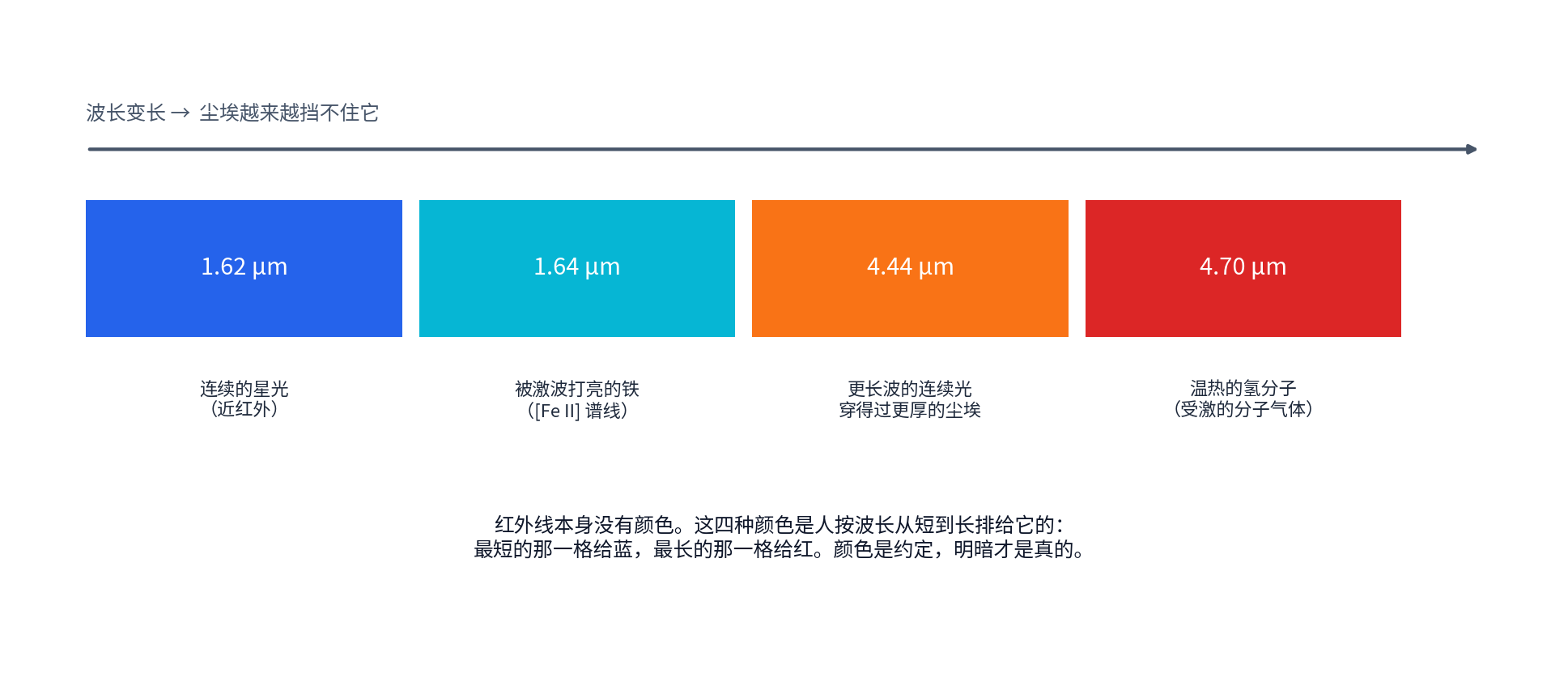
Another point: the colors in the photograph are not colors human eyes could see. Infrared light has no visible color, so people assign colors to it. This image uses four filters on Webb's Near-Infrared Camera, or NIRCam. ESA/Webb specifies the mapping: 1.62 µm is blue, 1.64 µm is cyan, 4.44 µm is orange, and 4.7 µm is red. The order is clear: the shortest wavelength gets blue, the longest red, with the others arranged between them. ESA/Webb's image-processing guide calls this "representative colour." The colors are conventions; the variations in brightness are real.
A Tail Is a Windsock
Now for the most memorable thing in the image.
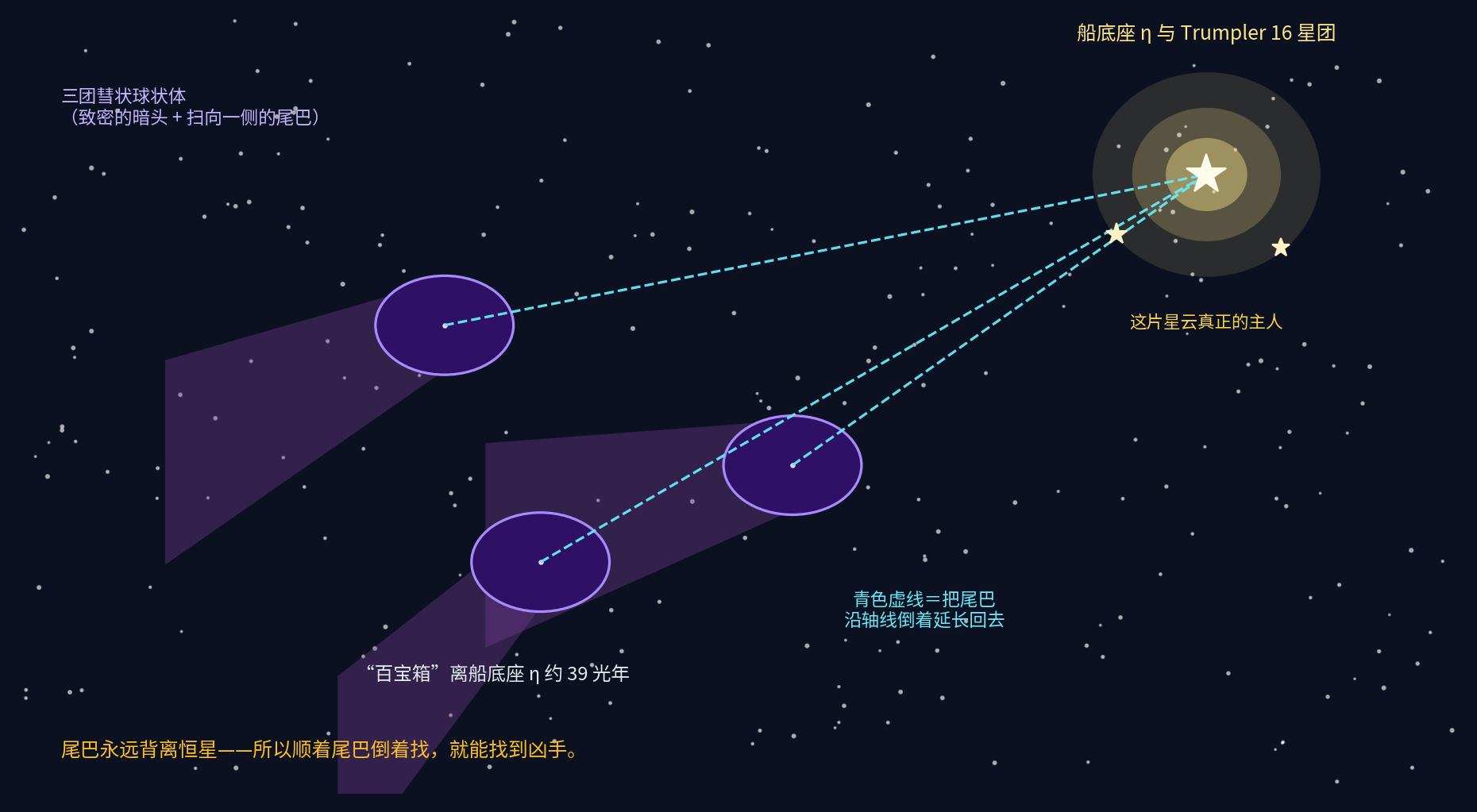
Why does a cloud grow a dense head and a tail swept behind it? Because a nearby massive star, or group of stars, is using ultraviolet light to boil away the cloud's surface. UV photons strike the upwind face, heating and ionizing the gas. The gas expands and escapes; stellar winds carry the stripped material downstream into a long tail. The cloud's densest and toughest knot holds out as the head. What is blown away forms the tail.
The tail therefore always points away from the star.
That rule has an elegant use. In the Carina Nebula, extend any tail backward and the lines converge on the same place. Mookerjea and colleagues described the region in just these terms in their 2019 Astronomy & Astrophysics study: all three tails point away from Eta Carinae and the O stars of the Trumpler 16 cluster. The 2005 paper that discovered the Treasure Chest was blunter still. The eastern edge of its dust pillar is uncannily straight and points directly back toward Eta Carinae and Trumpler 16.
These are not isolated examples. In 2015, P. Hartigan, Wright, Smith, and Bally surveyed more than a square degree of Carina, selecting 61 interesting regions and examining their pillars, globules, and jets one by one. They concluded that the pillars and ripples all form on the sides facing the central ionizing stars. They also added an honest qualification: the region contains so many O stars that assigning any one pillar to a unique culprit is difficult.
One windsock tells you where the wind came from. A sky full of them can reveal where the source lies, how strong it is, and how long it has blown. That is why astronomers become excited by a cloud with a tail. It is not a still life; it is a record of the scene.
Why Infrared Is Essential
The cloud's head is dark because dust blocks visible light.
The Treasure Chest turns that fact into a striking number. The 2005 paper measured up to 50 magnitudes of visible-light extinction for some cluster members. What does 50 magnitudes mean? By definition, each 5 magnitudes is a factor of 100 in brightness, so 50 magnitudes is 10^20, or a hundred quintillion. In visible light, dust would reduce a star's light reaching us to one hundred-quintillionth of its original brightness. No telescope could see it.
What happens in infrared? Using the widely adopted 1985 interstellar-extinction law of Rieke and Lebofsky, the same dust dims light at 1.65 µm by only about 3,200 times, at 2.2 µm by about 170 times, and at 4.8 µm by less than three times. The dust and star are unchanged; changing the wavelength turns "impossible" into "plainly visible."
That is Webb's task here. Hubble sees the cloud's surface. Webb sees inside.
The four filters do more than make a striking image. Two are narrowband filters centered on particular spectral lines. At 1.64 µm, ionized iron ([Fe II]) marks gas brightened by shocks, where high-speed jets from young stars crash into the cloud. At 4.7 µm, molecular hydrogen marks warm molecular gas. Together, the two lines map where jets are active and where intact molecular cloud remains. That is what astronomers read in this picture.
Who Named It the Treasure Chest?
In late 2004, Nathan Smith, Keivan Stassun, and John Bally submitted a paper titled "Opening the Treasure Chest: A Newborn Star Cluster Emerges from a Dust Pillar in the Carina Nebula." They coined the name and explained why: the cloud resembled an open chest with treasure sparkling inside. They even joked that it was a sight one might expect in a shipwreck on the ocean floor.
The numbers in that paper still carry weight twenty-one years later.
They counted at least 69 stars within the cluster. The words "at least" matter: 69 was the limit of what their equipment could detect, not a complete census. ESA/Webb's present figure of "about 70" is really the same lower bound.
The most massive member is CPD -59°2661, a spectral type O9.5 V star. Here too the sources differ. ESA/Webb says it is "about 19 times the mass of the Sun," while the standard 2005 calibration of Galactic O stars by Martins, Schaerer, and Hillier assigns an O9.5 V star a spectroscopic mass of 15.6 Suns. Neither value is necessarily wrong. Stellar masses can be derived in several ways, and spectroscopic and evolutionary methods commonly differ by more than ten percent. The dedicated calibration paper is the more rigorous source, but ESA's number lies within a reasonable range.
Whichever mass is used, the star is extraordinary. The same calibration gives an O9.5 V star about 48,000 times the Sun's luminosity. A rough main-sequence mass-luminosity relation says luminosity scales with mass to the 3.5 power. Insert 19 solar masses and the result is around 30,000 solar luminosities, somewhat below the calibrated value but in the same range. The relation captures the essential point. Luminosity grows much faster than mass, so fuel burns much faster too. Using the same exponent gives a main-sequence lifetime of roughly 6.4 million years, less than one-thousandth of the Sun's ten-billion-year life.
One more number shows how fierce it is. That calibration puts the ionizing-photon output of an O9.5 V star at about 7.6 × 10^47 per second. Every one of those ultraviolet photons has enough energy to knock an electron from a hydrogen atom. The star does this every second.
How rare are O stars? Estimates put the total in the entire Milky Way below 20,000, among several hundred billion stars. Finding one born inside a cloud only two light-years across is unusual.
Its location is more interesting still. The 2005 paper says CPD -59°2661 and the compact ionized-hydrogen region around it are breaking out of the dust pillar. The cloud is under attack from both sides: Eta Carinae and Trumpler 16 erode its surface with ultraviolet light, while the O star it has just formed pushes outward from within. Those two forces together made the open-lidded chest.
The cluster's age is the second major discrepancy. The 2005 paper estimated less than 100,000 years and gave the expanding cavity a dynamical age of only tens of thousands of years, essentially newborn. Oliveira and colleagues estimated 1.3 million years in 2018. ESA/Webb uses the latter figure while candidly noting the earlier estimate of "as young as 100,000 years." The values differ by more than a factor of ten. That does not mean someone simply made a mistake. Dating a cluster still buried in dust, with a different extinction for every star, is among astronomy's hardest tasks.
Creation and Destruction in the Same Frame
Now for the cloud's most unsettling feature.
The 2005 paper found that two-thirds of the Treasure Chest's members showed strong infrared excess, a sign of dusty disks around the stars. Including longer-wavelength data might raise the fraction to nearly 90 percent, the paper said, possibly one of the highest disk fractions then known in a young cluster.
Dusty disks are the raw material for planets. Two-thirds of the stars still having their building supplies should be excellent news.
The problem is that the ultraviolet light carving the cloud into this beautiful shape is the same light falling on those disks.
Winter and Haworth's 2022 review in the European Physical Journal Plus addresses this problem directly. In the Orion Nebula, it notes, the brightest proplyds, planet-forming disks ablated by external UV light, lose mass at rates as high as 10^-6 solar masses per year. Material typically accretes inward onto their stars at only 10^-8 solar masses per year. The disks lose material a hundred times faster than they retain it. The authors also stress an easily missed point: most stars form in clusters that contain massive OB stars. Astronomers' preference for observing quiet, nearby, low-mass star-forming regions created the impression that planet formation is usually gentle. In their words, understanding external photoevaporation is essential to understanding how "the majority of planets form."
Consider the arithmetic. A typical protoplanetary disk of 0.01 solar masses, about ten Jupiter masses, would disappear in 10,000 years if stripped at 10^-6 solar masses per year. Even at the gentler rate of 10^-7, it would last only 100,000 years.
How long do planets need? Core-accretion calculations by Benvenuto, Fortier, and Brunini in 2009 produced formation times of about 440,000 years for Jupiter, 1.4 million for Saturn, 2.5 million for Neptune, and 4.75 million for Uranus.
Place the two sets of numbers together and the real weight of this image appears: outer planets need millions of years to grow, while a disk under strong ultraviolet radiation may have only tens of thousands. This does not prove that no planets can form in the Treasure Chest. Inner, dense disks still sheltered by cloud material may survive. Those already exposed probably do not have time.
The boundary of the claim matters, because some recent reports have gone beyond the evidence. This Webb image is an ESA/Webb Image of the Month, not an illustration for a new paper. It records the cluster, tail, and jets; the official text says that many members have circumstellar disks. It does not say Webb measured those disks being erased. The calculation above assembles a picture from decades of observation and theory, each part with a source. It is not a new conclusion announced by this photograph alone.
Another episode shows science correcting itself. In 2003, Smith, Bally, and Morse reported a set of proplyd candidates in Hubble images of the Carina Nebula. Eleven years later, Grenman and Gahm published a survey specifically seeking tiny globulettes. They counted nearly 300 around Carina, most with radii below 1,000 astronomical units and masses below one Jupiter. By their definition, they argued, most of the 2003 "proplyd candidates" were globulettes, not ablated planetary disks. Numerical simulations give those globulettes lifetimes of about 10,000 years.
Ten thousand years is nearly "disappearing now" for a cloud. It also corrects another common misconception: nebulae are not scenery, and they do not stand still. These structures have measurable lifetimes, and they are using them up.
One more misconception about density has an unexpectedly interesting answer. Mookerjea and colleagues measured about 10^4 particles per cubic centimeter in the globule's diffuse component in 2019, and between 200,000 and 800,000 in its dense component. That sounds substantial. Air at sea level contains about 2.5 × 10^19 molecules per cubic centimeter, so even the densest part of the cloud is roughly thirty trillion times thinner than the air you are breathing. But do not reverse the comparison at the other extreme. An ultrahigh-vacuum chamber at 10^-10 pascals still holds about 24,000 molecules per cubic centimeter, making the cloud's dense core ten to thirty times "thicker" than a very good vacuum chamber. The whole globule contains about 1,000 solar masses. Something thirty trillion times thinner than air has accumulated the mass of a thousand Suns. Cosmic arithmetic is deeply counterintuitive.
What the Monsters Look Like
What stands at the end when the windsock is traced backward?
ESA/Webb says Eta Carinae lies 39 light-years northwest of the Treasure Chest. It is the brightest object in the Carina Nebula, a system containing at least two stars, one of them about a hundred times the mass of the Sun. The 2019 paper gives the projected distance another way, as 12 parsecs, which converts to the same 39 light-years. The sources agree. On another side lies the Trumpler 16 cluster, home to several more extremely hot, massive stars.
Human observers witnessed one chapter of Eta Carinae's history. During the first half of the 19th century it underwent the astronomical event called the Great Eruption. It began brightening around 1837 and peaked in April 1843 at roughly magnitude -0.8 to -1, with sources differing slightly. For a time it was the second-brightest star in the night sky, surpassed only by Sirius, despite lying nearly a thousand times farther away. It then faded, dropping below naked-eye visibility by the 1860s. Material expelled in that eruption now forms the Homunculus Nebula around it and travels at about 700 kilometers per second. Estimates of the mass expelled range from two or three Suns to more than ten, with no consensus.
A star sneezed in the 19th century, and people recorded it. The quieter thing it does every day, shaving away every cloud within tens of light-years with ultraviolet light, became visible only after infrared telescopes arrived.
What Webb Has Learned in Carina
This Treasure Chest is not Webb's first visit to the region.
On July 12, 2022, Webb released its first official images. One showed the Cosmic Cliffs along the edge of NGC 3324 in the Carina Nebula. It became one of Webb's signature views: a wall of gas cut by ultraviolet light and stellar winds from massive stars, with the highest "peaks" about 58 light-years tall.
Then came the scientific results. In a 2022 paper, Megan Reiter and colleagues used the Cosmic Cliffs data to identify 24 previously unknown outflows in NGC 3324, most recognized through molecular-hydrogen emission. They also identified seven new Herbig-Haro objects and confirmed every jet known from the Hubble era. Using the sixteen-year baseline between Hubble observations in 2006 and Webb in 2022, they measured the jets' proper motions. These jets visibly change within a human lifetime.
The image of the Treasure Chest comes from Webb Cycle 3 program 5408, led by Reiter and titled "Diving Deeper: Revealing the Full Population of Accretion and Outflows in the Heart of the Carina Nebula." Its proposal states the ambition plainly. Extrapolating from NGC 3324, the team expects to find about 400 previously unknown jets across Carina. It uses the F164N narrowband filter for [Fe II] and F470N for molecular hydrogen, plus broadband images to subtract the continuum. The proposal also explains why Carina was chosen: at 2.3 kiloparsecs, it is the nearest massive star-forming region with a fully sampled stellar mass distribution. This is the first observing epoch, establishing a baseline for later time-series work.
Every strand of cyan and red in this photograph is therefore a candidate for that list of 400.
China Is Counting the Other Half of the Milky Way
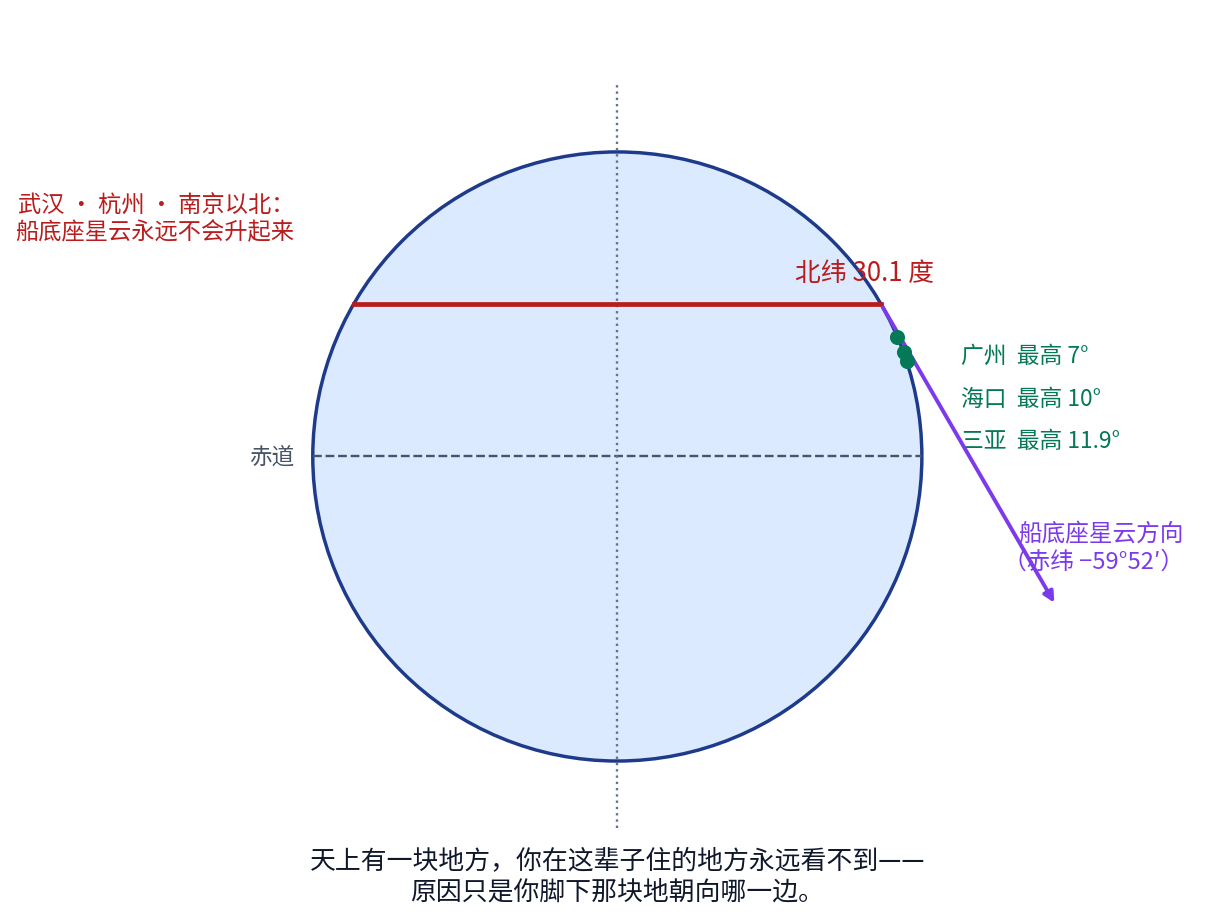
The Carina Nebula lies at a declination of -59°52', so it never rises north of latitude 30.1° north. Even from Sanya, it reaches an altitude of less than 12°. Most of China cannot see it. But China has a telescope dedicated to counting this image's central subject: molecular clouds, the raw material of stars.
Purple Mountain Observatory operates a 13.7-meter millimeter-wave radio telescope at Delingha in Qinghai. Since 2011, it has conducted the Milky Way Imaging Scroll Painting survey, or MWISP, detecting millimeter-wave emission from interstellar carbon monoxide and its isotopologues: the J=1-0 transitions of 12CO, 13CO, and C18O. The survey covers Galactic longitudes from 10° to 230°, Galactic latitudes of plus or minus 5.25°, and 2,310 square degrees around the northern Galactic plane. On December 11, 2025, the project released its first data globally. According to an August 4, 2026, China News Service report on results from Purple Mountain Observatory, the data had already identified more than 104,000 interstellar molecular clouds and cataloged 149 supernova remnants, more than 80 percent closely associated with molecular clouds.
Why does carbon monoxide matter? Molecular clouds consist mainly of molecular hydrogen, but cold molecular hydrogen emits almost no spectral lines and is effectively invisible. Carbon monoxide mixed into the cloud produces easy-to-detect millimeter emission, acting as a tracer that speaks for the hydrogen. To learn where the Milky Way keeps the raw material for stars, how much exists, and how it moves, astronomers count carbon monoxide.
The boundary must be drawn carefully because claims that "China has this too" are often pushed too far. The Treasure Chest lies at Galactic longitude 287.8°, outside MWISP's first-stage coverage from 10° to 230°. That is not a failure of the telescope. From Delingha in the Northern Hemisphere, this part of the sky never rises. MWISP is doing the same job on the other half: counting clouds of stellar material one by one across the portion of the Milky Way visible from China.
One frequently misapplied instrument is worth mentioning. FAST, the Five-hundred-meter Aperture Spherical radio Telescope in Guizhou, operates from 70 MHz to 3.0 GHz. It can do many things in that range, including study the 21-centimeter line of neutral hydrogen, pulsars, and fast radio bursts. But the J=1-0 line of carbon monoxide is at 115 GHz, far beyond FAST's band. FAST cannot see this line. That is division of labor, not a defect. Molecular-cloud carbon monoxide requires a millimeter-wave telescope; atomic hydrogen and pulsars call for FAST. Different wavelengths need different instruments, a point that has already appeared three times in this story: visible light cannot penetrate dust, but infrared can; ultraviolet light destroys planetary disks, but infrared reveals the destruction; carbon monoxide requires millimeter waves, while neutral hydrogen requires centimeter waves.
Sources: NASA Image of the Day, "Webb Opens Treasure Chest"; ESA/Webb Image of the Month potm2607a and ESA/Webb's image-processing guide; STScI Webb Cycle 3 proposal 5408, PI Megan Reiter of Rice University; Smith, Stassun, and Bally, "Opening the Treasure Chest: A Newborn Star Cluster Emerges from a Dust Pillar in the Carina Nebula" (2005); Mookerjea et al., "Opening the Treasure Chest in Carina," Astronomy & Astrophysics (2019); Reiter et al., "Deep Diving off the 'Cosmic Cliffs,'" Monthly Notices of the Royal Astronomical Society (2022); Hartigan, Wright, Smith, and Bally, "A Survey of Irradiated Pillars, Globules, and Jets in the Carina Nebula," The Astronomical Journal 149, 101 (2015); Grenman and Gahm on tiny globulettes in the Carina Nebula, Astronomy & Astrophysics (2014); Smith, Bally, and Morse, "Numerous Proplyd Candidates in the Harsh Environment of the Carina Nebula," The Astrophysical Journal 587 (2003); Winter and Haworth, "The External Photoevaporation of Planet-Forming Discs," European Physical Journal Plus (2022); Martins, Schaerer, and Hillier, "A New Calibration of Stellar Parameters of Galactic O Stars," Astronomy & Astrophysics 436 (2005); Benvenuto, Fortier, and Brunini on core-accretion calculations for the four giant planets (2009); the Rieke and Lebofsky interstellar-extinction law (1985); ESA/Webb's July 12, 2022, Cosmic Cliffs release weic2205; AAVSO and Constellation Guide material on the light history of Eta Carinae; Wikipedia entries on the Carina Nebula, Eagle Nebula, cometary globules, O-type main-sequence stars, and FAST; Purple Mountain Observatory's announcement of the first MWISP data release on December 11, 2025, and a ScienceNet report; China News Service's August 4, 2026, report on MWISP and ultrahigh-energy cosmic rays; and Messier Objects observing information for M16.