
Three telescopes, ten years of exposure, and a pot on a stove.
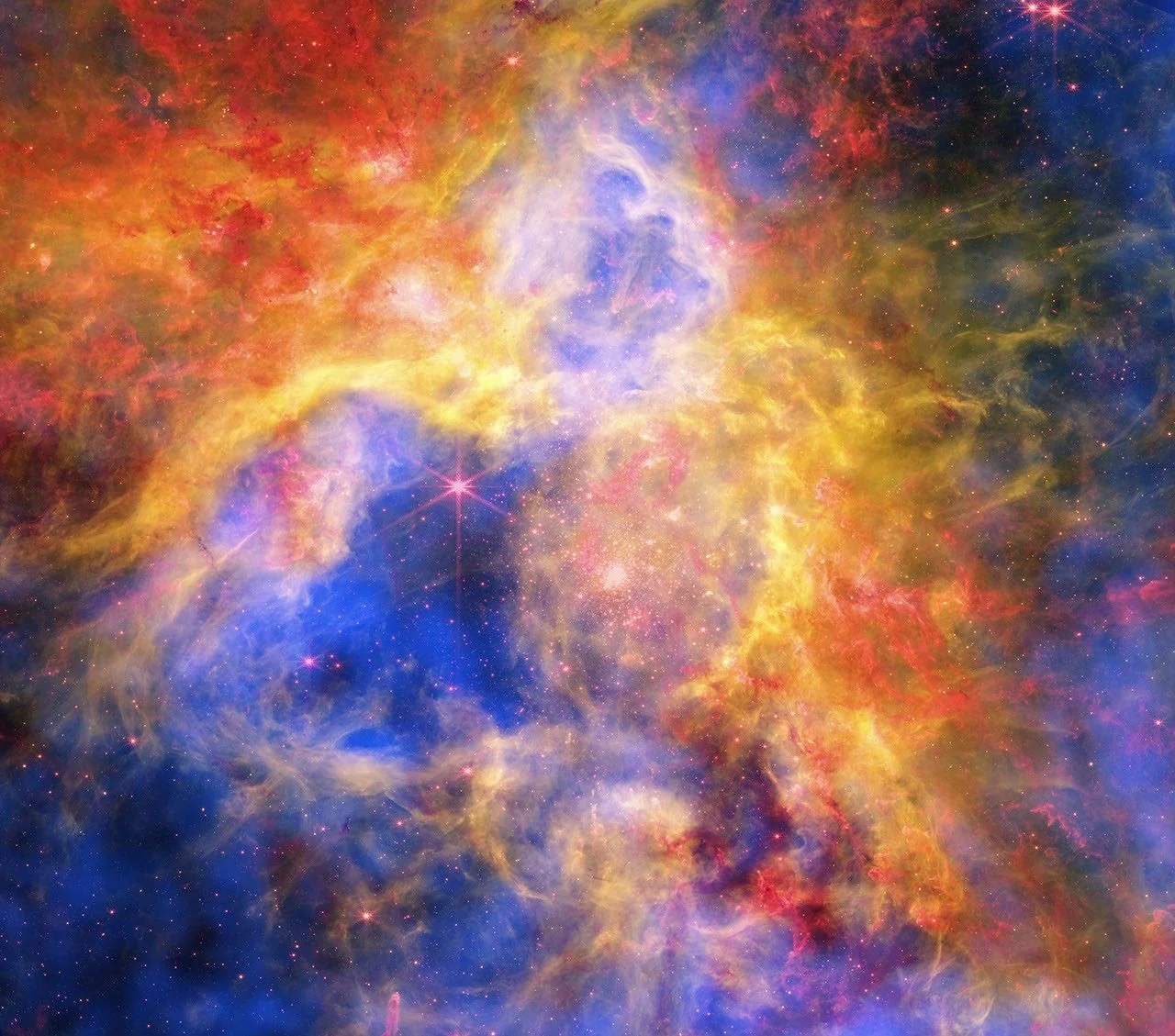
Image: NASA Image of the Day | Image credit: X-ray: NASA/CXC/Ohio State Univ./J. Rodriguez et al; Infrared: NASA/ESA/CSA/STScI; Optical: NASA/ESA/STScI; Image Processing: NASA/CXC/SAO/P. Edmonds | Image page
NASA's own comparison for this image is a collage assembled from layer upon layer of colored cellophane.
Blue, green, and red overlap at the center to make orange, gold, and deep purple. You might assume those colors were added in editing. In a sense, they were, but not for decoration. Each color represents a different kind of light, and each kind of light corresponds to a different temperature.
This cloud is the Tarantula Nebula, also known as 30 Doradus. It lies in the Large Magellanic Cloud, about 160,000 light-years away.
Three Colors, Three Temperatures, Three Depths
First, here is how to read the image.
Blue comes from the Chandra X-ray Observatory. It shows gas blown from the surfaces of young, massive stars and heated by shock waves to millions of degrees. NASA's news release offers a useful analogy: the shocks resemble the sonic booms made by supersonic aircraft.
Green comes from Hubble's visible-light observations, specifically the hydrogen-alpha line. It traces warm hydrogen curling through the image in wisps and sheets, while also revealing individual stars.
Red comes from the Webb telescope's infrared view. It shows cool dust, the raw material that will one day make new stars and planets. The tiny bright points among the red are thousands of young stars.
Why separate the scene into three layers? Because the kind of light an object emits depends mainly on its temperature. NASA's educational materials lay out the relationship clearly: gamma rays come from temperatures above 100 million degrees, X-rays correspond to 1 million to 100 million degrees, visible light to several thousand through 10,000 degrees, and infrared to 10 through 1,000 degrees, the realm of cool dust and gas clouds.
The three filters are therefore also three depths. The blue layer is the hottest cavity, blown open by stellar winds. The green layer is the illuminated, ionized wall of gas. The red layer is the coldest and thickest nursery, still undisturbed. Look with only one kind of eye and most of the scene vanishes. When Webb first examined this region in infrared in 2022, it revealed tens of thousands of young stars that dust had hidden and no one had seen before.

The Steam Is Escaping Around the Lid
This image is more than beautiful. Behind it is a paper published this year in The Astrophysical Journal, "Taming the Tarantula: How Stellar Wind Feedback Shapes the Gas and Dust in 30 Doradus," led by Jennifer Rodriguez of Ohio State University.
The paper addresses a long-standing imbalance in the books.
Massive stars drive fierce stellar winds that clear away surrounding gas. The displaced gas heats up and emits X-rays. In theory, astronomers can use the brightness and mass of those stars to calculate how luminous the hot gas should be. But the observed X-rays have always been much fainter than classical stellar-wind models predict. NASA frames the question neatly: Where has the energy gone, and what has tamed the Tarantula Nebula?
The new research identifies three escape routes.
The first is leakage. As much as half of the hot gas is slipping through gaps in the shell of gas and dust and escaping the nebula. The observational clue is that the peak X-ray brightness lies inside the hydrogen shell: the hot gas is only partly contained.
The second is mixing. Cool and hot gas churn together at the shell's boundary, reducing the overall temperature.
The third is conduction. Heat simply flows away. NASA provides the paper's best first step into the idea: like a pan sitting on a stove, the hot and cool material eventually tend toward the same temperature.
Gas millions of degrees hot, 160,000 light-years away, obeys the same thermodynamics as a pan on your stove. The conclusion of a paper by eight astrophysicists can be explained with one piece of cookware.
This Blue Took Ten Years, 54 Visits, and 571 Hours
One detail is easy to miss.
The blue layer was not captured in a single photograph. Chandra observed the same patch of sky 54 times from January 2006 to January 2016, accumulating 571 hours of exposure, or 23 days, 19 hours, and 56 minutes. The image spans about 470 light-years.
The view before you took a decade to assemble.
A Nursery Mass-Producing Extremes
The region merits that attention. It is the largest, brightest, and most active star-forming region in the Local Group, with a total mass of roughly 1 million Suns. The name "Tarantula" came from the dusty filaments seen through early telescopes. Webb's view prompted NASA to offer a better comparison: a burrowing tarantula's den, lined with silk.
At the nebula's center lies the young cluster R136. No more than 2 million years old, it produces the energy that illuminates the entire cloud. R136 contains R136a1, the most massive star known.
The story of its mass is especially good. In 2010, the European Southern Observatory announced that R136a1 had a current mass of about 265 Suns, may have been born at up to 320 solar masses, and shone with nearly 10 million times the Sun's luminosity. Lead researcher Paul Crowther offered a memorable line: unlike humans, these stars are born heavy and lose weight as they age. In 2022, a NOIRLab team used speckle imaging from the Gemini South telescope, combining 40,000 exposures of 60 milliseconds each, and revised the estimate down to 170 to 230 solar masses. Researcher Venu Kalari put it plainly: the most massive star we currently know is not as massive as we once thought.
That is not science failing. It is science working. A number corrected after 12 years by a sharper instrument is better than one copied forever.
These giants share a fate: the greater their mass, the shorter their lives. A star's luminosity increases approximately with mass to the power of 3.5, so it consumes fuel much faster. Its lifetime decreases roughly with mass to the power of 2.5. A star ten times as massive does not live one-tenth as long, but roughly one three-hundredth as long. The Sun can burn for 10 billion years; textbooks give a 40-solar-mass O5 star a main-sequence lifetime of 1 million years. R136 is only 2 million years old, yet its most massive members have already used up most of their lives.
The Neutron Star That Hid for 37 Years
At the edge of the Tarantula Nebula hangs one of the great events in modern astronomical history: SN 1987A.
At 07:35 Universal Time on February 23, 1987, underground detectors in Japan, the United States, and Russia caught a small burst of neutrinos over a span of roughly a dozen seconds. The light arrived about two hours later. At Las Campanas Observatory in Chile, Ian Shelton and Oscar Duhalde found it on routine plates of the Large Magellanic Cloud. It was the first supernova visible to the naked eye in the 383 years since Kepler's Supernova of 1604.
One thing remained missing: the neutron star the explosion should have left behind.
In February 2024, the Webb telescope supplied an answer in an unexpected form. At the center of the remnant it detected argon atoms stripped of five electrons. Ionizing argon that severely requires a central source that continues to release high-energy photons. After 37 years, an atom missing five electrons finally exposed the neutron star indirectly.
Sources: NASA Image of the Day, "Colorful Collage of Tarantula Nebula" (August 17, 2026); the NASA/Chandra news release "NASA Telescopes Create Colorful 'Craft' From Nearby Nebula" (August 11, 2026); Chandra's 2026 30 Doradus gallery page; the abstract of Rodriguez et al., "Taming the Tarantula," ApJ 998, 318 (2026); NASA Imagine the Universe's guide to temperature across wavebands; NASA/ESA Webb, "A Cosmic Tarantula, Caught by NASA's Webb"; European Southern Observatory release eso1030 and NOIRLab release noirlab2220; Encyclopaedia Britannica on the Tarantula Nebula; Crowther's review of massive stars in 30 Doradus; stellar-lifetime chapters from Penn State ASTRO 801 and the BCcampus Astronomy textbook; ESA/Webb release weic2404 and European Southern Observatory release eso0708 on SN 1987A; the CERN Courier review of neutrino astronomy; and NASA Hubble's Messier archive entries for M8 and M17.