
An explanation cut short by a period, a verifiable 31-degree figure, and an empty patch of sky at the south celestial pole.
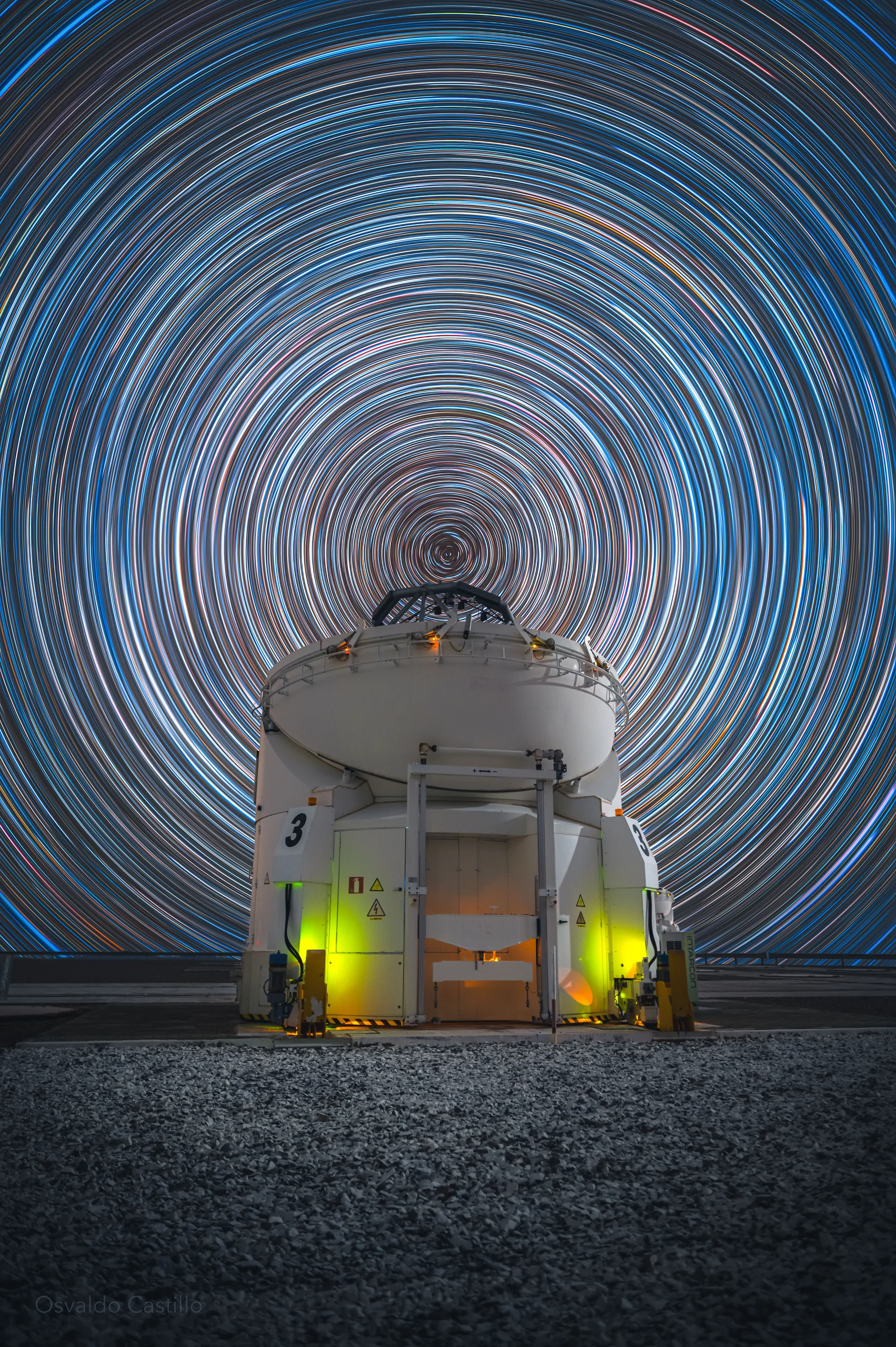
Image: NASA Astronomy Picture of the Day (APOD) | Image credit and copyright: Osvaldo Castillo | Today's page
Today's APOD is a vertical photograph filled with concentric arcs of light.
The arcs circle a point in the sky. Near that point, each is little more than a short mark. Farther away, they sweep across the entire frame. Directly below the center stands a telescope, its dome open and faintly lit, as quiet as though it were looking somewhere else.
The photograph was made at Paranal Observatory in Chile. The telescope is AT3, one of the European Southern Observatory's four 1.8-meter Auxiliary Telescopes. Photographer Osvaldo Castillo fixed his camera to a tripod and combined 300 consecutive 25-second exposures, letting Earth do the drawing.
APOD titled it The Sky Turns Above Paranal.
APOD Stops Halfway Through the Explanation
APOD's caption begins this way, in words written by professional astronomers and worth reading closely:
"At the latitude of the European Southern Observatory's Paranal Observatory in Chile, about 25 degrees south, Earth's rotation carries the surface eastward at more than 1,500 kilometers per hour. Although that is faster than the speed of sound at sea level, the motion cannot be felt."
Then comes a period.
That period is the subject of this article. APOD offers a fact that could make any child stare, then turns to the photographic technique. But why the motion cannot be felt is the deepest physics in the image.
Begin by checking the arithmetic.
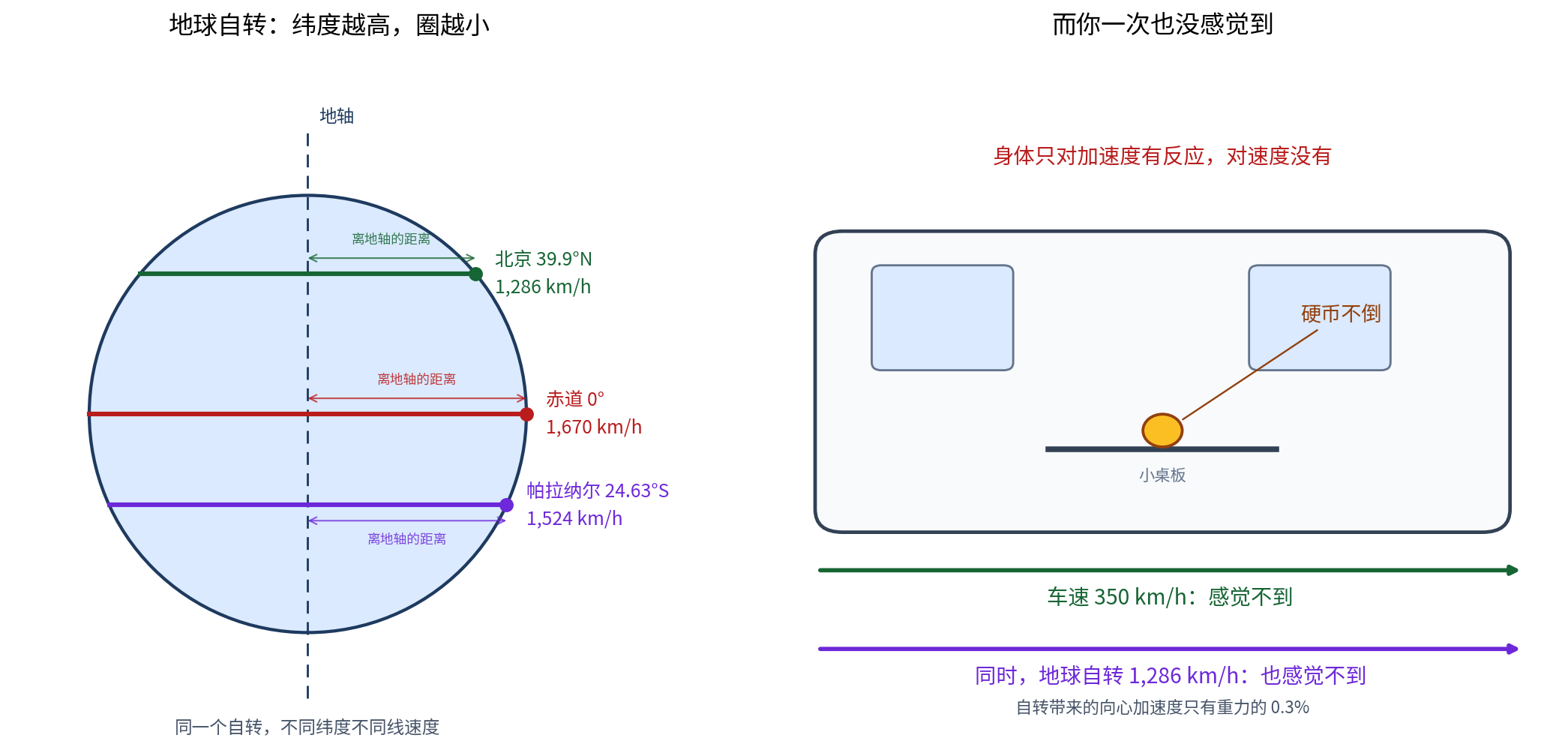
Earth's equatorial circumference is 40,075 kilometers and a sidereal day lasts 86,164 seconds, putting the ground speed at the equator near 1,670 kilometers per hour. Paranal is not on the equator. It lies at latitude 24.63 degrees south. ESO gives the precise coordinates as 24.62722 degrees south, 70.40389 degrees west, at an elevation of 2,635 meters. Its circle around Earth's axis is therefore smaller.
Allow for Earth's ellipsoidal shape and the mountain's 2,635-meter elevation, and Paranal stands 5,803.7 kilometers from the rotation axis. Its daily circuit is 36,466 kilometers. Completed in one sidereal day, that gives a speed of 1,523.6 kilometers per hour.
That is 423 meters per second.
Under the International Standard Atmosphere, the speed of sound in dry air at 15 degrees C and sea level is 1,225 kilometers per hour. Divide 1,523.6 by 1,225.1 and the result is 1.24.
The ground at Paranal is flying east at about Mach 1.2, nearly 300 kilometers per hour faster than sound.
APOD's figure of more than 1,500 kilometers per hour is correct and slightly conservative; rounding the latitude to 25 degrees produces a slightly lower result. The figure survives recalculation.
Why, then, is it imperceptible? There are three layers to the answer, each more fundamental than the last.
First, the air comes with us. Gravity and friction make the entire atmosphere rotate with Earth. There is no 1,500-kilometer-per-hour gale because the air is not moving at that speed relative to the ground.
Second, and most important, the body senses acceleration, not velocity. The inner ear, the stomach and a glass of water on the table respond only to a change in motion. Uniform motion cannot be detected from inside the moving system. This is the Galilean principle of relativity, and it is the most valuable idea in the photograph.
Third, the small acceleration that really does remain is negligible. Centripetal acceleration from Earth's rotation at Paranal is 0.031 meters per second squared. Divide that by gravitational acceleration, 9.81, and the result is 0.3 percent. The only real bodily consequence of this Mach 1.2 journey is that a person weighs roughly three parts in a thousand less than on a nonrotating Earth. This conversion is calculated here rather than quoted from a source, so the claim is deliberately approximate.
A coin standing on a train table makes the principle visible. At 350 kilometers per hour it stays upright, because the steady speed itself cannot be felt.
At the same time, in Beijing, the coin and train are also flying east with Earth at about 1,286 kilometers per hour, calculated by the same method for latitude 39.9 degrees. No one aboard has ever felt that speed for even a second.
The upright coin is the proof.
31 Degrees: A Number the Photograph Gives Away
APOD supplies the exposure details: 300 consecutive frames, each 25 seconds long.
How far did the sky turn during the photograph?
Three hundred times 25 is 7,500 seconds, or 2 hours 5 minutes. Earth's sidereal rotation rate is 15.041 degrees per hour.
7,500 seconds x 0.004178 degrees per second = 31.3 degrees.
Three hundred photographs and more than two hours beside a tripod produced just 31 degrees of sky rotation, a little more than one eleventh of a full circle. This is a lower bound. Any readout interval between frames would lengthen the elapsed time. APOD calls the exposures consecutive, however, and gaps would leave broken star trails, so the assumption is sound.
One observation that APOD does not make explains the image's entire visual structure in a sentence:
Every star in the frame swept through the same 31.3-degree angle. The length of the arc it drew depends on its distance from the celestial pole.
A star nearly touching the pole traces only a short segment through 31 degrees. A star 90 degrees from the pole traces the full apparent length of that angle.
The photograph must therefore consist of nested arcs, short in the middle and long at the edge. This is geometry, not a photographic trick.
An internal check also explains the composition. At latitude 24.63 degrees south, the south celestial pole hangs 24.63 degrees above the southern horizon. APOD says AT3 appears below the pole, exactly as expected. The pole is only a little more than one quarter of the way up the sky, leaving just enough room for a foreground telescope beneath it.
A Child in the Southern Hemisphere Cannot Find Polaris
This is the part of the photograph that gives the greatest pause.
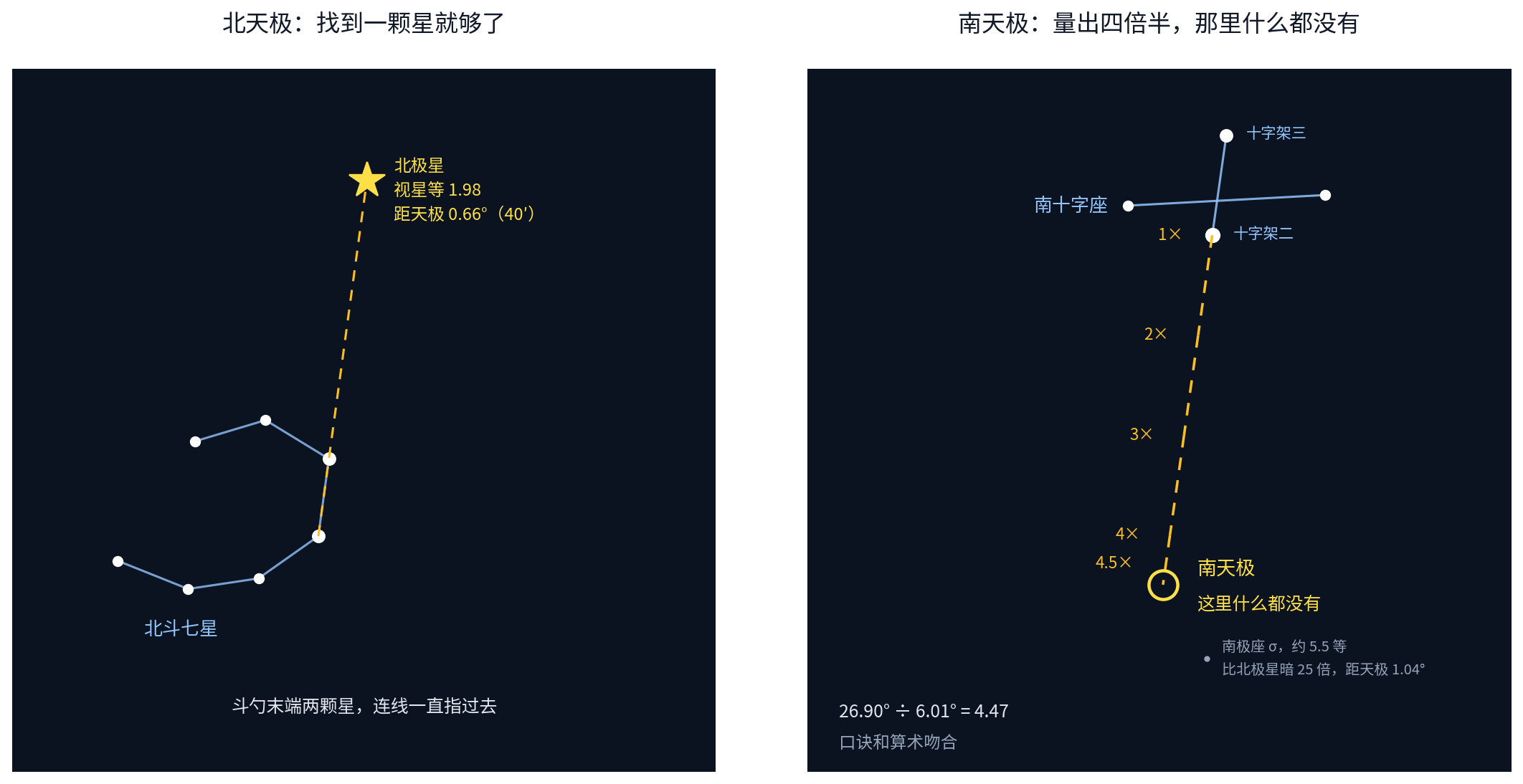
The Northern Hemisphere has Polaris. It is not the brightest star, but it barely moves, and finding it reveals north. NASA's educational page gives simple instructions: find the Big Dipper; the two stars at the outer edge of its bowl point toward Polaris, at the tip of the Little Dipper's handle, or the little bear's tail in Ursa Minor. NASA adds honestly that Polaris is not the brightest star in the sky, but it is usually easy to find even in a city.
What about the Southern Hemisphere?
NASA's words are direct: "There is no bright star marking the south celestial pole."
The British Astronomical Association is more specific: by contrast with the north, no bright star lies near the southern pole; the closest is a fairly faint magnitude +5.4 star, Sigma Octantis.
Place the two stars side by side:
Polaris has an apparent magnitude of 1.98 and in 2026 lies about 0.66 degrees, or 40 arcminutes, from the north celestial pole.
Sigma Octantis has an apparent magnitude near 5.5 and lies 1.04 degrees, or 63 arcminutes, from the south celestial pole.
The magnitude difference is 3.49, which converts to a brightness ratio: Sigma Octantis is about 25 times dimmer than Polaris. It is also 1.6 times farther from its pole.
Magnitude 5.5 means it is invisible in a city. A truly dark sky is required.
Navigators and astronomers in the Southern Hemisphere therefore use another method: measurement.
Extend the long axis of the Southern Cross from Gacrux toward Acrux by about 4.5 times its own length. That reaches the south celestial pole.
The rule sounds like folklore, but it can be calculated. The angular separation between Gacrux and Acrux is about 6.01 degrees. Acrux lies at declination -63.099 degrees, so its distance from the south celestial pole is 90 minus 63.099, or 26.90 degrees. 26.90 divided by 6.01 is 4.47.
Four and a half times. The mnemonic and the arithmetic agree exactly.
At the end of the measurement is nothing.
A child in the Southern Hemisphere uses the long arm of the Southern Cross to measure four and a half lengths toward an empty patch of sky.
Osvaldo Castillo's photograph turns that emptiness into the center of a circle.
A Telescope That Walks
The telescope in the photograph matters far more than it appears to.
Paranal's stars are usually the four 8.2-meter Very Large Telescope Unit Telescopes. The instrument in this picture is only 1.8 meters across, one of four Auxiliary Telescopes. ESO's public page states their purpose plainly:
"The four Auxiliary Telescopes are 1.8-metre telescopes that feed light into the Very Large Telescope Interferometer."
"The transporter section moves on rails, allowing the Auxiliary Telescopes to be relocated among 30 different observing positions."
ESO's technical page supplies the crucial number. An Auxiliary Telescope can occupy any of 30 possible stations, together providing the Very Large Telescope Interferometer's longest possible baseline of 202 meters. The page also adds a practical truth: repositioning is a complex operation.
There is an official discrepancy. One table on ESO's public site gives the longest baseline as 140 meters, while the technical page gives 202. Both are official. This article uses 202 meters and identifies the technical page as the source.
Why does it matter? A telescope's resolving power depends on aperture. Interferometry exploits that fact:
Four small 1.8-meter telescopes sit on movable bases, travel along rails to 30 different parking places, and spread as far as 202 meters apart. Combined, they can distinguish detail like a telescope with a 202-meter aperture.
They are not backups. ESO says the four small telescopes allow the VLTI to operate every night. The four eight-meter Unit Telescopes can devote only a limited number of nights each year to interferometry.
The quiet little telescope in the photograph is what keeps the whole system working nightly.
A 17-Year-Old Girl Named the World's Four Largest Optical Telescopes
The four 8.2-meter telescopes have names: Antu, Kueyen, Melipal and Yepun.
The names come from Mapudungun, the language of Chile's Indigenous Mapuche people. ESO's March 6, 1999 press release, VLT Units Named at Paranal Inauguration, records how they were chosen. A writing contest was held for schoolchildren in Chile's Second Region, and the winning entry came from:
"17-year-old Jorssy Albanez Castilla from Chuquicamata near the city of Calama. She received her prize at the Paranal inauguration ceremony - an amateur telescope."
A 17-year-old girl from a copper-mining town named the world's four largest optical telescopes. Her prize was an amateur telescope.
One of her four names was later corrected by ESO itself, and that story is better than the name alone.
The 1999 release translated Antu as Sun, Kueyen as Moon, Melipal as Southern Cross and Yepun as Sirius.
ESO later created a page titled On the Meaning of YEPUN to correct the mistake. It says YEPUN was "originally translated as Sirius," but questions arose. The investigation found an etymology in yeln, to carry, and pun, night: "the one that brings the night." A Mapudungun dictionary compiled by the 19th-century missionary Fray Félix José de Augusta defined YEPUN as the "star of the night." The oral autobiography of Mapuche elder Pascual Coña associated YEPUN with the evening and morning star. A native speaker, José Ancan, said Yepun was the body known to science as Venus.
Dr. Guillermo Delgado, who led the investigation, concluded: "We have enough information to support the view that the correct translation of 'YEPUN' is indeed 'Venus' as the 'evening star.'"
ESO's current public language incorporates the correction. A Picture of the Week published on January 7, 2013 says the four names represent the Sun, Moon, Southern Cross and Venus.
The 1999 release saying Sirius remains online. So does the correction. Both are official.
This is how knowledge actually works. A translation error was noticed, traced through a 19th-century missionary dictionary and the oral account of a Mapuche elder, and formally corrected. The old document was not erased.
Yepun is the evening star, Venus. Ancient Chinese called Venus at dusk Changgeng and the same body at dawn Qiming. Two languages at opposite ends of Earth both noticed that one star had two faces.
Why Build on a Mountain in Chile?
How good is Paranal's sky? ESO's observing-climate page reports these figures from 2016 through 2023:
Median seeing is 0.72 arcseconds. Typical humidity is 5 to 20 percent. The sky is "clear or photometric" for about 75 percent of winter nighttime, from April through September, and 80 percent of summer nighttime, from October through March. About 30 percent of the time is photometric. Temperatures range from -8 to 25 degrees C.
A site-selection release dated December 4, 1990 makes a still stronger statement: the Paranal region has so little atmospheric water vapor that it is "probably the driest area on the surface of the Earth." The same release records a ten-hour observing run with seeing of 0.32 arcseconds, including three consecutive hours at the "almost incredible" level of 0.25 arcseconds.
One warning is necessary. A widely repeated trio - 100 millimeters of annual rain, 320 clear nights and 15 percent humidity - actually describes Cerro Armazones, 20 kilometers away and 400 meters higher, the site of the Extremely Large Telescope. It does not describe Paranal. ESO has not published annual rainfall for Paranal itself, so no figure is given here.
Why is the Atacama so dry? ESO states the condition without explaining it, but four geographic mechanisms overlap:
Subtropical high pressure: The eastern side of the South Pacific anticyclone shapes much of the climate along South America's west coast, producing stable descending air and little rain.
A cold current: The Peru, or Humboldt, Current runs north along the coast from southern Chile to the equator, cooling and further stabilizing Pacific air moving toward land.
A temperature inversion: Cold water beside the high Andes reverses the atmosphere's usual temperature pattern because air touching the water cools faster than the air above it.
A rain shadow: As westerly winds cross the Andes, they release most of their moisture as orographic precipitation, leaving the leeward side in a classic rain shadow.
The third mechanism has a specific consequence for the observatory. The cold current and inversion trap a layer of coastal fog known in Chile as camanchaca at low elevation. Paranal, at 2,635 meters, sits above it.
The shore can remain fogbound all day while the summit is dry and cloudless. That is why these telescopes stand on a mountain 12 kilometers from the sea rather than beside the water. This particular causal explanation combines the geographic mechanisms above with ESO's published elevation and humidity figures; no single source states it in exactly these words.
Someone Planned a City-Sized Project Next Door, Then Withdrew It
This section began as bad news. It became good news, and inside that good news is the article's most important lesson.
On January 10, 2025, ESO issued a release titled World's Darkest and Clearest Skies Threatened by Industrial Megaproject. It publicly opposed an energy company's proposed green-hydrogen and ammonia complex near Paranal, a project called INNA. The figures were specific: the site would lie only 5 to 11 kilometers from Paranal's telescopes and cover more than 3,000 hectares, comparable to a small city or urban district.
On March 17, 2025, ESO published a quantitative analysis. Sky brightness over the Very Large Telescope would increase by at least 35 percent; over the Extremely Large Telescope site by at least 5 percent; and over the southern Cherenkov Telescope Array site, only five kilometers from the project, by at least 55 percent. Turbulence from wind turbines could worsen seeing by up to 40 percent. The complex would contain more than 1,000 light sources.
Director of Operations Andreas Kaufer added a dispiriting qualification: the light-pollution figures assumed the project would use the best lighting technology currently available. In other words, 35 percent was the best case, not the worst.
ESO Director General Xavier Barcons said the megaproject's proximity to Paranal posed a critical risk to one of the planet's most pristine night skies. Dust during construction, increased atmospheric turbulence and especially light pollution would irreversibly damage astronomical capability. ESO representative in Chile Itziar de Gregorio called Chile, and Paranal in particular, a truly special place for astronomy whose dark sky was a natural heritage transcending borders and benefiting all humanity. She identified a specific cost: a brighter sky would severely restrict the direct detection of Earth-like exoplanets.
Then the direction changed.
On December 2, 2025, an open letter led by Nobel laureate Reinhard Genzel and signed by "nearly 30 internationally renowned astronomers" was released.
On February 2, 2026, ESO announced that the company had canceled the INNA project and would turn toward renewable-energy initiatives. On February 6, the company formally asked Chile's Environmental Assessment Service to withdraw the proposal, ending the review.
As of today, that remains the latest official position. The project is canceled and the application withdrawn.
Barcons made two statements in the announcement, both worth keeping because they reject an easy but false framing:
"When the cancellation is confirmed, we will be relieved that the INNA industrial complex will not be built near Paranal."
"ESO and its Member States fully support the decarbonization of energy."
The problem was never green energy. It was location. As Barcons had also said, Chile should not be forced to choose.
Someone found a problem. Someone measured it as a number - 35 percent, in the best case. Someone wrote a letter. Then the project was withdrawn.
This is not a story about the night sky disappearing. It is a story about people doing something and having it work. Those two stories have very different effects when told to a child.
The China Connection: 164 Degrees of Longitude, Two Shifts
Lenghu belongs in this story, but not as a contest over which site is better. That comparison would be wrong.
In 2021, Deng Licai and colleagues published Lenghu on the Tibetan Plateau as an Astronomical Observing Site in Nature. They monitored a summit on Saishiteng Mountain near Lenghu, Qinghai, for three years, at elevations between 4,200 and 4,500 meters. The abstract reports:
Clear photometric conditions on 70 percent of nights; median seeing of 0.75 arcseconds; a median nighttime temperature variation of only 2.4 degrees C; and precipitable water vapor below two millimeters during 55 percent of nighttime hours. The paper itself gives a night-sky background of 22.0 magnitudes per square arcsecond.
Two comparisons must not be made, because this is where the account is easiest to distort.
Do not say Lenghu has better seeing than Paranal. Lenghu measures 0.75 arcseconds; ESO's own median for Paranal is 0.72 arcseconds. Paranal is slightly better. The honest description is comparable.
Nor should Lenghu's 70 percent of clear nights be set against a supposed 30 percent for Paranal. The two sources define "photometric conditions" differently. Paranal's genuinely comparable figure for "clear or photometric" weather is 75 to 80 percent. Comparing 70 with 30 would manufacture a sensational and completely false conclusion.
Lenghu's importance appears in the first sentence of the Nature abstract, and it is not a quality argument:
"In the context of scientific opportunities in time-domain astronomy, a good site on the Tibetan Plateau would fill the longitudinal gap between the known best sites, all of which are in the Western Hemisphere."
This is an argument about longitude.
Paranal lies at 70.4 degrees west, Mauna Kea at 155.5 degrees west, and La Palma at 17.9 degrees west. The world's best optical sites are all in the Western Hemisphere. When a supernova or gamma-ray burst occurs during western daylight, no one there is watching.
Lenghu lies at 93.9 degrees east. It fills that gap.
Paranal and Lenghu are not rivals but two shifts relieving each other. Their longitudes differ by about 164 degrees, or roughly 11 hours. Dawn in Chile arrives as night begins at Lenghu.
That is the photograph's subject - Earth's rotation - expressed at the level of human organization. Earth turns one observatory's daylight into another observatory's night. A webcam opened in the morning shows someone else working the night shift.
Lenghu does have clear, peer-reviewed advantages: an elevation of 4,200 to 4,500 meters versus 2,635 meters, producing less water vapor, which is decisive for infrared astronomy; and the median nighttime temperature change of only 2.4 degrees C, evidence of exceptionally stable air near the ground. Those are the valid comparisons, not seeing.
There is one final parallel. Paranal must be protected from light pollution. China's Five-hundred-meter Aperture Spherical Radio Telescope, FAST, must be protected from radio-frequency interference.
Official material defines a 30-kilometer-radius FAST radio-quiet zone centered on the telescope, divided into three rings: a core zone within five kilometers, an intermediate zone from five to ten, and a remote zone from ten to 30. The legal basis is the revised 31-article Measures for the Protection of the Electromagnetic Wave Quiet Zone of Radio Astronomy Observatories, effective April 1, 2019, intended to ensure FAST can meet its scientific goals by preventing human-made electromagnetic pollution.
One needs darkness; the other needs silence. Chile used negotiation over an industrial project and the implications of 3,000 hectares. China uses regulation and three concentric rings across a 30-kilometer radius. Both are protected spaces deliberately created so that nothing happens.
The international organization ESO later joined is called the IAU Centre for the Protection of the Dark and Quiet Sky from Satellite Constellation Interference. Quiet is in the name.
At the End
The sky turned 31 degrees in this photograph, taking 2 hours 5 minutes.
During the same interval, the telescope called AT3 and the entire mountain beneath it traveled about 3,170 kilometers eastward, faster than sound, without anyone feeling a thing.
Osvaldo Castillo stood beside the tripod and let the shutter open and close 300 times. Earth drew its own rotation.
A manually controlled camera, a tripod and a sky with Polaris can show the same motion in 50 minutes.
Fifty minutes yields 12.5 degrees. It is a fair exchange.
Sources: NASA Astronomy Picture of the Day for August 28, 2026; NASA Science; the European Southern Observatory's Paranal site and observing-climate pages, Very Large Telescope and Auxiliary Telescope pages, interferometer technical page, press releases eso9921, eso9015, eso2501, eso2506 and eso2602, announcement ann25009, On the Meaning of YEPUN, Picture of the Week potw1301a, and public webcam page; NASA Goddard Space Flight Center's lunar-eclipse tables; NASA Science's Polaris page; the British Astronomical Association; the Royal Observatory Greenwich; Weber State University astronomy teaching material; Deng et al., Nature 596:353-356 (2021); Encyclopaedia Britannica, "South America: Factors Influencing Climate"; the Max Planck Institute for Extraterrestrial Physics; China Daily; China National Radio; and the State Council Information Office of China.