
A rule adopted in 1998, an effect named in 1852, and an experiment that can be built with two paper cups.
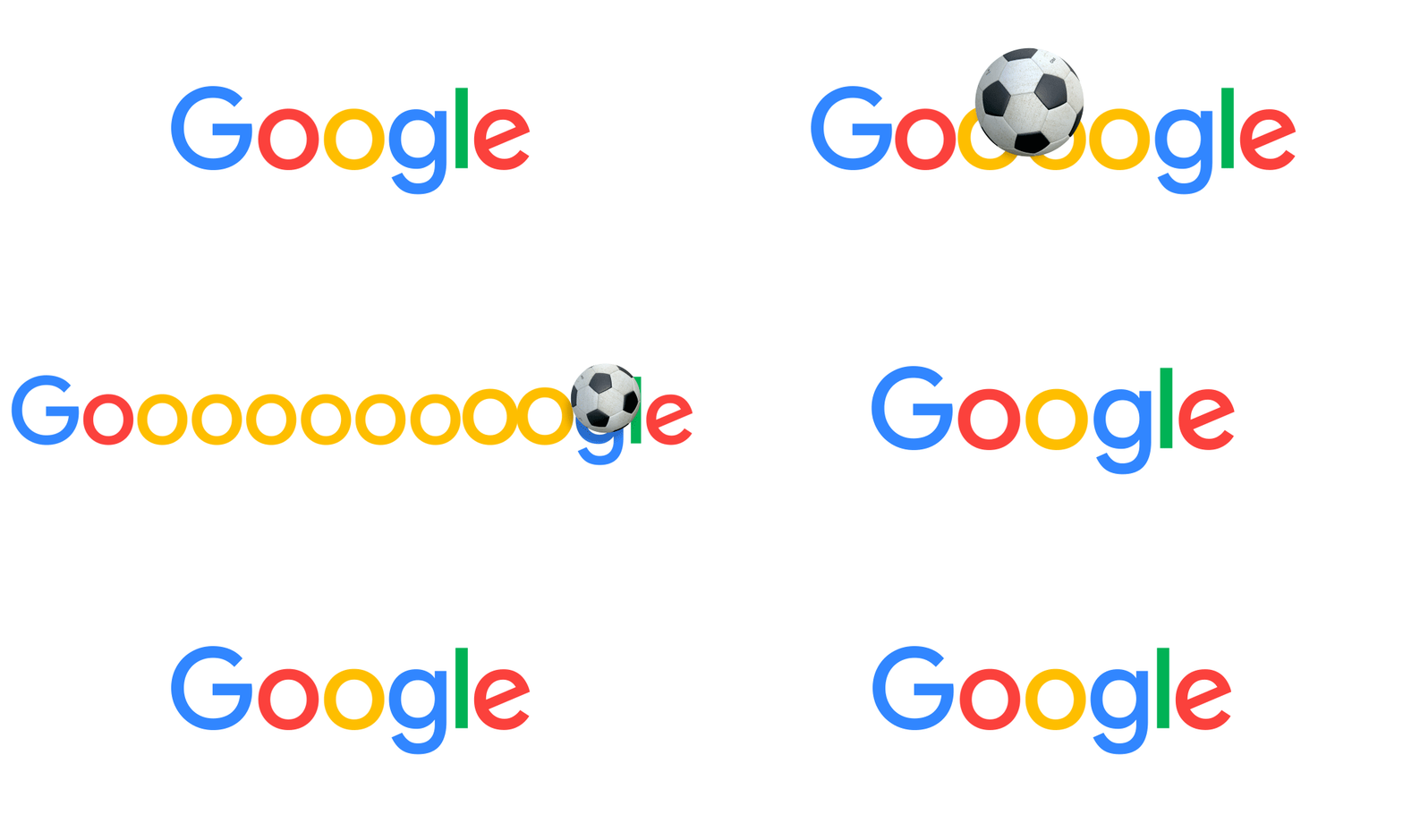
Image: Google Doodle, Bundesliga 2026-27 Begins! | Official page
Open Google today and its letters move.
A soccer ball rolls in from the left, through the two O's in the middle of Google, and out the other side. At first the design seems merely playful, but Google's official page explains its purpose: the artwork "shows a football rolling through the 'O' in Google to recreate the sound of an announcer yelling 'Gooooooal!'"
The ball rolls through the O to draw out that long cry of "goal."
This is an animated Doodle, not an interactive game. The official page offers only two sentences of explanation and gives "football" as its topic. It says nothing at all about a guest artist or the countries where the Doodle appeared. Those fields are blank, and should be reported as blank.
It celebrates a specific event: the 2026-27 German Bundesliga season begins today, August 28, 2026.
Why Today, and Why Later Than Usual?
The Bundesliga's official season calendar is precise. Matchday 1 runs from August 28 to 30, while Matchday 34 closes the season on May 22, 2027. Eighteen clubs play a double round-robin schedule: 34 matchdays and 306 matches. A winter break follows Matchday 14, with play resuming on January 8, 2027.
The Bundesliga usually begins in mid-August. This year it starts one week later. The official explanation is a single sentence: the calendar reflects a one-week delay caused by the 2026 FIFA World Cup.
A World Cup held elsewhere shifted the opening of Germany's domestic league by seven days, so this Doodle appeared on August 28 instead of in the middle of the month. It is a small fact, but one that makes the connections in the world suddenly visible.
The opening match is:
Bayern Munich vs. VfB Stuttgart, Friday, August 28, at 20:30 Central European Summer Time. In Beijing, that is 2:30 a.m. on Saturday, August 29.
By tradition, the previous season's champion hosts the opener. The identity of that champion has been confirmed, not guessed: the German Football League's official news headline congratulates Bayern Munich on winning the 2026 Bundesliga title under head coach Vincent Kompany, a second consecutive championship. Bayern clinched the shield on Matchday 30 by beating Stuttgart 4-2 at home.
Bayern kept the shield last season by beating Stuttgart 4-2, then opens the new season at home against Stuttgart again. The Bundesliga's schedule announcement calls it a renewal of the rivalry.
At the time of writing, the match had not begun. There is no prediction here, only a time and place.
The Team Money Cannot Buy
The Bundesliga's most distinctive feature has nothing to do with the ball and everything to do with voting rights.
Its official rules explain a provision called 50+1. Club members must retain 50 percent plus one of the votes, and therefore a majority. In the Bundesliga's words, the purpose is to ensure that the club, and by extension its fans, has the final say in how it is run, rather than an external influence or investor. A club in which an outside investor has the greatest say cannot compete in the Bundesliga.
The rule carries more weight once you understand what came before. Until 1998, every German club was a nonprofit association and private ownership was prohibited altogether. The 50+1 rule was not simply a restriction but an opening. German soccer first admitted commercial capital in 1998, then immediately fitted a bolt to the door.
The rule has exceptions, and their rationale is particularly revealing. An investor that has supported a club continuously for more than 20 years may qualify for an exemption. The two named clubs are:
Bayer Leverkusen, founded in 1904 by employees of the Bayer company.
VfL Wolfsburg, founded by Volkswagen in 1945.
These were not teams bought by wealthy outsiders. The factory came first and the team followed. One was created by workers at a pharmaceutical plant, the other by workers at a carmaker. The exemption is not a loophole but an acknowledgment of history. There was once a third exception, Hoffenheim, approved in December 2014. Reports from early 2023 said its benefactor had returned majority voting rights to the club, and the 2026 official legal document names only Leverkusen and Wolfsburg.
The current status of the rule was settled only seventeen days ago.
In August 2026, Germany's national competition authority, the Bundeskartellamt, formally ended its antitrust review of 50+1. Its president, Andreas Mundt, said:
"We are not conducting, and will not initiate, any proceedings aimed at prohibiting the 50+1 rule."
The conclusion was that the basic rule is compatible with competition law as long as it is applied consistently and without unjustified discrimination. A June 2025 document from the authority laid out the legal reasoning more fully. The basic 50+1 rule did not constitute conduct whose purpose was to restrict competition, but in the long run all clubs had to ensure that the parent association, open to new members, controlled the professional division. The authority also identified three areas requiring correction. One was that the old exemption provision designed for Leverkusen and Wolfsburg was no longer sufficient under case law from the European Court of Justice.
The rule is not a fossil. It was adopted in 1998, ordered to be reworked in 2025, and cleared in August 2026 with an explicit warning that it must eventually apply equally to everyone.
A national competition authority spent more than two years seriously examining a rule about soccer. That alone shows that the rule governs something real.
Volkswagen's Team Was Relegated
The most elegant footnote to the rule came at the end of last season.
ARD's sports service, part of Germany's public broadcasting system, put it bluntly: Wolfsburg was relegated for the first time after 29 years in the Bundesliga.
Wolfsburg is one of the two 50+1 exceptions, the Volkswagen team. The club that sent it down was Paderborn, from a city of about 150,000 people, promoted through a playoff after finishing third in the second division.
The playoff system deserves explanation. The clubs finishing 17th and 18th in the Bundesliga are relegated automatically, while the top two in Bundesliga 2 are promoted. Then 16th place in the Bundesliga plays third place in Bundesliga 2 over two legs for the final top-flight spot. Introduced in 1981, the system was suspended in 1991 when German reunification brought East German clubs into the league, then restored in 2009.
Last season, the first leg ended 0-0 at Wolfsburg. Paderborn won the return leg at home 2-1, but only after extra time. The specialist publication kicker titled its report "Second-Division Side Wins the Playoff for the First Time Since 2019." Bundesliga teams usually survive this mechanism; an upset is rare.
The new season's other two promoted clubs are also worth noting. Schalke 04 returns after three years away. SV Elversberg will play in the Bundesliga for the first time in its history, becoming the league's 59th club. It comes from a small Saarland community of only a few thousand people.
The team backed by an automotive giant went down; the team from a village of a few thousand came up. In this league, rules matter more than money is not merely a slogan.
A EUR 12.27 Standing Ticket
The Bundesliga also offers something rare in world soccer: supporters can stand to watch a match.
The German Football League's official spectator report supplies the complete figures for 2025-26. The Bundesliga sold 12.718 million tickets, up 9.1 percent year on year. Average attendance was 41,562, with stadiums 96.1 percent full. Four clubs sold every place for the entire season: Union Berlin, Leverkusen, Bayern and St. Pauli. Twelve more Bundesliga clubs exceeded 90 percent capacity. The top two divisions together sold a record 21.4 million tickets.
The most persuasive figures in the report, however, are the prices. The official averages are EUR 12.27 for a standing ticket and EUR 37.14 for a seat.
For a little more than twelve euros, roughly RMB 100, a supporter can stand inside a stadium that is 96 percent full and watch top-flight soccer.
These are average prices actually paid, not price caps. The Bundesliga imposes no official ceiling on ticket prices. The low price comes from somewhere else: at a club where members control the majority of votes, pricing must answer to those members. The connection between governance and price is more interesting than the simple claim that the league sets a cap.
Standing terraces also reveal a striking contrast.
Borussia Dortmund's South Stand, known as the Yellow Wall, now holds 25,000 people and is therefore Europe's largest standing terrace, according to the club's own website. Another figure, 24,454, appears in a third-party source citing club data. The two differ slightly, so the club's own "about 25,000" is used here. Its website calls the terrace the epicenter of Dortmund's passion for soccer.
Here is the revealing part: the same stadium holds 81,365 spectators for Bundesliga matches but only 66,099 seated spectators in European competition. Roughly 15,000 places disappear because UEFA requires all-seater stadiums for international matches, and temporary seats must be installed on the South Stand. Fifteen thousand places vanish overnight.
Why is England different? This is not a cultural preference but a legal rule with a grave history. The official UK Sports Grounds Safety Authority says that the all-seater policy arose from Lord Taylor's report on the Hillsborough disaster and has applied since the 1994-95 season to grounds long occupied by clubs in the top two divisions. England later introduced licensed standing, officially defined as standing at certain grounds only in seated areas with rails or seats fitted with individual barriers. Each supporter must have an assigned seat and place, in both home and away sections. The legal basis is Statutory Instrument 2022 No. 728. Trials began at five grounds on January 1, 2022, and the system expanded to all qualifying grounds on July 4, 2022. By January 19, 2026, 39 grounds had licensed standing areas.
The two countries therefore mean different things by standing. England provides seats with rails and counts capacity by seat. Germany uses true stepped terraces, fitting many more standing people into the same area than seats would allow. That is where the missing 15,000 places go.
The same official report contains another remarkable number. Schalke 04 averaged more than 61,000 spectators while playing in the second division. A second-tier club drew more people per match than the league-wide averages in Spain's La Liga, 30,945, and Italy's Serie A, 30,084.
Why Did Germany Wait So Long for a National League?
The Bundesliga was founded in 1963, surprisingly late for Europe. England's league began in 1888.
The Bundesliga's official history explains why. Before 1963, German soccer was regional: champions of the regional leagues advanced to a national final to decide the German title. The decisive moment came at a meeting in Dortmund on July 28, 1962. In the official account, 103 of the German Football Association's 129 delegates voted to establish a centralized league.
The stated motives were to stop the best players moving abroad and revive the national team after its elimination from the 1962 World Cup. West Germany had lost to Chile in the quarterfinal.
Players left because Germany clung for so long to amateurism. Clubs were nonprofit associations and players were not full-time professionals, so professional leagues in Italy and Spain recruited them. Creating a national league meant accepting professionalism.
The sequence is clear: professionalism was accepted in 1963, private ownership only in 1998, and a national competition authority reviewed 50+1 again in 2026. The whole history of German soccer is a story of admitting money one extremely cautious step at a time.
The first matchday was Saturday, August 24, 1963. The official history preserves its best detail:
"Dortmund's Timo Konietzka wrote himself into the history books when he found the net after only 58 seconds."
The first goal in Bundesliga history arrived 58 seconds after the league began.
One more fact may surprise supporters: Bayern Munich was not among the 16 founding clubs. The regional champion in 1962-63 was city rival 1860 Munich, and only one club per city could enter. The team that has won 34 titles in 63 seasons was not eligible for the first one.
Now the Ball: Why Does It Curve?
A soccer Doodle must eventually return to the ball, and the physics of the ball bears a German name.
John Lambropoulos, a professor of mechanical engineering at the University of Rochester, explains the Magnus effect in four statements simple enough to remember:
"Whenever air is moving slowly over an object, the pressure is high. When the air moves fast around the object, the pressure is low."
"The pressure difference produces a force that makes the ball curve."
"Spin is the key to producing it. The faster the ball spins, the larger the pressure difference and the more it curves."
"If the ball spins around a vertical axis, it curves left or right; if it spins around a horizontal axis, it dips or rises."
The last sentence contains the most testable idea in this story: the direction of the spin axis determines the direction of the curve.
The effect is named for the German physicist Gustav Magnus, whose work in 1852 explained the sideways deflection of a spinning object.
A German physicist's name explains every curling shot in a German stadium.
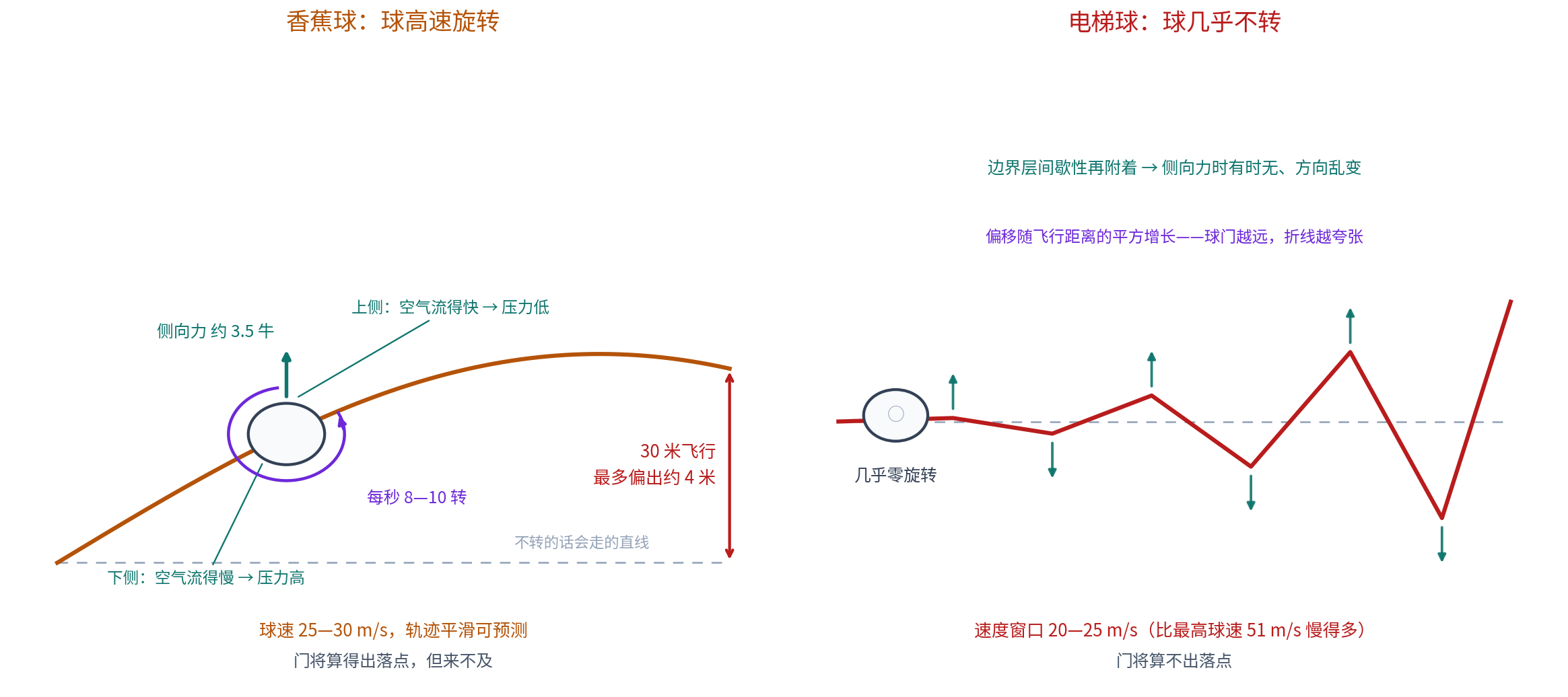
How large is the force? An article in Physics World, "The Physics of Football," supplies a set of figures: a ball moving at 25 to 30 meters per second, or roughly 90 to 108 kilometers per hour, and spinning eight to ten times per second experiences a lateral force of about 3.5 newtons. A FIFA-standard ball weighs 410 to 450 grams, so its sideways acceleration is about eight meters per second squared, nearly 0.8 times gravitational acceleration. The result is that:
Over a 30-meter flight, air can push the ball as much as four meters sideways.
Four meters is about the distance between hitting the goal and missing it. The publication year of that article was not verified and its content appears to be relatively old, so only its order of magnitude is used here. Its explanation of one famous free kick remains disputed in the literature, and the article itself uses the word "hypothesis"; it is not treated here as settled fact.
A Ball Without Spin Is More Frightening
Now for the counterintuitive part: the hardest ball to save is not the one spinning fastest, but one with almost no spin at all.
A peer-reviewed paper from the LadHyX laboratory of France's National Centre for Scientific Research and École Polytechnique is titled "The Physics of Knuckleballs," published in New Journal of Physics, volume 18 (2016), article 073027. Its authors are Darbois Texier, Cohen, Quéré and Clanet.
The abstract begins by calling zigzagging trajectories rare events in ball sports, observed in baseball, volleyball and soccer; the paper also mentions cricket. They arise from intermittent breaking of the lateral symmetry of the surrounding flow. After examining older explanations based on seams and similar features, the paper proposes a new explanation based on unsteady lift.
In plain language, within the speed range of the drag crisis, the boundary layer over the ball's surface intermittently reattaches, creating brief asymmetries. The sideways force then appears and disappears, changing direction unpredictably and sending the ball along a broken path. One condition is essential: the ball must barely spin.
The paper gives the transverse displacement scaling as δ/D = (3C̃ₗ/16π)(x/D)², meaning that the displacement grows with the square of the distance traveled. The farther the goal, the more dramatic the zigzag.
For a soccer knuckleball, the speed window is about 20 to 25 meters per second, distinctly below the maximum match speed of 51 meters per second.
The counterintuitive conclusion is simple: fooling the goalkeeper does not mean kicking as hard as possible. There is a right speed, around twenty-something meters per second, and the ball must scarcely spin. Hit it faster and the effect fades.
The difference between a banana kick and a knuckleball fits in one sentence: a goalkeeper can predict the banana kick but cannot reach it; the goalkeeper cannot predict the knuckleball at all.
Finally
At 2:30 tomorrow morning in Beijing, a match will begin at Allianz Arena. It will have a result, but that result does not yet exist, so it is not in this article.
What exists is this: on July 28, 1962, 103 of 129 people voted yes. On August 24 the next year, the league began, and someone scored after 58 seconds. For the next 63 years, every weekend brought people to the terraces, paying a little over twelve euros for a standing ticket in stadiums 96 percent full.
Every curve the ball makes through the air still follows a principle written down in 1852.
Institutions come from human votes. Curves come from the air.
Sources: the official Google Doodles page; the Bundesliga's official website, including its season calendar, schedule announcement, 50+1 explainer, league history, German champions FAQ and China broadcast page; the German Football League; the German Football League's 2025-26 Spectator Report; the Bundeskartellamt's August 2026 closure announcement and June 2025 remedial requirements; Borussia Dortmund's website; the UK Sports Grounds Safety Authority; ARD Sportschau; kicker; the University of Rochester News Center; Darbois Texier et al., New Journal of Physics 18 (2016), 073027; Physics World; the Exploratorium's Science Snacks; the Ministry of Education of the People's Republic of China, document Jiaotiyihan [2025] No. 22; the Chinese government website, Implementation Opinions on Reform and Development of Youth Football in China; Xinhua; and the Chongqing municipal government website.