
How does a discarded oil drum become an instrument? Someone takes a hammer and works the pitch, the overtones and even the future softness or brightness of each note into the steel.

Image: Google Doodle, Celebrating the 60th Anniversary of the Notting Hill Carnival | Official page: doodles.google
Open Google today and the familiar colored logo above the search box has changed. A blue letter G holds three bright feathers.
Google's official description is only two sentences long. The Doodle celebrates the Notting Hill Carnival, "Europe's biggest street festival, where the streets of West London overflow with joyful music, dance and color." Each year, it says, more than two million people gather to celebrate freedom and Caribbean culture.
This time, the event in the Doodle is happening now. Within hours of your reading this, people on the streets of London will begin splashing paint on one another.
Sixty Years, Beginning When?
Subtract 60 from 2026 and you get 1966.
That year, Rhaune Laslett, a social worker who lived in Notting Hill and whom the carnival's official website describes as "a Londoner of Native American and Russian descent," organized a street gathering for local children. She invited Russell Henderson, already a well-known steelpan player in the Caribbean community, and his band.
The official history puts what followed beautifully. Henderson's steel band "wove its way through Portobello Road as a local crowd spontaneously gathered and danced in the street to the sound of pan." That was how the first Notting Hill Carnival began.
Look elsewhere, however, and you will find another year: 1959.
On January 30 of that year, Trinidadian activist and newspaper editor Claudia Jones staged an indoor "Caribbean Carnival" at St Pancras Town Hall in Camden, London. The BBC broadcast it. The University of Bristol's Black history project records her purpose in a striking phrase: to "wash the taste of the riots out of Black people's mouths."
So which one was the first?
The two institutions best placed to answer the question both confront it directly, and each chooses its words with precision.
The Museum of London calls the 1959 event the "first Caribbean carnival." It calls the 1966 gathering the street party that "created the Notting Hill Carnival we know today."
The carnival organizers say Jones is "widely credited with planting the seeds" of carnival in Britain, while the carnival itself was "officially born" in 1966.
Both were firsts; they simply answer different questions. One was the first appearance of a Caribbean carnival in Britain. The other was the first Notting Hill Carnival. A seed is not planted on the day it sprouts.
(Some accounts compress the two into the claim that "Jones founded the Notting Hill Carnival in 1959." That folds two events into one. When the two institutions themselves are this careful, there is no need to simplify on their behalf.)
Why Were These People in London?
To understand the festival, we first need to answer an earlier question. Why did so many Caribbean people live in West London in the 1950s?
The usual answer is the name of a ship: the Empire Windrush. Two details need correcting, and both are revealing.
First, its arrival date. The UK National Archives is direct: "Although the date of the ship's arrival is often given as 22 June 1948 - now commemorated annually as Windrush Day - the passenger list records the date as 21 June."
The day something happened and the day on which we commemorate it need not be the same.
Second, it was not the first ship. The same archival page records that the Ormonde arrived in Liverpool on March 31, 1947, carrying 241 people, including 11 stowaways and six distressed seamen. The Almanzora reached Southampton on December 21, 1947, with 200 Caribbean passengers.
The Windrush is the symbol, not the first.
Then there is the familiar figure of "492 people." Royal Museums Greenwich instead gives "1,027 passengers and two stowaways" aboard, more than 800 of whom listed a previous address in the Caribbean. Goldsmiths, University of London, has turned those 1,027 landing cards into a database searchable by name, where a child can look up a real person.
What those arrivals encountered in London belongs to a painful history. The carnival organizers begin their own history with the riots of late summer 1958 and a killing on May 17, 1959. Kelso Cochrane, a 32-year-old Antigua-born carpenter, was murdered on a Notting Hill street. A blue plaque marks the site today; more than 1,200 people reportedly attended his funeral; and the case remains unsolved.
Interpretations of this history differ, and this article will not choose among them. It will preserve one verifiable fact: the organizers themselves place these two events at the beginning of the festival's story. Laslett said in 1966:
"If we could get them infected with the desire to participate, this could only have good results."
The Museum of London records another thing she said, before the event she imagined existed:
"I could see the streets crammed with people in brightly coloured costumes, dancing, following bands, they were happy ... men, women, children, black, white, brown, but all laughing."
She described something that did not yet exist. Sixty years later, it appears for two days every year.
Now for the Drum
It is time to consider the loudest object at the festival.
The United Nations' Chinese-language page introduces the steelpan as "the only acoustic instrument invented in the 20th century." Originating in Trinidad and Tobago, it grew from the local practice of turning discarded oil drums into instruments.
(A careful distinction is needed. "Only" is the language used by the United Nations and Trinidad and Tobago. Physicists are more reserved. A landmark 1996 paper in Physics Today calls the steelpan, "made from one end of an oil drum," perhaps "the most important new acoustical musical instrument developed in the twentieth century." Most important and only are different claims.)
Its history runs roughly like this.
In 19th-century Trinidad, colonial authorities restricted African drumming traditions. People began striking bamboo tubes on the ground, creating what became known as Tamboo Bamboo bands. By the 1930s, bamboo bands were banned too, so performers turned to trash-can lids, discarded milk cans and brake drums - anything metal that would ring.
Then came the crucial discovery. In the 1930s, people realized that an indentation in the bottom of a metal drum could be tuned to a definite pitch.
After World War II, thousands of 55-gallon oil drums left on beaches by the British Navy provided abundant material for experimentation. In 1945, the first 14-note pan to include semitones was developed. By 1955, the steelpan had largely been standardized.
Who invented it? There was no single inventor. The Physics Today paper is explicit that "many claims have been made for the invention of the tuned steel drum." It names contributors including Bertie Marshall, Anthony Williams and Ellie Mannette. Many pairs of hands made this instrument.
Another fact is often misstated. The steelpan became the legal national instrument of Trinidad and Tobago in July 2024, when Parliament voted unanimously, only two years ago. This is not an antique sealed behind glass. It is still being legislated, defined and carried forward.
(One more clarification: the steelpan is not on UNESCO's Intangible Cultural Heritage list. Trinidad and Tobago currently has no element inscribed there. Its international status comes from the UN General Assembly, whose 2023 Resolution A/RES/77/316 established August 11 as World Steelpan Day.)
One Instrument, One Continuous Sheet of Steel
Here is the central wonder of the story.
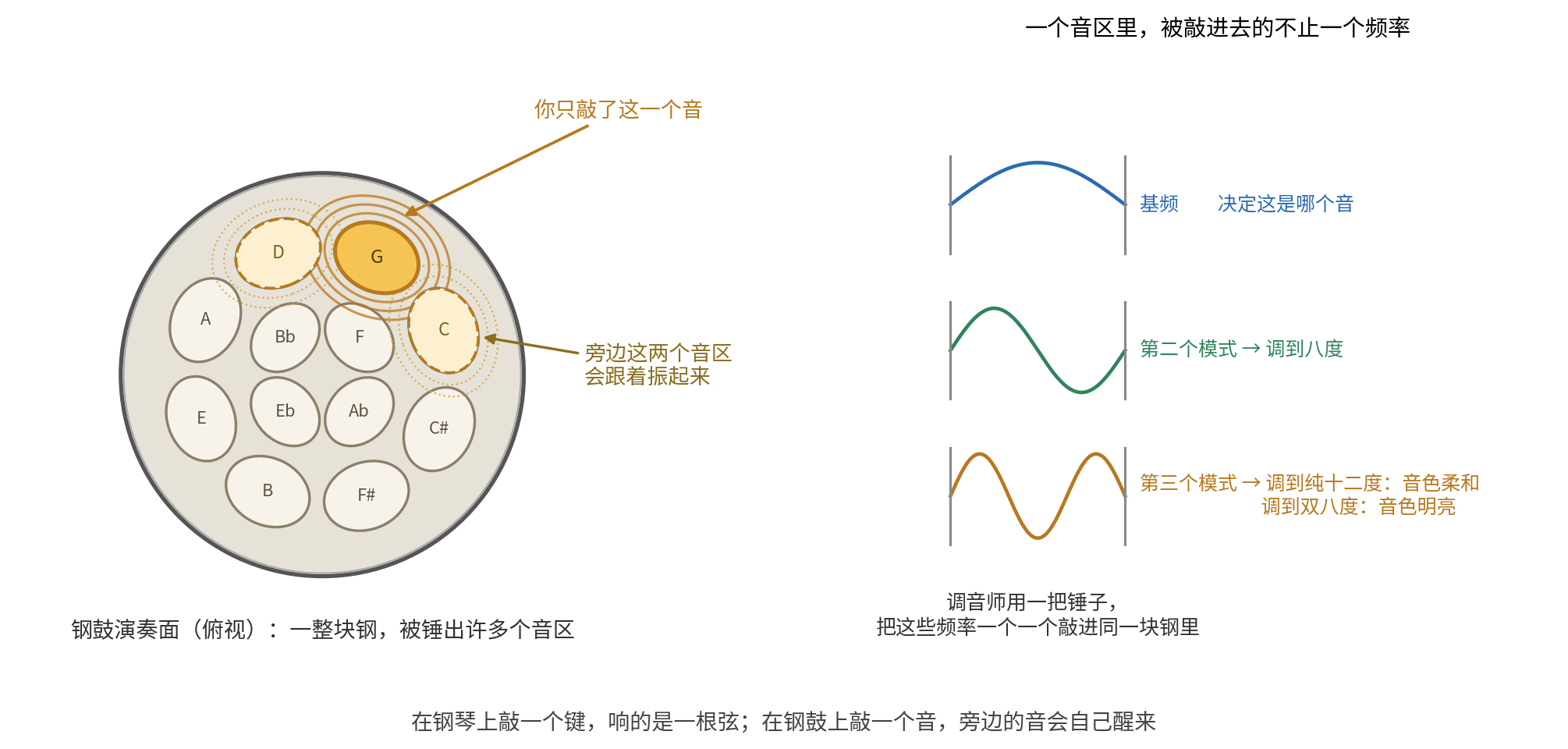
To make a steelpan, one end of an oil drum is hammered into a shallow bowl that becomes the playing surface. That surface is divided into note areas, each producing a different pitch. The remaining cylindrical body, known as the skirt, acts as a baffle, acoustically separating the two sides of the playing surface.
So far, this is merely "many notes on a sheet of steel." Two further facts make it extraordinary.
First, the tuner also hammers overtones into every note.
The Physics Today paper says that an expert builder "also tunes at least one overtone of each note area to a harmonic of the fundamental (nearly always the octave)." In larger note areas, "a second overtone is tuned to either the third or the fourth harmonic."
Then comes its loveliest sentence:
"Tuning the third mode to a perfect twelfth (the third harmonic) produces a more mellow sound; tuning it to a double octave (the fourth harmonic) produces a brighter sound."
The tuner is not merely hammering pitch into steel. The hammer also determines whether the future note will sound mellow or bright. It selects timbre.
How difficult is that? The same paper gives a number. Of the configurations tested, only about 1.2 percent produced a tuned second harmonic. Of those, only about 4 percent produced a third harmonic as well.
Second, the notes wake one another up.
The paper reports:
"Striking the B3 note on a steelpan simultaneously excites the nearby B4 and B5 note areas."
"Damping the B4 note causes a very noticeable change in the timbre of B3."
As the striking force increases, "more and more note areas are excited, until at normal playing levels nearly the entire pan is vibrating and radiating sound."
Press a key on a piano and one string sounds. Strike one note on a steelpan and the notes beside it wake up. When a band plays at full force, the whole drum sings as one.
It is not a sheet of steel with many notes arranged on it. It is one sheet of steel taught to be many notes at once, while continuing to vibrate as a single body.
One image is worth remembering. Two steelpans stand today on the third floor of the United Nations General Assembly Building in New York. The Caribbean Community presented them on November 17, 1995, to mark the UN's 50th anniversary. They, too, were made from 55-gallon oil drums.
From One Drum to a Whole Street
How did the steelpan travel from Trinidad to London? There is a precise year: 1951. The Trinidad All Steel Percussion Orchestra, or TASPO, came to Britain and performed at the Festival of Britain to great acclaim. Some members stayed. Fifteen years later, several of them helped establish steelpan at Notting Hill.
Another turning point came in 1973, when organizer Leslie Palmer introduced static sound systems. A Jamaican form had been grafted onto a Trinidadian carnival. The organizers call Notting Hill the "only full-scale carnival in the world to feature multiple static sound systems."
Then there is "mas," short for masquerade. Its history matters more than the feathers. Google Arts & Culture says mas emerged in the 19th-century Caribbean after emancipation, when formerly enslaved people "mockingly mimicked plantation owners" and incorporated elements of African culture to create it.
Trace the three feathers in today's Doodle backward, and they began as a joke - a joke at the master's expense.
About 15,000 costumes covered in sequins and feathers are now made each year.
How Many People? Three Official Figures, Three Answers
One discrepancy deserves to be shown exactly as it is.
Three official sources give three different attendance figures. Today's Google Doodle says more than two million. Notting Hill Carnival Ltd., the organizer, says it expects more than one million visitors. The Royal Borough of Kensington and Chelsea, which issues the licenses, says the event attracts hundreds of thousands each year.
Who is wrong? Probably no one. An open event with no tickets or fences, spread across several streets, cannot be counted exactly; it can only be estimated. Different estimators, methods and definitions produce different numbers.
The organizers themselves qualify their claims that it is second only to Rio and Europe's largest street event with words equivalent to "considered to be." Google states the claim as fact.
Those differences in phrasing matter more than any one number.
A Carnival Museum in Chinatown
Does this festival have a connection to China? It does, but the line runs through Trinidad, not London.
On December 11, 2025, Chinese Ambassador to Trinidad and Tobago Ren Hongyan visited a local steelpan manufacturer, Trinidad and Tobago Instruments Ltd. China's Ministry of Foreign Affairs recorded his words:
"The Trinidad and Tobago steelpan plays an important role in cultural exchanges between China and Trinidad and Tobago. We hope that the two sides will use the steelpan as a bridge to deepen cooperation in the cultural industries and promote people-to-people exchanges."
The steelpan as a bridge.
At the other end of it is a more concrete image. In January 2026, the same ambassador attended an exhibition at the Carnival Museum of Trinidad and Tobago. The ministry's account notes that the museum, founded in 2021, stands in Port of Spain's Chinatown.
The museum of Trinidad Carnival is in Chinatown.
That is not a metaphor. Chinese people have been arriving in Trinidad and Tobago for more than two centuries. The country holds an annual dragon boat festival commemorating their arrival; the 2025 edition drew nearly 30 teams and more than 1,000 spectators. In 2026, Trinidad and Tobago also held a Lunar New Year temple fair.
On one side is a carnival museum in Chinatown; on the other, a Lunar New Year fair on a Caribbean island. The bridge runs both ways.
(One limitation should be clear: no evidence was found of a steel band or a conservatory steelpan program in China. For now, this bridge stands mostly on the Trinidad and Tobago side.)
China's closest parallel can be found on its national Intangible Cultural Heritage list: Puning Yingge, included in the first group in 2006 and associated with Jieyang, Guangdong. Its official description contains four words that capture the structure of carnival: "dancing while walking." Groups range from 12 performers to 108. Each carries a pair of brightly colored wooden sticks and moves down the street to gongs, drums and shouted calls.
It is a procession in motion, not a performance fixed to a stage. People in two hemispheres arrived at the same form.
Sixty Years
In 1966, the steel band Laslett invited walked down Portobello Road, and the neighborhood began walking with it.
Today, the same street will hold hundreds of thousands of people, or one million, or two million - see above. Every steel band that passes still depends on the same method: hammer the end of an oil drum into a bowl, then work the overtones into it one by one.
An instrument invented under prohibition and a festival that grew from a neighborhood scarred by riots became, 60 years later, Europe's largest street celebration. Today they also appear on the browser homepages of hundreds of millions of people.
Sources: the official Google Doodles page (August 30, 2026); the official history and 2026 schedule from Notting Hill Carnival Ltd.; the Royal Borough of Kensington and Chelsea's official events schedule; the Museum of London, "The Origins of Notting Hill Carnival"; the UK National Archives, "Empire Windrush"; Royal Museums Greenwich; Goldsmiths, University of London's Windrush passenger-list database; Rossing, Hampton & Hansen, Physics Today, March 1996; the United Nations pages for World Steelpan Day and the UN Gift Collection; Caribbean Community reporting on the steelpan national-instrument legislation; the Google Arts & Culture collection on Notting Hill Carnival; the Greater London Authority's 2026 funding announcement; reports from the Embassy of the People's Republic of China in Trinidad and Tobago (December 2025, January 2026 and October 2025); China's official Intangible Cultural Heritage website, "Yingge (Puning Yingge)"; the Exploratorium's Chladni Singing exhibit notes; and Harvard University's Natural Sciences Lecture Demonstrations.