
An 18-meter fish eats things smaller than a grain of rice; the spots on its back are recognized by an algorithm built to catalog stars.
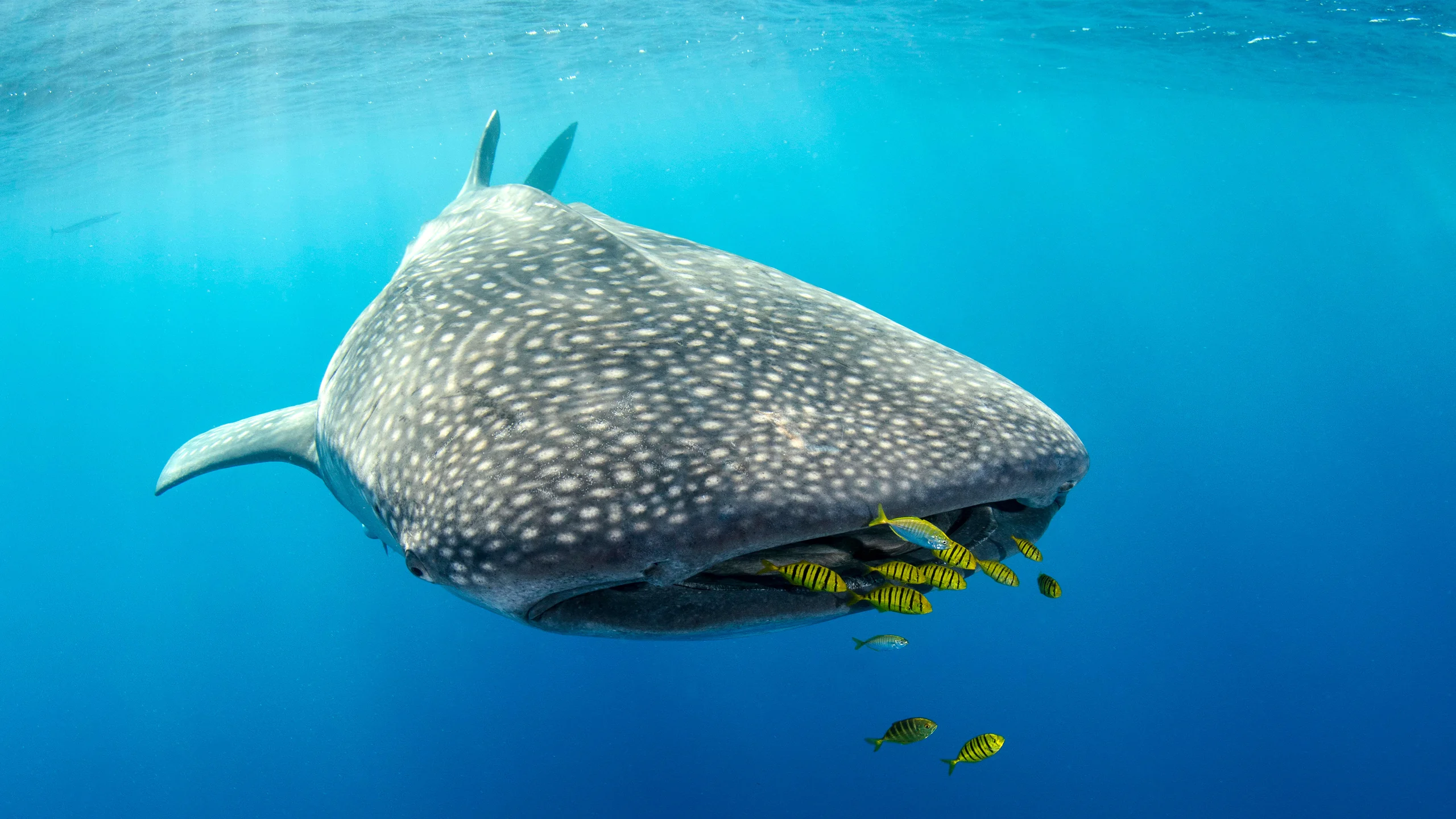
Image: Bing Daily Wallpaper | Whale shark and golden trevallies, Cenderawasih Bay, West Papua, Indonesia (© Pete Oxford/Nature Picture Library)
Open Bing's Chinese homepage today and an underwater photograph fills the screen. A giant fish crosses the frame, its body covered in pale spots as though someone had scattered stars across dark blue cloth. A small group of golden fish holds close to its head like an escort.
Bing calls the image The Giant Fish Called a Shark. It does not say why it chose today. But the date gives the reason: August 30 is International Whale Shark Day, the 19th since the observance began in 2008.
Two Things First
First, it is a fish, not a whale. It breathes through gills, its body is covered in placoid scales, and it is unmistakably a shark. Second, it is the largest living fish. Those two facts make its name: whale shark.
How large does it grow? Scientists devoted an entire paper to that apparently simple question. The figure most often repeated online is 20 meters. But Sizing Ocean Giants, published in PeerJ in 2015, sorted through the records one by one and concluded that an 18.8-meter specimen from the Arabian Sea off India was the most reliably measured and precisely documented. For the more spectacular figures in circulation, the paper's verdict was plain: no one could establish how they had been measured.
Weight is more awkward still. Figures of 20, 30 and 34 metric tons appear in print, but almost none comes from actually weighing a living whale shark. There is no practical scale for the job.
The length of a fish can be measured while its weight remains almost beyond measurement. That is the first lesson here in what it means to know something.
The Largest Fish Eats the Smallest Things
A whale shark has thousands of teeth, each only three to five millimeters long, and uses none of them to eat. Its food is plankton: krill, copepods, fish eggs and small fry.
That presents a problem. Its filter mesh has openings only 1.2 millimeters wide, yet measurements by Motta and colleagues off the Yucatán Peninsula in 2010 found that it processes 326 to 614 cubic meters of seawater per hour - more than 300,000 to 600,000 liters.
A kitchen colander makes the difficulty obvious. Pour soup through one and leaves press against the holes, slowing the flow until the mesh clogs. Why does a whale shark's filter not do the same?
The answer is crossflow filtration. The paper says water and suspended particles pass at high speed roughly parallel to the gill arches or filter pads. Water exits between the pads while particles are carried toward the back of the pharynx, where they gather and are swallowed.
The key word is parallel. A colander clogs because water moves perpendicularly through the mesh and pins debris against it. A whale shark sends water along the filtering surface. Particles are not pressed into the mesh but swept toward the throat.
It is not sieving. It is sweeping.
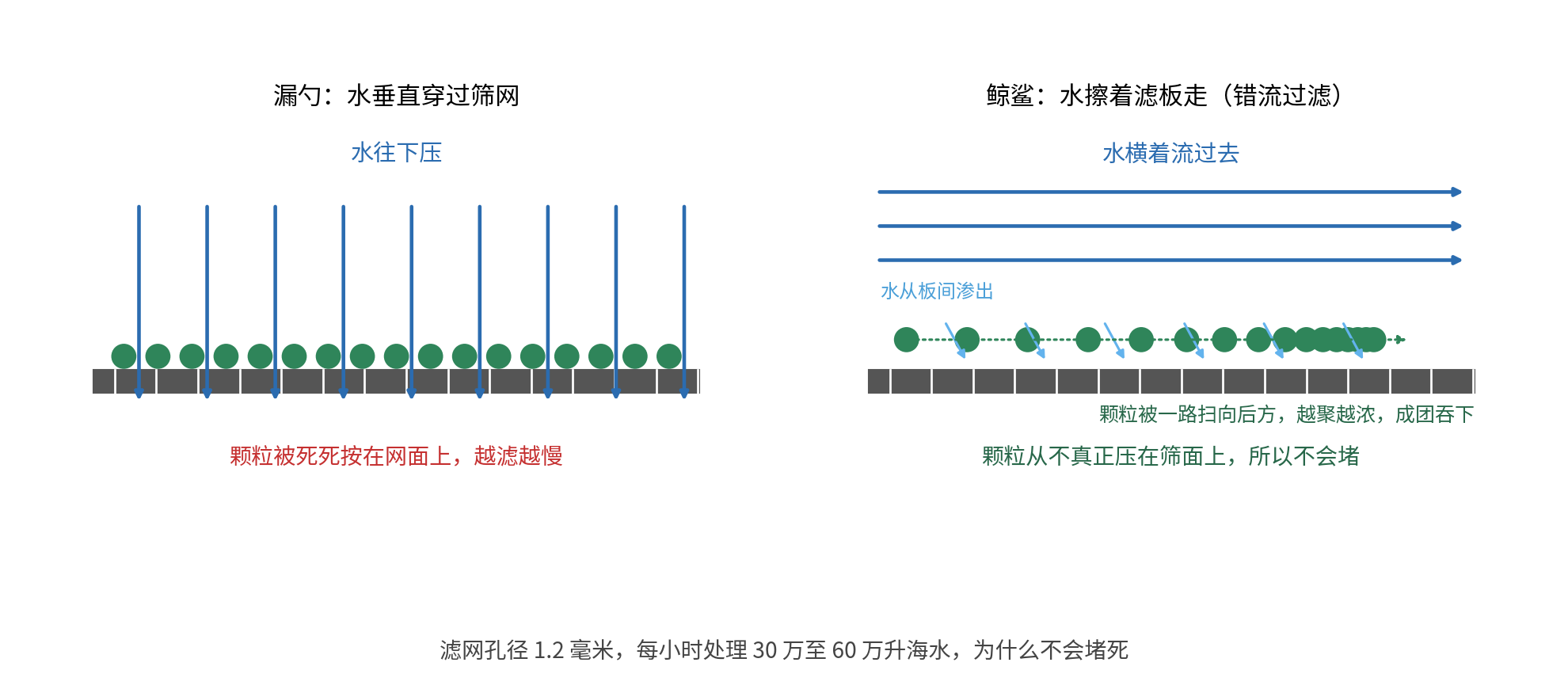
Even so, the filter occasionally needs clearing. Motta recorded whale sharks forcefully expelling accumulated material through the mouth, rather like a cough, on average once every 7.4 minutes.
Another fact overturns an intuition. The largest land animals - elephants, giraffes and sauropod dinosaurs - all eat plants. The largest fish was long assumed to eat only animal plankton. In 2022, Meekan and colleagues at the Australian Institute of Marine Science used stable-isotope analysis on whale shark tissue and found the chemical signature of Sargassum. The Chinese Academy of Sciences summarized the study under the blunt headline Whale Shark Is the Largest Omnivore. Meekan observed, "On land, the biggest animals have always been herbivores." The pattern appears to hold in the water too.
An Algorithm for Stars Recognized Ten Thousand Fish
Look again at those spots.
Every whale shark has a unique pattern that remains unchanged for life, like a fingerprint. A 2021 study verified this directly with genetic markers. In West Papua, spot patterns allowed researchers to identify two encounters with the same individual 10.63 years apart.
The problem is finding the same fish among tens of thousands of photographs.
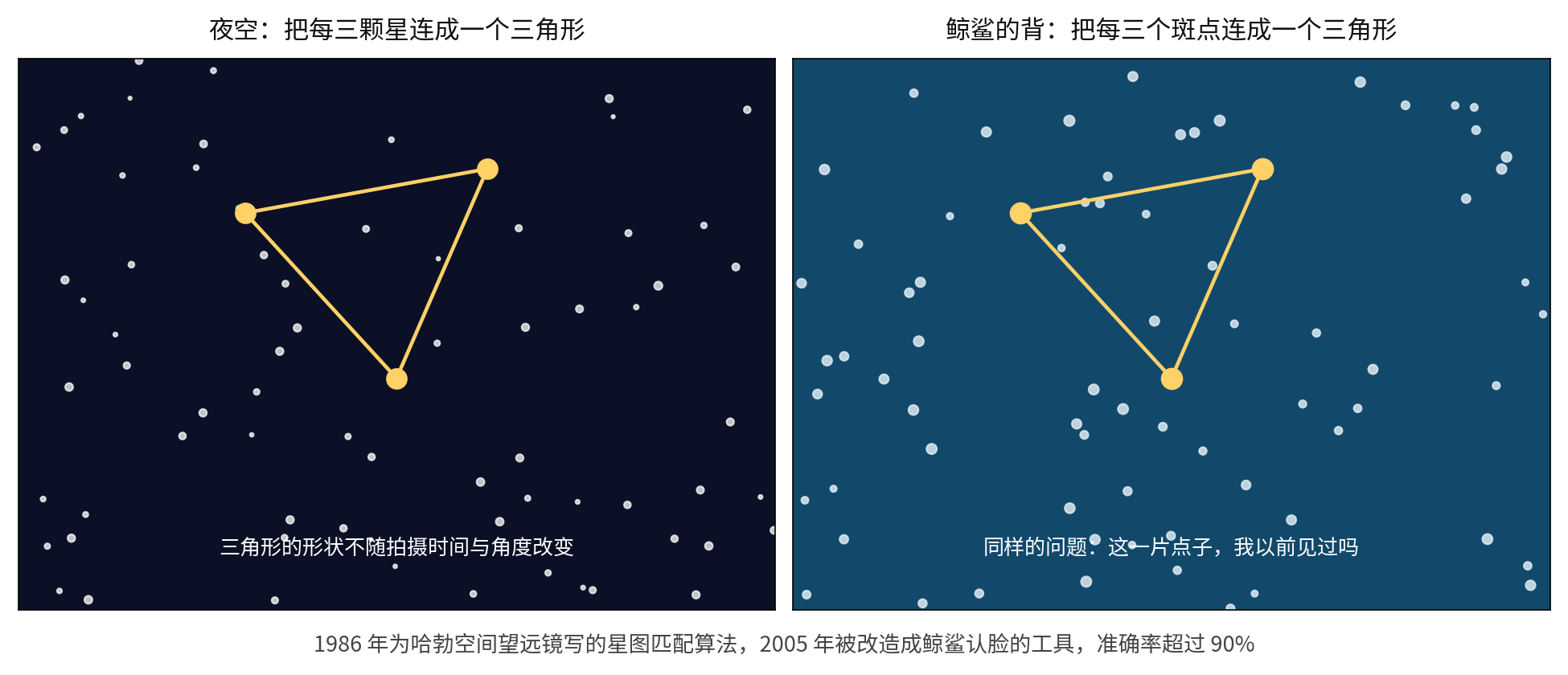
The story begins in 1986. Princeton physics professor Edward J. Groth wrote a pattern-matching algorithm for the Hubble Space Telescope. Within a star field, it joined each set of three stars into a triangle, then compared those triangles with another image. Because the stars' relative positions did not change, the triangles became an identity card for that region of sky. The algorithm was later incorporated into Hubble's data-processing software.
In 2002, Portland software programmer Jason Holmberg encountered a whale shark while diving in the Red Sea. He contacted Brad Norman, who had founded ECOCEAN in Perth and spent years identifying Ningaloo whale sharks one by one from their white spots. For the technical challenge, they turned to Goddard Space Flight Center astrophysicist Zaven Arzoumanian, who participated in his spare time, independently of his NASA work.
Stars are fixed points of light in a photograph. Shark skin stretches and twists as the animal swims, while underwater light flickers. The group added spot extraction, rotation correction and contrast enhancement. Arzoumanian later described their approach this way:
"What we actually did was make an extremely precise algorithm a little less precise."
The results appeared in the Journal of Applied Ecology in 2005. Matching accuracy exceeded 90 percent, and the system immediately uncovered more than 100 previously unnoticed repeat identifications in the existing archive.
Looking up at the night sky and down at a whale shark's back poses the same mathematical question: have I seen this field of points before?
A Bay Named for a Bird of Paradise
The photograph was taken in Cenderawasih Bay, or Teluk Cenderawasih, in West Papua, Indonesia. Cenderawasih means bird of paradise. Its former name, Geelvink, came from a Dutch frigate that passed through in 1705. The bay was renamed from a colonial vessel to a local bird.
A bay named for a bird in the sky is home to the largest fish underwater.
The whale sharks here differ from those in most other places: they are present almost every day.
The reason lies in a fishing platform known locally as a bagan: a boat, a huge wooden frame, and a net suspended 10 to 20 meters below the surface. A row of lights hangs above it all night, drawing plankton and small fish. The fish the whale sharks want are also the fish the crews are trying to catch.
The sharks have learned to visit. They turn upright and lift their heads above the surface, vacuuming small fish from the edges of the nets. Cenderawasih is one of the few places in the world where this posture can be observed reliably.
A 2025 study reviewed 13 years of photographs, from September 2010 through October 2023, and identified 268 individual whale sharks, 159 of them in Cenderawasih Bay. Several figures are especially revealing. Males made up 89.8 percent, a male-to-female ratio near nine to one. Most were juveniles four to five meters long. More than half were identified again at least once, and 1,118 sightings occurred "almost entirely around lift-net platforms."
One tempting inference requires care. Another study fitted fin-mounted satellite tags to 16 whale sharks and followed them for more than a year. Only four remained inside the bay for the entire tracking period; one traveled 5,144 kilometers away.
Residence is a property of the place, not of each fish. The bay is more like a restaurant that always has guests, while the guests keep changing.
This Whale Shark Day Is Different
A recent change has not yet reached many reference works: the whale shark is no longer listed in Appendix II of the Convention on International Trade in Endangered Species of Wild Fauna and Flora, or CITES.
At the 20th Conference of the Parties, held in Samarkand, Uzbekistan, from late November to early December 2025, a proposal jointly submitted by 17 countries including Argentina, the Bahamas, Bangladesh, the Philippines and the Maldives was adopted. The whale shark moved from Appendix II to Appendix I, the convention's highest level of protection, reserved for species threatened with extinction and allowing trade only in exceptional circumstances. The change took effect on March 5, 2026, exactly 178 days before today.
The uplisting was adopted by consensus, without a vote.
That makes today the first International Whale Shark Day since the species received the highest level of international trade protection.
Twenty-three years earlier, at the 12th Conference of the Parties in Santiago, Chile, a proposal from India, Madagascar and the Philippines made whale sharks and basking sharks the first shark species ever placed in CITES Appendix II. The world's two largest fish entered together and, 23 years later, moved one level farther together.
The whale shark remains classified as Endangered on the IUCN Red List. The assessment estimates declines of about 63 percent in the Indo-Pacific, more than 30 percent in the Atlantic, and more than 50 percent globally. The time span is three generations, which for whale sharks means 75 years.
Why do three generations take so long? A whale shark does not produce its first offspring until roughly age 30. It takes longer to become a parent than a human takes to reach 30.
Its lifespan has an ingenious measure. In 2020, Ong, Meekan and colleagues dated whale sharks using carbon-14 left by nuclear testing. Atmospheric tests during the 1950s and 1960s injected carbon-14 into oceans worldwide, creating a global timestamp. By slicing a vertebra and locating the growth band in which carbon-14 suddenly rose, researchers could determine the year that band formed. They confirmed that one growth band forms each year. Some had suspected two per year, which would have cut previous age estimates in half. The oldest animal in the sample was 50 years old. The Australian Institute of Marine Science gave its announcement an excellent title: Cold War Nuclear Tests Reveal the True Age of Whale Sharks.
One caveat matters: the study did not conclude that whale sharks live for 100 years. That figure is an extrapolation beyond the data, not the paper's result.
What Are the Small Yellow Fish Doing?
The golden fish close to the whale shark's head are juvenile golden trevallies.
Their position is deliberate. A 2024 paper devoted to the association says that in many cases the trevallies occur "immediately adjacent to the shark's mouth," where individuals measuring 30 to 100 millimeters are usually found. Citing hydrodynamic research, the authors explain that the front of a whale shark is where a small fish receives the greatest reduction in drag.
The paper's larger proposal is more interesting. The little fish are not simply hitchhiking; the whale shark serves as a floating nursery. In the open ocean there is no coral reef or mangrove in which to hide, so one fish uses another fish's body as a kindergarten. The authors suggest this relationship may explain how golden trevallies came to occupy the entire Indo-Pacific: they grow up riding whale sharks.
Juvenile golden trevallies also shelter among jellyfish tentacles. The two places that look most dangerous to humans are safest for the little fish. As adults they lose their gold color, turn silver-gray, leave, and become predators that dig crabs from the sand.
The One in China
The whale shark is a Class II nationally protected wild animal in China. It is explicitly listed in the revised national register issued in February 2021. The Chinese-language Wikipedia article still says it is not on China's protected wildlife list; that statement is obsolete and wrong.
The protection is more than language on paper. In September 2023, the Taizhou Coast Guard in Zhejiang responded to a report, detained a vessel that had harmed a whale shark that same night, and arrested those involved. Official media explained the rule plainly: a captured whale shark must be released immediately; even a dead one must be reported to the authorities. Confirmed capture and sale can bring criminal prosecution.
Just over a year earlier, immediately before International Whale Shark Day, a whale shark appeared near Zhucha Island, Qingdao, in the Yellow Sea of northern China. Li Xinzheng, a researcher at the Institute of Oceanology of the Chinese Academy of Sciences, offered two explanations, one worrying and one welcome.
The first was that the year had been exceptionally hot: warmer seawater brought a warm-water whale shark into the Yellow Sea. The second was that the nearshore environment of Shandong was improving, because healthy marine ecosystems contain abundant plankton and food.
The same sighting was both a warning about climate change and evidence of environmental recovery.
Across the Taiwan Strait is another record worth preserving. Taiwan established a whale shark catch-reporting system in July 2001 and then imposed a declining annual quota: 80 animals in 2002, 65 in 2005, 60 in 2006, 30 in 2007, and a complete ban beginning in 2008. This was not a single prohibition but a curve from 80 to zero over six years.
One Last Thing No One Knows
We know whale sharks can live beyond 50.
We know they can cross the Pacific. A whale shark named Anne, described in a 2018 paper, traveled 20,142 kilometers from waters off Panama to the vicinity of the Mariana Trench. Smithsonian scientist Héctor Guzmán, who studied her, said, "We know very little about why whale sharks migrate. Are they looking for food? Looking for mates? Or driven by something else?"
We even know how deep they dive, though that fact comes with a revealing turn. Textbooks for more than a decade gave 1,928 meters as the deepest whale shark dive. In 2026, scientists recognized an awkward possibility: that figure might be the tag's limit rather than the shark's. Commercial depth sensors generally withstand only 2,000 meters. The team built a custom tag rated to 2,500 meters and attached it to a seven-meter juvenile male in Australia's Coral Sea. It descended somewhere between 1,978 and 2,527 meters.
What looked for a decade like the whale shark's depth record was really the length of our ruler. When an answer lands exactly on an instrument's upper limit, it is probably the instrument, not the answer.
We know a whale shark's eyeball carries roughly 2,900 scales. It has no eyelids, so it grows scales on the eye itself, and can retract the eyeball halfway into the socket in less than a second.
We know that every spot pattern is as unique as a fingerprint, and a star-cataloging algorithm has recognized 10,000 individual faces.
But humanity has thoroughly examined only one pregnant whale shark. The 10.6-meter female caught off eastern Taiwan in the 1990s carried more than 300 embryos, the largest litter known in any shark. Sources still disagree about the year, the precise number of embryos and their lengths, because there has been only one such animal. A single specimen is the sum of what we know about reproduction in the world's largest fish.
A paper published in 2025 could still write:
"Globally, no whale shark pupping ground or nursery area has yet been identified."
Where is the largest fish on Earth born?
No one knows.
The ocean still holds questions waiting to be asked.
Sources: Bing China Daily Wallpaper (August 30, 2026); McClain et al., PeerJ 3:e715 (2015); Motta et al., Zoology 113(4) (2010); Arzoumanian, Holmberg & Norman, Journal of Applied Ecology 42(6) (2005); NASA Spinoff 2009; Setyawan et al., Frontiers in Marine Science 12:1607027 (2025); Meyers et al., Pacific Conservation Biology 26(4) (2020); Sheaves et al., Pacific Conservation Biology 30(1) (2024); Ong, Meekan et al., Frontiers in Marine Science 7:188 (2020); Meekan et al., Ecology (2022) and the Chinese Academy of Sciences summary; Guzmán et al., Marine Biodiversity Records 11:8 (2018); Miller et al., Hydrobiology 5(2):10 (2026); Syakurachman et al., Diversity 17:839 (2025); Tomita et al., PLOS ONE 15(6) (2020); Womersley et al., PNAS 119(20) (2022); the IUCN SSC Shark Specialist Group's Cenderawasih Bay ISRA factsheet; the CITES CoP20 proposal result published by the Government of Canada and US Fish and Wildlife Service bulletin PB-26-001; China's List of National Key Protected Wild Animals (2021); Qingdao Daily's Guan Hai News; Taiwan's responsible authority, Results of Whale Shark Total Catch Controls and Release Measures; Sharkbook (sharkbook.ai); the World Wide Fund for Nature shark program; and Western Australia's Department of Biodiversity, Conservation and Attractions.
(The Bing wallpaper photograph is licensed by Microsoft for wallpaper use. This article links to it and does not reproduce it independently.)