
One city, one ceiling and a man who calculated pi to 16 digits.
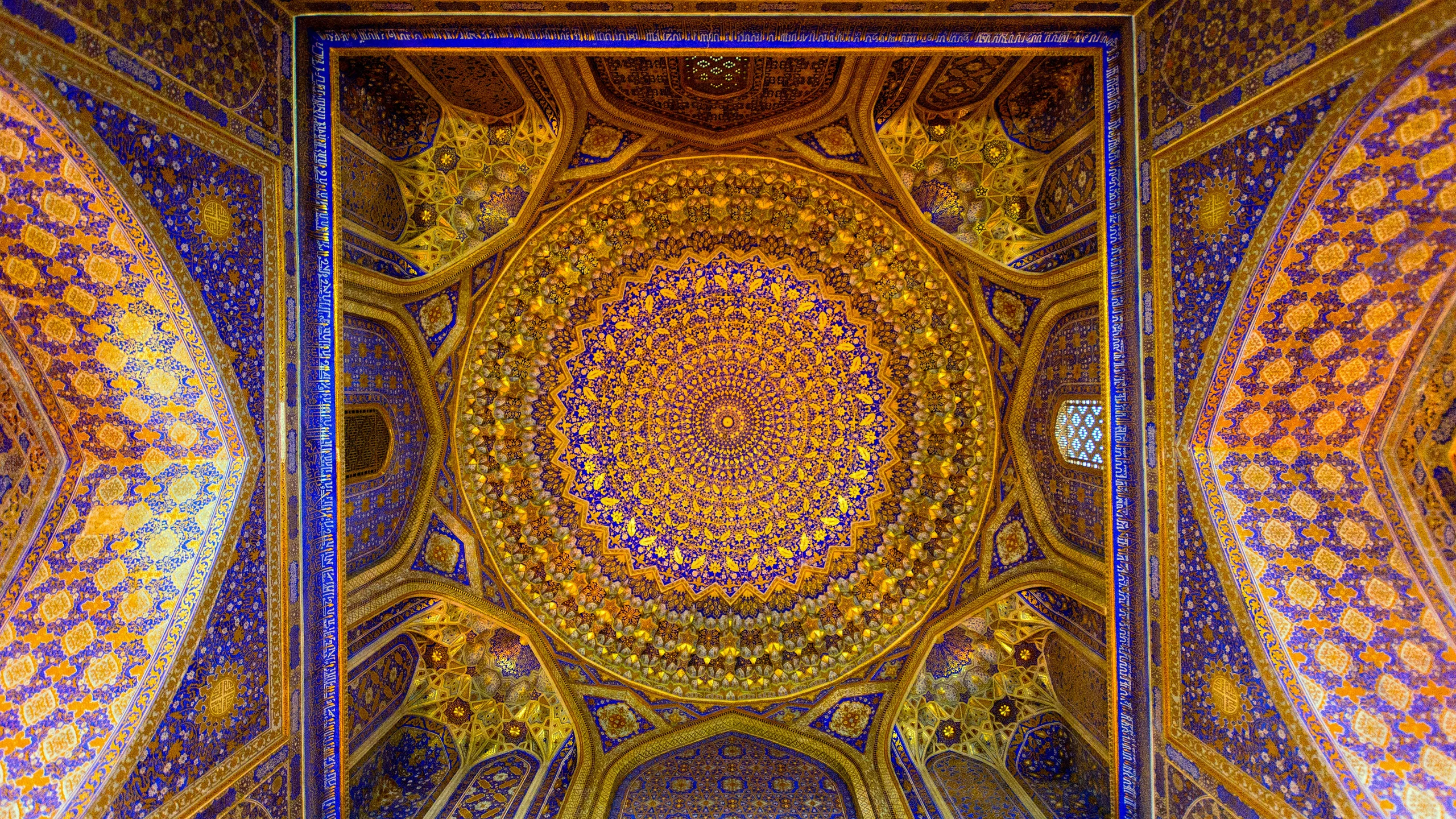
Image: Bing Daily Wallpaper | Architectural detail in Registan Square, Samarkand, Uzbekistan (© Piero M. Bianchi/Getty Images) | View on the Bing homepage
Open Bing today and there is no mountain, sea or animal on the screen. There is only a pattern: dark blue glaze folding inward layer by layer until it almost makes you dizzy. Bing calls it A Masterpiece of Patterned Art.
This is Registan Square in Samarkand, Uzbekistan. Bing says only "architectural detail" and does not identify the building, so this article will not guess. But one fact can be established immediately. These patterns were not painted or printed. They were assembled, and the people who assembled them may have worked with only five shapes.
The Square's Name Means "Sandy Place"
The word Registan comes from Persian and literally means "sandy place." Today it is a square enclosed by three madrasas built in three different centuries.
The earliest is the Ulugh Beg Madrasa, constructed from 1417 to 1420 and now more than 600 years old. Ulugh Beg, its patron, later taught there himself. The other two arrived two centuries later: the Sher-Dor Madrasa, built from 1619 to 1636, and the Tilya-Kori Madrasa, built from 1646 to 1660. Both were sponsored by Yalangtush Bahadur, the 17th-century governor of Samarkand.
In 2001, UNESCO inscribed the city as "Samarkand - Crossroad of Cultures," making this its 25th anniversary on the World Heritage List. One sentence in the evaluation deserves attention: its architecture "played a seminal role in the developments of Islamic architecture over the whole region, from the Mediterranean to the Indian subcontinent." The radius of influence of one ceiling crosses two continents.
An optical mechanism directly related to that ceiling is worth noting. The famous "golden dome" inside the Tilya-Kori Mosque is actually flat. Archnet, the scholarly database, explains that the dome effect is an elaborate trompe l'oeil, with blind arches supporting three tiers of honeycomb-like rings. You look up and see a sphere where no sphere exists.
Five Shapes and a Wall Full of Stars
Now for the underlying mechanism.
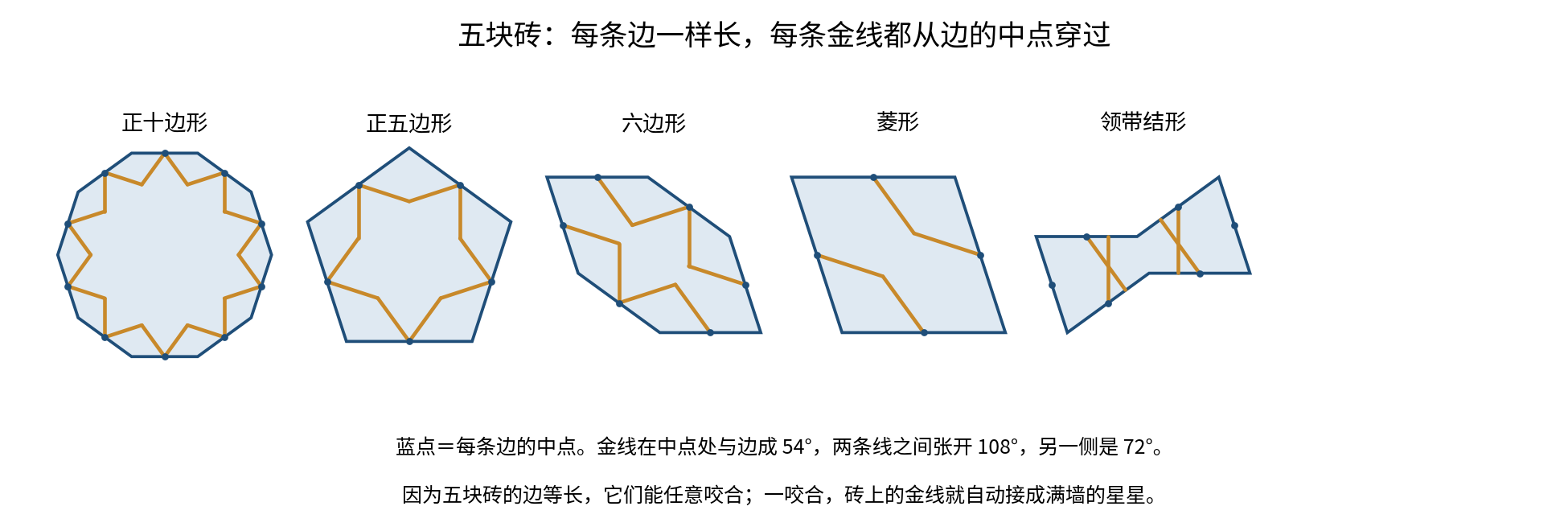
In 2007, Peter Lu and Paul Steinhardt published a paper in Science arguing that the bewilderingly complex star patterns of medieval Islamic architecture could be assembled from a set of equilateral polygons. These girih tiles come in five shapes: a decagon, a pentagon, a hexagon, a rhombus and a bow tie.
Two properties matter. First, every edge of every tile has the same length, so the shapes can interlock like floor tiles. Second, decorative lines have already been drawn across each tile, always crossing the midpoint of an edge at fixed angles of 72 and 108 degrees.
Then the trick unfolds. Arrange the tiles and their lines join by themselves, growing into a wall full of stars. A craftsperson does not need to draw one immense plan across the wall and copy it square by square. The same five actions can simply be repeated.
Imagine five cookie cutters, each stamping a few lines into its cookie. Pack the cookies closely across a table, then look up: the lines have connected into a complete design.
This is not speculation. The paper says that ink outlines of the five girih tiles appear in panel 28 of the Topkapi Scroll. That pattern book is a 29.5-meter-long, 33-centimeter-wide roll of parchment containing 114 drawings, now held in the Topkapi Palace Library in Istanbul.
An Argument That Still Has Not Ended
This requires a pause, because the dispute is more instructive than its conclusion.
The most sensational part of Lu and Steinhardt's paper was not the five tiles. It was their claim that a pattern on the Darb-i Imam shrine in Isfahan, dating to 1453, could be mapped one to one onto Penrose tiles, the nonrepeating quasiperiodic forms devised by a 20th-century mathematician. Of 3,700 tiles, they counted only 11 mismatches, each an isolated point that could be repaired locally.
The claim was beautiful, and it drew a thorough challenge.
That same year, Emil Makovicky responded in Science that the pattern's large-scale framework was actually periodic, a conventional Seljuk method, and "as constructed, cannot be extended into a quasiperiodic pattern." If one wished to find quasiperiodicity, he added, the date should move back to the Blue Towers of Maragha from 1196 and 1197, not Isfahan in 1453.
Two years later, mathematician Peter Cromwell wrote an even sharper critique. His methodological point went to the heart of the matter: given only a finite patch of tiling, it is impossible to determine whether the pattern is periodic. His judgment of the craftspeople was perhaps the fairest sentence in the debate: they had the tools to construct quasiperiodic patterns, but not the theoretical framework.
One widely repeated claim also needs correction. Islamic art is often said to have used all 17 possible symmetries of the plane. Mathematics does indeed permit only 17 wallpaper groups, first classified by Fedorov in 1891. But after mathematician Branko Grunbaum examined the Alhambra pattern by pattern in 2006, he accepted only 13 groups there. No study could be found that counts the symmetry groups of Samarkand, so no number is given here.
How a Flat Plan Becomes a Honeycomb Ceiling
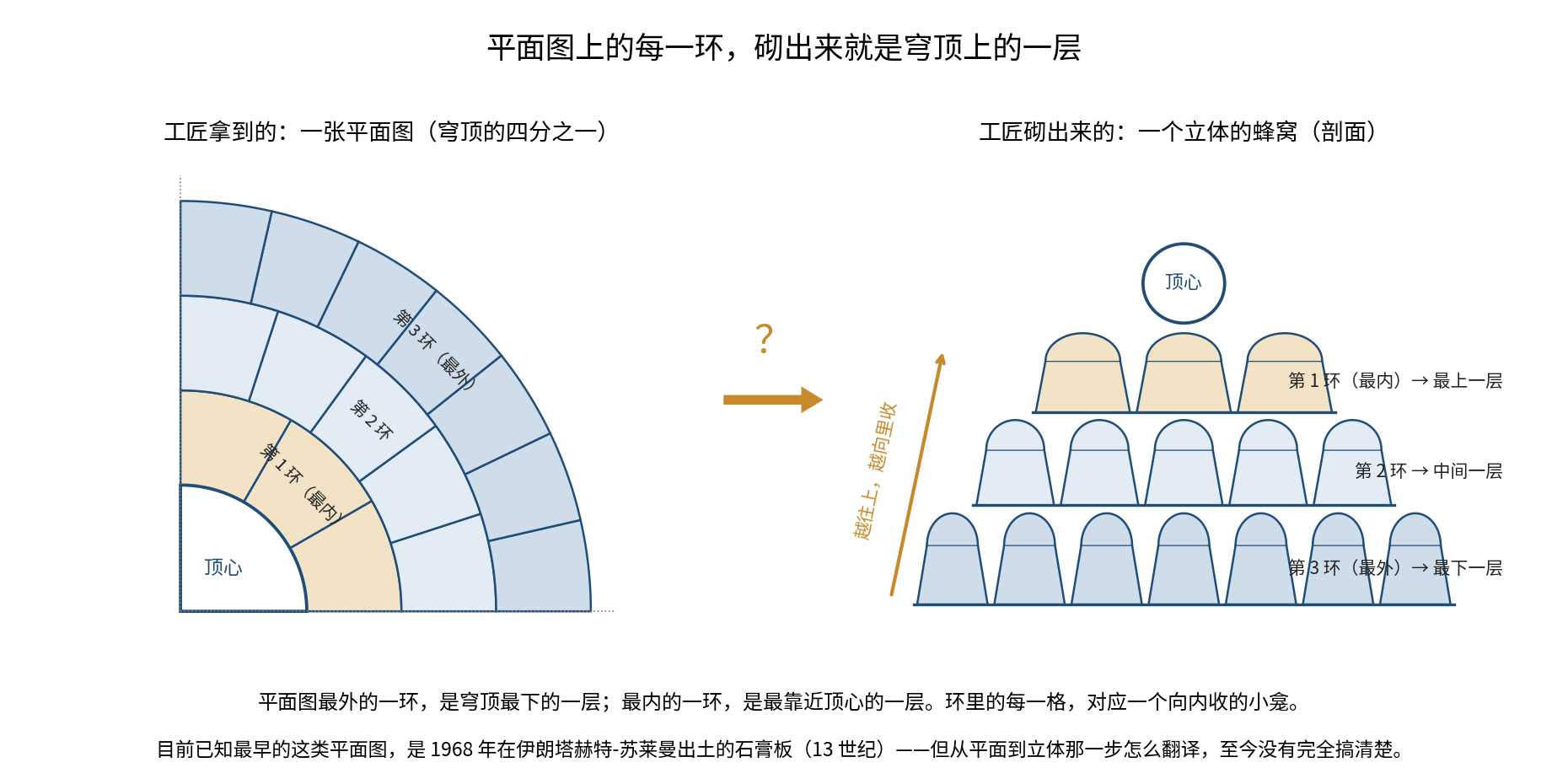
The honeycomb structures that fold inward in tiers are called muqarnas. Their hardest feature to grasp is that they are three-dimensional, while the craftsperson's plan was two-dimensional.
In 1968, a German archaeological team excavated a plaster panel at Takht-i Sulayman in Iran. It was 47 centimeters high, 50 centimeters wide and less than four centimeters thick, engraved with "the planar projection of one-quarter of a muqarnas dome." Dating to the 13th-century Ilkhanid period, it is the earliest known example of an architectural working drawing.
Eight hundred years ago, in other words, a craftsperson took a flat drawing and built a three-dimensional honeycomb. Exactly how that plan was translated into space is still not fully understood. Every drawing in the Topkapi Scroll is flat. We know they were used for construction, but we do not know the conversion rules.
The Man Who Built the Madrasa Was an Astronomer
Ulugh Beg lived from March 22, 1394, to October 27, 1449. He was Timur's grandson and the ruler of Samarkand. What truly absorbed him, however, was the sky.
In 1420 he began building an observatory in the city. The structure was a three-story cylinder 46 meters in diameter and more than 30 meters high. Its central instrument was a giant meridian arc with a radius of 40.04 meters. Researcher Kevin Krisciunas calls it "by far the largest meridian instrument ever built," with a resolution of a few arcseconds, each one 1/3,600 of a degree.
Why make it so large? Before the telescope, angular precision came from the absolute size of the scale. The longer the arc occupied by one degree, the more finely that degree could be divided. On a radius of 40 meters, one degree spans about 70 centimeters. This was not merely an instrument. It was a building.
The observatory produced the Zij-i Sultani, a star catalog with an epoch of July 4, 1437. It lists 1,018 stars in 48 constellations. More than 20 southern stars could not be seen from Samarkand; they were copied from earlier sources and corrected for precession.
Even so, Krisciunas's assessment holds. Between Ptolemy, around AD 170, and Tycho Brahe, around 1600, this was the only important star catalog produced in more than 1,400 years.
Ulugh Beg measured the sidereal year as 365 days, six hours, 10 minutes and eight seconds. The modern value is 365 days, six hours, nine minutes and 9.8 seconds. He missed by 58 seconds. Without a telescope or a clock, a masonry arc and a team looking upward for more than a decade came within a minute.
In the Same Courtyard, Someone Was Calculating Pi
This is the central fact of the story.
The leading scholar at Ulugh Beg's observatory was Jamshid al-Kashi. In July 1424, he calculated pi accurately to 16 decimal digits. He did it by approximating a circle with a regular polygon containing 3 x 2^28, or 805,306,368, sides. More than 800 million.
Whose record did he break? Zu Chongzhi's. The fifth-century Chinese mathematician had established that pi lay between 3.1415926 and 3.1415927, and for almost 900 years no one surpassed him. Al-Kashi did, and his own record stood for roughly 180 years. The University of St Andrews' mathematics history calls it an achievement "far beyond anything that had been obtained before, whether by the ancient Greeks or the Chinese."
In The Key to Arithmetic, completed in 1427, the man who calculated pi did something else. Using decimal fractions, he calculated the total surface area of different types of muqarnas.
Put those two facts together. In the same city and the same life, one man was pursuing Zu Chongzhi's circle and calculating how much material a ceiling like the one on today's screen would require. The blue pattern before you and the number 3.1415926 learned in school were, 600 years ago in Samarkand, two parts of the same person's work.
Al-Kashi died in Samarkand on June 22, 1429. Twenty years later, Ulugh Beg was killed too, assassinated on his son's orders. In 1941, Soviet anthropologist Mikhail Gerasimov opened the Gur-e Amir mausoleum. The forensic conclusion was that the third cervical vertebra had been severed by a sharp weapon. His beheading was recorded not only in chronicles but in bone.
(The popular story that Germany invaded the Soviet Union three days after the tomb was opened because of "Timur's curse" should be treated as legend. Even people close to those present said it was invented.)
The Strongest Link to China Is Not Papermaking
When the Silk Roads are discussed, one story appears repeatedly. At the Battle of Talas in 751, Chinese prisoners included papermakers, and Samarkand thereby learned to make paper.
It is a compelling story, but it does not stand securely. Encyclopaedia Iranica, citing scholar Jonathan Bloom, calls it "just a story" for two reasons: paper was already being made in Central Asia before 751, and Chinese paper used bast fibers while early Persian paper was made chiefly from rags. In fairness, Bloom did not completely rule out a contribution from Chinese prisoners, and records of papermaking spreading west from Samarkand do appear only after Talas. By the 10th century, texts said Samarkand paper was "exported all over the world."
Two other links are much firmer.
First, the city's names in Chinese during the Tang period. The Book of Wei called it Xiwanjin, the Book of Sui called it Kang, and Xuanzang wrote Samojian in the Great Tang Records on the Western Regions, adding that "rare and precious goods from foreign lands gather in this country." In 658, the third year of the Xianqing era under Emperor Gaozong, the Tang established the Kangju Area Command at Samarkand. Two independent sources support the date: Chinese state media and Encyclopaedia Iranica both point to 658.
The second link is better: Samarkand painted China on its walls. In 1965, roadwork at the Afrasiab site in old Samarkand uncovered seventh-century murals. The west wall is known as the Ambassadors' Hall, where envoys from different countries present tribute. The north wall is the "Chinese wall". One side shows riders hunting leopards. The other is a scene on water, with musicians aboard a boat and "a woman larger than her attendants" feeding fish. Scholars interpret it as the court of the Tang emperor Gaozong and Wu Zetian.
Thirteen centuries ago, people in Samarkand painted a Chinese woman feeding fish on their wall and made her larger than everyone around her. The murals remain in the small museum beside the site.
Later, during the Yongle reign, Chen Cheng traveled there twice as an envoy and wrote Records of the Countries in the Western Regions and Itinerary of the Western Regions. Research by the Palace Museum includes a precise detail: the Timurid Empire ordered craftspeople to imitate Chinese blue-and-white porcelain, establishing kilns in Samarkand, Nishapur and Shiraz in the early to mid-15th century to produce Chinese-style wares. In 1404, Spanish envoy Ruy Gonzalez de Clavijo saw a caravan from China in Samarkand.
There is also the story running in the opposite direction. Timur himself set out to invade Ming China in December 1404, unusually choosing a winter campaign, and died on the road at Otrar in mid-February 1405. The grandfather marched toward China and died en route. The grandson stayed in Samarkand and turned it into an observatory.
The newest link is active. Since 2012, Chinese and Uzbek archaeologists have worked as a joint team. At Mingtepa on the southern edge of the Fergana Valley, the Chinese team discovered an outer city, expanding the known site from a 0.5-square-kilometer inner city to 2.8 square kilometers. It is very likely the capital of the Han-era kingdom of Dayuan. New evidence arrived this April at another site: fragments of silk from a roughly 1,500-year-old family tomb contained madder, indigo and other dyes pointing to sources in southern China.
Why Did Bing Choose Today?
Bing does not say. Its original English text discusses glazed tiles, geometry, calligraphy and the Silk Roads, without mentioning a holiday.
The date nonetheless stands out. On August 31, 1991, Uzbekistan adopted its declaration of independence. The statutory celebration is held on September 1; China's Ministry of Foreign Affairs lists "Independence Day: September 1." This is the 35th anniversary, and the main celebrations already took place last weekend, with a drone light show and fighter jets carrying the flag.
The precise claim is therefore that this image falls within the celebrations for the 35th anniversary of Uzbekistan's independence. Whether that is why Bing selected it cannot be confirmed, so no reason is invented.
Another current event is more striking. The 2026 Shanghai Cooperation Organisation summit runs from August 30 to September 3 in Bishkek, Kyrgyzstan, and opens today. A common error deserves correction: the summit held in Samarkand was on September 16, 2022. News about the China-Kyrgyzstan-Uzbekistan railway is also being updated today. Its section in Kyrgyzstan covers 304.84 kilometers, nearly 60 percent of the route, with 50 planned bridges, 29 tunnels and 20 stations, ending at Andijan in Uzbekistan. The railway terminates in the country whose blue tiles appear on today's screen.
How Much of That Blue Is 600 Years Old?
An uncomfortable fact belongs here, because this account will not polish the story for anyone.
UNESCO's official page states that "inappropriate restoration interventions ... have affected the authenticity of the property." At Registan specifically, the person overseeing restoration from 1982 onward regarded the exterior decoration as merely the building's "clothing." Completely resurfacing all three madrasas with newly fired glazed tiles was therefore "simply a matter of efficiency," and reinforced-concrete domes were used to represent Soviet technological progress. Islamic-art scholar Robert Hillenbrand called projects of this kind "inaccurate and poorly executed."
No reliable source gives a percentage for modern reconstruction, so none is offered here. The honest version is this: a substantial part of the blue in the photograph was fired anew in the 20th century. That is not a fraud; a 600-year-old building will collapse without repair. It simply makes the word "original" more complicated.
That is precisely why the photograph deserves a second look. The pattern is real, the geometry is real, and the logic of the five tiles has not changed in 600 years. What changed was the kiln and the date of firing.
Sources: Bing HPImageArchive (zh-CN); UNESCO World Heritage Site No. 603, "Samarkand - Crossroad of Cultures"; Archnet (MIT/Aga Khan) entries for Tilya-Kori and the Ulugh Beg Observatory; MIT 4.614 Islamic Architecture course notes; Lu & Steinhardt, Science 315:1106 (2007); Makovicky, Science 318:1383 (2007); Cromwell, The Mathematical Intelligencer 31 (2009); Grunbaum, Notices of the AMS (2006); the Getty publication The Topkapi Scroll; Muqarnas research on the Takht-i Sulayman plaster panel; R. H. van Gent's Utrecht University pages on Ulugh Beg's observatory and star catalog; Krisciunas, The Legacy of Ulugh Beg; the MacTutor History of Mathematics entries for Ulugh Beg, al-Kashi and Zu Chongzhi; Britannica, Risalah al-muhitiyya; Encyclopaedia Iranica on the Afrasiab murals and papermaking; Xuanzang's Great Tang Records on the Western Regions, as cited by China Daily's Dao Zhonghua; the Palace Museum, "Cultural Exchange Between the Ming Dynasty and the Timurid Empire as Seen in Paintings from the Yongle Period"; the Belt and Road Portal on joint Chinese-Uzbek archaeology; People's Daily, April 9, 2026; China's Ministry of Foreign Affairs country profile for Uzbekistan; the Ministry's Samarkand Declaration of the Council of Heads of State of the Shanghai Cooperation Organisation; China News Service, August 26 and 31, 2026; IIAS, The Restored Splendours of Timurid Samarqand; National Geographic, January 10, 2022; TED-Ed, The Complex Geometry of Islamic Design; and the Metropolitan Museum of Art, Islamic Art and Geometric Design.