
One joke, one public runway table and one subtraction. That is enough to tell which way the aircraft was flying.
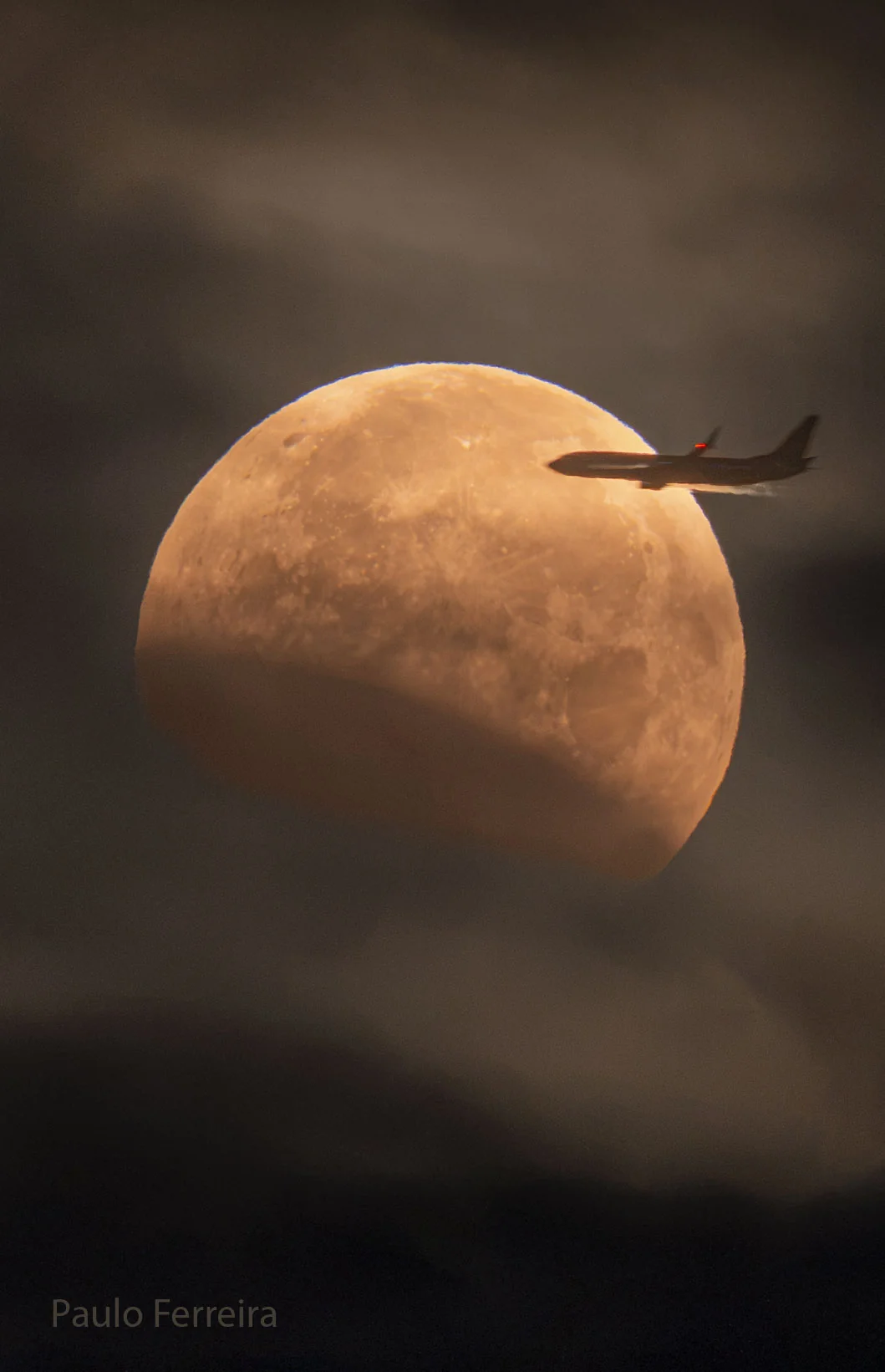
Image: NASA Astronomy Picture of the Day (APOD) | Image credit: Paulo Ferreira | Today's page
Today's APOD is an unusual photograph: a climbing airliner and a Moon with a large bite taken out of it by Earth's shadow, together in a single frame. It was taken last week in Portugal.
NASA begins its caption with a joke:
"Do you have to sit on the right side of the airplane to see this lunar eclipse?"
No. But if you happened to be sitting on the left, NASA continues, "you might have some initial difficulty."
The joke can be taken seriously. You can calculate the answer.
One Subtraction
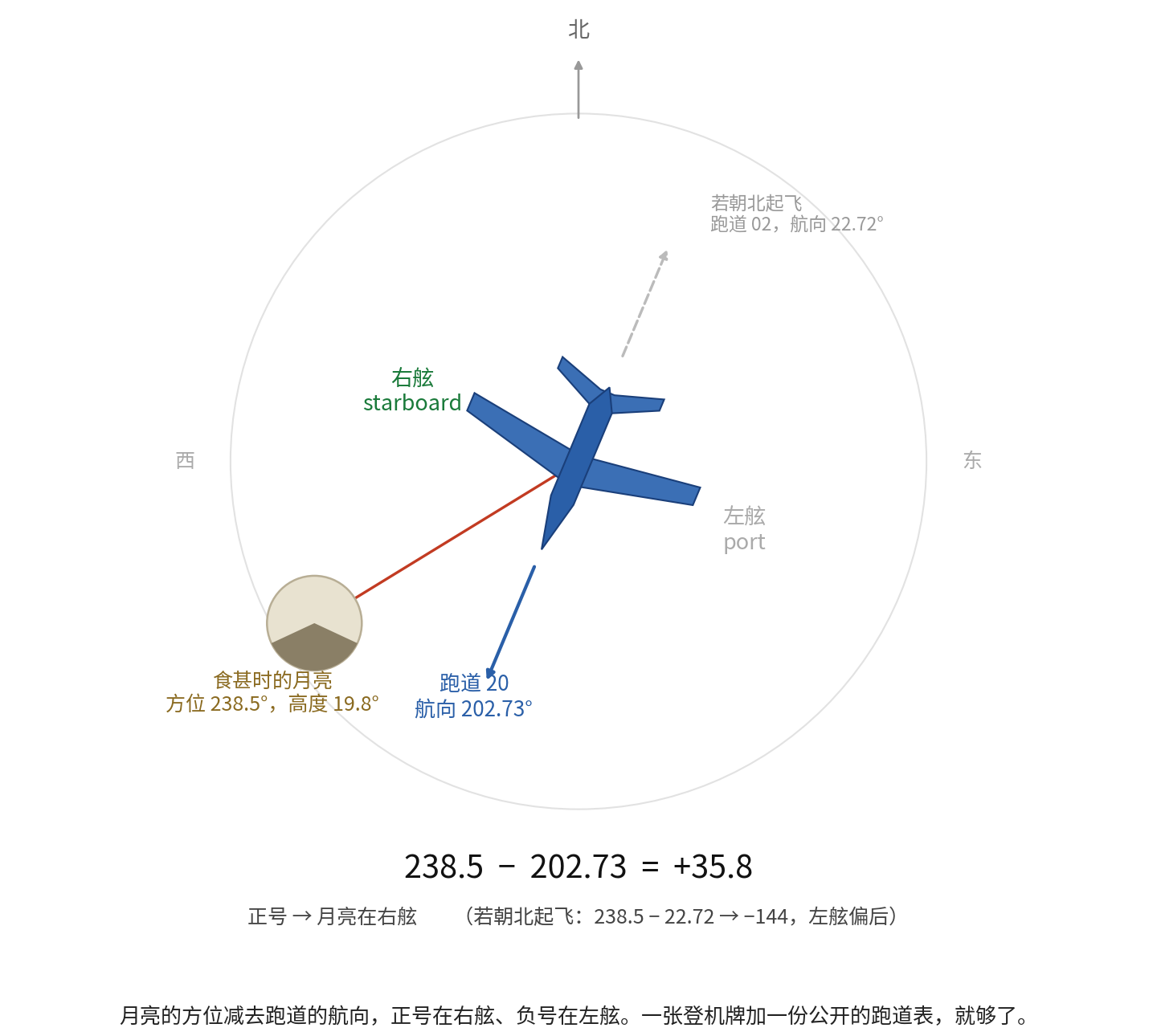
Lisbon Airport has a single runway. That is not a guess. Portugal's Aeronautical Information Publication, in the edition effective from August 6, 2026 - the edition in force on the morning of the eclipse - states it plainly: Runway 02 has a true bearing of 22.72 degrees; Runway 20 has a true bearing of 202.73 degrees. One strip, two directions: an aircraft departs roughly north or roughly south.
The greatest phase of last week's lunar eclipse occurred at 5:13 a.m. local time in Portugal on Friday, August 28. At that moment, the Moon stood west-southwest, at an azimuth of 238.5 degrees and an altitude of 19.8 degrees.
Now subtract.
For a southbound departure on Runway 20, with a heading of 202.73 degrees: 238.5 - 202.73 = +35.8. Positive. The Moon is on the starboard side, slightly ahead.
For a northbound departure on Runway 02, with a heading of 22.72 degrees: 238.5 - 22.72 = 215.8, or -144 when normalized to the range from -180 to +180 degrees. Negative. The Moon is on the port side, behind you.
NASA says a passenger on the left would have some trouble at first, which places the Moon on the right. The table permits only one answer: the aircraft was taking off to the south.
One joke, a runway table anyone can consult online and a subtraction tell you which way the airplane was pointed when it left the ground.
(For precision: establishing which runway direction Lisbon and Porto were actually using that day would require wind records from that morning, and those were not found. Strictly speaking, the southbound departure is inferred backward from NASA's sentence; it is not independent evidence. The inference is consistent, but it remains an inference.)
What If You Chose the Wrong Side?
That is the second half of NASA's answer. Because lunar eclipses generally last for several hours, once the aircraft is airborne, you can "soon safely cross the aisle to see it."
The line sounds casual, but it contains a beautiful comparison of scale.
First ask: can the aircraft's flight move the Moon to the other side?
No, and not even close. An airliner travels about 900 kilometers in an hour. The Moon is 384,400 kilometers away. By the small-angle formula, how far does that 900-kilometer displacement shift the Moon's apparent direction?
900 / 384400 = 0.00234 radians = 0.134 degrees = 8.05 arcminutes.
Eight arcminutes. How wide does the Moon itself appear? About 31 arcminutes. After a full hour of flight, the Moon has not even moved through its own apparent width. It has shifted by only a quarter of a Moon.
(Eight arcminutes is not too small to see. The naked eye can resolve one or two arcminutes, and eight can be measured against background stars in a photograph. Historically, the Moon's distance was measured using parallax of this kind. The point is not that the displacement is invisible, but how it compares with the next number.)
During the same hour, Earth's rotation moves the Moon's azimuth by 10.7 degrees, from 238.5 to 249.2 degrees.
That is 643 arcminutes.
Eight versus 643: a ratio of 1 to 80.
An hour and 900 kilometers of flight buy you eight arcminutes. Simply letting time pass gives you 80 times as much, free, through Earth's rotation. NASA is entirely serious about crossing the aisle: in this case, two meters sideways accomplish more than 900 kilometers forward.
(The literal sense in which an airplane cannot keep up with the Moon is this: the point on Earth directly beneath the Moon moves steadily westward. At Lisbon's latitude, its speed is about 1,259 kilometers per hour, while the aircraft manages only 900. A westbound flight can make the Moon set more slowly, but cannot stop it from setting.)
A Solar Eclipse Is a Private Screening; a Lunar Eclipse Is a Public One
The photograph's real subject lies in NASA's second sentence:
"Lunar eclipses are typically visible from half of planet Earth facing the Moon, making them one of the most commonly witnessed astronomical events."
Half the planet. It is worth doing the arithmetic because this is the key to understanding what makes a lunar eclipse different.
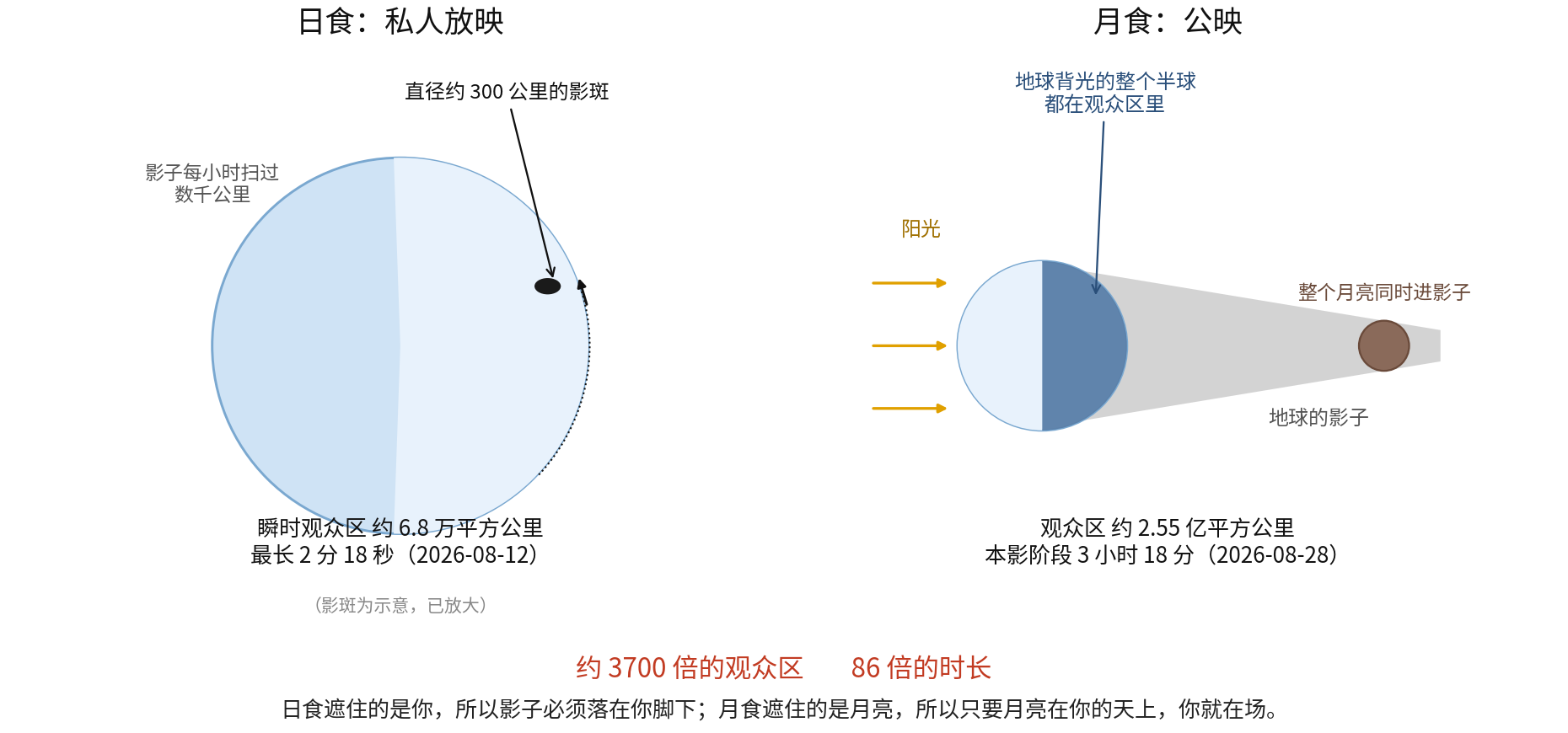
During a solar eclipse, you are what gets shadowed. The Moon's shadow must land on the patch of ground beneath your feet. How large is that shadow? NASA says its diameter is "about 300 miles, or 480 kilometers" at most. The measured path of totality for the solar eclipse of August 12 this year was 294 kilometers wide. A spot two or three hundred kilometers across races over Earth's surface at 3,000 to 7,000 kilometers per hour.
During a lunar eclipse, the Moon is shadowed. The entire Moon enters Earth's shadow at once, and everyone who can see it is looking at the same altered celestial object. It is like an audience watching a single screen go dark: every row sees the same screen.
The contrast in area is blunt:
The solar eclipse's instantaneous audience, treating its 294-kilometer-wide path as a circular spot, covered about 68,000 square kilometers.
The lunar eclipse's audience, half of Earth, covered about 255 million square kilometers.
The difference is about 3,700-fold.
Time tells the same story. At the longest point along the August 12 total solar eclipse, totality lasted 2 minutes 18 seconds. The umbral phase of the August 28 lunar eclipse - from the first bite of the umbra until the Moon left it completely - lasted 3 hours 18 minutes.
That is 86 times longer.
NASA's educational material for children makes the contrast especially sharp: "On average, a total eclipse occurs at the same place on Earth only once about every 375 years, for a few brief minutes."
Lunar eclipses arrive every few years. All you need to do is look up on the right night.
Seeing It and Seeing All of It Are Different Things
NASA's sentence needs one more layer, and that is precisely what makes this photograph more interesting.
It is true that half the planet can see a lunar eclipse. But seeing the beginning is not the same as seeing it from beginning to end, because the Moon eventually sets.
Last week's eclipse followed one universal timetable: the penumbral phase began at 01:24 UTC, the partial eclipse at 02:34, greatest eclipse came at 04:13, the partial eclipse ended at 05:52, and the penumbral phase ended at 07:02. Those moments were identical everywhere on Earth. Whether the Moon remained in the sky at each location was another matter.
Checking city by city to see whether the Moon stayed above the horizon for the entire umbral phase, from first to last contact, gives this result:
At Lisbon, the Moon was still +2.9 degrees high when it left the umbra, so observers could see the entire phase. At Porto it was +2.0 degrees, also enough. Seville barely made it. Madrid fell short by 1.8 degrees; Dublin by 2.7. The Moon set in London and Paris before the umbral phase ended. At greatest eclipse, it was already brushing Berlin's horizon at +0.3 degrees. Warsaw, Athens and Helsinki missed the greatest phase altogether; Moscow did not even see the umbral phase begin.
Across continental Europe, only the Atlantic fringe - Portugal and the southwestern corner of Spain - saw the performance from start to finish.
(NASA's official visualization uses the most accurate wording: the eclipse was visible from western Europe and western Africa. The looser label "Europe" used in various catalogs can suggest that Berlin and Lisbon saw the same show. China saw none of this eclipse; at greatest eclipse it was 12:13 p.m. Beijing time and the Moon was below the horizon. That is geometry, not luck.)
One widespread description also needs correcting: this was neither a total lunar eclipse nor a "blood moon." Its umbral magnitude was 0.9299, and 96.3% of the lunar surface entered the umbra. It fell 7% short of totality. This was a very deep partial lunar eclipse.
Sixteen Days, Two Shows
Put the two events together and the photograph acquires its full weight.
On Wednesday, August 12, 2026, a total solar eclipse crossed the Arctic, Greenland, Iceland and Spain. Its path of totality was 294 kilometers wide, and the longest totality lasted 2 minutes 18 seconds. Portugal lay outside the path. Neighboring Spain was inside it; Portugal was not. A strip only a little over 200 kilometers wide made the difference.
Sixteen days later, on Friday, August 28, the same sky presented a different show. This time Portugal not only saw it; it was the only place in continental Europe to see the entire umbral phase.
The same people, beneath the same sky, 16 days apart. A narrow line kept them outside the first time; the second time they had the best seats.
That is the difference between a private screening and a public one, performed in the most concrete way possible.
The photographer was not even an astronomical photographer. Public information describes Paulo Ferreira as a filmmaker and visual creator in the Porto metropolitan area. He did not spend the night keeping watch like a dedicated stargazer. One morning near an airport, he simply looked up.
That is what a public screening means: no ticket and no equipment. NASA puts it plainly: "You don't even need any special equipment - just your eyes."
(One misconception spread by marketing for solar-eclipse glasses is worth stopping here: viewing a lunar eclipse requires no eye protection. NASA says, "You don't need any special equipment to observe a lunar eclipse, although you do need a clear line of sight to the Moon." The rules requiring filters apply to the Sun.)
That Morning, the Moon Set After Daybreak
One more detail deserves its own section because it contains the geometry of the full Moon.
In Lisbon that morning, sunrise was at 7:02 a.m. and moonset at 7:11 a.m.
The Moon set nine minutes after the Sun rose. This full Moon descended through a daylit sky: as the Sun rose in the east, the Moon was still hanging in the west.
That is not a coincidence. A full Moon is full precisely because it stands almost opposite the Sun - as one rises, the other sets. A lunar eclipse can occur only at full Moon because only then can Earth stand directly between the Sun and Moon.
"A lunar eclipse occurs only at full Moon" is not a rule imposed from outside. It is another description of the same geometry.
China's Line: A Difference of 1,296 Kilometers in One Night
How do we measure the figure used throughout this article, the average Earth-Moon distance of 384,400 kilometers?
With lasers. A beam is fired at the Moon, reflected from a retroreflector on its surface, and timed on its round trip. China does this too.
On the night of January 22, 2018, the Yunnan Observatories of the Chinese Academy of Sciences used the laser-ranging system on a 1.2-meter telescope to receive pulses reflected by the retroreflector Apollo 15 left on the Moon. Its ranging precision was better than one meter.
A detail in the Xinhua report is more interesting than "better than one meter." The distances measured that night ran from 385,823.433 to 387,119.600 kilometers.
The difference in one night was 1,296 kilometers.
The Moon did not move that far. Earth's rotation carried the telescope at Lijiang through that distance. (These are distances from the observing station to the reflector, not the more commonly quoted average of 384,400 kilometers from Earth's center to the Moon's center. The discrepancy is on the scale of Earth's radius.)
This is the other side of the calculation earlier in the article. Seen from Earth's surface rather than its center, the Moon's direction differs by 57 arcminutes. Earth moves a telescope more than a thousand kilometers in one night, changing the measured distance by more than a thousand kilometers. An airliner covers 900 kilometers in an hour for an eight-arcminute change, while a telescope is carried through a distance measurable in thousands of kilometers overnight. It is the same geometry: beside an airport in Portugal, a filmmaker turned it into a photograph; on a mountain in Yunnan, observers measure it again each night with meter-level precision.
Half the planet saw last week's performance. Our side did not. The next one visible to us arrives in 2028.
But tonight at 8:30, the Moon will rise in the east, with more than 80% of its face illuminated. It is the same Moon Earth's shadow crossed four days ago.
Choose a rooftop and take a photograph. Return at the same time tomorrow and take another.
After seven days, you will hold evidence you measured yourself that the Moon has been moving all along.
Sources: NASA Astronomy Picture of the Day for September 1, 2026; NASA's official lunar- and solar-eclipse pages; NASA Space Place; NASA Scientific Visualization Studio (items 5672 and 5647); the NASA/GSFC lunar-eclipse catalog and 2026 lunar-eclipse bulletin; EclipseWise data for the total solar eclipse of August 12, 2026; the US Naval Observatory's rise-and-set API; the official NAV Portugal Aeronautical Information Publication for LPPT and LPPR, edition effective August 6, 2026; Xinhua's January 23, 2018 report on lunar laser ranging by the Yunnan Observatories of the Chinese Academy of Sciences.