
One person spent twenty-two years photographing Earth's shadow in full. This Friday brings another chance, though none of it will be visible from China.
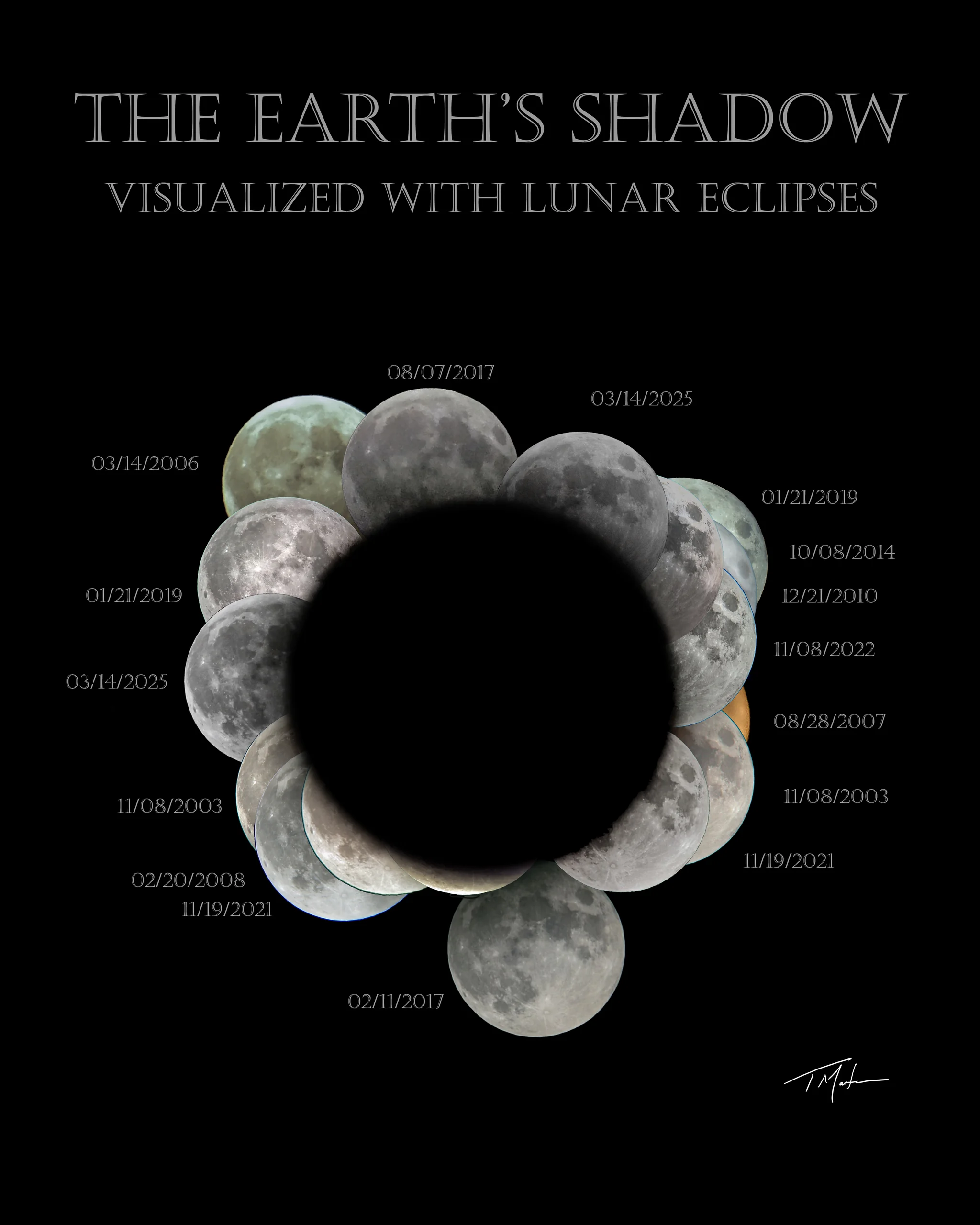
Image: NASA Astronomy Picture of the Day (APOD) | Image credit and copyright: Tim Martin | Today's page
Today's APOD begins with a question: "How did this big hole form in space?"
The answer follows immediately: "This is not a black hole. It is a shadow: the shadow of the Earth."
The Shadow You Miss Every Month
The image shows a huge dark disk rimmed with bright moons. Each moon records a lunar eclipse, with a piece bitten away by Earth's shadow. Put the moons in the positions where those bites occurred, and a circle that no one can ever see all at once emerges.
The key is that a single lunar eclipse can reveal only one arc of the circle.
APOD phrases it carefully: "Since at least the time of Aristotle, humans have noticed that the Earth's dark shadow across the Moon during a partial lunar eclipse is rounded - although never a complete circle."
"Never a complete circle" is the hinge of the story. Each time, the Moon grazes the shadow's edge and traces an arc. You can see the arc, but never the entire circle.
Unless you assemble twenty-two years of arcs.
The Photographer
APOD's credit gives only a name: Tim Martin. Its link leads to the faculty directory at Elon University in North Carolina, where he is a physics lecturer.
The university profiled him in March 2025, when it organized an observing event for that month's total lunar eclipse. The article said Martin had set up an advanced telescope imaging system for a ten-year project to make detailed lunar-eclipse images and outline the full profile of Earth's umbral shadow.
That is third-party evidence independent of APOD: he really has been doing this work, and for a long time.
How many eclipses did he use, from which years, and how did he align them? APOD's only cited source is a social-media post that could not be retrieved. So we do not know, and we will not invent an answer. We know only that APOD says "twenty-two years," while the university calls it a "ten-year project." A plausible guess is that the formal project began about a decade ago but used older material. That remains only a guess.
How Large Is the Shadow?
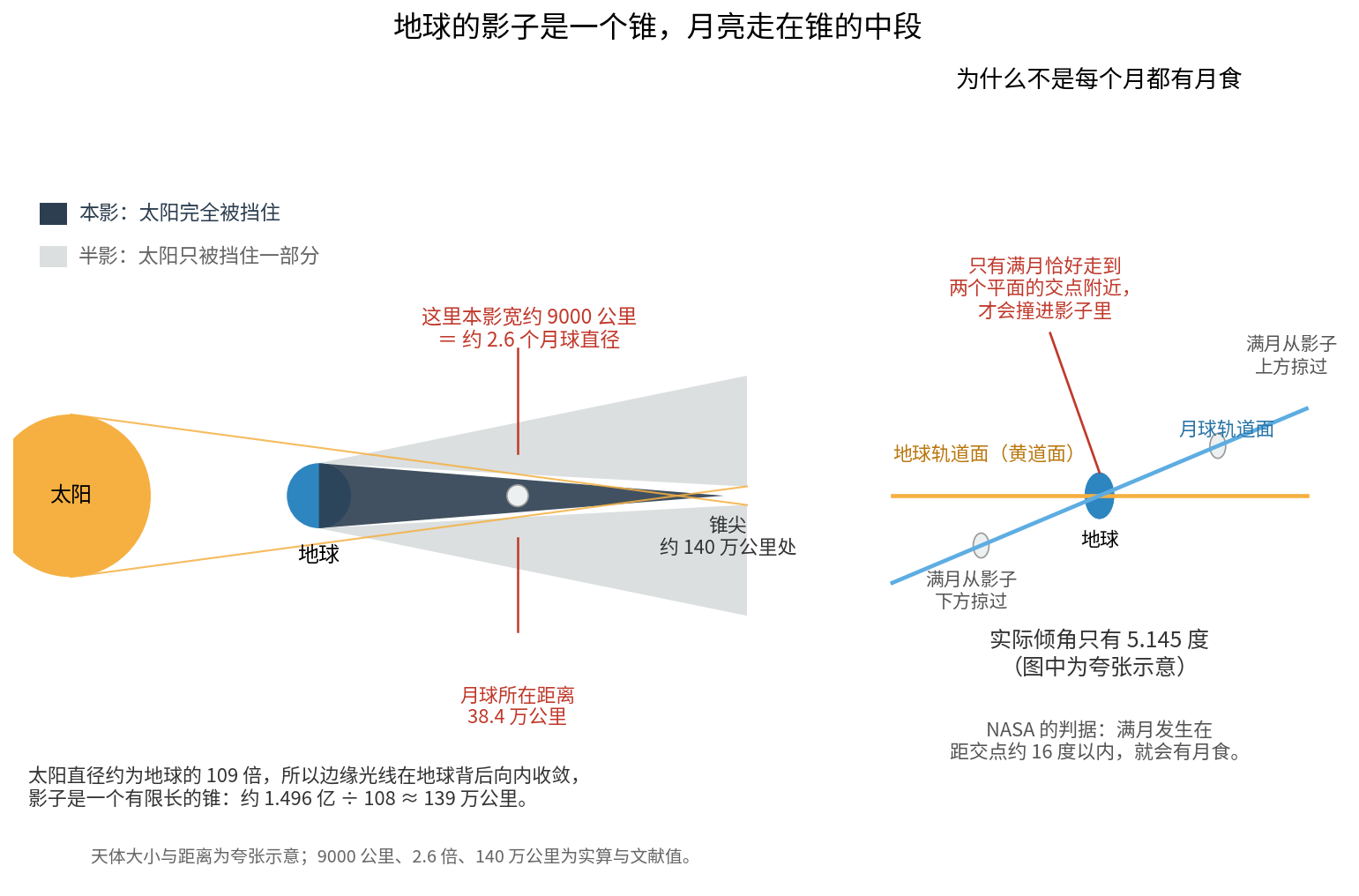
Earth's shadow is not a cylinder. It is a cone.
The reason is simple: the Sun is much larger than Earth, with about 109 times Earth's diameter. Light from opposite edges of the Sun passes around Earth and converges inward, producing a finite cone of darkness behind it.
How long is the cone? Similar triangles give an answer: cone length is approximately the Earth-Sun distance divided by 108, or 149.6 million kilometers divided by 108, which is about 1.39 million kilometers. An Ohio State University astronomy lecture gives "about 1.4 million kilometers long, roughly 3.7 times the average Earth-Moon distance," in agreement with the calculation.
The Moon, 380,000 kilometers away, travels through the forward-middle section of that cone. At lunar distance, the cone's cross-section is about 9,000 kilometers wide, or roughly 2.6 lunar diameters.
In angular terms, Earth's umbra spans about 1.3 degrees at the Moon's distance, while the Moon itself spans only 0.5 degrees.
What Aristotle Actually Said
APOD invokes Aristotle, so it is worth finding his actual words.
In Book II, chapter 14 of On the Heavens, he argues that Earth is spherical. After saying that sensory evidence further corroborates the conclusion, he writes in J. L. Stocks's translation:
"How else would eclipses of the Moon show segments shaped as we see them? As it is, the shapes which the Moon itself each month shows are of every kind - straight, gibbous, and concave - but in eclipses the outline is always curved: and, since it is the interposition of the Earth that makes the eclipse, the form of this line will be caused by the form of the Earth's surface, which is therefore spherical."
Notice the elegance of the argument: he separates lunar phases from lunar eclipses.
During the phases, the boundary between light and dark can be straight at quarter Moon, convex or concave, because the illuminated portion of the Moon itself is changing.
During an eclipse, however, the edge is always curved and always bends the same way. It is not the Moon's shape. It is Earth's shape projected onto the Moon.
(One point requires care. The common modern formulation is that only a sphere casts a circular projection from every angle. Aristotle did not explicitly make that stronger claim. He said only that an eclipse's edge is always curved, and therefore Earth's surface is spherical. Later writers supplied the more rigorous step.)
The Same Shadow Let Ancient Observers Measure the Moon
This is the most remarkable extension of the idea. The same shadow that reveals Earth's shape can also tell us the Moon's size.
Aristarchus's method worked roughly as follows.
First, during a lunar eclipse, measure the ratio between the angular diameter of Earth's umbra at the Moon and the angular diameter of the Moon. His result was about 2.7 to 1.
Second, use the fortunate fact that the Sun and Moon have nearly the same apparent diameter. The geometry then reduces to an exceptionally clean result:
Earth's radius = 3.7 x the Moon's radius.
What is the modern value? Earth's diameter is 12,742 kilometers and the Moon's is 3,474 kilometers, a ratio of 3.67.
More than two thousand years ago, using the naked eye, one eclipse and an angle-measuring instrument, the error was less than one percent.
(The method still works. In a 2021 paper in the Journal of the British Astronomical Association, several amateur astronomers reproduced it during the May 2021 lunar eclipse. Timing the umbra as it crossed Tycho crater gave an umbral diameter of 10,034 kilometers; drawing tangents to the umbral edge to locate its center gave about 8,800 kilometers. Their paper explicitly traced the technique back to Hipparchus. A two-thousand-year-old method can still be repeated with a phone and graph paper.)
A Subtle Problem: The Shadow Is 2 Percent Too Large
Pure geometry predicts one size for the umbra. Observers noticed long ago that actual eclipse timings did not match: the shadow was larger than it should be.
In the early eighteenth century, La Hire found that enlarging the umbra by about 1/41 made the calculation fit observations. Lambert later used 1/40 and Mayer 1/60. Beer and Madler derived 1/50 from an eclipse in 1833. Finally, Chauvenet adopted 1/50, or 2 percent. That figure became the standard enlargement used by many national astronomical institutions around the world to predict eclipses, and it remains in use.
Why is the shadow 2 percent too large? Because Earth is not a smooth bare sphere. It is wrapped in air. The atmosphere refracts and absorbs some sunlight that would otherwise skim Earth's edge, effectively making the planet larger.
Curiously, the number is still not fully explained. In 1951, Danjon argued for the more physical approach of adding the thickness of the opaque atmosphere, which he took as 75 kilometers, to Earth's radius. That yields only about 1 percent. The most rigorous modern method uses 87 kilometers and allows the shadow's cross-section to be an ellipse, because Earth is oblate. Yet a 2022 modeling study gave a theoretical value of about 211 kilometers, more than twice the empirical value.
A correction used for more than two centuries in every lunar-eclipse prediction still lacks a settled physical explanation. That is not a gap in knowledge so much as the visible edge of knowledge, and this is what an edge looks like.
Why Is There Not a Lunar Eclipse Every Month?
APOD includes a pun that works only in English: the Moon is not eclipsed every "moon-th." Its answer takes one sentence: "because the Moon's orbit around the Earth is slightly tilted."
How slight? NASA gives the average inclination as 5.145 degrees.
That is all it takes. If the Moon's orbit lay in exactly the same plane as Earth's orbit, every full Moon would bring a lunar eclipse and every new Moon a solar eclipse: twenty-four eclipses a year, enough to become routine. Instead, because of those five degrees, most full Moons pass above or below Earth's shadow.
Only when a full Moon occurs near a node, where the two orbital planes intersect, does it enter the shadow. NASA's criterion is that if the full Moon occurs within about 16 degrees of a node, some part of Earth will see a lunar eclipse.
That produces an eclipse season, the interval when the Sun is near a node. The midpoints of consecutive eclipse seasons are 173.3 days apart. Each season contains at least one and sometimes two lunar eclipses. In all, four to seven solar and lunar eclipses occur somewhere on Earth each year.
Solar and lunar eclipses also come in pairs, crowded into the same eclipse season about half a synodic month apart.
August 2026 is a perfect example.
On August 12, 2026, a total solar eclipse crossed Greenland, Iceland, northern Russia, the Atlantic and parts of Spain and Portugal. APOD published photographs of it on August 13, 14 and 17.
On August 28, this Friday, there will be a lunar eclipse.
At new Moon, the Moon blocks the Sun; at full Moon, it enters Earth's shadow. Along the same line of nodes, one passes in front and the other behind, sixteen days apart. In half a month, APOD has supplied a complete demonstration of an eclipse season.
Friday's Lunar Eclipse: China Will Not See It
APOD ends by saying: "A new lunar eclipse will occur later this week and be best seen from parts of North America, South America, Europe, and Africa."
Asia is not on that list.
According to Fred Espenak's eclipse calculations, the phases of the partial lunar eclipse of August 28, 2026, converted to Beijing time, are:
- Penumbral eclipse begins: 09:23
- Partial eclipse begins: 10:33
- Greatest eclipse: 12:13
- Partial eclipse ends: 13:52
- Penumbral eclipse ends: 15:02
Every phase occurs during daylight in China. At greatest eclipse, noon in Beijing, the Moon is at its deepest point below the horizon. Not one second will be visible anywhere in China.
(Some sites list the visibility region as "Europe, western Asia, Africa, North America and South America." "Western Asia" means places such as Turkey and the Middle East, where the ending may be visible around moonset. It does not include East Asia. Chinese-language outlets can easily reduce this to "visible in Asia," but that is incorrect.)
Two figures for this eclipse are often confused. Its umbral magnitude is 0.93, meaning 93 percent of the Moon's diameter will enter the umbra. Measured by lunar surface area instead, about 96 percent will be covered.
Both 93 percent and 96 percent are correct. They measure different things: one a diameter, the other an area. When the figures appear to disagree, first ask what is being measured.
This eclipse narrowly misses totality. It is also the final partial lunar eclipse in Saros series 138, a series that began in 1521 and will continue until 2982.
In China, the Shadow Had a Name: Anxu
Aristotle inferred Earth's shape from the shadow. In China, someone gave the shadow a name.
Zhang Heng, who lived from AD 78 to 139, wrote the Ling Xian around AD 120. In a passage quoted by Sun Xiaochun of the University of Chinese Academy of Sciences, he explains that moonlight comes from the Sun; that a place directly opposite the Sun remains dark because Earth blocks the light; that this region is called anxu, or the dark void; and that when the Moon passes through it, an eclipse occurs.
Anxu means Earth's shadow. Zhang Heng not only understood that a lunar eclipse is caused by Earth blocking sunlight; he named this invisible region of darkness in space.
(The Chinese text is badly corrupted in many online versions. The two most common errors change "blocked by Earth" into "blocked by another" and substitute an incorrect rare character for "all" in "all stars." The first error is particularly destructive: change "Earth" to "another" and the meaning disappears.)
It should not be described as the world's first explanation, or even China's earliest. Jing Fang, who lived before and around Zhang's time, had already written about the spherical form of celestial bodies and discussed eclipses; Wang Chong challenged Zhang's account of reflected light. The precise claim is that Ling Xian contains one of ancient China's clearest and most influential naturalistic explanations of lunar eclipses. It pulled the eclipse out of the realm of myths about a heavenly dog devouring the Moon.
Ancient Records Still Do Physics Today
This is the part I most want readers to know.
Earth's rotation is slowing. Tidal friction raised by the Moon transfers angular momentum from Earth to the Moon, gradually slowing our planet as the Moon recedes.
But how quickly? A few decades of modern observations cannot provide the full answer because the effect is too small.
The only way is to go back thousands of years.
In 2016, Stephenson, Morrison and Hohenkerk published a study in Proceedings of the Royal Society A. They compiled and analyzed ancient and medieval eclipse records from 720 BC to AD 1600, along with observations of stellar occultations from 1600 to 2015.
Their historical evidence included 180 timed Babylonian records from 720 to 9 BC, 111 timed Chinese records from AD 434 to 1280, 11 Greek records and 54 Arabic records.
The result: the observed increase in the length of the day is 1.78 +/- 0.03 milliseconds per century. The theoretical value from tidal braking alone is 2.3 +/- 0.1 milliseconds per century.
The discrepancy is evidence. It shows that something besides tides affects Earth's rotation, generally attributed to the redistribution of mass inside Earth through processes such as postglacial rebound after the last ice age.
In other words, people who wrote down the time a lunar eclipse began more than two thousand years ago are helping constrain the physics of Earth's interior today.
How large is the cumulative effect? Integrate the rate backward and, around 700 BC, Earth was so far ahead of a simple extrapolation from today's rotation rate that the accumulated difference was about 20,000 seconds, or five and a half hours. Ignore that correction when calculating the location of an ancient solar eclipse and you can put it on the other side of the planet.
Five lunar eclipses dated by day survive on Shang-dynasty oracle bones, among the most secure astronomical evidence available for dating the Shang period. The Xia-Shang-Zhou Chronology Project assigned Gregorian dates to them. A 2021 paper in Astronomical Research & Technology recalculated the parameters of all five eclipses using the modern JPL planetary ephemeris DE422 and examined where they would have been visible at the time.
(A distinction often blurred in Chinese reporting matters here. The 2016 paper used timed records from Chinese official histories dated from AD 434 to 1280, not oracle-bone inscriptions. The oracle bones say only that the Moon was eclipsed on a certain evening and give no precise time. In Delta T fitting they therefore act as constraints from "untimed events," a different kind of evidence.)
Two lines from the Book of Songs, in "At the Turn of the Tenth Month," make the ancient attitude toward eclipses unmistakable: a lunar eclipse is ordinary, but a solar eclipse is ominous.
Those lines also capture a fact of geometry. During a lunar eclipse, everyone on Earth's night side can see the event at once. A solar eclipse casts a shadow on the ground that only people within a strip tens to hundreds of kilometers wide can see. Lunar eclipses are common and solar eclipses strange not because of omens, but because the shadows differ in size.
Sources: APOD for August 25, 2026; Elon University's March 17, 2025 campus report; Aristotle, On the Heavens, Book II, chapter 14, translated by J. L. Stocks; Fred Espenak's EclipseWise calculations and page on umbral enlargement; NASA pages on lunar eclipses and the Moon's orbit; Ohio State University's Ast161 notes; Bucknell University's ASTR101 material; Bob King in Sky & Telescope; timeanddate; Mallama (2022), arXiv:2112.08966; Lonsdale et al. (2021), Journal of the British Astronomical Association; Stephenson, Morrison and Hohenkerk (2016), Proceedings of the Royal Society A; Ma Lihua et al. (2021), Astronomical Research & Technology, vol. 18, no. 4; Sun Xiaochun's reading of Ling Xian for Guangming's science channel; the Virtual Telescope Project; and Griffith Observatory.