
Bing offers remarkably little information today. But once you know what this plant is, it tells its own story.
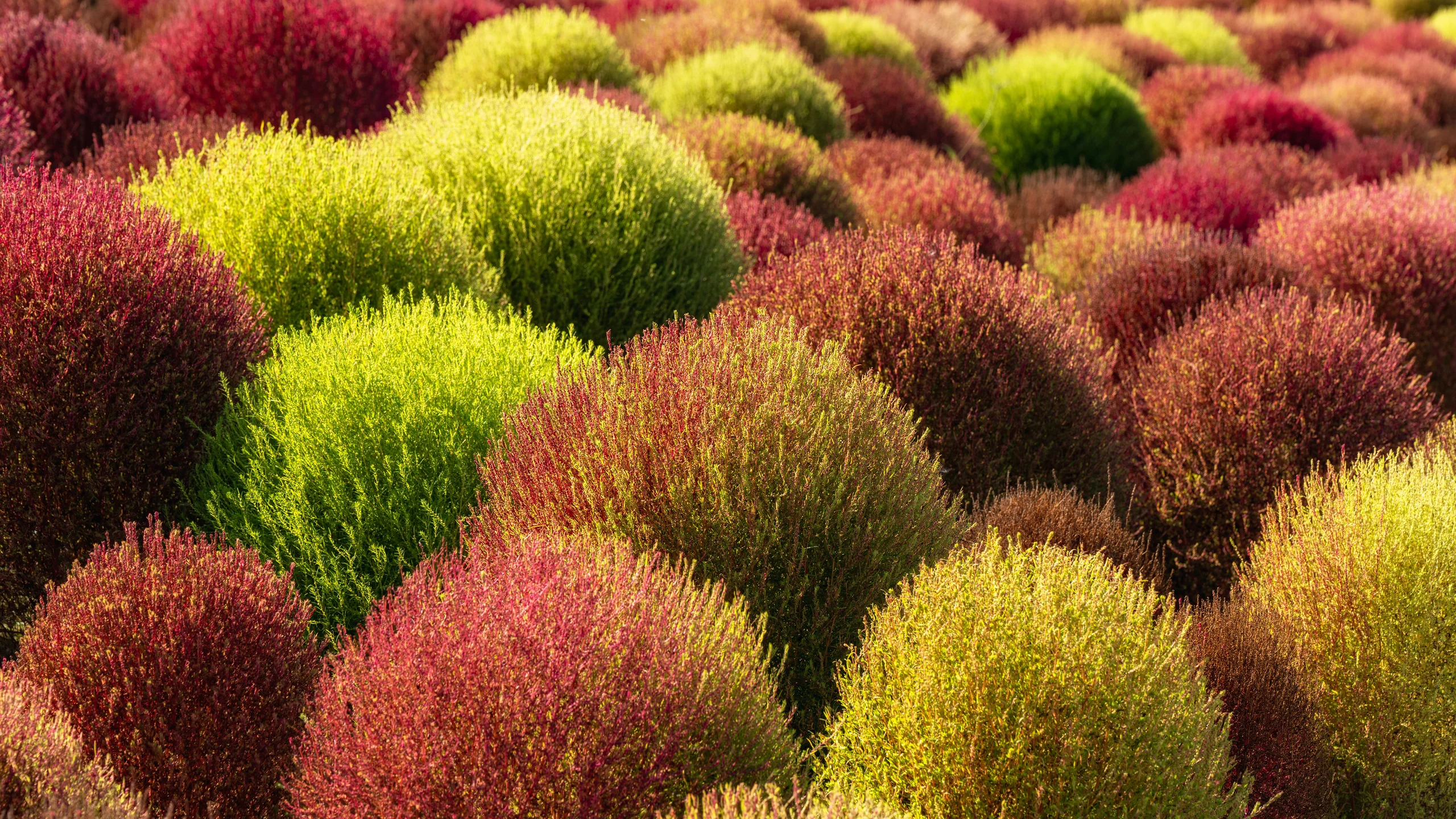
Image: Bing Daily Wallpaper | Field of kochia plants, China (© lingqi xie/Getty Images)
Open Bing's Chinese homepage today and the caption beneath the image is unusually short: "Field of kochia plants, China." Six words and a country. That is all.
I checked Bing's English-language description for the same day: Field of kochia plants, China. The German site says the same. Editors in all three countries declined to offer a more precise location. For now, there is no way to confirm where in China the photograph was taken, and there is no reason to guess.
That hardly matters. Kochia is far more interesting than its location.
One Plant, Three Names in China
Its accepted name is Bassia scoparia; older books call it Kochia scoparia. The traditional Flora of China placed it in Chenopodiaceae, while the classification now in common use folds that family into Amaranthaceae. The two family names found in books from different periods reflect different taxonomic systems, not an error.
Its Chinese common names are revealing. Plant Plus lists names that translate as "broom seedling," "broom vegetable" and "Guanyin vegetable." The names describe its uses: when dried, its fine branches and compact form make an excellent broom. This was hardly a Chinese invention. A U.S. Department of Agriculture plant guide notes that people grow kochia for brooms in China, Russia, Bulgaria, North Macedonia, Romania and Italy. Six countries independently looked at the same plant and decided to sweep floors with it.
Its dried ripe fruit is also the traditional Chinese medicinal ingredient difuzi. An article in the overseas edition of People's Daily defines it precisely as "the dried mature fruit of Kochia scoparia" - the fruit, not the root or leaf.
Outside China, however, the plant has a very different identity. We will come to that shortly.
Its Most Important Move Comes in Autumn
First, the truly surprising part.
While it is alive, kochia is an orderly clump rooted in the ground. By autumn, the plant has matured and dried. What happens next?
The U.S. Department of Agriculture's Natural Resources Conservation Service describes it this way: "When mature, kochia plants break off at the base and become tumbleweeds, which disperse seeds."
Read that slowly. It does not wait for the wind to carry its seeds. It gives its entire body to the wind.
SARE, a U.S. agricultural extension program, is more specific: mature kochia breaks near the base, tumbles like a tumbleweed and scatters seeds as it bounces. With nothing to stop it, it can travel a long way.
How far is "a long way"? Someone measured it. GROW, an integrated weed-management platform run by several U.S. land-grant universities, gives a distance of 3,280 feet - exactly 1,000 meters. A parenthetical note follows that number: the plant was stopped at that distance by a fence.
One kilometer was not its limit. It was where something forced it to stop.
How many seeds does it shed along the way? Washington State and the U.S. Forest Service give the same typical figure: about 14,600 per plant. Field measurements range from 2,000 to 30,000. Under especially favorable conditions, with no nearby competition, studies have recorded more than 100,000 seeds from a single plant.
The same Forest Service source contains an even better number: under stressful conditions, one kochia plant may produce only five seeds in a year.
Fourteen thousand six hundred versus five. The same species, the same one-year life span. Its entire wager rests on how well that single year goes.
One Detail Often Gets Misstated
Botanists call a plant's separation point an abscission zone. But kochia's breakaway point is not quite like the abscission zone described in textbooks.
Textbook abscission is active work by the plant: it releases ethylene and deploys cellulase to break down the walls in a layer of cells until a leaf stalk detaches. A 1968 North Dakota State University dissertation specifically investigated separation in tumbleweeds, including kochia. Its conclusion was different: separation in kochia is a mechanical process. As the plant ages and dries, fungi invade and weaken its tissues. When the wind bends the plant far enough, the ring of tissue at the stem base can no longer hold.
The paper about ethylene and cellulase concerns another species, Kochia indica. The two plants look alike and both tumble, but their mechanisms are not the same. Chinese popular-science accounts often mix them together, so the distinction matters.
The accurate version is this: kochia has a pre-weakened break zone at the base of its stem. Once the plant has dried in autumn, the wind pushes it until the whole plant snaps off there. Exactly how that ring becomes weak remains too uncertain for us to summarize on the plant's behalf.
How It Grows Where Other Plants Cannot
Bing titled today's image "Resilience Takes Root." The phrase has more substance than it might appear to.
First, kochia is a C4 plant. Its more efficient photosynthetic pathway gives it an advantage over ordinary C3 plants in hot, bright and dry conditions. Under the fiercest summer sun, other grasses struggle while kochia grows.
Second, it is a facultative alkali halophyte. "Facultative" matters: it tolerates salt and alkaline soil but does not require them. SARE supplies a number. Kochia can germinate in solutions containing as much as 10,000 ppm of salt. Seawater is about 35,000 ppm, so the plant can emerge in water approaching 30% of seawater's salinity.
Third, its roots go extraordinarily deep. Under drought conditions, measured roots have reached 16 feet, nearly 5 meters.
That explains why kochia so often occupies places no one wants: roadsides, construction sites, salt flats and abandoned strips of disturbed farmland. It does not prefer these places. Other plants cannot survive them.
The Same Plant, a Different Fate Across the Pacific
Kochia is native to China and the wider Eurasian landmass. It has grown there long enough for people to give it several names, bind it into brooms, dry it for medicine and eat its young shoots.
In the middle to late 19th century, it was introduced to North America as an ornamental plant.
Then things went wrong.
A study cited by the U.S. Department of Agriculture found that, from 1880 to 1980, kochia spread faster than any other introduced weed in the western United States.
What followed was worse. A 2019 review in Weed Science traced the history of herbicide resistance in North American kochia:
In 1976, atrazine-resistant kochia appeared in Kansas cornfields. In 1987, kochia resistant to ALS inhibitors appeared in Kansas wheat fields - only five years after that class of herbicides reached the market. Dicamba resistance appeared in Montana and North Dakota in 1995. In 2007, glyphosate-resistant kochia arrived in fallow fields in western Kansas.
People changed the chemical; the plant changed a gene. On average, another round arrived in less than a decade.
Its ability to move and change so quickly depends on that autumn break. SARE records another constraint: kochia seeds do not survive long. After two or three years buried 30 centimeters deep, at most 3% can still germinate; shallower burial is even worse.
It cannot wait. Every autumn it must break itself off, roll away and scatter thousands of seeds in new ground before the old generation loses its chance.
"It has to break to move" is not a poetic line. For kochia, it is the only way to live.
One Clarification About Its Red Color
Kochia turns red in autumn, which is why it is planted in parks and flower fields. But the claim that anthocyanins make kochia red is almost certainly wrong.
This branch of the order Caryophyllales - Amaranthaceae, including the former Chenopodiaceae - uses a different group of pigments: betalains. They give beets, amaranth and purslane their red color. A 2018 review in Antioxidants states the point bluntly: anthocyanins and betalains have never been found together in the same plant tissue. Plants take one pathway or the other.
No study was found that directly measured the pigments in red kochia, nor any that established whether low temperatures or daylight trigger its color change. The most accurate statement is therefore limited: kochia belongs to a lineage whose red colors come from betalains. No one appears to have asked this species about the details of its own red coat.
One more distinction is useful. The round, evenly spaced plants in parks that seem to turn red all at once are usually the cultivated form Bassia scoparia f. trichophylla. Wild kochia has a looser shape and changes color unevenly. The photograph looks orderly because someone arranged the plants.
Sources: the Bing Daily Wallpaper official feeds for zh-CN, en-GB and de-DE; the U.S. Department of Agriculture Natural Resources Conservation Service, Bassia scoparia Plant Guide; the USDA PLANTS database, Kochia scoparia Plant Guide; the U.S. Forest Service Fire Effects Information System entry for Bassia scoparia; SARE, Manage Weeds on Your Farm: Kochia; the GROW integrated weed-management platform's kochia entry; the Washington State Noxious Weed Control Board; Colorado State University Extension; Becker, Tumbleweeds: Ecology and Abscission (1968, North Dakota State University dissertation); Kumar et al., 2019, Weed Science 67(1), review of herbicide-resistant kochia in North America; Miguel, 2018, Antioxidants 7(4):53; the Missouri Botanical Garden entry for B. scoparia f. trichophylla; Plant Plus of the Institute of Botany, Chinese Academy of Sciences; and the overseas edition of People's Daily, December 9, 2017, page 9.