
A bottle holds two kinds of time. One wakes at a flash of light. The other does not go away.
Screenshot: National Geographic Photo of the Day · Original page
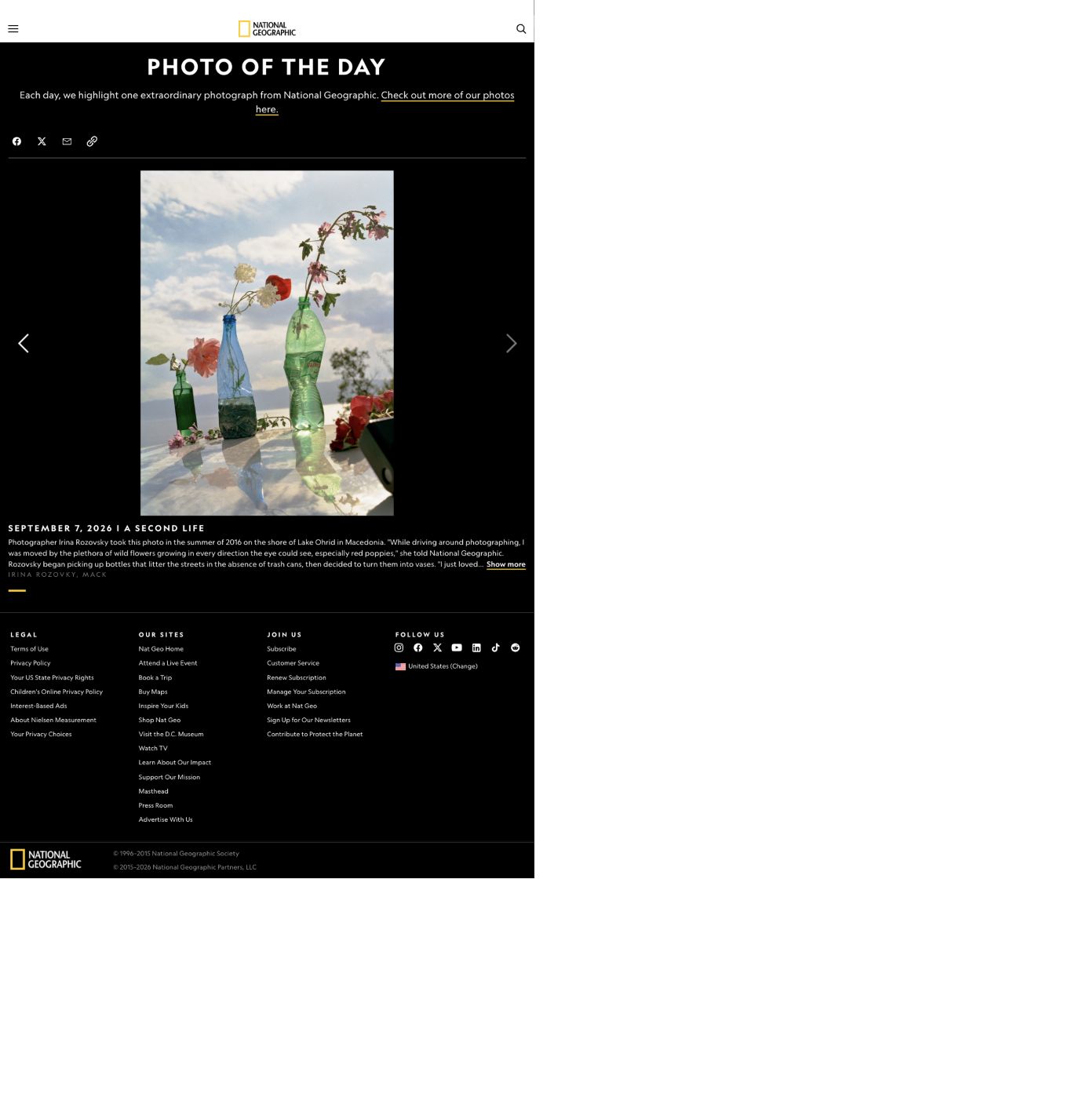
Today's National Geographic Photo of the Day is titled "A Second Life."
The scene is so simple that its caption needs only one sentence: wildflowers stand in a recycled plastic bottle in the sun.
(National Geographic's strict copyright rules prevent the photograph from being reproduced here or used as a cover. The original can be viewed at the permanent National Geographic link above.)
Photographer Irina Rozovsky made the image in the summer of 2016 on the shore of Lake Ohrid in North Macedonia. She has described to National Geographic how, while driving around taking photographs, she was struck by the wildflowers growing in every direction, especially the red poppies. There were few trash cans along the roads, so she picked up discarded bottles and turned them into vases. She liked the resulting sense of fresh hope.
The photograph is interesting because it fits two things through the same bottle neck:
One can wake from years of sleep when somebody turns the soil. The other does not disappear, however long it waits.
Begin with the one that wakes.
The Seed Is Waiting for Light, Not Spring
The red flowers are most likely common poppies, Papaver rhoeas, also known as field poppies. A species cannot be identified with certainty from one photograph, and the genus contains other red-flowered species, so "most likely" is as far as the evidence allows.
Kew's plant catalog describes the species' habitat in three words: fields, roadsides and waste ground.
Notice what those places share: their soil has been disturbed.
That is not a coincidence but a survival strategy. A species account compiled by Britain's Garden Organic gives an exceptionally clean experimental result:
"Light, even if only a brief flash, is required for germination."
The same account supplies several numbers. Ninety-four percent of seedlings emerged from the top 20 millimeters of sandy soil. The optimum depth was five to ten millimeters, and the maximum was 20.
Put those findings together and the mechanism appears:
A poppy seed lies in the soil. As long as earth covers it, it remains in darkness and waits. One day the ground is opened - plowed, dug, bombed or trampled - and even a momentary flash of light reaches it. That is the signal to germinate.
It is the kind of mechanism that can make a curious child sit up straight. It explains every sudden crop of plants you have ever seen along the edge of a construction site.
The plant is prolific too. Garden Organic's figures average about 1,300 seeds per capsule and between more than 10,000 and 60,000 seeds from a whole plant.
One point needs special care because it is the easiest claim in this story to overstate.
The idea that poppy seeds can sleep underground for 100 years is widespread and repeated by authoritative institutions, but the evidence is less firm.
On one side, the Smithsonian says the seeds can remain dormant for "up to 100 years"; Kew says they can "often" remain dormant for 80 years; and the Botanical Society of Britain and Ireland says at least 80 years and possibly more than a century.
On the other are results from actual burial studies, all compiled in the Garden Organic account cited above: nine years of survival in dry storage; six to eight years or longer in soil; a 79 percent decline after six years in undisturbed soil and 93 percent in cultivated soil; and under grassland conditions, an average annual decline of six percent and a half-life of 11 years.
Those accounts are not necessarily contradictory. An 11-year half-life means most seeds die within years, while a tiny surviving fraction might persist much longer. The "80 to 100 years" figure probably describes that long tail. But no direct experiment was found in which an individual poppy seed germinated after a documented century underground.
So set aside the beautiful number and keep the repeatedly demonstrated fact: the seed must see light before it will wake.
The Flowers That Opened on Battlefields
If you know the red poppy worn on British remembrance days, the mechanism above explains the entire symbol.
Kew says soil churned again and again by explosions provided the stimulus that dormant seed banks needed to germinate. The Smithsonian puts it more directly: trench digging, bombs and mass graves devastated Europe's landscape during World War I and caused millions of poppies to bloom across the disturbed ground.
Kew also records an eyewitness. Its director, Sir Arthur Hill, saw the Somme's "poppy-covered battlefields," made sacred by the many crosses scattered among them.
John McCrae wrote "In Flanders Fields" during the Second Battle of Ypres in the spring of 1915. It appeared in Punch on December 8 of that year and spread around the world almost immediately.
Those flowers were not metaphors. They were the literal result of this mechanism operating in ruined earth.
This Lake Is 1.36 Million Years Old
Now look at the water behind the bottle.
Lake Ohrid is Europe's oldest lake. How old? A 2019 study in Nature produced a measured answer, not by estimating, but by drilling.
An international team bored 568 meters into the sediment beneath the lake's center, at a site already 245 meters underwater. Drilling ran from April 1 to June 7, 2013, advanced a total of 2,785 meters and recovered 93.2 percent of the core.
The record showed that the lake formed about 1.36 million years ago and has existed continuously ever since.
(UNESCO's official page still says roughly two to three million years, an estimate made before the drilling. Where the figures conflict, the core record takes precedence.)
For scale, Lake Ohrid is roughly five times older than our species, Homo sapiens.
That raises the real question of this section:
Why has it lasted so long?
Most lakes are short-lived. A lake is a hollow. Rivers pour in, sediment settles, and after thousands or tens of thousands of years the hollow fills and becomes flat land. Most of the world's water bodies are younger than 20,000 years.
Ohrid has survived for two reasons.
First, it keeps sinking. The lake occupies a graben system, formed where the crust stretches and a central block drops. As the basin subsides, sediment cannot fill it.
Second, much of the water entering it carries almost no sediment.
The Water Seeps Through the Mountain Next Door
This is the most beautiful mechanism in the story.
Beyond a mountain beside Lake Ohrid lies another lake, Prespa. Prespa's surface is about 155 meters higher. Galicica National Park gives elevations of 695 and 850 meters for the two lakes; 155 is the difference.
The mountain between them is Galicica. The park describes its geology precisely: a Paleozoic metamorphic silicate base capped by 500 to 550 meters of massive, porous limestone.
Water dissolves limestone. The US National Park Service explains the process this way: rain or snowmelt mixes with carbon dioxide in the air and in decaying vegetation in the soil, forming carbonic acid. The acidic water seeps through surface fractures. When it reaches carbonate rock, it enters the cracks and dissolves them into chambers and passages.
In other words, water has hollowed that limestone cap into a complete subterranean plumbing system.
Water from the upper lake passes through that network under the mountain and emerges from springs along the lower lake.
Geographer Jovan Cvijic proposed the connection in 1906. In 2002, an artificial-tracer experiment physically demonstrated it: researchers put a tracer in at one end and recovered it at the other. Later environmental-isotope measurements supplied proportions. Between 37 and 42 percent of the water at the Saint Naum springs comes from Lake Prespa; at the Tushemisht springs, the share is 52 to 54 percent.
How long does the underground passage take? Official Drin River project materials give a startling number: water travels through the karst system from Zavir to Tushemisht in only six hours. This describes one segment of one route, not the entire journey from Lake Prespa to Lake Ohrid.
The Saint Naum springs now discharge five to 7.5 cubic meters per second.
How much of Lake Ohrid's total inflow does Prespa provide? Five authoritative sources give five answers. NASA Earth Observatory says about 20 percent; a 2024 hydrology paper says about 25 percent; Euronews says roughly one-third; the Drin project says more than 40 percent; and the UN Environment Programme World Conservation Monitoring Centre says nearly half. Rather than select one, use the range: one-fifth to nearly one-half.
Whichever figure is correct, the essential fact remains: much of this lake's water arrives not through surface rivers but through the inside of a mountain. Groundwater carries no sediment.
A sinking basin plus an inflow system without sediment: that is the recipe for surviving 1.36 million years.
One Lake Is Holding the Other's Fate
The bad news is upstream.
Lake Prespa is shrinking rapidly.
A 2024 hydrology paper is titled "Catastrophic Water Loss of the Ancient Lake Prespa: A Chronicle of a Death Foretold." Its figures are stark:
- The water level has fallen nearly ten meters since the 1950s.
- The level of 841.66 meters in July 2024 was the lowest recorded since observations began in 1917.
- Between 1984 and 2020, the surface area shrank by 18.87 square kilometers, or 6.9 percent.
- Volume fell about 54 percent, reaching a 56.8 percent loss in 2022.
NASA Earth Observatory independently reports consistent figures: Prespa lost seven percent of its surface area and half its water between 1984 and 2020, probably because of increased agricultural withdrawals.
The paper ends with a linear-regression projection: the lake could disappear entirely by the end of this century, in 2078 under the worst scenario or 2104 under the best.
(For perspective, 2078 is 52 years away. Many children reading this today may live to see it.)
Care is needed here. NASA explicitly notes that Ohrid's level has remained relatively stable in recent decades because underground springs, rather than Prespa's surface water, provide most of its inflow.
The accurate word is therefore "affects," not "determines." That is the better lesson: vulnerability and resilience can exist in the same system at once.
212 Species That Live Nowhere Else
What grows in a lake that has lived for 1.36 million years?
UNESCO says its nutrient-poor waters contain more than 200 endemic species, with especially high endemism among bottom-dwelling organisms: algae, diatoms, flatworms, snails, crustaceans and 17 endemic fish species.
A more precise academic count gives 212 endemic species, 182 of them animals, with an adjusted endemism rate of about 36 percent across all taxa.
The taxonomic breakdown is more remarkable still. The UNEP World Conservation Monitoring Centre's heritage datasheet says 90 percent of snails, 88 percent of parasitic ciliates, 71 percent of flatworms, 66 percent of small crustaceans and 60 percent of fish are unique to this lake.
It has the highest endemism rate of any ancient lake in the world.
Why? The paper offers a movingly simple explanation. Only a small number of lineages originally entered Ohrid from the Balkans, and most of today's endemic species probably began evolving inside the lake in the early Pleistocene.
A few ancestors entered and were shut inside for more than a million years. They branched in place into forms found nowhere else.
The best-known is the Ohrid trout, Salmo letnica, which lives only in this lake. It is now in trouble. Annual catches historically reached 200 to 250 metric tons, but the population now depends on hatchery support. Authorities released 620,000 juveniles in August 2025 and planned one million for 2026. Researcher Trajce Talevski supplied a sobering figure: only about five percent of released juveniles survive to spawning age. A single police operation removed 254 abandoned ghost nets from the lake.
Twice at the Threshold of the Danger List
The Ohrid region was among the world's first mixed World Heritage sites, recognized for both natural and cultural value. It was inscribed for nature in 1979, gained cultural criteria in 1980 and expanded to include Albania's side in 2019. About one-third of the lake lies in Albania.
Over the last two years, it has twice stood at the door of the List of World Heritage in Danger.
In 2025, the World Heritage Committee's decision at its 47th session explicitly said that the conditions for inscribing the property on the danger list had been met. Threats included urban development, failures in spatial planning, inappropriate interventions, eutrophication of the lake, large infrastructure and the cumulative and continuing effects of other projects. The same decision identified two pollution hot spots and problems with landfills and waste management.
In July 2026, it again avoided the danger list at the 48th session. The draft document said inscription was not recommended and asked both countries for an updated report by December 1, 2027. At the time this source article was written, UNESCO's property-document page still listed decisions only through the 47th session, so the final document number and wording should be checked against the official site.
The International Union for Conservation of Nature was less restrained. In 2025 it rated the site "critical," saying its outstanding universal value faced a severe risk of irreversible loss and that management was fragmented, under-resourced and inconsistent.
One historical episode is worth preserving because it directly disrupted the low-sediment mechanism above. In 1962, the Sateska River was artificially diverted into Lake Ohrid. That nearly doubled the catchment area and delivered large amounts of sediment from sand and gravel extraction in the riverbed.
A low-sediment balance built over 1.36 million years was broken by one river diversion.
The Other Half: the Bottle
Now consider the other object in the photograph.
The following figures come from an official 2023 UN Environment Programme page:
- The world produces more than 430 million metric tons of plastic each year, two-thirds of it in short-lived products.
- More than 280 million metric tons of short-lived plastic products become waste each year.
- Forty-six percent of plastic waste is landfilled, while 22 percent is mismanaged and becomes litter.
- About 36 percent of all plastic is used in packaging, and 85 percent of that packaging is ultimately landfilled or mismanaged.
Another UNEP report estimates the flow into water: about 11 million metric tons entered aquatic ecosystems in 2016, a figure projected to rise to roughly 29 million metric tons by 2040, nearly three times as much.
Recycling fares little better. An official 2022 OECD release says only nine percent of plastic worldwide is successfully recycled.
Now for the number you have almost certainly heard:
"A plastic bottle takes 450 years to decompose."
The source article searched for the origin of that number and could not find it.
More revealingly, NOAA's Marine Debris Program does not endorse the claim. It says that although you may hear that some items take hundreds of years to break down, many factors can cause an object to break down quickly or not at all. The same page acknowledges a lack of reliable data and says only a few peer-reviewed studies have investigated the subject.
What NOAA is willing to say is this: every kind of plastic, even one labeled biodegradable, can remain in oceans and the Great Lakes for an unknown length of time.
The accurate formulation is not "450 years," but this:
Plastic does not disappear. It only becomes smaller.
The fact that the most familiar number has never been verified is itself a useful lesson in scientific literacy. Repeating a number ten thousand times does not make it true.
At the global level, negotiations toward a Global Plastics Treaty began in 2022 and have still not produced an agreement. The August 2025 round in Geneva collapsed over whether to limit the volume of plastic production, the scope of controls on chemicals and product design, the treaty's legal force, and support for developing countries. The chair resigned in October 2025. A one-day meeting in Geneva on February 7, 2026, had a single agenda item: choosing a new chair. The latest reporting available to the Chinese source ended three days before that meeting, so it could not verify whether substantive talks resumed afterward.
The Photographer
Irina Rozovsky was born in Moscow in 1981. She now lives in Athens, Georgia, where she and her husband Mark Steinmetz run a photography workshop called The Humid. Her work is held by the Museum of Modern Art, the Metropolitan Museum of Art, the Philadelphia Museum of Art and other institutions.
(A small correction: National Geographic credits her as Rozovky, omitting an s. Her own website and her publisher use Rozovsky.)
The photograph appears in her book Mountain Black Heart, published by MACK in August 2026, last month.
The book is not about Lake Ohrid; Ohrid is one stop within it. The publisher tells how the project began. One summer morning in 2014, Rozovsky woke in a Serbian mountain village to the sound of hundreds of trumpets as a brass festival assembled among the hills. Over the next decade she returned repeatedly to photograph across the Balkans: Montenegro, Bosnia and Herzegovina, Macedonia, Croatia, Greece, Romania, Bulgaria and Albania.
MACK describes the photographs as intimate and ambiguous, balanced between vitality and suggestions of dark history. Rozovsky put it more directly in an interview: this is a place "with light and dark in it."
What does the book's title mean? Neither the publisher's US and UK sites nor her interview explains it. There is one possible association: the first country photographed for the book was Montenegro, whose native name, Crna Gora, literally means "black mountain." That is only an association, unsupported by a source.
China Has a Fish Shut Away for Three Million Years
End with a fish: the Dianchi golden-line barbel.
According to China Science Daily, published by the Chinese Academy of Sciences, it appeared when Dianchi Lake formed 3.2 million years ago and is called a "Dianchi antique." A People's Daily account says more than three million years ago.
It is endemic to Dianchi. Like the Ohrid trout, it lives in this one body of water and nowhere else.
It spawns in deep pools and underground rivers. Those are karst-spring habitats, the same kind of place as Saint Naum.
Its story followed a similar course. By the 1980s it had disappeared from the main body of Dianchi as pollution worsened, illegal fishing continued, introduced species outcompeted it, and its spawning grounds in deep pools and underground rivers were damaged. The numbers are hard: Dianchi had 26 native fish species in the 1960s; only four now remain in the lake proper.
But this story has a second half. Artificial propagation succeeded in 2007, when the first effort produced only a few hundred fry. Since then, more than eight million hatchery-raised juveniles have been released into the Dianchi watershed.
Researcher Yang Junxing of the Kunming Institute of Zoology made a practical observation: when native-fish conservation is joined to local livelihoods, people become much more willing to protect the fish. Sustainable use is real conservation.
Return to the photograph.
Beside Europe's oldest lake, a photographer picked an unwanted bottle off the road, placed several red poppies in it and set it in the sun.
The flowers were there because somebody had disturbed the soil and a waiting seed happened to see a flash of light.
The bottle was there because it could not leave by itself.
One of those events took years. Nobody knows how long the other will take. They met at the same bottle neck and were photographed.
The title is "A Second Life." The bottle received its second life.
But the more memorable thought may be this: the seeds in the soil were still waiting for their first.
Image: National Geographic Photo of the Day · Photograph: Irina Rozovky, MACK (National Geographic's original credit; the photographer and publisher spell her name Irina Rozovsky) · Original page
Sources
National Geographic Photo of the Day; MACK Publishing (US and UK sites); Irina Rozovsky's website; AnOther interview; Wagner et al., Nature (2019), and the University of Bristol release; official ICDP SCOPSCO project materials; Wagner et al., Biogeosciences 14, 2033 (2017); Albrecht and Wilke, Hydrobiologia; Amataj et al., Environmental Geology (2007); Hydrology 11(12):199 (2024); UNESCO World Heritage Centre, property 99 and documents 43 COM 8B.9, 47 COM 7B.54 and draft 48 COM 7B.62; IUCN World Heritage Outlook; UNEP-WCMC World Heritage datasheet; Galicica National Park; GWP-Med and the GEF/UNDP Drin River project, DRIN CORDA; NASA Earth Observatory; US National Park Service karst guidance; US Fish and Wildlife Service ecological risk assessment; Earth Journalism Network; Kew's Plants of the World Online and "A Tale of Two Poppies"; Garden Organic's Papaver rhoeas species account; Smithsonian Magazine; Canadian War Museum; Plantlife; UN Environment Programme; OECD; NOAA Marine Debris Program; IUCN and IISD reporting on the Global Plastics Treaty; China Science Daily; People's Daily, "People's Eyes: Ecological Governance"; and the Kunming Institute of Zoology, Chinese Academy of Sciences.