
Today's Google Doodle marks National Voter Registration Day in the United States. This article is about how the institution developed and how its mechanisms work; it takes no position on policy.
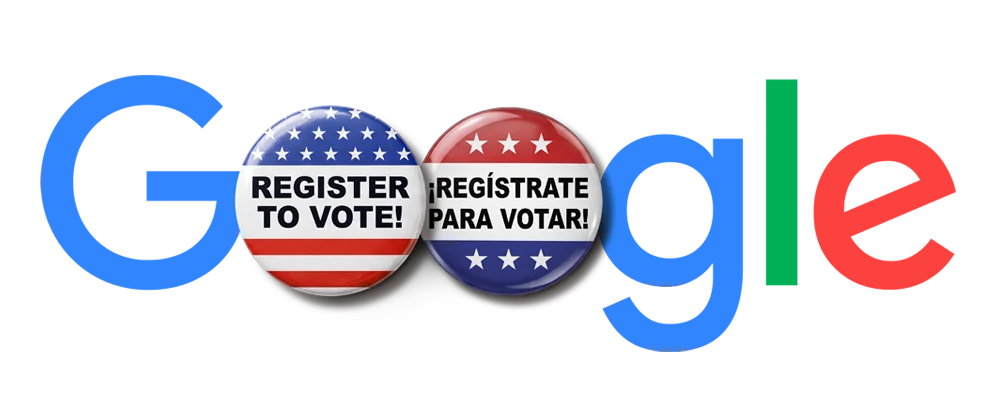
Image: Google Doodle, "National Voter Registration Day 2026" | Official page: doodles.google
Open Google in the United States today and its logo has changed. The official page offers only two sentences: this annual Doodle celebrates National Voter Registration Day 2026, a civic holiday that reminds Americans to register to vote.
What makes the page interesting is what it does not contain.
Commemorative Google Doodles usually make a point of naming a guest artist and include an artist's statement, sketches and an interview. This one has no credit. The corresponding Doodle pages from 2018, 2020, 2022 and 2024 do not name an artist either.
That is because it was never primarily an artwork. The official descriptions in 2018, 2020 and 2022 all say the same thing: click the Doodle and it opens a tool that helps you register in your state and find basic voting information.
It is a button.
The story behind that button begins with an institutional question unfamiliar to many readers outside the United States. Follow it far enough, and the question becomes something more fundamental.
Begin with the Date, Because the Rule Quietly Changed
National Voter Registration Day is not a federal holiday. It is a civic initiative launched in 2012 by a coalition of roughly 2,000 organizations, and it was first held on September 25 that year. It is now organized by a nonprofit called Nonprofit VOTE and endorsed by official bodies including the National Association of Secretaries of State, the National Association of State Election Directors and the U.S. Election Assistance Commission. Congress passes a resolution each year. A resolution expresses support; it does not create a holiday.
The date rule is the third Tuesday in September. September 1, 2026, was a Tuesday, so that month's first three Tuesdays were September 1, 8 and 15. Today really is the third.
But that rule dates only to 2022. From 2012 through 2021, the observance fell on the fourth Tuesday: September 25 in 2012, September 22 in 2020 and September 28 in 2021. It moved forward one week in 2022 and has remained on the third Tuesday since.
More curiously, the official website has not fully caught up. Its homepage still says "the fourth Tuesday of every September," while its About page says the third. The two pages currently contradict each other. This is not consequential, merely a small trace of delayed website maintenance. But it neatly demonstrates that even a highly public date has no single source that updates automatically everywhere.
One more pattern is visible. The searchable Doodles appeared in 2016, 2018, 2020, 2022, 2024 and 2026 - all even-numbered years, when the United States holds federal elections. What the official description calls an "annual Doodle" is, in practice, an election-year Doodle.
Why September? The 2026 U.S. midterm election is on November 3. The date itself follows a rule enacted in 1872: the Tuesday after the first Monday in November of every even-numbered year. In 2026, the first Monday is November 2, making Election Day November 3. Voter-registration deadlines generally fall several weeks before Election Day and vary by state. Mid-September is about seven weeks before November 3, placing the observance ahead of deadlines in the great majority of states. The slogan of the first event in 2012 captured the logic: register in September so your vote counts in November.
Why Must Americans Register Themselves?
This is the article's central institutional question, and the answer is historical.
Citizens in most democracies do not have to enroll themselves. Canada maintains a National Register of Electors, established in 1997. Elections Canada continuously updates it with data from the tax agency, when taxpayers consent; immigration and defense departments; provincial driver's-license systems; and vital-statistics agencies. It covers more than 28 million eligible citizens, who do not need to register anew for every election. Germany's municipal authorities compile electoral rolls from local population registers: anyone whose residence is registered by the 42nd day before an election is enrolled automatically. In Sweden, the tax agency's population register determines eligibility, the roll closes 30 days before the election, and every eligible voter automatically receives a voting card.
What those three countries share is not simply a more active government. Each already had a resident or population-registration system built for other purposes, including taxation, civil registration and residency records. The electoral roll is a table derived from that system.
The United States has no national resident register and no national electoral roll. The Help America Vote Act of 2002 requires each state to maintain a single, uniform statewide list - state, not national. The reason reaches back to Article I, Section 4 of the Constitution: state legislatures prescribe the times, places and manner of elections for senators and representatives, while Congress may make or alter those rules. Fifty states administer elections, joined by thousands of county and municipal election offices.
How did registration itself begin?
In the early 19th century, election officials often knew everyone in their precinct and needed no list. As cities expanded, voting became anonymous. Massachusetts was the first state to introduce a registration requirement, but scholars still disagree on whether to date the beginning to 1800, 1801 or a Boston ordinance of 1821 that required municipal officials to "make out lists of all persons qualified to vote." The answer depends on whether one counts a state law, a municipal ordinance or the preparation of tax rolls as registration. The careful formulation is Massachusetts in the early 19th century.
In 1832, a Ledger Turned Away a Boston Taxpayer
The legal foundation of American voter registration came from a small case.
Joseph Capen was a taxpaying resident of Boston. He went to vote on Election Day and was turned away because his name was not on the voter list. He sued the responsible election official.
In 1832, the Massachusetts Supreme Judicial Court ruled against him. Its often-cited reasoning was that when a constitution grants a political right or privilege but does not specify how it must be exercised, the legislature acts within its proper constitutional authority by adopting reasonable and uniform provisions governing the time and manner of that exercise.
In one sentence: the constitution grants the right to vote; the legislature may set rules for exercising it. Registration in advance is one such rule.
The decision cleared the way for states to establish registration systems through their own laws. It came in 1832, 194 years ago, before any present-day partisan alignment. No contemporary U.S. political context is needed to understand it: one person, one ledger, one rejection and one judgment that the legislature could set the rules.
What followed extended the same path. The National Voter Registration Act, commonly called the Motor Voter Act, was signed on May 20, 1993, and took effect on January 1, 1995. It provides that an application or renewal for a driver's license also serves as a voter-registration application unless the applicant declines to sign. Agencies administering certain public-assistance programs, state-funded disability services and armed-forces recruitment offices must also offer registration. Six states were exempt because, before August 1, 1994, they either required no registration or offered Election Day registration at every polling place.
Then came automatic registration. Oregon enacted it in 2015 and implemented it in 2016, becoming the first state to do so. As of August 19, 2026, the National Conference of State Legislatures counted 24 states and Washington, D.C. with some form of automatic registration.
Paper also became a web page. Arizona introduced the first online voter-registration system in July 2002. Its approach was practical: it added registration to the motor-vehicle agency's existing online service because the agency already held each applicant's signature, eliminating the need to collect another one on paper. The entire system cost less than $100,000. As of May 2026, 42 states plus Washington, D.C., and other jurisdictions offered online registration.
The sequence took two centuries: "I know you, so no list is needed" became "the list excludes you," then "register while renewing your license," and finally "complete it on a web page in ten minutes." Today's Google button sits at the end of that sequence.
A Question That Belongs to No Particular Country
How the United States designs its elections is for Americans to decide, and this article takes no position on it. But dig beneath the act of voting and you reach a purely mathematical problem, independent of any country and more interesting than the institutional history.
The problem is this: a group of people each has a ranked set of preferences. Is there a "fair" rule that can combine all those individual rankings into one collective ranking?
This is not only an election problem. Prize committees ranking finalists, sports leagues ordering teams, recommendation systems turning many people's likes into one chart, and corporate boards choosing among three plans all face the same structure.
In 1951, Kenneth Arrow gave an uncomfortable answer in Social Choice and Individual Values.
He began with five requirements that seem hard to dispute. Unrestricted domain: the rule must handle any possible arrangement of individual preferences. Social ordering: its result must be a coherent ranking, both comparable and transitive. Weak Pareto efficiency: if everyone prefers x to y, society must prefer x to y as well. Non-dictatorship: there can be no single person whose strict preferences always determine the collective result. The final condition is independence of irrelevant alternatives: society's ranking of x and y must depend only on each person's ranking of x against y, not on a third option z.
He then proved that when there are more than two alternatives, no rule can satisfy all five conditions at once. Retain every condition and the task is impossible.
This is Arrow's impossibility theorem. Arrow received the 1972 Nobel Prize in Economic Sciences for pioneering contributions to general equilibrium theory and welfare economics. At 51, he was the youngest recipient in the prize's history.
A common misreading says that the theorem "proves democracy is impossible" or that it means a dictator must emerge. It does not. It states a fact about a formal system: the five requirements are incompatible. Non-dictatorship is one condition that the theorem shows may have to fail; dictatorship is not a prediction about political reality. The theorem also has an often-overlooked premise: there must be at least three alternatives. With only two, simple majority rule satisfies all five conditions perfectly.
That helps explain a familiar intuition. A choice between two options feels clean. Add a third and the process begins to feel awkward. The problem is not that people have become irrational. The arithmetic itself contains an obstacle.
The Same Preferences, Two Results
A simple example makes the obstacle visible.
Suppose there are three candidates, A, B and C, and three groups of voters. Five people rank A over B over C. Four rank B over C over A. Three rank C over B over A. There are 12 voters in all.
Now use two different rules.
Plurality voting, in which each person votes only for a favorite and the most votes wins: A receives 5 votes, B receives 4 and C receives 3. A wins.
Instant-runoff voting, in which the last-place candidate is eliminated if no one has a majority and those ballots transfer to the next preference: with 12 voters, a majority requires 7. No one reaches it in the first round. C has the fewest votes and is eliminated; the next preference on those 3 ballots is B. The second round is A with 5 and B with 7. B wins.
The people are the same. Their preferences have not changed by a word. Change only the aggregation rule, and the winner changes.
That is the problem described by Arrow's theorem: the same people with the same preferences can produce a different result under a different rule for combining them.
Tomorrow, the button on Google's U.S. homepage will become a colored logo again. The arithmetic behind it will remain. It waits wherever many people's opinions must become one decision, including the next time a group of friends votes on where to eat.
Sources: official doodles.google pages for 2018, 2020, 2022, 2024 and 2026; the official National Voter Registration Day website and releases; Nonprofit VOTE; Article I, Section 4 of the U.S. Constitution at constitution.congress.gov; 2 U.S.C. § 7; the National Voter Registration Act, Pub. L. 103-31, at GovInfo and the U.S. Department of Justice Civil Rights Division; the Help America Vote Act, Pub. L. 107-252; Congressional Research Service report R45549; Capen v. Foster, 29 Mass. (12 Pick.) 485 (1832), original opinion at CourtListener; Joseph P. Harris, Registration of Voters in the United States (1929), and subsequent scholarship; MIT Election Data and Science Lab; the Oregon Legislative Assembly's Legislative Policy and Research Office brief; National Conference of State Legislatures pages on automatic and online registration; the Brennan Center for Justice report on Arizona; Elections Canada; Germany's Federal Returning Officer; the Swedish Election Authority; Stanford Encyclopedia of Philosophy, "Arrow's Theorem"; the official Nobel Prize page; International IDEA, Electoral System Design; and the ACE Electoral Knowledge Network