
Today's National Geographic Photo of the Day has no face: just a chest bearing traditional scars and a blue-and-silver rosary. The official caption's explanation of those two things does not agree with Kenya's own census.
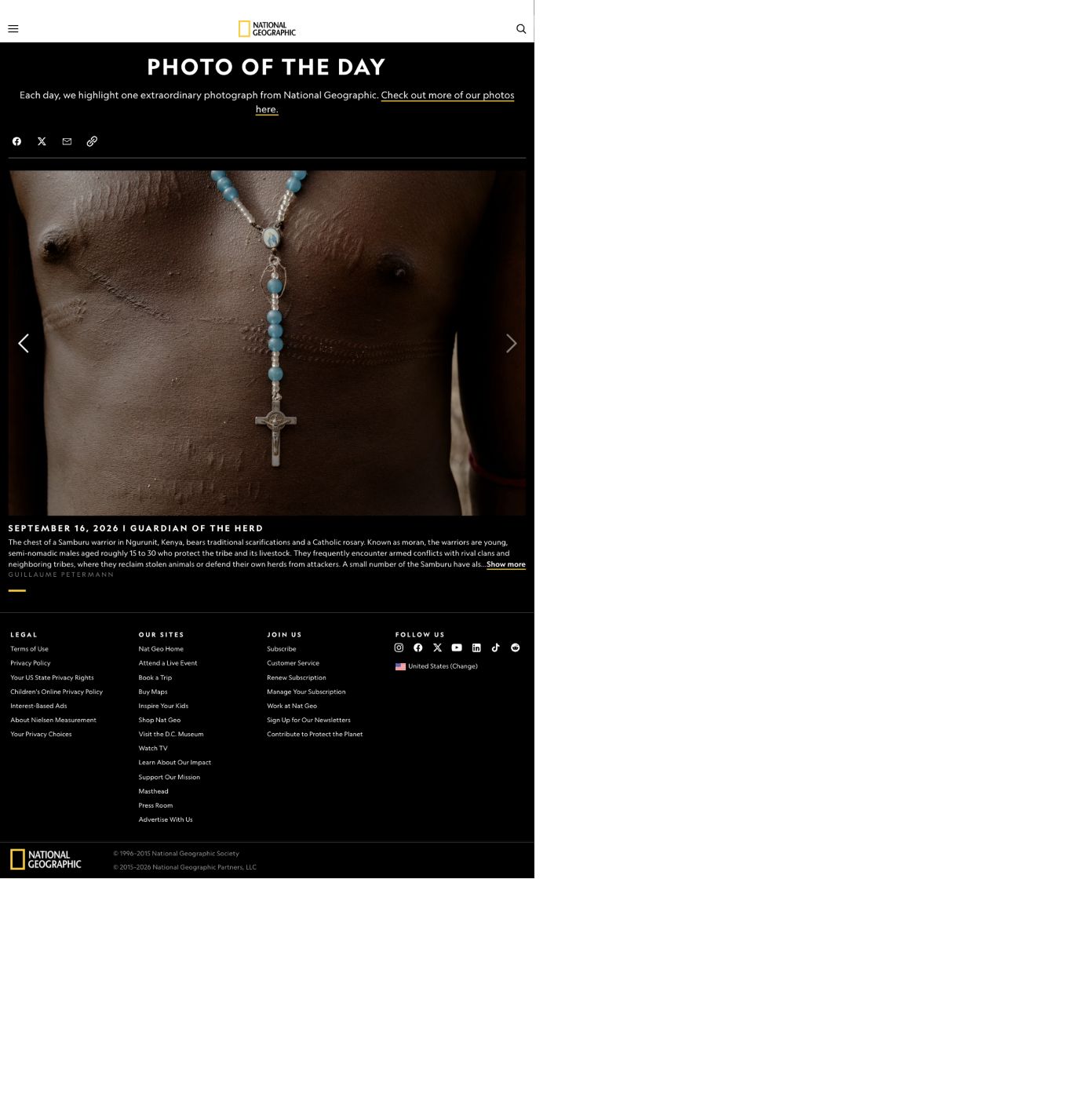
Screenshot: National Geographic Photo of the Day | Photograph: Guillaume Petermann | Original page
National Geographic calls today's photograph "Guardian of the Herd." Guillaume Petermann framed it tightly: the chest of a Samburu warrior in Ngurunit, Kenya, its skin patterned with raised scars and a blue-and-silver rosary hanging down the center.
The caption ends this way: "A small portion of the Samburu have also partially converted to Christianity while retaining many markers of their cultural identity."
It sounds cautious. It is also the reverse of the truth.
Start with the Numbers
Kenya's 2019 census gives the religious composition of Samburu County as follows: 57.33% Catholic (176,566 people), 84.60% Christian overall (260,534 people), 9.88% followers of traditional religion (30,433 people), and less than 1% Muslim.
That is not "a small portion." Samburu is overwhelmingly Christian, with a clear Catholic majority.
But the same census contains another equally important figure. The county's 9.88% share of traditional believers is 14 times Kenya's national average of 0.68%.
Both figures are true. And they often describe the same people.
The chest in the photograph is not a rare hybrid case. It is ordinary in this county.
Once that is understood, the real question changes. It is no longer "How can he possess both things?" but "How did the two learn to coexist?"
The answer is hidden in a word.
The Word Is Nkai
In traditional Samburu belief, God is called Nkai. The National Museums of Kenya says that the Samburu believe in one god, Nkai, who dwells in nature. Their sacrifices and prayers make two principal requests: rain and the safety of their livestock.
(The Maasai call God Enkai, Nkai or Engai - the same word. Samburu and Maasai are branches of the Maa languages, with 77% to 89% lexical similarity. Samburu people often refer to themselves together with the Maasai as Maa.)
Here is the crucial step.
When Catholic missionaries arrived and translated the Bible into local languages, they could have coined a new word or transliterated a Latin one. They did neither.
They used Nkai.
A 2020 paper in the Journal of Language, Culture, and Religion presents the textual evidence clearly: the word for "God" is Enkai in the Maa Bible and Nkai in the 2019 Samburu New Testament.
In the paper's theological language, the traditional idea of God "has been sufficiently Christianized that the name Enkai designates both the divinity historically known by traditional Maasai communities and the God worshiped by Christians."
In plain English: the Samburu did not simply move into Christianity. Christianity was moved into the Samburu language.
One feature came along unchanged in that move, and few people notice it.
Maa nouns have grammatical gender. The ɛnk- at the beginning of "Nkai" is a feminine prefix.
In Maa, then, the word for God is grammatically feminine. And that word was carried intact into the Catholic Bible.
That Bible Was Bought with Cattle
The origin of this New Testament is the part of the story most worth remembering.
The translation was undertaken by the East African organization Bible Translation and Literacy, or BTL. How was it funded? According to BTL's own account, Samburu church leaders decided in 2008 that each would contribute one cow, and the cattle would be sold to begin the translation.
In a semiarid pastoral region, wealth is not land but livestock, because only wealth that can walk can escape a drought.
They paid for a book in their own language with the form of wealth most real to them.
The Samburu New Testament was launched on December 14, 2019, at Kenyatta Stadium in Maralal, the county seat. Then deputy president William Ruto attended and paid to reduce the price of 5,000 copies from 150 Kenyan shillings to 10.
A Samburu woman at the event, Julia Leaduma, told Kenya's The Star:
"Today is a happy day for the Samburu people because we now have our own Bible. We now know that Jesus understands Samburu too."
Translation of the Old Testament continues.
An Anthropologist's Name for What Happened
There is a temptation to tell this story as "tradition versus modernity" or "indigenous versus foreign." Neither frame works here.
Bilinda Straight, an anthropologist of Samburu religion, wrote the first ethnography devoted entirely to Samburu divinity and belief. She used a precise word for what has happened across generations: neither conversion nor resistance, but repartee.
It means an exchange of quick replies: one side speaks, the other answers, neither replaces the other, and each is altered a little.
Her observation is that Samburu people "continually and actively engage in repartee with Catholic, Anglican, and varied secular European knowledge forms," while "most Samburu continue to experience the world as one created by and operating through Nkai."
Both things are true, like the two percentages.
Last Year, Ngurunit Became a Parish of Its Own
That thread leads to the place where the photograph was made.
Ngurunit lies at the foot of the Ndoto Mountains in Marsabit County, northern Kenya. From Nairobi, the route follows paved road to Laisamis, then turns west onto dirt.
Its Catholic history can be listed year by year. In the 1970s, a fidei donum priest named Fr Redento began missionary work there. The Salesians of Don Bosco arrived in 1981 and celebrated the first Masses. The first school was established in 1983. Bishop Ravasi consecrated Mary Help of Christians Church in 1989.
Then, on May 25, 2025, Ngurunit formally became an independent parish. Six couples were married at the ceremony.
When this photograph appeared on National Geographic's homepage, the place in the picture had been a parish for less than 16 months.
There is another geographical tension. Marsabit County as a whole is nearly half Muslim: about 48.5% Muslim, 35% Christian and 15.5% traditional religion. Ngurunit is home to Samburu and Rendille people, and to a Catholic church consecrated in 1989 and elevated in 2025.
The photograph stands on a religious boundary.
He Belongs to Lkiseku
The caption defines a moran as a "young semi-nomadic man aged roughly 15 to 30." That is not wrong, but it omits the ingenious core of the institution.
Samburu men are organized not simply by age, but into age-sets. About every 12 to 15 years, an initiation brings an entire cohort of boys into moranhood. The previous cohort "graduates" together, taking a step toward elderhood. Every age-set has a name.
A 2020 paper in the Cambridge Archaeological Journal provides a complete sequence from the 19th century to the present: Lkipiku (1837-51), Lkiteku (1851-65), Ltarigrig (1865-79), Lmarikon (1879-93), Ltirito (1893-1912), Lmiricho (1912-22), Lkileku (1922-36), Lmekuri (1936-48), Lkimaniki (1948-61), Lkichili (1961-76), Lkiroro (1976-90), Lmeoli (1990-2005), Lkichami (2005-19) and, most recently, Lkiseku (2019-2034).
The man in the photograph belongs to Lkiseku.
Here is the system's most elegant feature.
In a society without written records, a person may not know the year of his birth. But he will know whether he belongs to Lkiseku or Lmeoli, and everyone knows that Lkiseku follows Lmeoli. An age-set is not merely an identity. It is a calendar shared by a whole society.
How reliable is the sequence?
Reliable enough that archaeologists use it to date rock art in the Ndoto Mountains. The table was assembled because researchers needed to know which generation of moran made a painting and convert that generation into calendar years.
The Paper's Second Author Is a Samburu Man from Ngurunit
This was the most gratifying discovery in the research for this article.
The paper is titled "I Have Done Hundreds of Rock Paintings." Its second author, Stephen Longoida Labarakwe, is identified in the paper as a Samburu man from Ngurunit and a teacher. The authors write that their method rests on "an emic perspective on 'being Samburu.'"
The paper describes something many outsiders assume vanished long ago: Samburu moran still make paintings in caves.
They camp in rock shelters in the Ndoto Mountains between periods of herding, applying ochre to their bodies and painting the stone with camels, cattle, people and occasionally wild animals.
The best part of the paper is the Samburu artists' own account of the images. Elders said:
"I have done hundreds of rock paintings."
"I am not good at painting."
One pointed to a human figure and said it represented "a girl he liked."
Asked why they made the pictures, they gave a short answer:
"I have been here."
A man outsiders call a "warrior" painted a girl he liked and the fact that he had been there.
I Will Not Invent a Meaning for the Scars
Online explanations of Maasai and Samburu chest scars abound. The most common says that each mark represents a lion or an enemy the man has killed.
I searched the available museum and academic sources and found nothing that supports this claim.
The National Museums of Kenya goes only this far: among Maa-speaking peoples, such body markings are "like wearing an identity card on the face." They indicate gender, social rank, family and clan, and can also symbolize beauty or strength. Of the raised scars on the chest, the museum adds only that people consider them "both beautiful and nice to touch."
National Geographic's caption uses the phrase "traditional scarifications" without assigning them a meaning. The alt text says only "a scarred chest."
No further inference is warranted. When writing about living people, "I could not verify it" is more valuable than an invented answer. And "beautiful and nice to touch" sounds more like an answer a real person would give than "he killed a lion."
These Are the Driest Weeks of the Year
The photograph may have been selected today for no commemorative reason. But what is happening in that place now is worth understanding.
Marsabit County's rainy seasons run from March to April and October to November. Mid-September is the end of the long dry season, when pasture is at its thinnest, water is tightest and the short rains have yet to arrive.
The region has only recently passed through a deeper crisis. The 2020-2022 La Niña event brought four to five failed rainy seasons to the Horn of Africa, depending on the reporting cutoff, creating the worst drought in 40 years. In 2023, 6.4 million Kenyans needed humanitarian assistance, the country's highest total in at least a decade. In 2022, nearly 95% of water pans dried up, leaving residents to walk 8.6 to 17.6 kilometers for water.
A 2025 Agence France-Presse report put a figure on the pastoral cost: at least 70% of cattle died in Kenya's arid and semiarid lands.
The result is a substitution: camels are replacing cattle.
Samburu herder Chapan Lolpusike told a reporter, "We no longer have cattle in our family. We only keep camels." All his cows and bullocks died in the 2021-2022 drought.
Another herder, Naimalu Lentaka, was more specific, and his sentence is a lesson in itself:
"When there is green grass, that is when the cows have milk. The camel... even in the dry season, you still get milk. That is the whole difference."
Camels eat dried-out forage, can go more than a week without water and produce about six times as much milk as cattle. Most important, they keep producing milk in the dry season.
As for this year, a late-2025 update from Kenya's National Drought Management Authority classified Samburu County in the "normal" phase and Marsabit in "alert," while noting that Samburu's principal livelihood zones remained under pressure for both water and livestock. In its August 31, 2026, country report, FEWS NET forecast above-average short rains from October through December, with green harvests possible from December. It also warned that heavy rain could damage infrastructure and worsen disease and displacement.
On the day the photograph appeared, its subject's home stood between the last weeks of the dry season and rains forecast to be above average.
The two things Samburu people have traditionally asked of Nkai are rain and livestock.
The things they have prayed for across a thousand years are the same things Kenya's National Drought Management Authority now monitors every month.
The Last Paved Road to Ngurunit
From Nairobi to Ngurunit, the final paved stretch is the Isiolo-Moyale section of the A2 highway. It runs 504 kilometers from Isiolo through Archers Post, Merille, Laisamis, Marsabit and Turbi to Moyale.
Its principal contractor was China Wu Yi. The contract was worth about $420 million, or 42 billion Kenyan shillings, financed by the African Development Bank, the Kenyan government and the Export-Import Bank of China. The project was initiated in 2008 and completed in 2017. It also forms part of Kenya's LAPSSET Corridor.
The rosary on the moran's chest, the New Testament that calls God Nkai, and the parish created in 2025 all travel into and out of Ngurunit over a final stretch of asphalt completed by China Wu Yi in 2017.
The contrast is revealing. China's most famous project in Kenya is the Standard Gauge Railway: 592 kilometers, $3.6 billion, built by China Road and Bridge Corporation and opened on May 31, 2017. But its northwestern reach ends at Naivasha, hundreds of kilometers from Marsabit County.
The most famous line is precisely the one that did not enter the driest half of the country. What did reach it was a $420 million road that no one made a documentary about.
(A lighter comparison concerns camels. China has camels too: Bactrian camels, principally in Alxa in Inner Mongolia. According to China's National Forestry and Grassland Administration, Alxa's camel herd grew from 110,000 in 2017 to 174,000 in 2025, an increase of about 58%, while camel-milk production rose from 160 metric tons to 16,000 metric tons, exactly one hundredfold. But the directions of change are opposite. In Alxa, camels are moving from draft work into an industry tied to controlling desertification and raising incomes. Among the Samburu, drought is forcing a switch to camels for survival. The same animal is a new industry on one side and a last resort on the other.)
Sources
National Geographic Photo of the Day; Kenya National Bureau of Statistics, 2019 Kenya Population and Housing Census, Volume IV, on religion in Samburu and Marsabit counties; Goldhahn, Labarakwe, Skoglund and Westergren, Cambridge Archaeological Journal (2020); Joshua Robert Barron, Journal of Language, Culture, and Religion 2(1) (2020); BTL East Africa's Samburu translation project page; Kenya's The Star, December 15, 2019; Bilinda Straight, Miracles and Extraordinary Experience in Northern Kenya (University of Pennsylvania Press); National Museums of Kenya and Google Arts & Culture online exhibition; Cisa News Africa on the creation of Ngurunit parish (June 2025); Consolata on the 60th anniversary of the Diocese of Marsabit; UNDRR, Horn of Africa Floods and Drought, 2020-2023; Kenya National Drought Management Authority updates; FEWS NET Kenya country report (August 31, 2026); Agence France-Presse report (November 16, 2025); Ethnologue entry for Samburu; official sources cited by Wikipedia's entries on the Isiolo-Moyale Road and Kenya's Standard Gauge Railway; China's National Forestry and Grassland Administration bulletin on Alxa's camel industry; and Guillaume Petermann's website.