
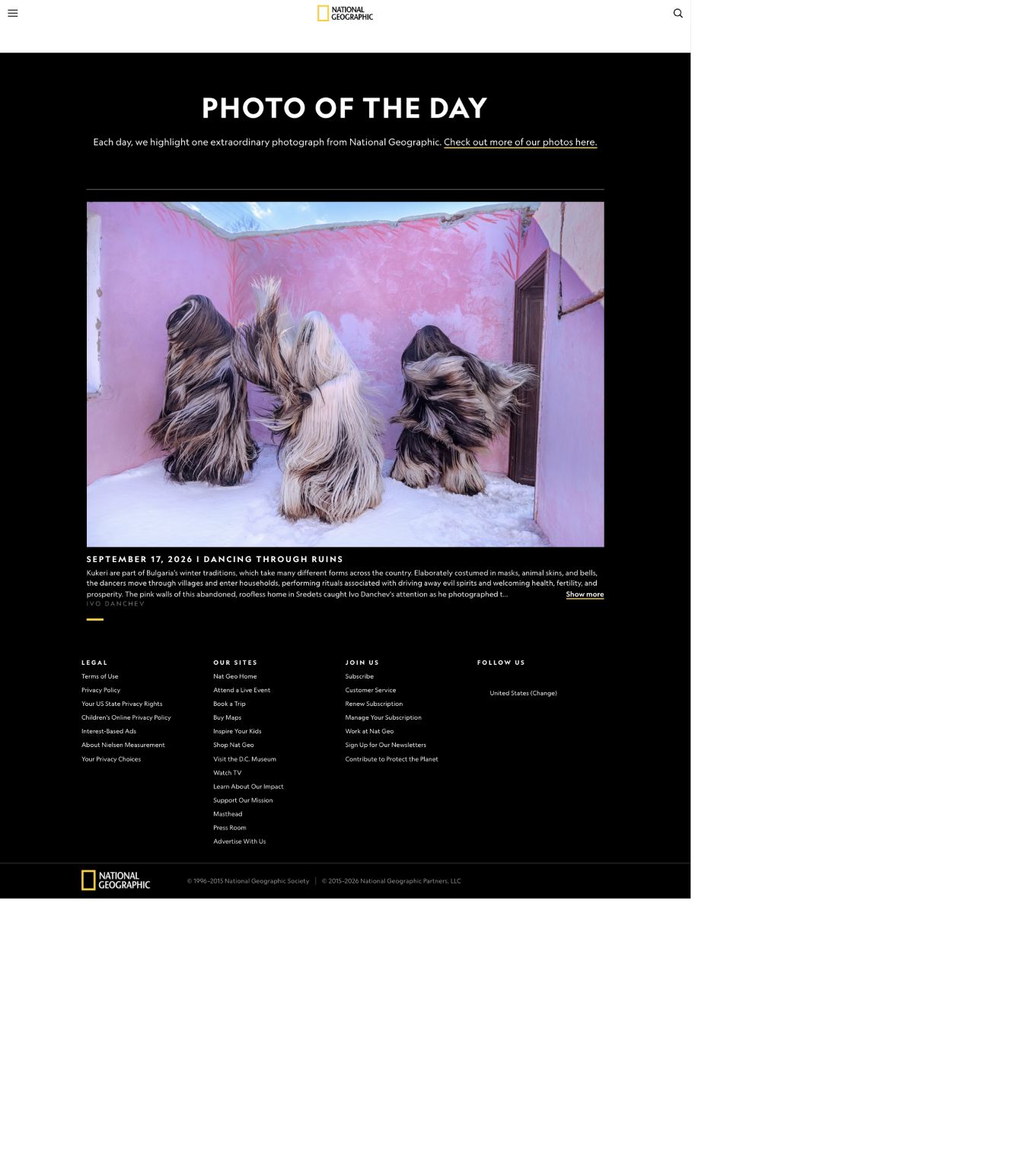
Three kukeri inside an abandoned house in Bulgaria's Strandzha Mountains.
Screenshot: National Geographic Photo of the Day | Photograph: Ivo Danchev | Original page
Three people wear whole goatskins, feathered masks and belts crowded with bronze bells. They are dancing inside a house.
The walls are pink. The house has no roof.
Photographer Ivo Danchev says the pink wall caught his eye first. He made the photograph near Sredets in Burgas Province, in the Strandzha Mountains at Bulgaria's southeastern edge along the Turkish border. But the roofless house is the photograph's true subject. We will come back to it.
What Are They Doing?
Bulgaria has a whole family of winter masquerade rituals, with different names in different places. Around Pernik in the west, participants are called survakari. Around Razlog in the Pirin Mountains, they are babugeri or chaushi. In eastern Bulgaria, including the Strandzha Mountains where this photograph was made, they are kukeri.
The dates vary too, a fact that is easy to get wrong.
Razlog holds its ritual on January 1. The Pernik region observes the old-calendar New Year on January 13 and 14. Eastern Bulgaria celebrates around Cheesefare, in the week before Lent begins.
The broad sequence is similar from place to place. In the morning, participants divide into groups and cross the entire town or village, entering yards and houses. In the afternoon they gather and parade to the central square for the main ritual. The cast contains fixed roles. UNESCO's official description names a leader, a newlywed couple, a priest and a bear. Early the next morning, the group visits every house again, performing ritual marriages for young men and women while the bear mauls people to confer health. The Sredets groups also include a tsar, a doctor and a barber, with musicians attached to each party.
Hosts reciprocate with money, fruit, cured pork fat, eggs or other food. A kuker carries a wooden sword all day and lightly taps each person he approaches, also for health.
A Person Turns Himself into an Instrument
Now consider the bells.
In Bulgarian they are called chan or hlopka; around Sredets, tuchove. A complete costume takes three to six goatskins, sewn together with heavy cord, and costs between 2,000 and 3,000 Bulgarian lev to make.
The Bulgarian News Agency recorded a particular figure in a report from Razlog. The kuker was a teenage boy.
His bells weighed more than 70 kilograms - more than the boy himself.
(That is the figure for one child, not a standard costume weight. The general claim is "tens of kilograms." But the specific case is more powerful than any range: he had to carry, with his entire body, the sound his body made.)
The claim that "sound, not the mask, drives out evil" is currently supported only by explanations from local residents and a local museum. The Regional Historical Museum in Burgas says the bells frighten evil spirits, while a Bulgarian News Agency headline says participants "chase evil away with the sound of bells." UNESCO's official description says only that they chase evil spirits away; it does not identify sound as the mechanism, and I found no folklorist who has argued the point directly.
The accurate formulation is therefore this: people in these villages understand the sound itself to be effective. That is enough. The image that follows is beyond dispute: a child straps on 70 kilograms of bronze bells and walks all day.
The masks are handmade and take anywhere from days to weeks. Dozens of colored beads outline the eyes and mouth, lengths of cord form a beard, and sometimes a rooster's tail feather rises from the crown.
UNESCO's description contains one especially moving sentence: "Throughout the year, families collect materials for masks and other attributes, with adults teaching young people and children to make the distinctive masks and costumes."
The ritual lasts two days. The preparation lasts a year.
Who Can Be a Kuker?
Traditionally, men. But that rule is changing quickly.
The Burgas museum entry is direct: kukeri are usually men, but in recent years women have begun wearing masks too. UNESCO's official inscription speaks of "groups consisting of men, women and children." The UN text itself acknowledges the change.
Razlog has an interesting threshold. Before a young man can receive the title of leader, he must have participated in animal skins for several consecutive years. Seniority is not age. It is how many times he has worn the hide.
The most notable recent change comes from the photographer. In a 2023 interview, Danchev said that more and more Roma communities are forming their own groups. Roma and Bulgarians "exchange costumes, help each other and form friendships."
This Tradition Does Not Need to Be 3,000 Years Old
Almost every piece of tourism copy says that kukeri descend from ancient Thracian worship of Dionysus, in an unbroken tradition 3,000 years old.
Scholarship is more restrained. In a 2022 paper, Bulgarian researcher Ivo Strahilov traced how the "Thracian origin" lineage was assembled. He described the methods of 19th-century ethnographers as "bold conjectures." Even classicists would say only that Dionysus was indeed a Thracian god, but almost no element of his cult can be identified with certainty as "purely Thracian."
The most damaging point lies in the middle: on medieval masquerade practices, "there is no archaeological research on the subject." The supposedly unbroken 3,000-year line is missing more than a millennium at its center. Strahilov's verdict is that this scholarly construction forged and implanted an alternative antiquity.
In his 2011 book, anthropologist Gerald Creed asked the opposite question: why did these supposedly "premodern" rituals not merely survive post-socialist Bulgaria, but grow more popular? He treats masquerade as a living tradition that is continually reinvented, not as a fossil.
The hardest evidence is hidden in a date.
Sredets now holds its kuker festival on the last Sunday of every February. That is a Gregorian date, detached entirely from the church calendar. The town's 2025 festival fell on February 23, while Cheesefare that year was March 2, a full week later. In 2027, Cheesefare will not arrive until March 14.
A ritual more than a thousand years old detached itself from the church calendar and moved to a Sunday when working people could come home.
A tradition willing to change its date for living people matters more than whether it is 3,000 years old.
(One easily confused fact: the ritual in today's photograph is not on UNESCO's list. The element inscribed on the Representative List of the Intangible Cultural Heritage of Humanity in 2015 was Surova in the Pernik region - the western version, on its western date. Eastern kukeri are still not listed. The Strandzha Mountains do have another listed heritage element, inscribed in 2009: barefoot fire-dancing in the village of Bulgari. In the same mountains, people dance under tens of kilograms of bells in winter and barefoot on embers in summer.)
The House Without a Roof
Now return to the pink wall.
According to Bulgaria's National Statistical Institute, as of the end of 2021:
The country had 167 villages with no residents at all.
Another 1,173 villages had fewer than 50 people, together accounting for about one-fifth of all settlements in Bulgaria.
Sredets municipality follows the same curve. Its population fell from 15,975 in 2010 to 12,711 in 2025, a loss of about one-fifth in 15 years. The municipality contains 32 settlements across roughly 1,000 square kilometers and is among Bulgaria's largest by area. The land is just as large. There are 20% fewer people.
Nor was this simply a wall the photographer happened to encounter. The opening of Danchev's project statement says that he traveled through Bulgaria's countryside for years, "from busy cities to empty villages." In an interview he was more explicit: a whole section of his research concerns rural abandonment.
The photograph is where two subjects meet:
Three people dance for health, fertility and abundance inside an empty house.
This is not irony. It is an exact portrait of rural Bulgaria now: the ritual continues, but the house it enters no longer has a roof.
Two Thousand Years Ago, China Did the Same Thing
The Rites of Zhou, in its section on the Summer Offices, describes the costume and duty of the fangxiangshi, a Zhou court official charged with driving out disease:
The fangxiangshi wears a bearskin, four golden eyes, a black upper garment and a red lower garment; carrying a spear and raising a shield, he leads a hundred attendants in seasonal exorcisms, searching through the rooms to drive out pestilence.
Line by line, the correspondences are almost exact.
"Wears a bearskin" encloses a person in an animal body, like the kukeri's sewn goatskins. "Four golden eyes" describes a four-eyed mask. "Carrying a spear and raising a shield" requires an implement in hand, like the wooden sword a Sredets kuker carries all day. And "leads a hundred attendants... searching through the rooms to drive out pestilence" describes a group going from room to room to force disease out.
"Searching through the rooms" is the crucial phrase. Exorcism is not a ritual completed in the square. It has to enter the house. On this point, the Zhou court more than 2,000 years ago and Bulgaria today are identical. UNESCO's "touring the whole village, visiting all the houses" is the same act.
China's nuo traditions survive today. The Nanfeng nuo dance of Jiangxi entered the first national list of intangible cultural heritage in 2006, item III-7. It is performed from the first through the 16th day of the first lunar month and preserves more than 180 mask types. Anshun ground opera in Guizhou entered the same first list as item IV-90. It has two annual seasons: the Spring Festival and the flowering of the rice in the seventh lunar month. The latter performance asks for an abundant harvest. Ground opera also has a defining detail: the mask is worn on the forehead, not over the face.
One comparison is more interesting than the familiar opposition of tradition and modernity.
The official introductions to these two projects on China's intangible cultural heritage website say that "few young artists are entering the field and nuo troupes are dwindling," and that "performers are aging and declining in number, and performances have stopped in many places."
In Bulgaria, by contrast, more than 13,000 people and over 30 international groups were expected at Pernik's 2026 masquerade festival. For the first time in 60 years, so many people registered that the parade had to be divided across two consecutive weekends. A Sredets costume costs 2,000 to 3,000 lev, and people keep making them.
The same ritual pattern, the same masks and animal skins, are moving in opposite directions in two countries.
Sources
National Geographic Photo of the Day, September 17, 2026, "Dancing Through Ruins"; UNESCO Representative List of the Intangible Cultural Heritage of Humanity, element 00968, "Surova folk feast in Pernik region" (2015, 10.COM), and UNESCO's Bulgaria page; Regional Historical Museum Burgas entry on kukeri; Bulgarian News Agency reports on Starchevata in Razlog; Sredets municipal profile and 2025 kuker festival announcement; the official Surva festival website, surva.org; Bulgaria's National Statistical Institute 2021 settlement population data, reported by Mediapool; Ivo Strahilov, "Between the 'Thracian Substratum' and 'Oriental Accretions': Bulgarian Mumming and the National Heritage Canon" (Seminar_BG, special issue 5, 2022); Gerald W. Creed, Masquerade and Postsocialism: Ritual and Cultural Dispossession in Bulgaria (Indiana University Press, 2011), and academic reviews of the book; Osservatorio Balcani e Caucaso Transeuropa's interview with Ivo Danchev (December 11, 2023); LensCulture's "Kukerland" project page; the Rites of Zhou, "Summer Offices: Fangxiangshi," in the Chinese Text Project; China's intangible cultural heritage website entries for "Nuo Dance (Nanfeng Nuo Dance)" and "Anshun Ground Opera"; and Guangming Daily, "Nuo: Decoding the 'Expressions' of Ancient Chinese Culture" (March 1, 2024).