
The strangest part of this spiral galaxy lies at its center, where the conspicuous spiral arms in the photograph do not reach.
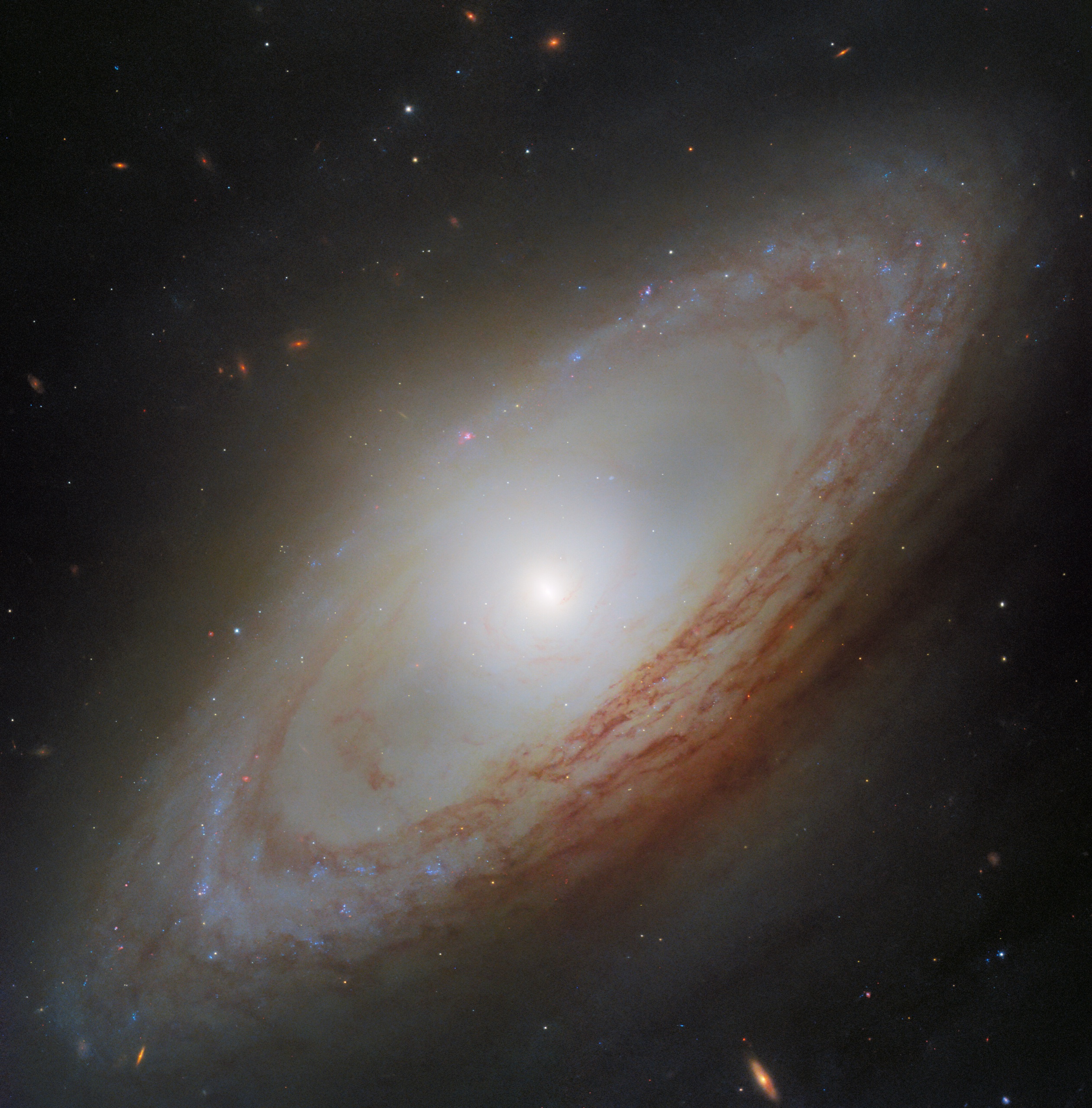
Image: NASA Image of the Day | ESA/Hubble & NASA, D. Thilker, the MAUVE-HST Team | Original page
NASA's Image of the Day for September 25 features the Hubble Space Telescope's view of NGC 4698, a spiral galaxy in the Virgo Cluster about 55 million light-years from Earth.
Stars, gas, and dust form a thin, tilted disk. Brownish clumps of dust lie among bright blue groups of young stars, and the outer spiral arms join into an almost ringlike structure. Unlike those of many spiral galaxies, its arms do not wind all the way into the bright center.
A Core Out of Step with the Disk
NGC 4698's central bulge is elongated, with its long axis almost at right angles to the galactic disk. More unusually still, stars and gas near the center rotate in a plane almost perpendicular to that of the outer disk.
The arrangement resembles two nested spinning tops whose axes do not line up: the outer disk turns one way, while the inner core seems to have been tipped through 90 degrees. A single photograph cannot directly reveal this motion. Astronomers measure redshifts and blueshifts in spectra from different parts of the galaxy to determine how fast each region is moving toward or away from us.
That is what "out of sync" means here. The difference lies in the plane of rotation, rather than simply its speed.
Motion Preserves a Galaxy's Past
NASA offers two possible explanations.
NGC 4698 may have acquired gas from outside. Arriving with angular momentum oriented differently from the galaxy's own, that gas could have formed a tilted inner disk, where new stars subsequently formed.
Alternatively, the galaxy may have undergone a minor merger. After a smaller galaxy was swallowed, its stars, gas, and direction of motion may not have fully blended into the existing disk, leaving a nearly perpendicular structure at the center.
Both explanations describe a galaxy whose shape continues to evolve. Galaxies absorb surrounding gas and merge with smaller neighbors. Long-ago events may leave few obvious remnants while preserving their orientation in the orbits of stars.
The Calm Is on the Surface
NGC 4698 is not currently undergoing a violent collision. Its outer disk is intact, its spiral arms delicate, and its blue star-forming regions and dark dust lanes look orderly.
The motion data reveal another structure beneath that calm: a core that preserves a history pointing in a different direction. Hubble shows us the light. Spectroscopy tells us how its sources are moving.
Sources
NASA Image of the Day, "A Galaxy Spinning Out of Sync" (Original page); NASA Science, "NASA's Hubble Spots an Out-of-Sync Galaxy".