
This image combines three telescopes, 31 years of observations and a point that even the James Webb Space Telescope cannot resolve. It is the brightest thing in the entire system, yet it lies outside the center of either galaxy.
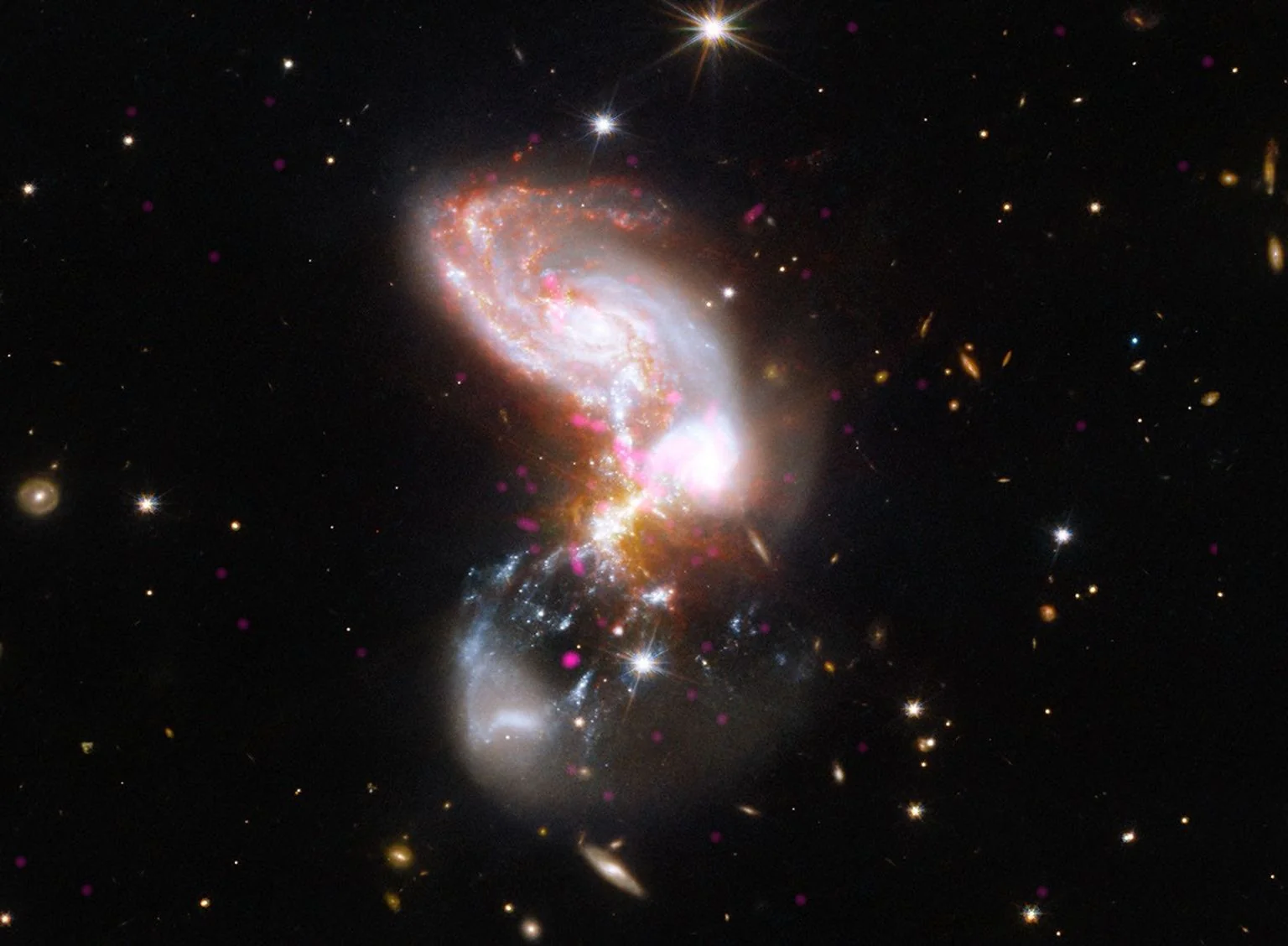
Image: NASA Image of the Day | Image credit: X-ray: NASA/CXC/SAO; Optical: NASA/ESA/STScI; Infrared: NASA/ESA/CSA/STScI; Image Processing: NASA/CXC/SAO/L. Frattare and J. Major | Image page
NASA's accessibility description offers a particularly good image. At the top is a spiral galaxy whose thick arms glow in fiery orange, white and red. Below is a hazy bowl flecked with grainy white ribbons and hot pink spots. Where the two collide, at the center of the frame, the galaxy looks utterly chaotic, like a firework.
The object is II Zw 096, in the direction of the constellation Delphinus, about 525 million light-years away. Tonight, shortly after 9 p.m., it will be high in the southern sky across much of China. You will not be able to see it, of course, but knowing where it is can make the act of looking up feel different.
First, the Most Important Thing for a Child to Know: These Colors Are Not Real
Begin with the easiest part of the image to misunderstand.
It combines data from three telescopes: magenta represents X-rays from the Chandra X-ray Observatory, blue and white are visible light from Hubble, and the infrared data come from the James Webb Space Telescope.
Human eyes cannot see X-rays or infrared light at all.
Chandra has an official page devoted to this point. Its explanation is direct: X-rays, along with radio, infrared, ultraviolet and gamma rays, are invisible to the human eye and therefore have no "color" of their own. Astronomers choose colors partly to make the data legible and partly as an aesthetic decision. Color often encodes either the intensity of radiation or its energy. Such images are commonly called false-color images, or more precisely, representative-color images.
Now look again at the last part of the credit: Image Processing: NASA/CXC/SAO/L. Frattare and J. Major.
The magenta in this picture is not the color of the universe. It is the color two people chose for X-rays.
One of them, Lisa Frattare, has been profiled on Chandra's official blog. She spent 20 years at the Space Telescope Science Institute analyzing data and processing images, worked on more than 300 Hubble images, and now works part-time for the Chandra team. Her career is almost a caption for this image: after two decades working with Hubble pictures, she is now layering Hubble and Chandra data together.
This is not fakery. It is a translation of something invisible into something the eye can see. But knowing that it is a translation is a very different way of looking from believing it is a photograph.
The Real Marvel: The Brightest Light Is Outside Both Galactic Nuclei
Now for why this object deserves an article of its own.
In 2010, Japanese astronomer Hanae Inami and her colleagues observed II Zw 096 with the Spitzer Space Telescope. Their paper was titled A Buried Starburst in the Interacting Galaxy II Zw 096 as Revealed by the Spitzer Space Telescope. Its conclusion was startling:
About 80% of the system's total infrared luminosity comes from an extremely compact, very red source that is not in the nucleus of either merging galaxy.
The paper put it more bluntly: the system is remarkable because its extranuclear infrared luminosity dominates the whole system.
In other words, two galaxies are colliding, yet the brightest place is neither the center of A nor the center of B. It lies somewhere in between.
After Webb launched, the same group looked again with its Mid-Infrared Instrument in 2022. This time they found that 40% to 70% of the system's thermal infrared luminosity, about 3 to 5 x 10^11 times the Sun's luminosity, comes from a source no more than 175 parsecs in radius.
That is about 570 light-years. It may not sound small, but the Milky Way is roughly 100,000 light-years across. The engine lighting this entire merger is therefore less than 1% of the Milky Way's diameter.
More importantly, 175 parsecs is not a measured size but an upper limit set by Webb's resolving power at that wavelength. Even Webb has not separated the point. We know only that it is smaller than 570 light-years, not how much smaller.
When explaining this to a child, that "we do not know yet" is more valuable than any exact number.
Astronomers Changed Their Answer Three Times in 15 Years
What, then, is shining inside that point?
This is the image's best lesson, because the answer has changed three times.
In 2010, Spitzer's mid-infrared spectrum showed none of the high-ionization emission lines expected from a buried active galactic nucleus, but it did reveal strong polycyclic aromatic hydrocarbon features. The conclusion was clear: the energy source was a starburst, an intense burst of stellar birth, and nothing more.
In 2022, Webb made the picture ambiguous. The paper said the evidence might be consistent with a Compton-thick active galactic nucleus, but was equally consistent with a starburst; neither interpretation was conclusive. The researchers declined to choose.
In 2025, a team combined high-resolution integral-field spectroscopy from the Very Large Telescope with data from the Atacama Large Millimeter/submillimeter Array and Chandra. Its conclusion was that the diagnostics support an obscured active galactic nucleus in region D1: a supermassive black hole wrapped in thick dust.
That is how today's caption arrived at the phrase "powerful black hole activity."
But one detail is revealing. In an official blog post accompanying the same batch of images, Chandra itself called II Zw 096 a dust-shrouded starburst and did not mention a black hole at all.
Two NASA pages used two different descriptions of the same object on the same day.
Neither is necessarily wrong. This is what science in progress looks like: one mystery, 15 years, three revisions and two official texts that do not quite agree, all of them honest. If a child remembers only one thing from this picture, let it be this: science is not a completed answer book. It is a record of people arguing and revising as they learn.
When Galaxies Collide, Their Stars Almost Never Do
Galaxy collisions prompt an obvious and deeply counterintuitive question: when two galaxies run into each other, do their stars crash together?
NASA's answer is crisp. Although galaxies plunge into one another, the stars within each are so widely separated that they do not collide with other stars during the encounter.
Why is space so empty? Here is an analogy - mine, not an official calculation. Shrink the Sun to the size of a marble and its nearest stellar neighbor would be about 400 kilometers away. Send two clouds of such marbles through each other, and the chance of marble striking marble is negligible.
Why, then, does a collision become so bright? Because what collides is not the stars but the gas.
NASA explains that when galaxies collide, their interstellar gas is compressed into thick clouds. Under strong gravity, those clouds collapse further and form new stars.
The stars are scattered through immense emptiness, but gas is diffuse and continuous, so it meets head-on. The raw material for stars is squeezed together, and the whole system suddenly begins making them furiously. II Zw 096 forms stars at about 120 solar masses per year. The Milky Way manages only one or two solar masses a year.
As for the end: NASA says the two galactic nuclei eventually merge, their stars settle into randomized orbits and an elliptical galaxy forms. The introduction to Chandra's image collection also sorts galaxies into spiral, elliptical and irregular types, noting that elliptical galaxies are older and probably the product of mergers.
II Zw 096 may even contain more than two galaxies. The 2025 integral-field spectroscopy paper describes three or more distinct galaxies.
What About Us? Will the Milky Way Hit Andromeda?
It is the natural question to ask after seeing an image like this, and over the past year its answer has become unusually lively.
NASA's 2012 account, from a famous Hubble announcement, said the Milky Way was destined for a major makeover in an encounter expected four billion years from now. The same page offered reassurance: the Sun would probably be flung into another region of the galaxy, but Earth and the solar system were in no danger of being destroyed.
In June 2025, Nature Astronomy published a paper titled No certainty of a Milky Way-Andromeda collision. Its lead author was Till Sawala. After accounting for uncertainties in the galaxies' present positions, motions and masses, the team found sharply divergent possible outcomes: the probability that the Milky Way and Andromeda will not merge within the next 10 billion years is close to 50%. With the best available data, the fate of our galaxy remains completely open.
The mechanism is particularly interesting. Including the Triangulum Galaxy, M33, raises the merger probability. The Large Magellanic Cloud follows an orbit nearly perpendicular to the Milky Way-Andromeda orbit, and its presence reduces the chance of a merger.
In April 2026, a team from Peking University's Department of Astronomy pushed back. The first author was doctoral student Wu Hao; the corresponding authors were Huang Yang and Zhang Huawei; collaborators included the University of Chinese Academy of Sciences and the National Astronomical Observatories. Using newer data, they found a 90% probability that the Milky Way and M31 will merge, with a median merger time of about 6.5 billion years.
So three answers now coexist: NASA's website says the collision is inevitable in four billion years; the Finnish team says the odds are about 50-50 and the outcome remains open; the Chinese team says 90%, in 6.5 billion years.
NASA's 2012 page still says "four billion years" and "destined." It was last updated in January 2025, before Sawala's paper.
That may be the most useful sentence in this article: textbooks and official websites will always update more slowly than papers. Every statement on an authoritative site carries an invisible timestamp.
Two Notes on Chinese Starburst Research
Chinese astronomers appear in more than the Andromeda debate.
In December 2024, Tan Qinghua of the Purple Mountain Observatory, both first and corresponding author, published a paper in Nature based on archival data from the Atacama Large Millimeter/submillimeter Array. It found that violent starbursts can directly build galactic bulges in situ, without requiring galaxy mergers. That July, Liu Daizhong of the same observatory reported in Nature Astronomy that the ultraluminous infrared galaxy PJ0116-24 has a rotating, turbulent gas disk with no obvious signature of a major merger.
Set those findings beside today's image and the tension becomes clear. II Zw 096 is a textbook case of a merger-driven starburst, while two Chinese teams are showing that a merger is not the only route.
Why Today? The Answer Is Not September 11
September 11 carries no astronomical anniversary connected to this image. Chandra launched on July 23, 1999; Hubble on April 24, 1990; Webb on December 25, 2021.
The day this image was released, however, does matter.
It belonged to a batch published by the Chandra team on August 25, 2026, titled Galactic Gems Glisten in New Gallery From NASA's Chandra. The collection contained 16 objects, including the Sombrero Galaxy, the Cigar Galaxy M82, the Whale Galaxy NGC 4631 and another merging pair, NGC 3256. The set was essentially an exhibition of galactic collisions. NASA Image of the Day selected II Zw 096 17 days later.
And on August 25, 2003, the Spitzer Space Telescope launched, the last of NASA's four Great Observatories.
Spitzer was the telescope that first uncovered II Zw 096's buried starburst in 2010. Its name is in the paper's title.
An image visible only through infrared data was released on the 23rd anniversary of the first great infrared observatory's launch. It was probably not deliberate, but it is a lovely coincidence.
Something Happening Now: This Telescope May Be Shut Down Next Year
This last part is not easy, but it is true and still unfolding.
The Chandra X-ray Observatory launched in 1999 and has now operated for 27 years. It is still working; today's image is direct evidence.
For the past two years, however, its budget has placed it on the edge of survival. Congress ultimately protected it for fiscal year 2026. The Senate report explicitly directed no less than $63 million for the Chandra X-ray Observatory, and the NASA authorization act expressly required continued operation of Chandra, Hubble and Webb.
Then the fiscal year 2027 president's budget request, released in April 2026, once again placed Chandra on a list of missions proposed for cancellation, alongside the Fermi Gamma-ray Space Telescope and several others. NASA astrophysics funding would fall about 65%, from roughly $1.6 billion enacted in fiscal 2026 to a proposed $552 million.
Nothing has been decided. But it means something very concrete: the magenta spots in the image you see today came from a machine that may no longer be operating next year.
Sources: NASA Image of the Day, NASA's Chandra Spots Galactic Gem; Chandra, Galactic Gems Glisten in New Gallery From NASA's Chandra, its gallery and official blog; Chandra, Adding Color to Chandra Images, and its public gallery; Inami et al., The Astronomical Journal 140:63 (2010), DOI 10.1088/0004-6256/140/1/63; Inami et al., The Astrophysical Journal Letters 940:L6 (2022), DOI 10.3847/2041-8213/ac9389; Riesco et al. (2025), arXiv:2507.06339; Caltech/IPAC Cool Cosmos; NASA, Hubble Shows Milky Way is Destined for Head-On Collision and Hubble Reveals Stellar Fireworks Accompanying Galaxy Collisions; Sawala et al., Nature Astronomy 9:1206-1217 (2025), DOI 10.1038/s41550-025-02563-1; Peking University Department of Astronomy research update and Wu et al., The Astrophysical Journal Letters 1001:L19 (2026), DOI 10.3847/2041-8213/ae5799; Purple Mountain Observatory, Chinese Academy of Sciences, announcements on the Nature work by Tan Qinghua and the Nature Astronomy work by Liu Daizhong; NASA Spitzer mission page; American Astronomical Society fiscal year 2026 and 2027 budget policy briefs; Zooniverse, Cosmic Collisions; EarthSky Andromeda Galaxy observing guide; TheSkyLive lunar calendar