
The rocket is standing upright. The launch site still has to wait for Earth to turn.
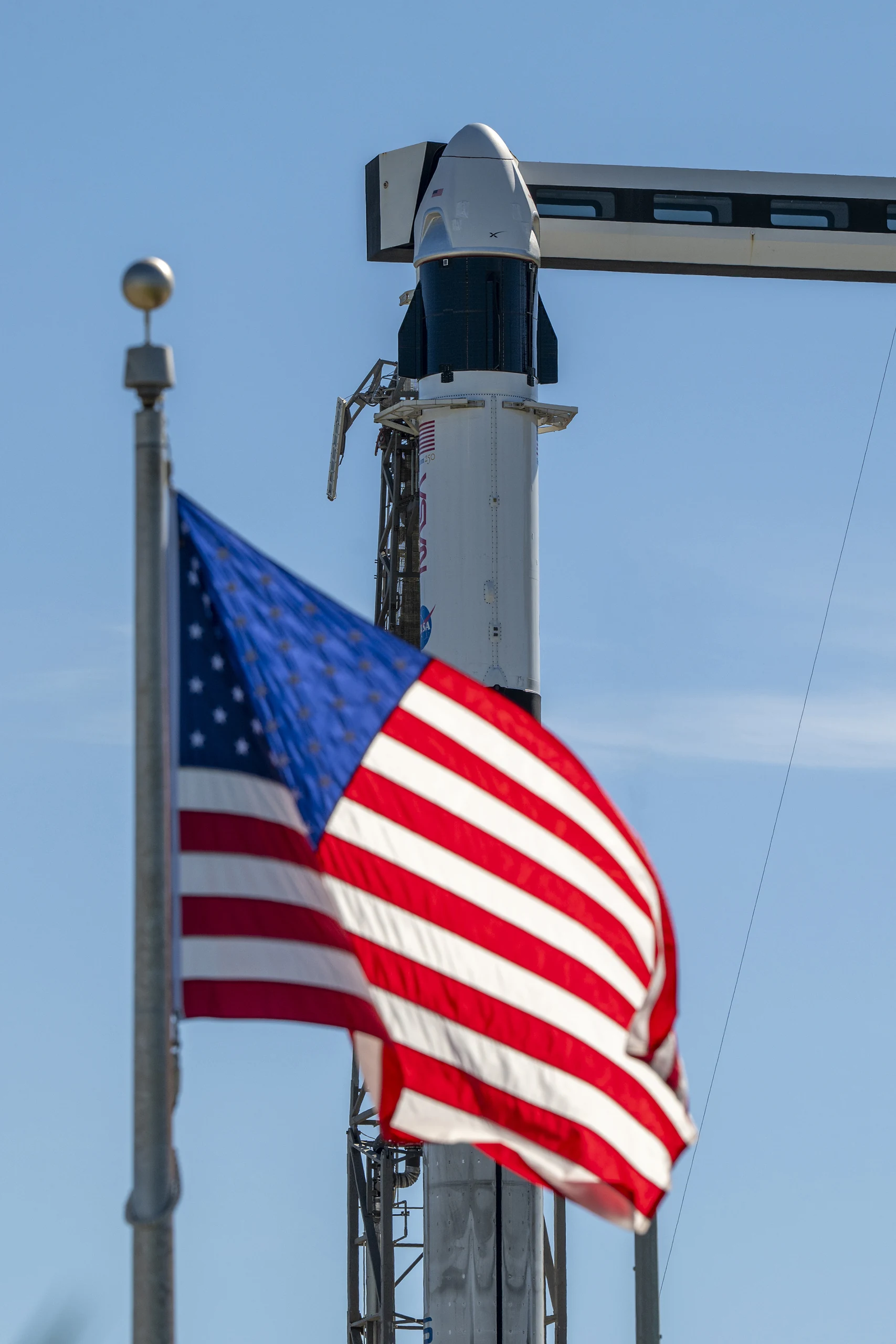
Image: NASA Image of the Day | Credit: SpaceX | Original page
NASA's September 29 selection shows Falcon 9 and Dragon preparing for Crew-13 at SLC-40 in Cape Canaveral, Florida. The photograph was taken on September 27.
The announced target was October 1 at 11:10 a.m. Eastern time. That was a prelaunch plan, not confirmation of an actual liftoff. Looking back at the photograph, the more lasting question is why a launch time needs to be so precise.
Waiting for a Plane
The International Space Station's orbit is inclined about 51.6 degrees to the equator. A spacecraft intending to meet it first needs an orbit close to the same plane. Making a large plane change after reaching orbital speed is expensive in propellant.
Over the short waiting period for a launch, that plane can be treated as approximately fixed while Earth rotates beneath it. The launch site moves with Earth and passes through a favorable position at particular times. The station's position, the spacecraft's rendezvous route and mission constraints also help determine the window.
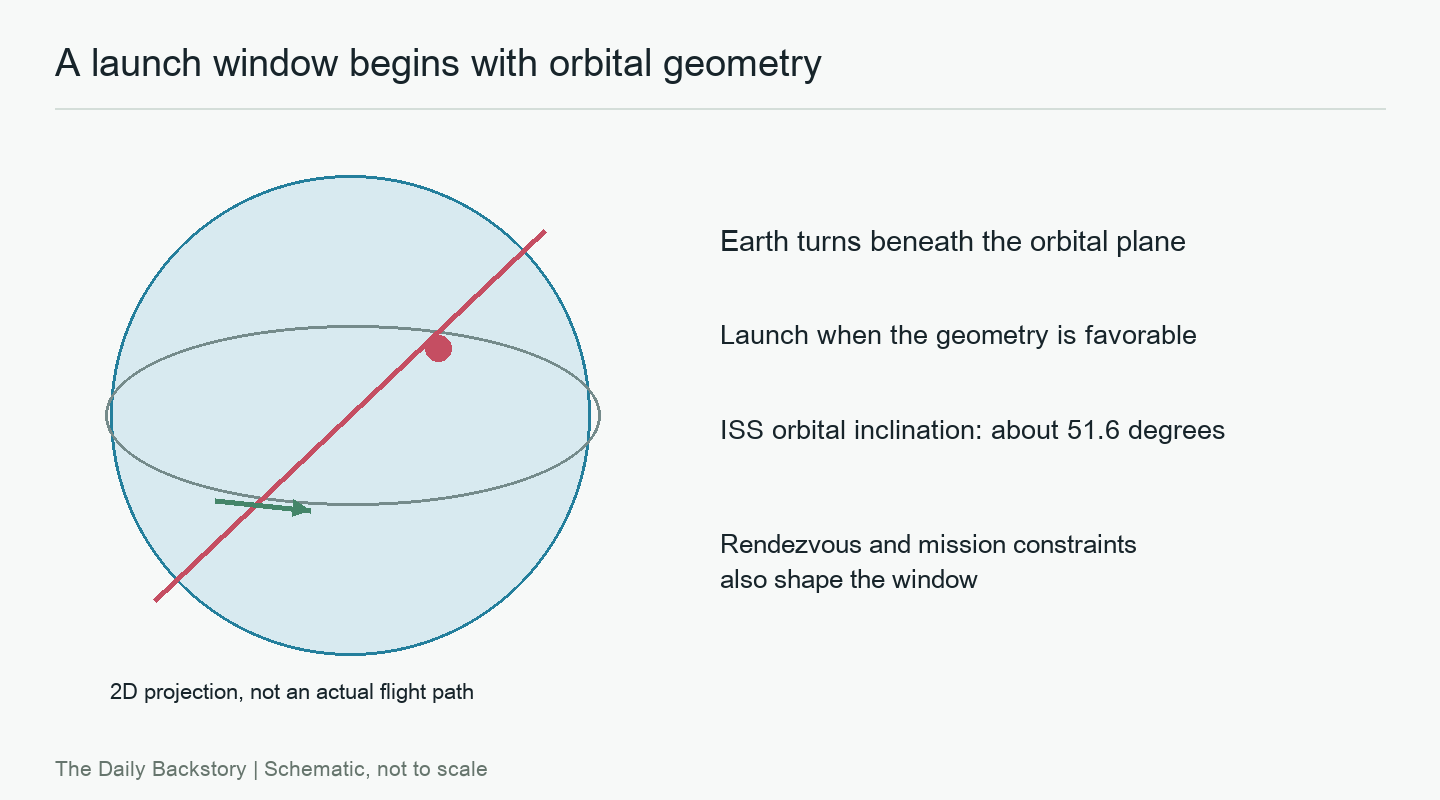
Diagram: The Daily Backstory; not to scale. Rendezvous and mission constraints also shape the window.
The announced 11:10 was therefore not an arbitrary appointment. Orbital geometry turns an enormous distance problem into a strict timing problem. Nor is the orbital plane permanently motionless: over longer periods, it precesses.
A Crew and an Interdependent Station
NASA's caption names the planned crew: Jessica Watkins, Luke Delaney, the Canadian Space Agency's Joshua Kutryk and Russian cosmonaut Sergey Teteryatnikov.
Mixed crews have an operational purpose as well as an international one. The station relies on interdependent systems, and cross-crew arrangements help preserve the ability to operate its different segments. The access arm gets people into the spacecraft. Communications networks must keep them connected after they leave.
Moving the Antenna Offshore, Then into Space
China's spacecraft tracking network has faced the same obstacle: radio links cannot treat Earth as transparent. Yuanwang tracking ships carry antennas into ocean areas beyond the reach of land stations. Tianlian relay satellites forward data from low-orbit spacecraft through space.
China's 2016 space white paper records the Tianlian-1 network reaching global coverage and Yuanwang-7 completing its maiden voyage, as a combined land-, sea- and space-based tracking network developed.
The launch window answers "When can we depart?" The tracking network answers "How do we stay in touch afterward?" A rocket needs both answers before it leaves the ground.
Sources
NASA: Original page and the announced launch and docking coverage plan; China's 2016 space white paper.