
One rocket, two photographers, two hundred meters.
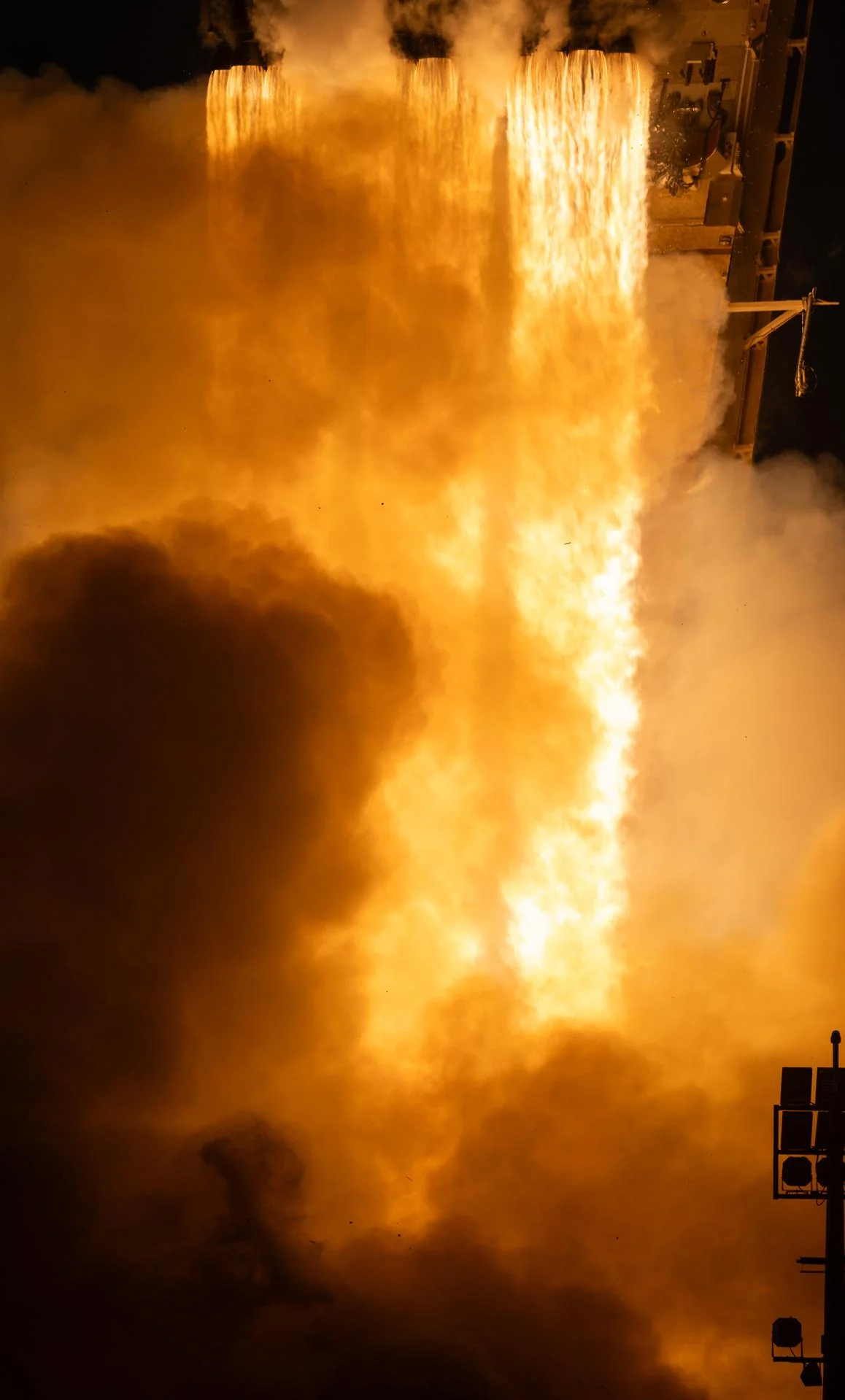
Image: NASA Image of the Day | Image credit: NASA/Joel Kowsky | Image page
At 7:26 a.m. Eastern time on August 30, a SpaceX Falcon Heavy lifted off from Launch Complex 39A at Kennedy Space Center, sending the Nancy Grace Roman Space Telescope on its way. It is now making a three-month journey to a destination 1.5 million kilometers from Earth.
This is one of NASA's photographs from that day. The frame is vertical, the fire fills most of it, and you can almost feel the sound. The credit reads NASA/Joel Kowsky.
But NASA released another photograph of the same launch. In that one, the rocket is black.
The Other Photograph
The official caption says the Roman Space Telescope "passes in front of the Sun during launch." NASA's own image description is more specific: "In a sepia-toned photograph, the Sun is a bright, enormous orb with a fuzzy edge. In front of this backdrop, a tall, thin rocket stands in silhouette above a column of cloud-like exhaust."
The credit reads NASA/John Kraus.
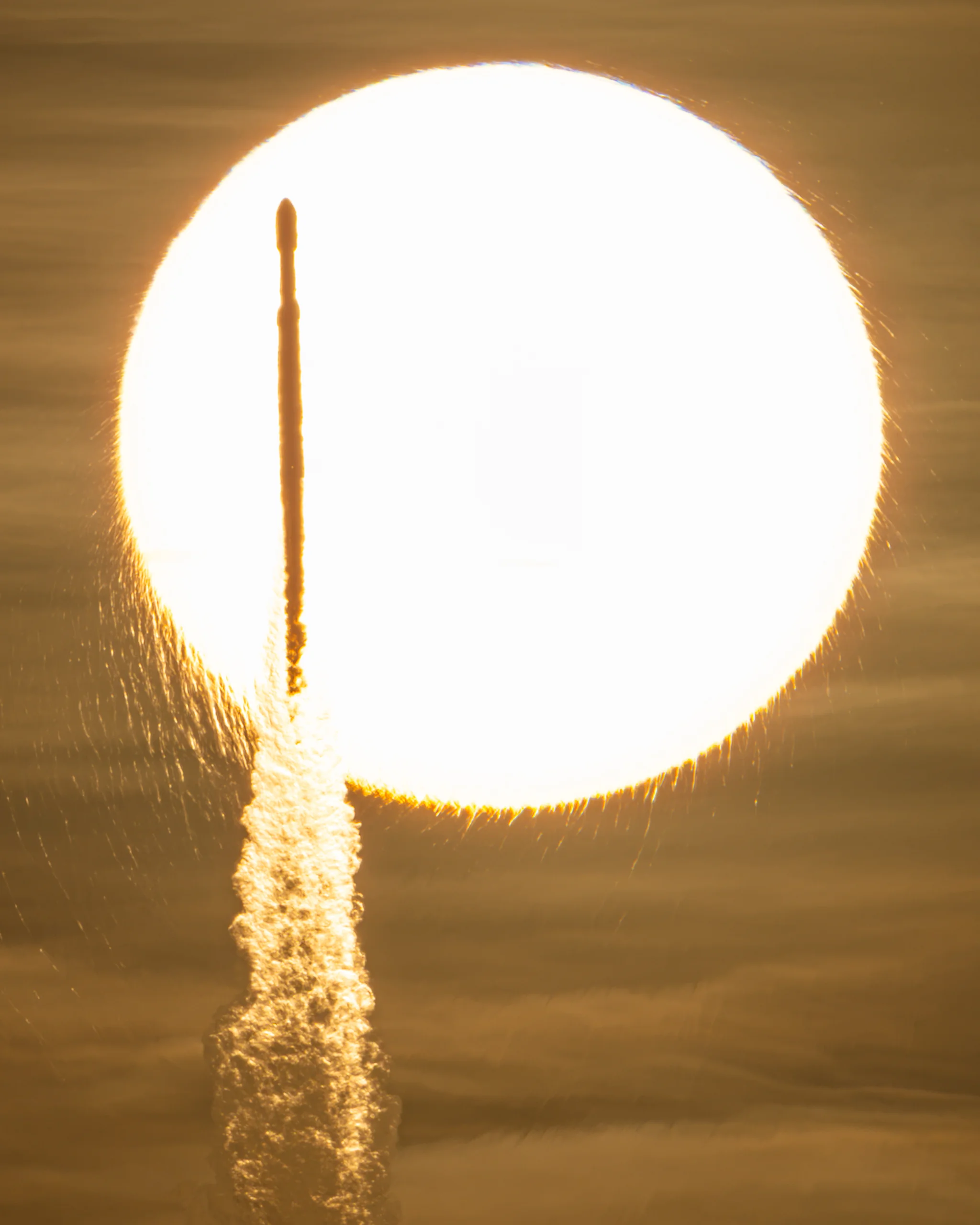
Above: Another official photograph of the same launch, showing the Roman Space Telescope passing in front of the Sun during ascent. Image credit: NASA/John Kraus
The same rocket in the same minute. One photographer caught the fire; the other caught the shadow.
There is an easily missed detail: Kowsky is one of NASA's best-known photographers of precisely this kind of solar transit. During the U.S. total solar eclipse on August 21, 2017, he photographed the International Space Station crossing the Sun at about five miles per second from Wyoming. He did it again in Virginia in June 2020. Just 18 days ago, on August 12, he traveled to Maine and placed a partial solar eclipse and an ISS transit in the same photograph.
This time he stayed close to the launch pad and left the Sun to someone else.
To understand why, we need to do some arithmetic.
The Sun Is Only Half a Degree Wide
The first point runs against intuition: the Sun is actually very small in our sky.
NASA gives us the two numbers needed to calculate its apparent size. The Sun is about 1.39 million kilometers across and about 150 million kilometers from Earth. Divide one by the other and the angle is 0.53 degrees, or roughly 32 arcminutes.
Put that on a familiar scale. With your arm extended, the distance from your eye to your hand is about 70 centimeters. How large would an object need to be at that distance to cover the entire Sun?
The answer is 6.5 millimeters.
A grain of rice. At arm's length, a grain of rice can cover the entire Sun.
(A coin cannot. A Chinese one-yuan coin is about 22 millimeters across and subtends nearly 1.8 degrees at arm's length, more than three times the Sun's apparent width. The familiar claim that a coin at arm's length just covers the Sun is wrong.)
Crossing That Half-Degree Takes a Fraction of a Second
Once we have the half-degree, the rest is elementary division.
How long does a rocket take to cross the face of the Sun? The answer depends on only three numbers: the Sun's angular width, the rocket's distance from you and its speed.
Duration = solar angular width (0.0093 radians) x distance / speed
Insert the numbers. For a photographer 19 kilometers from this launch, if the rocket's transverse speed at that moment was several hundred meters per second, the result is about one quarter of a second. As the photographer wrote: "It happened in a split second."
Try a more familiar case. For the International Space Station at an altitude of 400 kilometers and a speed of 7.66 kilometers per second, the result is 0.49 seconds. For the Chinese space station at 390 kilometers, it is 0.47 seconds. If the station is farther away and crosses at a low elevation, at a slant range of 700 kilometers, the time becomes 0.85 seconds.
Keep those figures in mind.
The Hard Part Is Not the Shutter but the Location
The fraction of a second is not what makes the photograph nearly impossible.
Imagine standing on the ground with the rocket aligned against the Sun. Step sideways and the rocket's apparent position in the sky shifts with you. Move far enough and it slides off the solar disk.
Anyone who wants to see a rocket against the Sun must therefore stand inside a very narrow strip on the ground. How wide is it? The formula is just as simple:
Corridor width ≈ solar angular width x distance
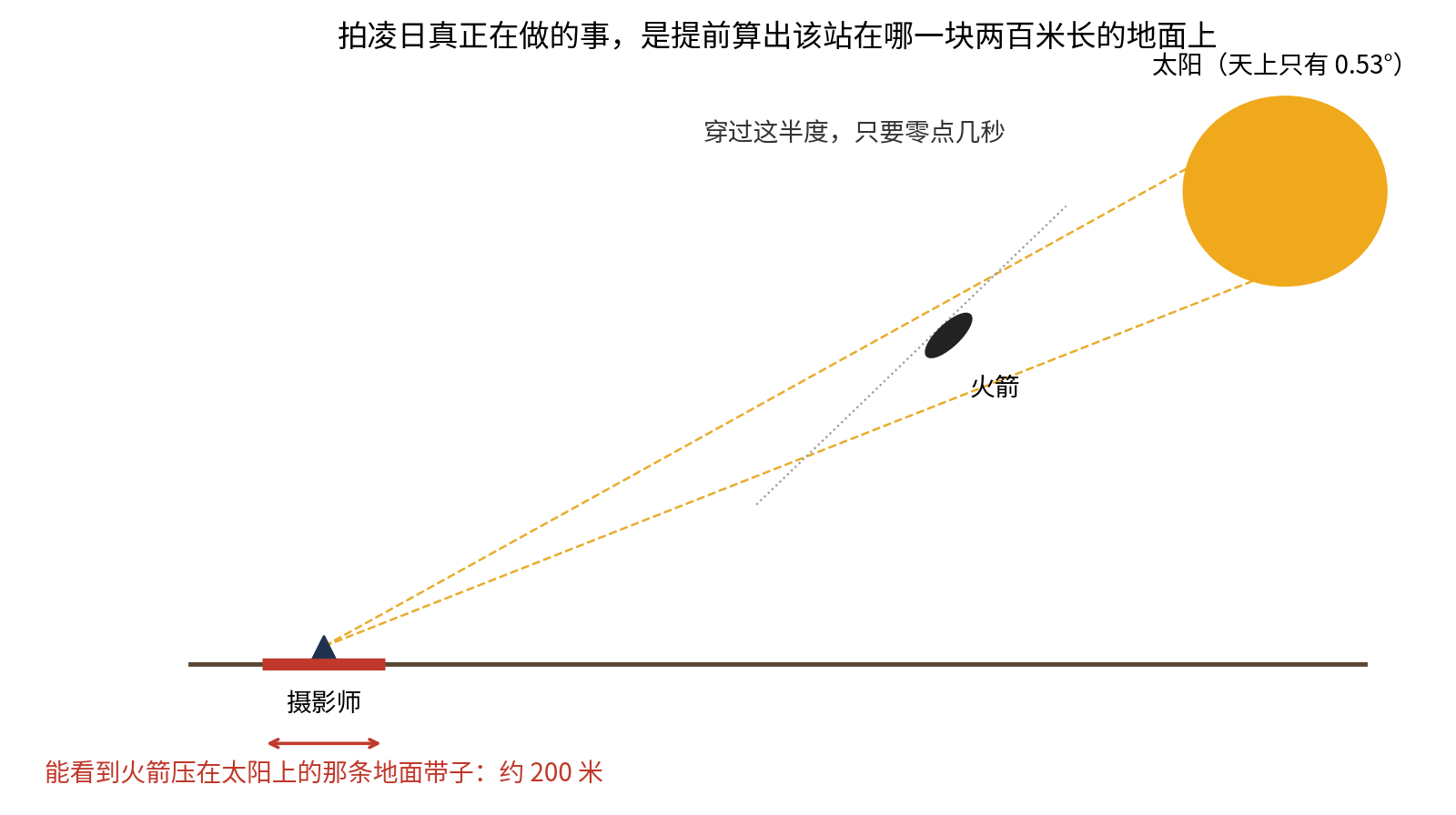
Above: Three variables in a transit. The Sun's half-degree is set by nature and the speed by the rocket; only the viewing location is yours to choose. (Diagram not to scale; angles exaggerated.)
For an ISS transit, this strip is roughly three to four kilometers wide. That is already narrow, though at least a car gives you room to search.
For a rocket transit, because the observer is only 10 or 20 kilometers away, the strip shrinks to about 200 meters.
Roughly the length of a parking lot.
The real work of photographing a transit is not pressing the shutter. It is calculating in advance which 200-meter stretch of asphalt to stand on.
This also explains why Kowsky stayed close. To photograph the transit, he would have had to leave the press site and drive more than 20 minutes to a parking lot in the countryside, wagering on two things: if the clouds did not clear, he would get nothing; if his calculation was wrong, he would get nothing. Near the launch pad, the fire was guaranteed to appear.
One photographer made the dependable choice and the other took the gamble. NASA published both photographs.
The Disk Behind It All
Now consider the object serving as the backdrop.
NASA says the Sun is "about 100 times wider than Earth" - 109 times by a more exact calculation - and that "1.3 million Earths could fit inside it." Yet in the silhouette photograph, a rocket tens of meters tall lies against that disk like a needle.
If you ever see dark marks on the Sun through a proper filter, remember another NASA line: "This sunspot's dark core is actually larger than Earth." A sunspot is only relatively dark. Its temperature is about 3,300 degrees Celsius; the surrounding photosphere is about 5,500 degrees, so the contrast makes it look black.
The Sun is now on the downslope of Solar Cycle 25. In October 2024, NASA and the U.S. National Oceanic and Atmospheric Administration jointly announced that the Sun had entered solar maximum. They also made a point worth remembering: scientists would need to wait months to determine the precise peak because "you can only identify the exact peak after observing a consistent decline in solar activity."
The Sun's highest point can be recognized only in hindsight. It is a neat example of how science works.
Finally: Never Look Directly at the Sun
This must be said because it matters more than anything above.
NASA's warning is explicit: "Viewing any part of the bright Sun through a camera lens, binoculars, or a telescope without a special-purpose solar filter secured over the front of the optics will instantly cause severe eye injury."
Another warning is even more urgent: "Do not look at the Sun through a camera lens, telescope, binoculars, or any other optical device while wearing eclipse glasses or using a handheld solar viewer - the concentrated solar rays will burn through the filter and cause serious eye injury."
The American Astronomical Society adds the crucial point of placement: the filter must be secured over the front of the optics. So-called solar eyepieces fitted at the viewing end are dangerous.
Standard photographic options include Baader film or an ND100000 filter, which reduces the light to one hundred-thousandth of its original intensity. Experienced observers use a simple rule: filter on before finding the Sun; camera down before filter off.
For families, the safest and cheapest method requires no special purchase: pinhole projection. NASA's instructions call for a cardboard box, a sheet of white paper, tape, scissors and aluminum foil. Make a tiny hole in the foil and let sunlight project an image of the Sun onto the paper inside the box. At no point do you need to look up at the Sun.
In China, Amateurs Made It Happen
There is an encouraging counterpart in China.
At about 12:04 p.m. on January 12, 2025, a young man named Diao Zhenyu set up a small all-in-one telescope with a solar filter in farmland near the Dagu River in Pingdu, Qingdao. He captured the Chinese space station crossing the Sun. According to the Qingdao Morning Post, he works at an ordinary Qingdao company and pursues landscape photography as a hobby. For this attempt, he researched the event, used several third-party programs to predict the path and ran countless simulations and calculations.
The event lasted just 0.9 seconds.
On another occasion in Lianyungang, Jiangsu, a group of photography enthusiasts used public Chinese space-station orbital data to calculate the time to the second: the station would pass overhead at 10:07:38 a.m. on August 29. Photographer Sun Chen caught it.
That transit lasted 0.5 seconds.
Return to the earlier formula. It predicted that a Chinese space-station transit should last 0.47 to 0.85 seconds. The two observed events lasted 0.5 and 0.9 seconds.
A division problem simple enough for an elementary-school student agrees with what two people waited to see in farm fields. That is part of what makes physics addictive.
There is another point worth making: photographing China's space station has official support. Co-producers of the "Global Photographing Tiangong" initiative include the News and Publicity Bureau of the China Manned Space Agency and the Astronaut Center of China. The photographers named in Xinhua's coverage include a Beijing Planetarium researcher and ordinary people in Yancheng, Jiangsu; Xiamen, Fujian; Qingdao, Shandong; and Gaozhou, Guangdong. Officials placed the cameras in amateurs' hands.
One common confusion also needs clearing up. The celebrated work astrophysics Ph.D. Liu Boyang did in 2022 - writing his own optical tracking software, hauling more than 200 kilograms of equipment and photographing changes in the Chinese space station's configuration more than 50 times - was not a solar transit. That was tracking: making a telescope follow the station during a passage lasting several minutes in order to photograph its form. A transit is the technical opposite, more like waiting in ambush: lock the camera on the Sun and wait for the station to cross in half a second.
Sources: NASA image pages and image library entries (Igniting Roman's Journey and Nancy Grace Roman Space Telescope Launches); NASA's Sun and eclipse-safety pages; the joint NASA-NOAA announcement on Solar Cycle 25; the American Astronomical Society's eclipse-safety page; Space.com; John Kraus's website; Transit Finder; Tianwentong; Xinhua; Qingdao Morning Post; Ziniu News.