
A photograph from the Indian Ocean brings a question about camouflage down to the skin itself.
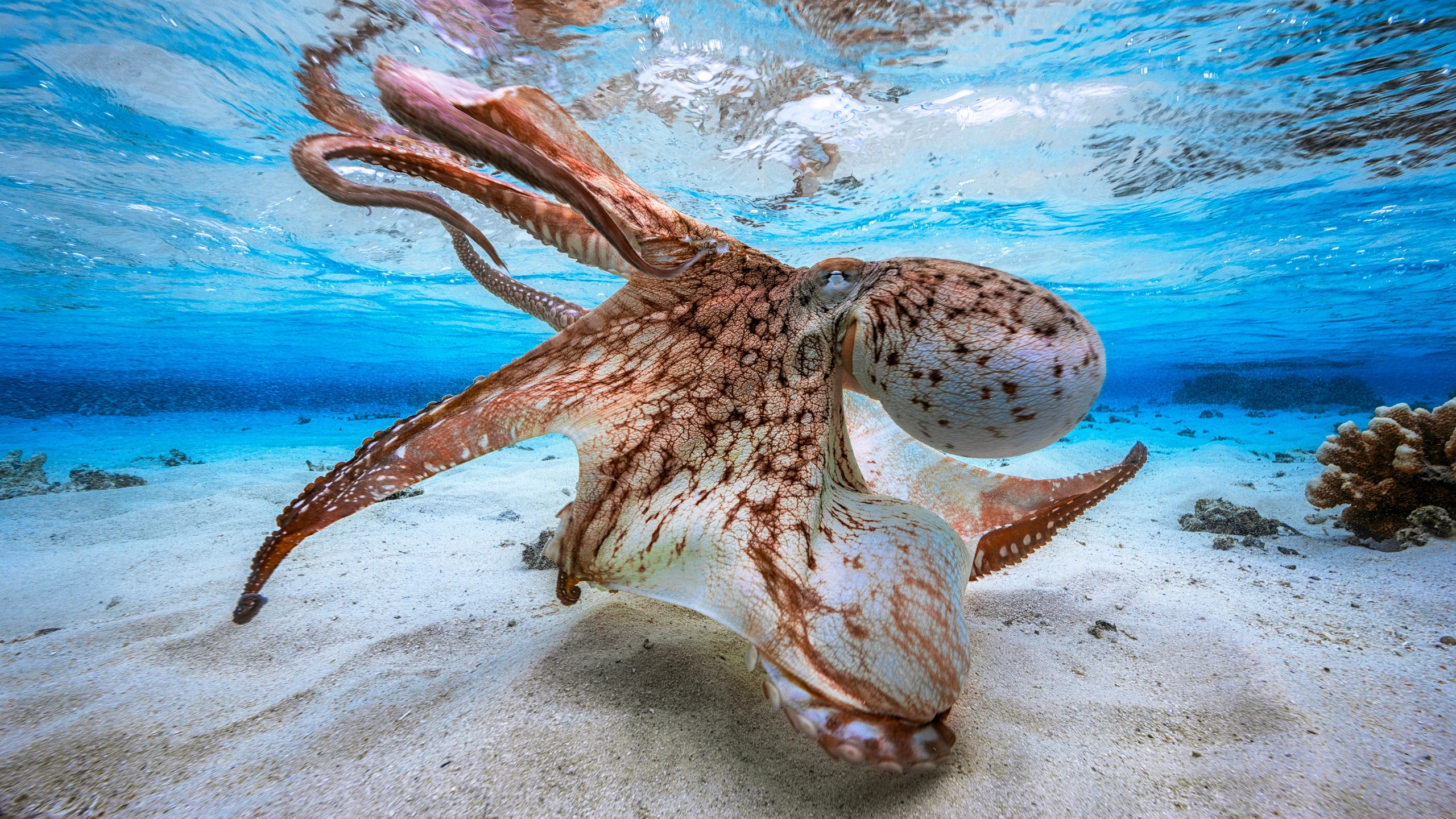
Image: Bing Daily Wallpaper | Mayotte, Indian Ocean | Copyright: Gabriel Barathieu/Minden Pictures | Original page.
Bing's Chinese edition for October 8 takes us into shallow water off Mayotte. Its caption describes the octopus as adopting a defensive posture. Arms and suckers fill the foreground, with blue water beyond: a soft-bodied animal making a considerable impression.
October 8 is also World Octopus Day. The cephalopod community TONMO traces this unofficial celebration to discussions in 2007. Its 2026 announcement lists five days of festivities, moving from octopuses to nautiluses, squid and cuttlefish, mythical sea monsters, and fossil cephalopods.
Eight arms, the eighth day. An enthusiasts' idea has found its way into a search engine's wallpaper caption.
How Color Spreads
Octopuses can change their skin's color, pattern and texture. One component of that ability is the chromatophore organ: an elastic pigment sac surrounded by radial muscles. As the muscles contract, they stretch the sac and expose more pigment. When they relax, the sac shrinks.
The eyes and nervous system help control body patterns. Brightness, contrast and edges provide information about the surroundings. Yet the limited range of visual pigments in octopus eyes, together with traditional behavioral tests, presents a puzzle: these animals do not appear to discriminate colors in the familiar way we do. How they match their surroundings remains an active question.
In 2015, M. Desmond Ramirez and Todd H. Oakley reported an experiment with the California two-spot octopus, Octopus bimaculoides, in the Journal of Experimental Biology. They removed pieces of skin, separating them from the eyes and central brain, then shone light on them.
The chromatophores in the isolated skin still expanded.
The researchers called the response light-activated chromatophore expansion, or LACE. The response was faster under blue light. A fitted sensitivity peak of about 480 nanometers closely matched the known spectral sensitivity of octopus eye opsin. They also detected the light-sensitive protein r-opsin in sensory neurons in hatchling skin.
The finding establishes something remarkable and specific: skin from this species can sense and respond to light locally, without input from the eyes or central brain.
Light Sensitivity Has Limits
Responding differently to different wavelengths does not, by itself, demonstrate color vision. A single light-sensitive channel also responds to changes in intensity. The experiment did not show that skin can identify a stone's color or independently organize an entire animal's camouflage.
The paper proposes that this dispersed light sense might help regulate body patterns alongside the central nervous system. Exactly how it contributes remains to be established.
That distinction makes the experiment more interesting. A piece of skin has an ability we usually associate with eyes; tracing that ability all the way to a coordinated disguise requires further evidence.
The animal in Bing's photograph has another boundary around it: the caption does not identify its species. We cannot simply make it the two-spot octopus studied in the laboratory.
Leave Some Space at the Tide Pool
China's coastal intertidal habitats also offer opportunities to encounter cephalopods. If an octopus appears beside a tide pool that is safe and permitted to visit, its color, texture and movements reward a quiet look. Staying back preserves more of the encounter than lifting rocks, handling the animal or trying to provoke a color change.
The laboratory discovery gives that encounter a new question. How does light become a pattern? Part of the answer can begin in the skin, while the full story is still being worked out.
Sources
Ramirez and Oakley: Eye-independent, light-activated chromatophore expansion, full paper (2015); TONMO: first celebration thread, 2007; TONMO: Cephalopod Awareness Days 2026.