
A flash lasts an instant. Its position can remain on a shared map.
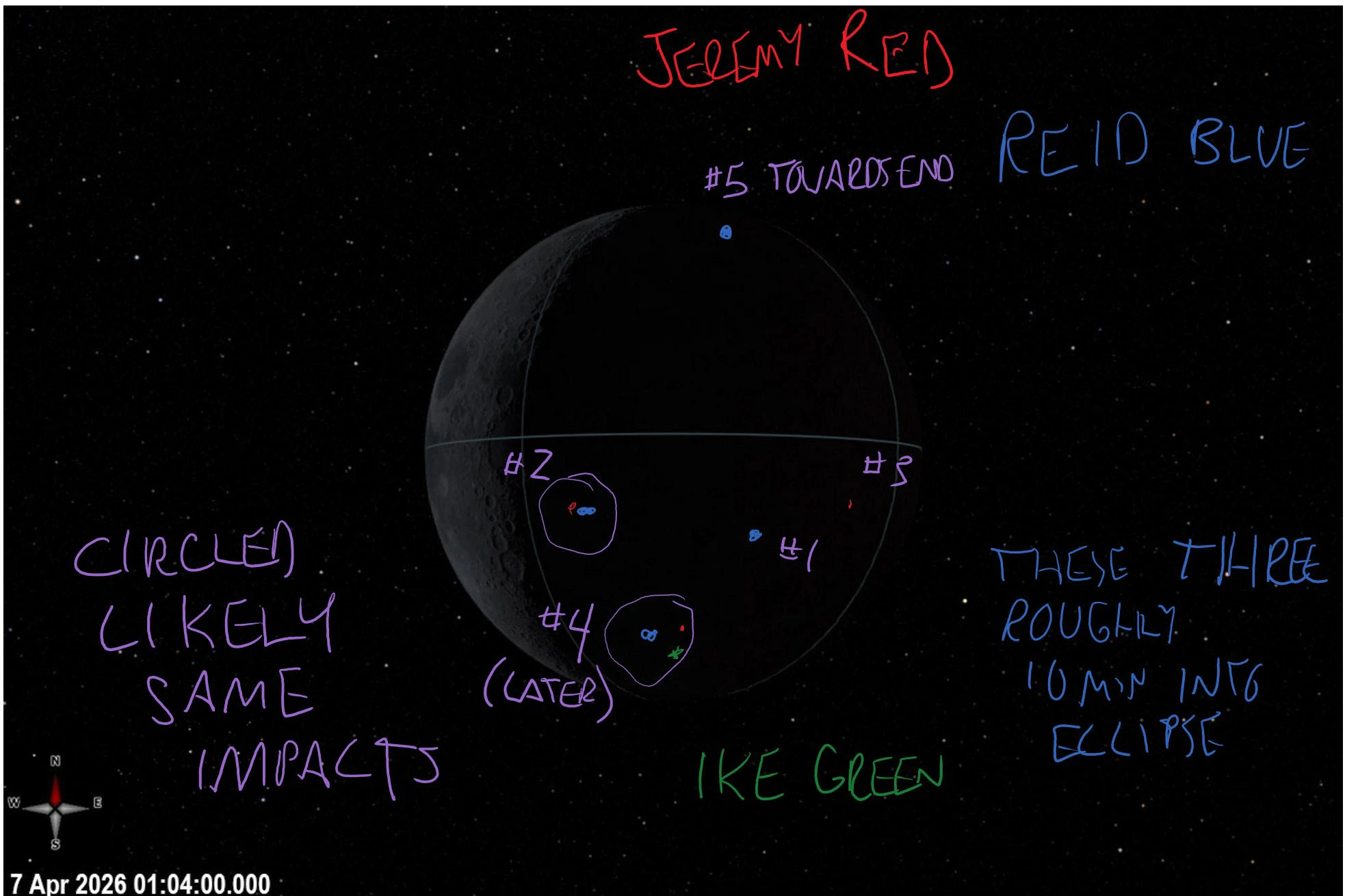
Image: NASA Image of the Day | Image Credit: NASA | Original page.
The picture resembles a page of classroom notes. Around a dark lunar outline sit circles, numbers and handwriting in several colors.
NASA selected it as its October 7 Image of the Day. The observations belong to April 6, 2026, when Artemis II's Orion spacecraft flew past the Moon's far side. A visualization of the Moon eclipsing the Sun serves as the background; the handwritten marks record impact flashes seen by the crew. The screenshot is not a direct photograph of the five flashes.
A Window of Darkness
During the flyby, the crew experienced a total solar eclipse lasting about 54 minutes. Seen from nearby, the Moon occupied a much larger angle in the sky and blocked the Sun long enough to reveal details normally overwhelmed by its light.
Totality on Earth is usually much shorter, though it is not limited to two or three minutes. Orion's unusual viewing geometry gave the crew nearly an hour of darkness.
As part of their science plan, the astronauts had been trained to watch for flashes from small rocks striking the lunar surface. They reported five exceptionally faint points of light. Orion was then about 46,000 miles, or 74,000 kilometers, from the Moon. That was the distance during the flash observations, rather than the flyby's closest approach or the spacecraft's distance from Earth.
The science team ruled out alternatives including cosmic rays and spacecraft reflections, confirming the observations. NASA says these likely included the faintest lunar impact flashes ever recorded with unaided eyes.
Small Rocks, High Speeds
The Moon lacks an atmosphere capable of substantially slowing or burning up incoming debris as Earth's atmosphere does. A fast-moving rock strikes the ground and converts some of its kinetic energy into heat and visible light.
From the flashes' brightness, scientists estimated that the fragments were no more than a couple of inches across. Those sizes come from an interpretation of the light, rather than a physical measurement of recovered rocks. Small fragments moving at high speed can produce a flash visible from far away.
Impact energy also excavates, breaks and ejects material. Only part becomes heat and light, and models are needed to work backward from brightness to the size of the projectile.
Three Colors on One Map
Reid Wiseman's marks are blue, Victor Glover's green and Jeremy Hansen's red. Purple denotes general annotations, rather than a fourth observer.
Placing those marks on the same visualization allows researchers to compare reported positions and consider which sightings refer to the same impact. Individual, fleeting observations become a record that can be checked again.
The screenshot alone cannot establish an annual lunar impact rate. Observing time, visible area and the ability to detect faint flashes all affect the statistics. It nevertheless provides a rare direct record from the far side, contributing to research on small impacts and the long-term risks they pose to future lunar infrastructure.
On October 7, NASA released a preliminary lunar science report and supporting material from the mission, including crew photographs, spoken observations, drawings and annotations. The tablet screenshot gains value within that larger collection: human observations can be studied alongside orbital datasets.
At the Edge of Lunar Day
Telescopes on Earth can also monitor lunar impact flashes, generally through continuous video and careful rejection of false signals. A brief bright spot alone is insufficient evidence of an impact; patience and verification belong to the observation.
A simpler starting point is the terrain near the Moon's day-night boundary. Low-angle sunlight stretches shadows and gives craters a strong sense of relief. Those landscapes preserve a long impact history, alongside later alterations. The Moon has not kept every impact unchanged.
A few blue, green and red marks give five easily missed flashes places to revisit. Once the observation ends, the science can continue along those positions.
Sources
NASA: Artemis II Crew Moon Photo Annotations; NASA Science: Artemis II Preliminary Lunar Science Report; NASA: October 7 lunar science data release.