
Waves burst against the rocks as dark birds fly past the spray. Bing identifies them as double-crested cormorants over California's Monterey Bay: birds that travel through the air and chase fish underwater.
Watch the same birds on a dock or a rock, and you may see another unmistakable pose. They spread their wings and hold them open. They may have just finished a dive.
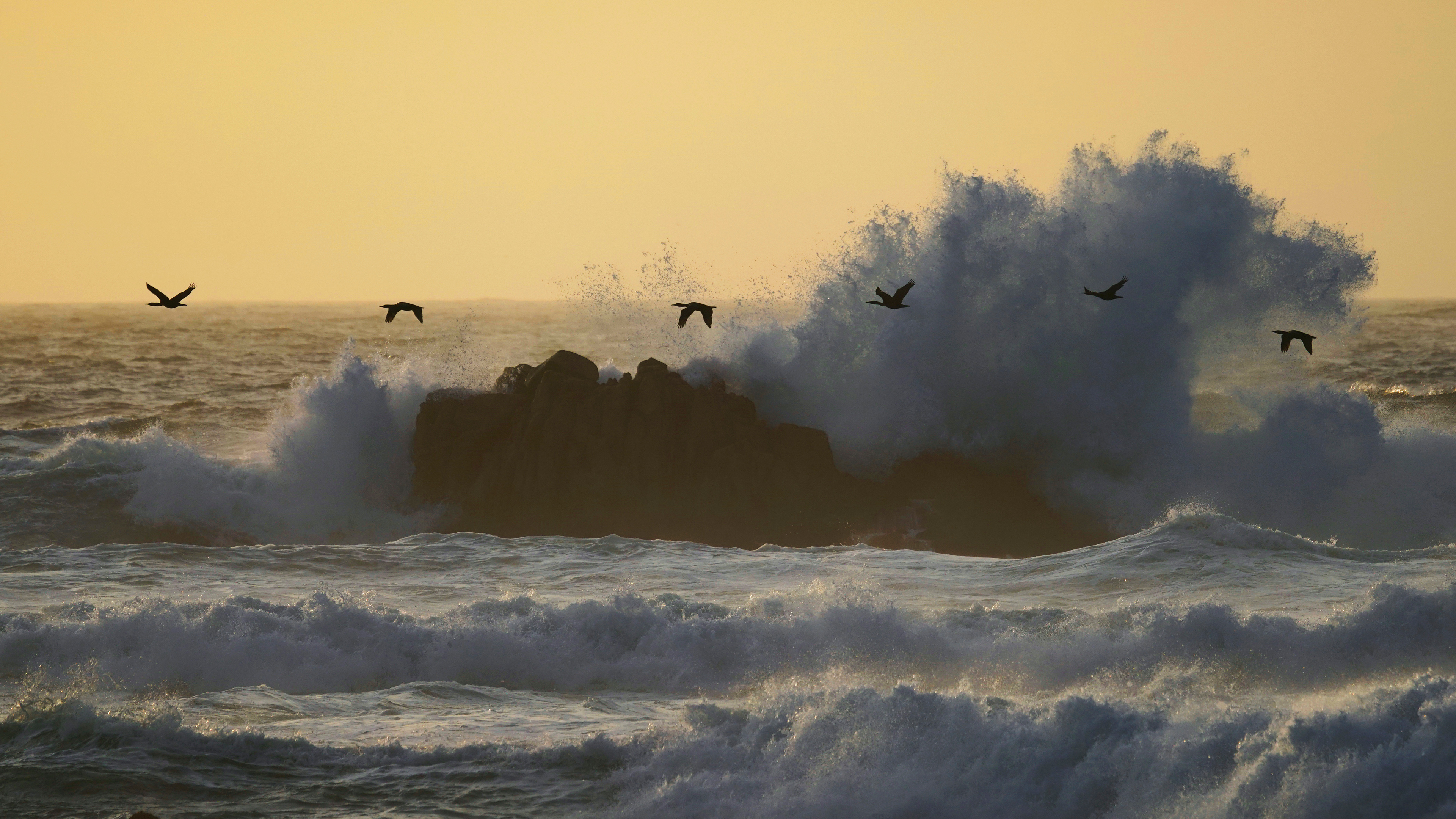
Image: Double-crested cormorants over Monterey Bay, California, USA. © Hiroya Minakuchi/Minden Pictures. Original page.
One set of feathers, two environments
The Cornell Lab of Ornithology describes a long-necked bird with a hooked bill that floats low in the water, rather like a boat sitting deep in the waves. Double-crested cormorants dive for small fish, then often dry their wings on rocks, docks or branches.
Air trapped in feathers adds buoyancy. Feathers that wet more readily can retain less of it. Cornell's teaching video explains how that can help a cormorant dive deeper. Wet feathers also carry costs for flight and insulation. Spreading the wings ashore is an ordinary part of this way of life.
A 2005 study examined the body feathers of four subspecies of great cormorant. Their loose outer sections wetted readily, while a highly waterproof central section retained a thin insulating layer of air. These were great cormorants, not the double-crested cormorants in the photograph. The study offers a clue from a relative; it does not measure the feathers of these particular birds.
Calling cormorants completely non-waterproof, or saying they must become soaked before they can dive, goes too far. Air helps keep a bird warm while also making it buoyant. Diving birds have to balance those effects. This photograph shows a flight, without telling us where the birds last went underwater.
Turn a sighting into a record
The US Fish and Wildlife Service gives May 9 and October 10 as the two dates for World Migratory Bird Day in 2026. Its theme is "Every Bird Counts - Your Observations Matter!" An official CMS notice also marks the International Waterbird Census's 60th anniversary. Volunteer records help researchers follow migration, population changes and habitat conditions.
Bing uses these seabirds to draw attention to migration. The image alone cannot establish that they are on a long-distance journey: birds also commute between feeding and resting places.
Next time you visit a river, lake or coast, take binoculars and look for long necks, hooked bills and wings held open. Record the location, date, number and behavior. Keep away from nesting areas and avoid chasing a flock. If the identification is uncertain, a photograph with an honest question mark is more useful than a hurried name.