
Golden galaxies gather at the center, with thin orange arcs tucked alongside them. They seem crowded into the same place, but they lie at different distances. Some orange shapes are images of distant galaxies altered by gravity in the foreground.
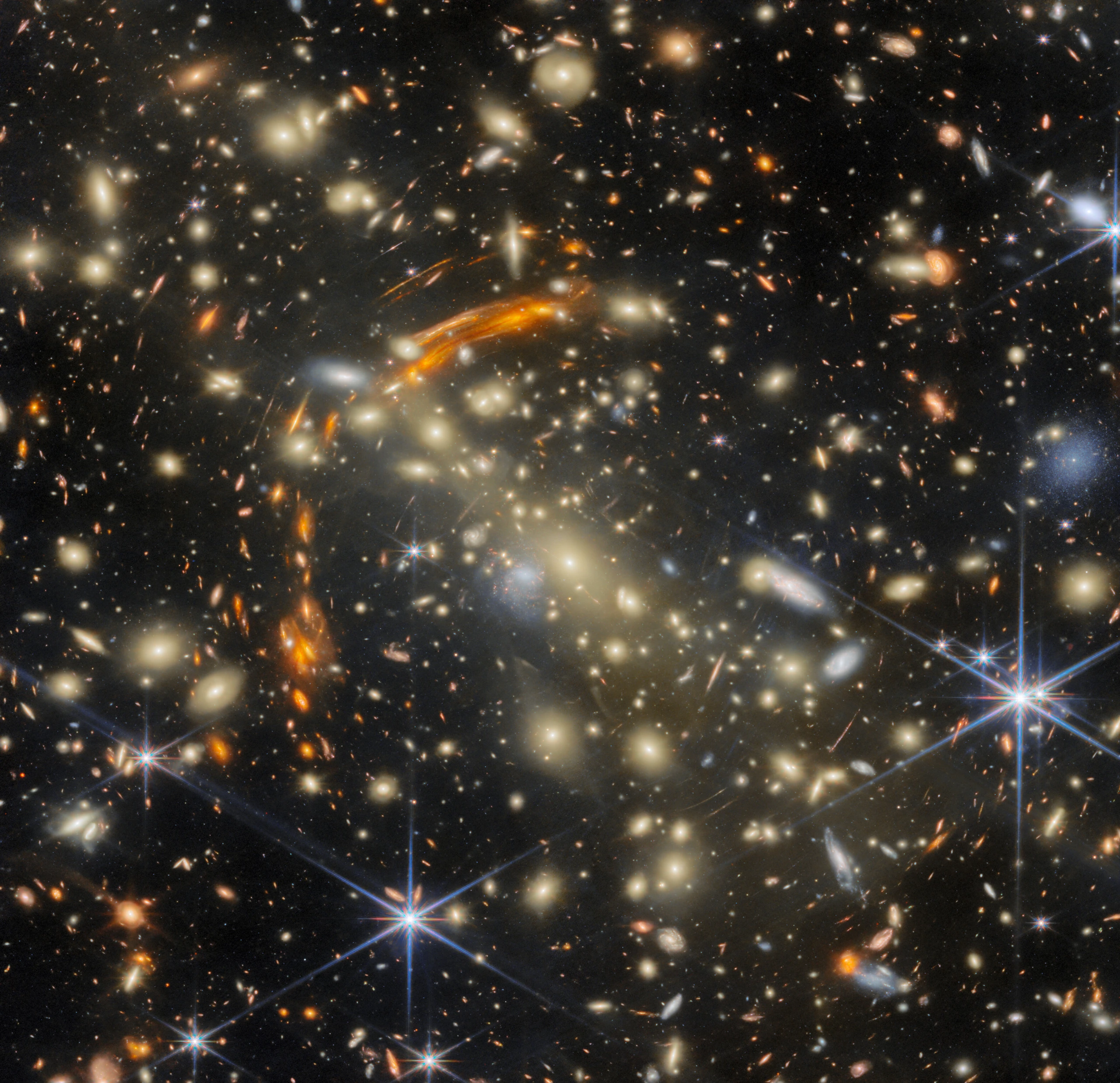
Image credit: ESA/Webb, NASA & CSA, L. Furtak, S. Fujimoto. Original page. NASA published its article on October 9; the image was first released on September 29. That release date is not a confirmed observation date.
Foreground mass changes the route light takes
The golden galaxies belong to the cluster MACS J0454.1-0300. The orange background galaxies are farther away. The foreground cluster's enormous mass bends the paths of light: gravitational lensing requires no sheet of glass.
Light from a single distant object can reach the telescope along different paths around the foreground mass. Tracing the received light back along its arrival directions can place images of that object at several positions in the sky. Other alignments stretch an image into an arc or magnify its details. There is more than one background galaxy here, so the orange spots do not all represent the same object.
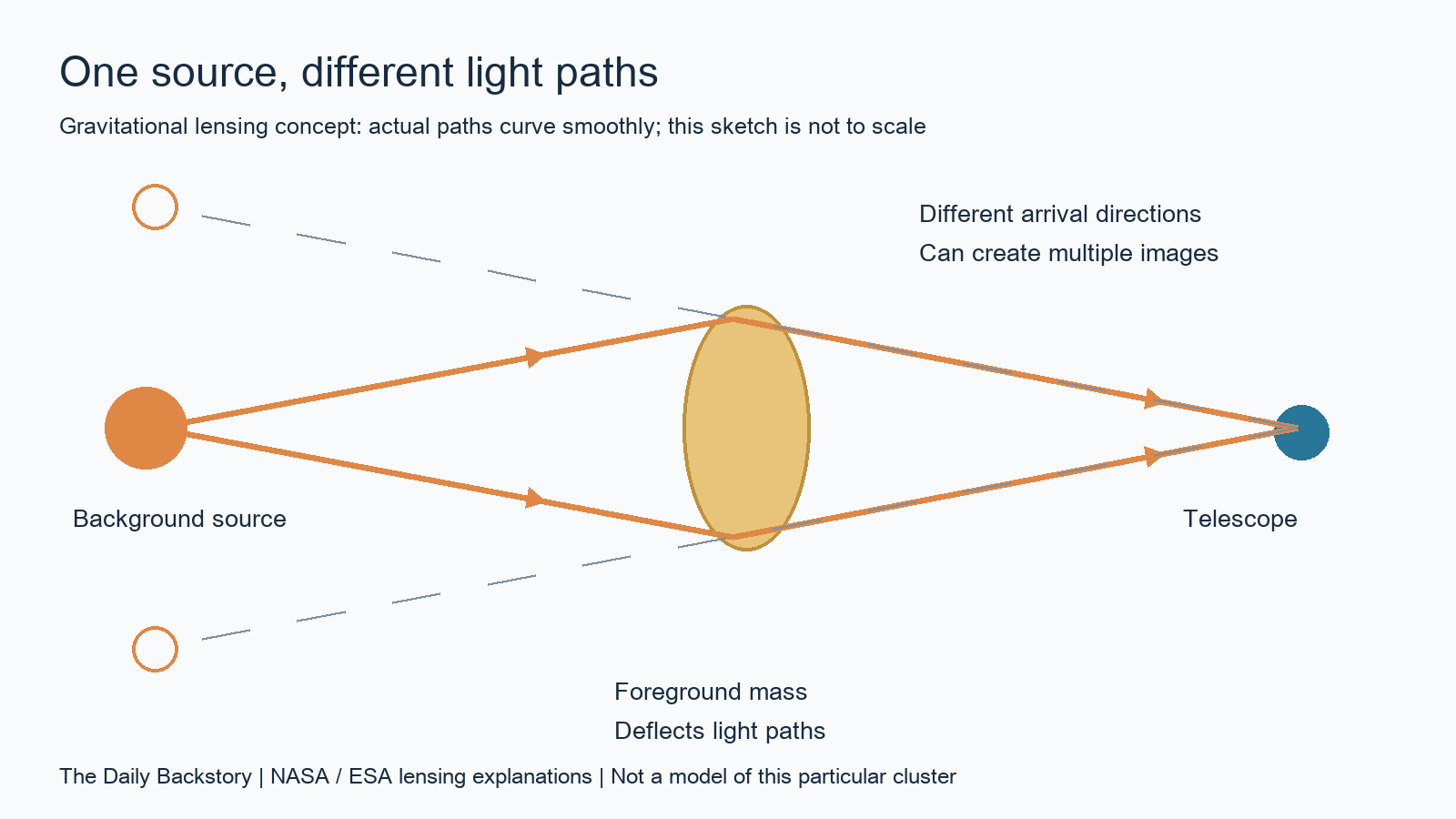
Diagram: Laili. Real light paths curve continuously. The angled lines illustrate the relationship between paths and arrival directions; this is not a lens model of the pictured cluster.
ESA/Webb's image description places the foreground cluster at an epoch when the universe was about eight billion years old. More distant background sources show an earlier universe. Light from one group of galaxies comes from about two billion years after the Big Bang; another galaxy is seen about 800 million years after it. These numbers describe the universe's age at those times, rather than directly stating the galaxies' distances from Earth in light-years.
Magnified details still need interpretation
ESA says that some bright knots correspond to regions only about five light-years across, with magnification exceeding 300 times. This natural boost lets researchers examine structures in early galaxies that would otherwise be difficult to distinguish. The inferred sizes and magnification depend on analysis of the lens; they cannot be read off the photograph with a ruler.
The image draws on Webb observing programs 5058 and 6882, led by L. Furtak and S. Fujimoto respectively. Foreground mass both alters the background images and helps reveal distant detail.
Open ESA/Webb's high-resolution image, find the brightest golden galaxies near the center, then look for the orange arcs. Try separating the scene into foreground and background. Color and proximity within the frame alone do not establish that two galaxies are neighbors.