
A cable descends into a hole in the ice, disappearing into darkness. There is no telescope tube pointed at the sky. The observatory's detectors are being lowered deep beneath Antarctica.
NASA's October 11 Astronomy Picture of the Day uses a photograph from 2010, late in IceCube's construction. The hole's walls and cable dominate the view, with a round detector module visible below. Water will refreeze around these instruments, sealing the observatory's eyes into the ice.
Hot water drilled the holes. The team's drilling paper distinguishes about 30 hours on average for drilling and reaming from an average production cycle of about 48 hours between starting successive holes. A time extrapolated from a momentary drilling speed cannot replace the construction record. The original array's final string was deployed on December 18, 2010.
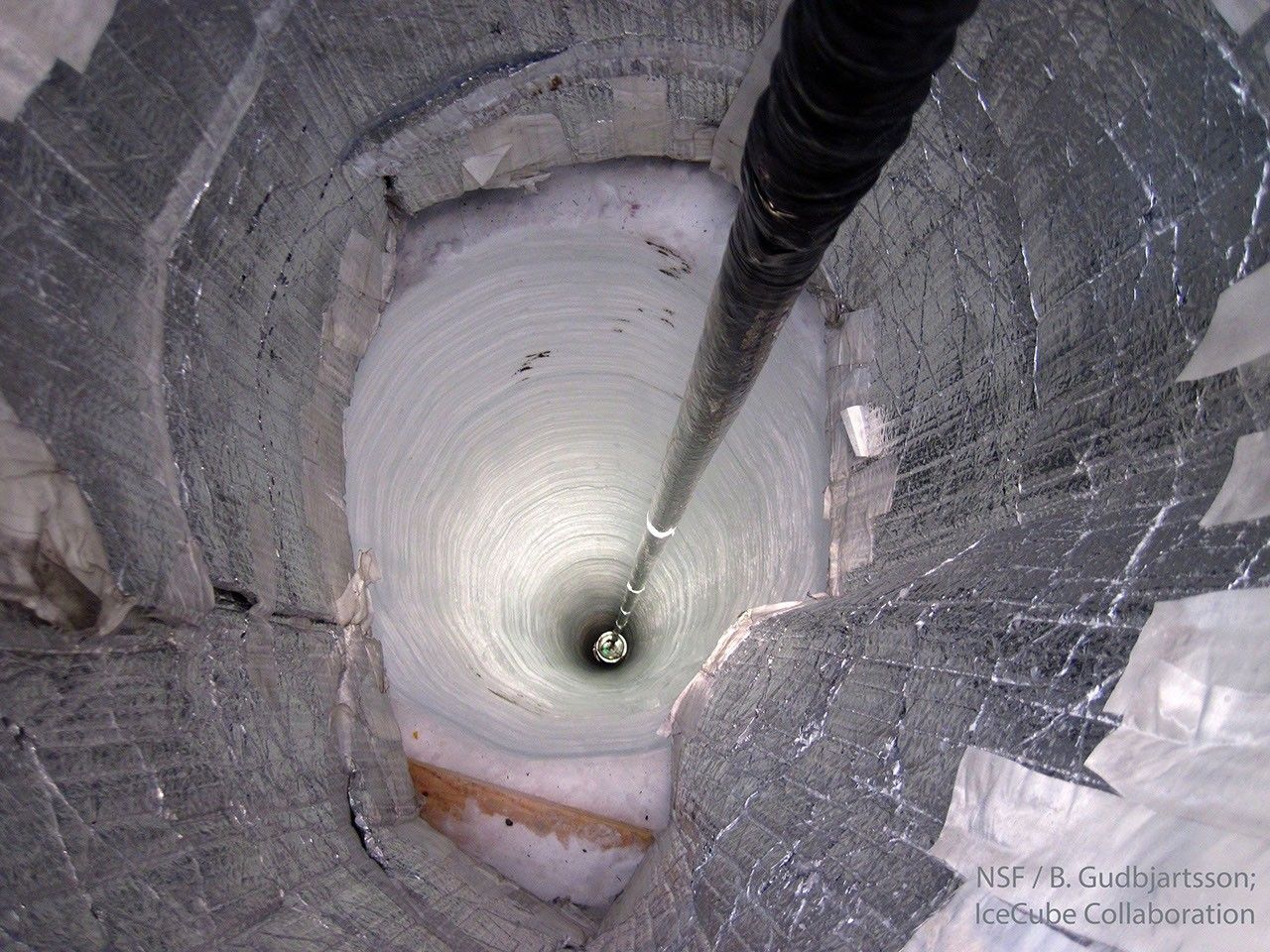
Image credit: NSF, B. Gudbjartsson, IceCube Collaboration. Original page.
Waiting for a rare encounter
Neutrinos seldom interact with matter. That lets them carry information from the distant universe, and makes them difficult to catch. IceCube turns a huge volume of ice into a place to wait for those rare interactions.
The observatory's instrument description gives the scale: the original deep-ice array has 86 strings carrying 5,160 digital optical modules, about 1,450 to 2,450 meters below the surface, covering roughly one cubic kilometer of ice. Those are the original array's figures, without folding subsequent upgrades into the count.
Occasionally, a high-energy neutrino interacts in the ice and produces secondary charged particles. The detectors record the light those particles produce. They do not photograph a neutrino directly.
Faster than light travels in ice
The faint blue light is Cherenkov radiation. A secondary particle can travel faster than light propagates through ice, somewhat as an aircraft exceeding the speed of sound produces a shock wave. It has not exceeded the speed of light in a vacuum. Light slows in ice; the comparison is with that slower speed.
Detectors record when light arrives and how much they receive. Computers use the spatial pattern and timing to reconstruct a particle's direction and energy. Working together, many small sensors turn the ice into a telescope without conventional lenses.
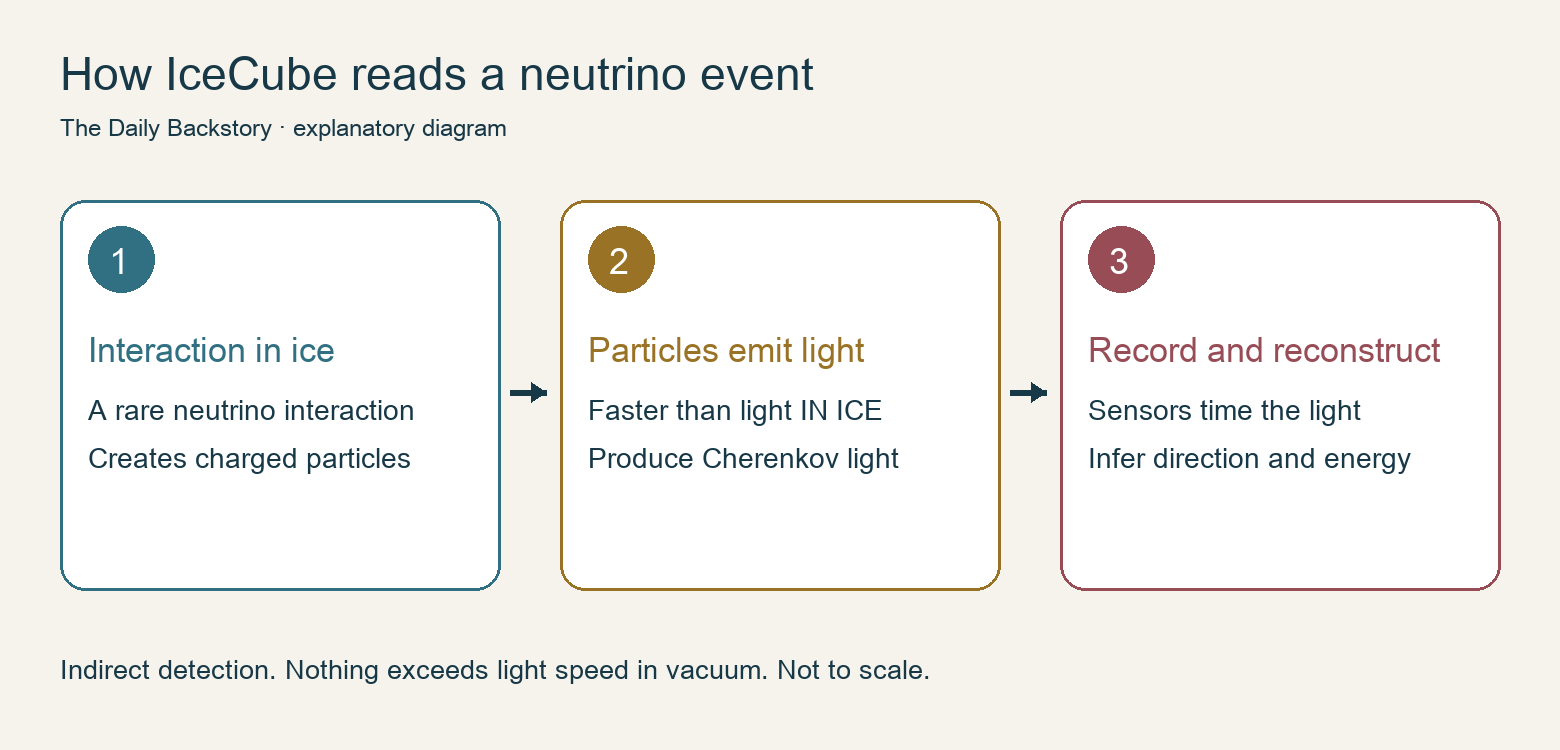
Diagram: The Daily Backstory. The sensors record indirect traces; the particles do not exceed the vacuum speed of light.
Earth as a filter
Cosmic rays striking the atmosphere produce many muons that enter the ice from above and also generate light. An IceCube northern-sky analysis uses Earth to remove that background: atmospheric muons cannot cross the whole planet, while neutrinos can arrive through it and produce upward-moving secondary tracks.
This does not remove neutrinos made in the atmosphere, nor does Earth transmit neutrinos equally at every energy. Researchers still use energy, direction and statistics to distinguish an astrophysical component. Looking through Earth is one analysis method, rather than IceCube's only view.
The 2023 study of our galaxy in neutrinos primarily selected cascades produced inside the detector, spreading light outward like a burst. These events can also reveal the southern sky. The result was a high-energy neutrino signal from the Milky Way as a whole, without identifying every individual Galactic source.
The same approach in the deep sea
China's TRIDENT project explores using a similar technique in deep South China Sea water. Its 2023 Nature Astronomy design paper reported a candidate site about 3.5 kilometers deep and proposed 1,211 strings with 20 optical modules each, monitoring about 7.5 cubic kilometers of water.
These are design specifications and projected capabilities, rather than measured results from a completed array. Antarctic ice and seawater can both serve as detector media, with different optical and engineering conditions. A larger instrument does not automatically improve every kind of observation by the same factor.
An old photograph, new recognition
The construction photograph dates to 2010; today's date belongs to the feature. A new connection comes from the official Nobel Prize page: Francis Halzen received the 2026 Nobel Prize in Physics for his contributions to IceCube and the discovery of high-energy neutrinos of astrophysical origin. IceCube's October 6 announcement records the news too.
Explore the array diagram in IceCube's science introduction. Locate the surface, then the strings of modules deep in the ice. Imagine light from one event reaching different positions in succession, and how that timing helps reconstruct where it came from. Sometimes reading the universe begins with looking underground.