
A telescope that does not focus, and the antimatter in the Milky Way whose origin no one can explain.
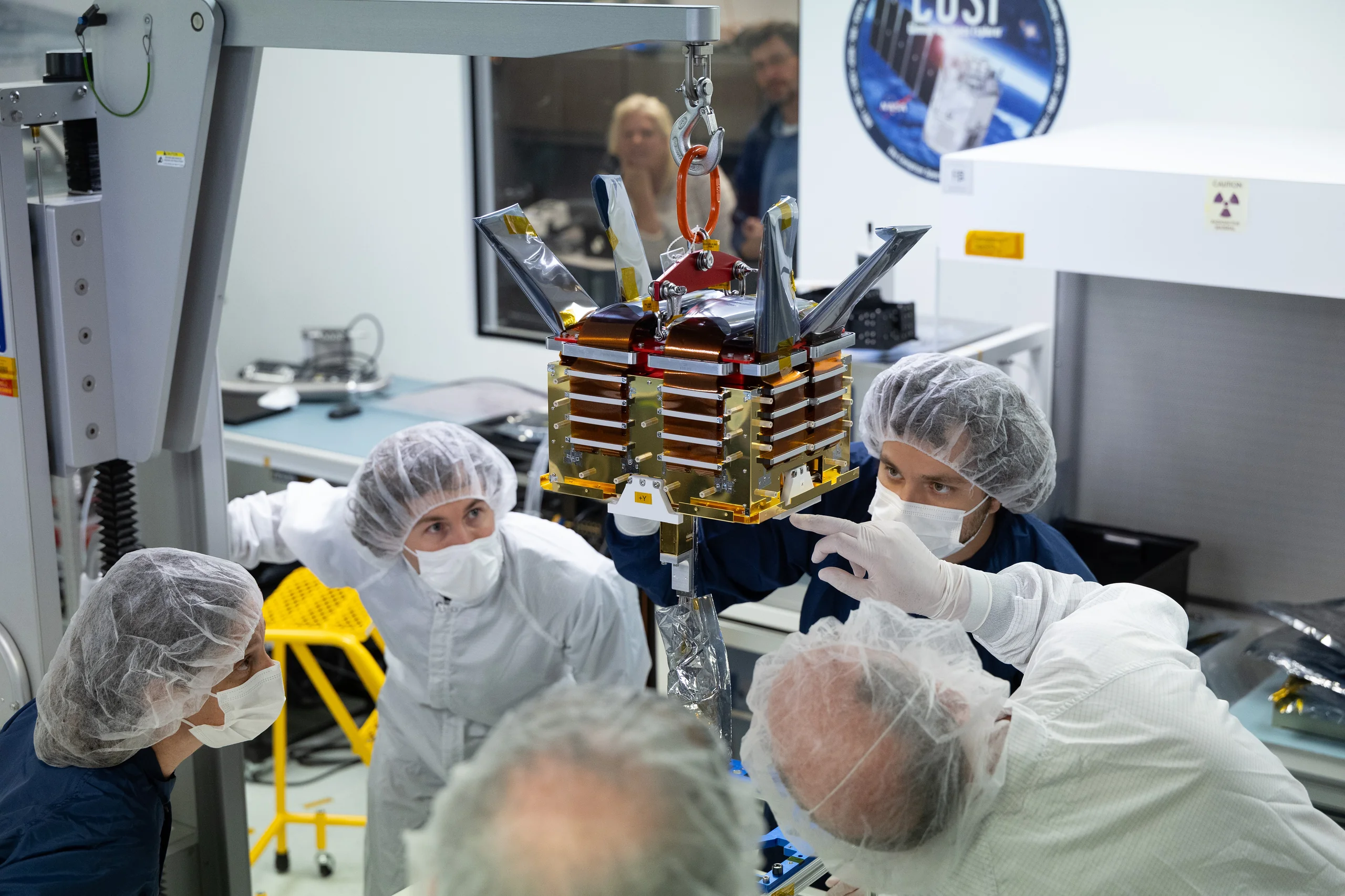
Image: NASA Image of the Day | Image credit: UC Berkeley/Alan Toth | Image page
A group of people stands around a metal box in a laboratory. Slings are lifting it slowly from a table, but it is only a few centimeters into the air. No one is speaking. Every pair of eyes is fixed on the same place.
The photograph was made on July 8, 2026. Four pieces of silver material sit on top of the box, crossed by flexible circuits. Those circuits carry signals out of the detector and into its readout electronics.
The object inside the box will go into space to see a kind of light that cannot be viewed with a telescope - at least not in the usual way.
A Question That Sounds Slightly Wrong
First, what does a telescope do?
It gathers light. Whether it uses a lens or a mirror, a telescope's job is to bend scattered light toward a point. Hubble, Webb and the telescope on a balcony all work on that principle.
Now replace visible light with gamma rays.
Gamma rays are the highest-energy form of light. A visible-light photon carries roughly 2 electronvolts of energy. The photons this box is designed to detect carry 200,000 to 5 million electronvolts - 100,000 to more than a million times as much.
That produces an awkward consequence: they refuse to bend.
Light refracts in a lens through gentle interactions with the electrons in atoms. A gamma-ray photon carries so much energy that when it strikes an atom, it does not turn politely. It kicks out an electron or breaks itself apart. X-rays can still use grazing-incidence optics, skimming a mirror at an extremely shallow angle to change direction slightly. At still higher energies, the required angle becomes too small to build into a useful instrument.
For gamma rays in the MeV range, then, focusing is a dead end. It is not a shortage of technology. Physics does not permit it.
What can be done instead?
Make It Collide
The instrument is called COSI, the Compton Spectrometer and Imager. "Compton" is the answer.
Here is how it works.
A gamma-ray photon enters a stack of detectors and strikes an electron in the first layer. It scatters. This is Compton scattering. After the collision, the photon continues in a new direction with slightly less energy; the missing portion has gone to the electron. The photon is then absorbed in a second layer, depositing everything it has left.
The instrument now has two pieces of information: where each interaction happened and how much energy was deposited in each one.
Add the two energies and you recover the photon's original energy. Compton scattering also follows a strict rule: the scattering angle corresponds directly to the energy lost. The sharper the deflection, the more energy the photon gives up. The division of energy between the two interactions therefore reveals the angle through which it turned in the first layer.
With that angle and the line along which the photon traveled after scattering, its origin can be restricted to a circle on the sky. It must have arrived from somewhere on that circle, though the instrument cannot yet say which point. This is known as the event circle.
One photon gives you one circle, which may not sound useful. But if a real source lies in one direction, every photon it emits produces another circle, and all those circles pass through the same point. Collect enough of them and the intersection emerges.
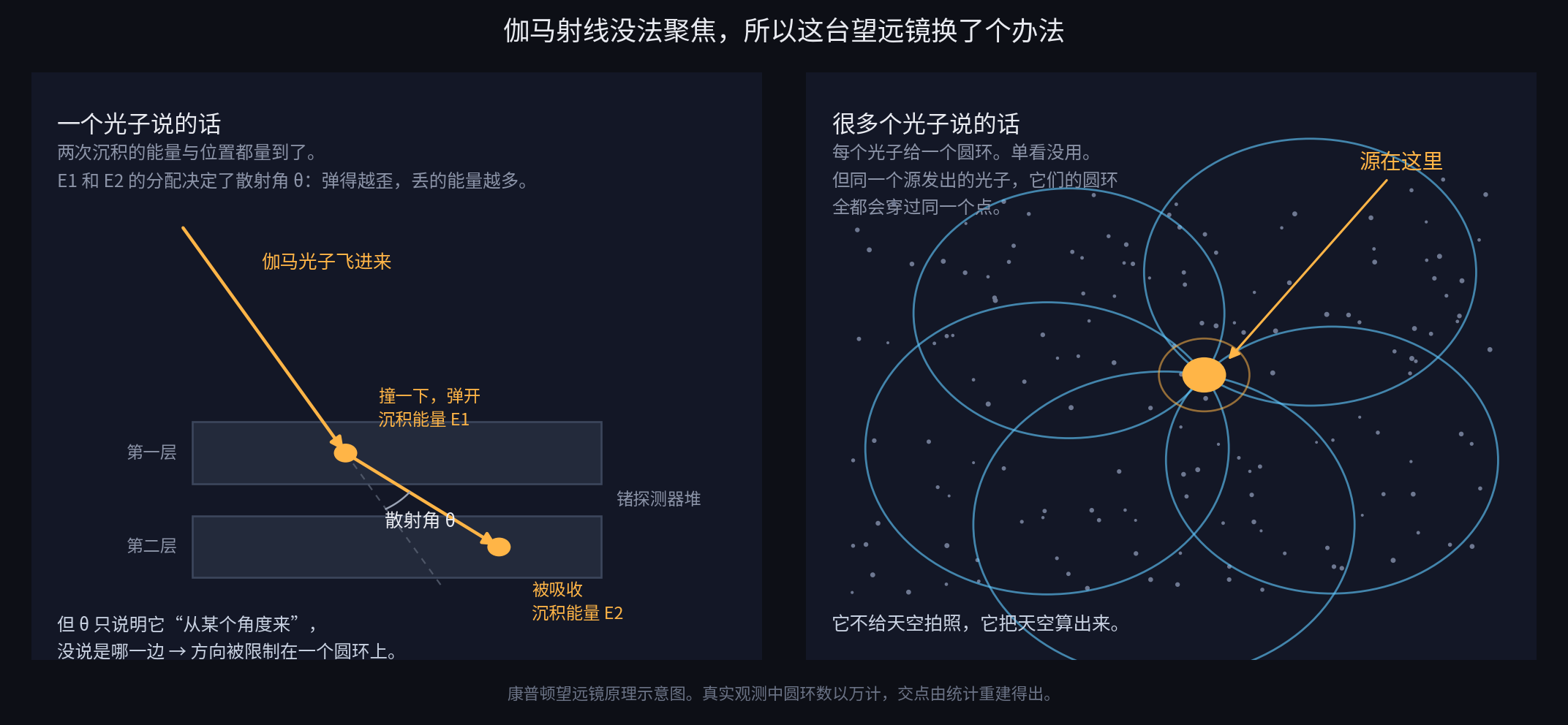
That is why COSI looks nothing like an ordinary telescope. It has no tube and no mirror, only a box filled with detectors.
It does not photograph the sky. It calculates the sky.
What Is Inside the Box?
Sixteen high-purity germanium crystals, each 8 by 8 by 1.5 centimeters. Sixty-four aluminum electrodes are etched onto each side of every crystal in a crossed grid, allowing the detector to report the three-dimensional location of every interaction.
Why germanium? Because its energy resolution is excellent. The whole method depends on measuring energy precisely. If the energy is wrong, the inferred scattering angle is wrong. The circle is drawn in the wrong place, and its intersection with other circles blurs.
The price is cold. According to a NASA technical account released this July, the detectors must operate below -205 F, about -183 C or 90 K, or their own thermal noise will overwhelm the signal. Cooling comes from a mechanical Stirling cryocooler. It consumes no expendable coolant such as liquid nitrogen, so the mission will not end because its refrigerant runs out.
At any instant, the instrument sees more than a quarter of the entire sky. It does not stare at a small patch as Hubble does. It opens its eyes onto a vast expanse.
The Gap It Is Meant to Fill
There is a part of the electromagnetic spectrum that humanity observes particularly badly.
Astronomers call the region from roughly 100,000 electronvolts to a few GeV the MeV gap. The reason is the problem above: the photons carry too much energy to focus, yet their interaction cross sections are small, so detectors must be large to catch enough of them. Without focusing optics, signals are also difficult to separate from the background. Atmospheric albedo and radioactivity induced in the instrument itself by cosmic rays pile onto the data. A 2026 review calls this range the most difficult experimentally.
The result is peculiar. We have excellent telescopes for visible light, radio waves, X-rays and GeV gamma rays, but the region between remains blurred.
And that region contains some exceptionally important things.
Antimatter in the Milky Way
This is the part of the story I most want to tell.
In the 1970s, astronomers carried detectors into the upper atmosphere by balloon and found a spectral line toward the center of the Milky Way. Its energy was 511 kiloelectronvolts.
That is not an arbitrary number. An electron's rest-mass energy is exactly 511 keV. When a positron, the electron's antimatter counterpart, encounters an electron, both are annihilated. Their mass becomes light, emitted as two 511 keV photons.
The line therefore says something very direct: antimatter is being annihilated on an immense scale at the center of the Milky Way.
How immense? Estimates suggest roughly 10^43 positrons every second - a one followed by 43 zeros.
Where does all that antimatter come from?
There are many candidates. Radioactive isotopes made by stellar nucleosynthesis - aluminum-26, titanium-44 and nickel-56 - emit positrons through beta-plus decay. Compact-object systems such as microquasars, low-mass X-ray binaries and millisecond pulsars can produce them too. Some researchers have proposed a connection with dark matter. Yet studies conclude that it is difficult to satisfy all the observational constraints without assigning extreme parameters to at least one class of source.
In other words, half a century later, no one knows exactly where the antimatter in the Galactic center comes from.
One of COSI's main tasks is to map the spatial distribution of the 511 keV line: does it come from one point, or is it spread across a broad region? During a 2016 balloon flight, COSI's predecessor detected the line at 7.2 standard deviations and found a distribution that did not resemble a point source and was more diffuse than earlier reports had suggested.
Evidence That Is Still Smoking
The second example is just as elegant.
The radioactive isotope aluminum-26 emits a 1.809 MeV gamma-ray photon when it decays. Its half-life is 717,000 years.
That may sound long, but the Milky Way is more than 10 billion years old. In 13.6 billion years, aluminum-26 can pass through nearly 20,000 half-lives. Even if the newborn universe had filled the entire Galaxy with it, not one atom should remain today.
Yet we do see 1.809 MeV radiation throughout the Galactic disk.
The aluminum-26 must therefore be newly made.
That is a weighty statement. The light is not a fossil. It is fresh. Stars are making elements now, and supernovae have exploded recently - not merely "long ago," but on the scale of the present.
COSI will map the Milky Way's aluminum-26. That map will show which workshops in the Galactic factory are operating now.
How This Box Got Here
The instrument did not appear from nowhere. Its difficult prehistory was written in balloon flights.
- 2005: Fort Sumner, New Mexico. A prototype carrying only two germanium detectors floated for about nine hours, simply to measure how noisy the gamma-ray background was at altitude.
- May 17, 2009: The same site. A ten-detector version stayed aloft for about 22 hours and successfully imaged the Crab Nebula, proving that the intersecting-circle method could actually make a picture.
- 2010: Alice Springs, Australia. A launch accident severely damaged the gondola. The detectors and readout electronics survived. The accident led directly to a redesign of the gondola for ultra-long-duration flight.
- 2014: McMurdo Station, Antarctica.
- May 2016: Wanaka, New Zealand. A super-pressure balloon carried the instrument to about 33 kilometers and kept it aloft for 46 days, setting a duration record for a midlatitude balloon flight. The mission detected the Galactic center's 511 keV line and imaged the Crab Nebula, Centaurus A and Cygnus X-1.
There is also an honest detail from that flight. Researchers analyzed the polarization of gamma-ray burst GRB 160530A and did not detect polarization. They could give only an upper limit of 46 percent at 90 percent confidence. That is a result of "nothing seen," but in science, a clearly stated non-detection is still data.
Three of the 12 detectors failed during the flight, and the other nine completed it. That is how real instruments work.
The hardware was assembled at the Space Sciences Laboratory at the University of California, Berkeley. Founded on April 17, 1959, the laboratory has participated in more than 100 NASA space-science missions, built instruments for more than 100 satellites and launched more than 150 balloons. The moment in the photograph, as the assembled detector unit is lifted from the table, is the installation of that unit into the satellite's structural base. Integration has reached a late stage.
Timeline
A NASA technical account released this September lists the assembly milestones from the summer:
- June 12: inspection of spacing between detector layers
- June 15: laser alignment test
- July 8: detector assembly lifted into the satellite base, the moment shown in the photograph
- July 15-16: installation of thermal shielding and adjustment of flexible circuits
NASA selected COSI on October 18, 2021, as a Small Explorer mission with a cost cap of about $145 million, excluding launch. Its principal investigator is John Tomsick of Berkeley's Space Sciences Laboratory. Partner institutions include NASA's Goddard Space Flight Center, the University of California San Diego, Lawrence Berkeley National Laboratory, National Tsing Hua University in Taiwan, the Italian Space Agency and the Institute for Research in Astrophysics and Planetology in Toulouse, France.
Under a launch-services contract NASA awarded in July 2024, COSI is scheduled to launch on a Falcon 9 from Cape Canaveral in August 2027. It will enter a low-Earth, near-equatorial orbit inclined by 5 degrees. NASA's stated reason for that inclination is to minimize passages through the South Atlantic Anomaly, whose high background would interfere badly with gamma-ray detection.
From the day this photograph was made, the planned launch was about a year away. The date has changed before - when COSI was selected in 2021, NASA's official target was 2025 - and this article makes no prediction about whether the present schedule will hold.
China Is Watching the Same Light
The most precise Chinese counterpart to COSI is not one of the better-known projects.
It is GECAM, the Gravitational Wave High-energy Electromagnetic Counterpart All-sky Monitor, also known as Huairou-1. At 4:14 a.m. Beijing time on December 10, 2020, a Long March 11 launched two satellites from Xichang. Satellite A is called Xiaoji and satellite B Xiaoming. Each weighs 160 kilograms. Placed on opposite sides of Earth in orbits about 600 kilometers high, together they can watch almost the entire sky. Each carries 25 gamma-ray detectors and eight charged-particle detectors arranged in a dome.
The projects align in three exact ways.
First, their energy ranges overlap. GECAM covers 6 keV to 5 MeV and COSI 0.2 to 5 MeV. They look at the same side of the same gap.
Second, their targets meet. GECAM was conceived to detect high-energy electromagnetic counterparts to gravitational-wave events. When two neutron stars merge, gravitational-wave detectors hear a thump, and a short gamma-ray burst appears somewhere in the sky a second or two later. The problem is that a gravitational-wave detector's location may be vague across hundreds of square degrees. Something must be watching that whole region at the critical moment. One of COSI's four main science goals is likewise stated explicitly: to search for counterparts to multimessenger sources.
Third, they use the same broad strategy. Neither employs focusing optics. GECAM uses a wide-field crystal array; COSI uses the geometry of Compton scattering. Each finds a different route around the same wall.
Sources: NASA Image of the Day, "COSI Telescope Comes Together"; NASA SVS, COSI assembly at Berkeley; NASA announcement selecting COSI; NASA launch-services contract; COSI instrument page at Berkeley; COSI balloon-flight history; Kierans et al., 2016 super-pressure balloon flight; Siegert et al., COSI detection of the 511 keV line; NASA Imagine the Universe, gamma-ray telescopes; Physics World, GECAM launch; Institute of High Energy Physics, public opening at LHAASO; Science Friday, building a cloud chamber; and Zooniverse, Burst Chaser