
Choosing the right backend technology is one of the most consequential decisions a business makes before writing a single line of production code. It shapes development speed, long-term maintenance costs, hiring options, and how well your application scales as your user base grows. Two of the most popular choices today are Node.js and .NET — each backed by a mature ecosystem, strong community support, and a track record of powering large-scale, mission-critical applications. This article breaks down how the two compare, and what to consider whether you plan to hire Node.js developer talent or hire .NET developer talent for your next project.
What Is Node.js?
Node.js is an open-source, cross-platform JavaScript runtime built on Chrome's V8 engine. It allows developers to use JavaScript on the server side, which means teams can use a single language across the entire stack — from the browser to the backend. Node.js is event-driven and uses a non-blocking, asynchronous I/O model, making it particularly efficient for applications that handle many simultaneous connections.
Common use cases include:
- Building real-time applications such as chat apps, live dashboards, and collaboration tools.
- Powering RESTful and GraphQL APIs for web and mobile clients.
- Streaming platforms and data-intensive services that require fast I/O.
- Microservices architectures where lightweight, fast-starting services are a priority.
What Is .NET?
.NET (developed by Microsoft) is a free, open-source, cross-platform framework for building web, desktop, cloud, and mobile applications. With the introduction of .NET Core and now unified .NET (5, 6, 7, 8 and beyond), it has become a high-performance, cross-platform framework that runs on Windows, Linux, and macOS. Developers typically write .NET applications in C#, a strongly typed, object-oriented language.
Common use cases include:
- Large-scale enterprise applications with complex business logic.
- Applications requiring strict type safety and long-term maintainability.
- Systems that integrate deeply with the Microsoft ecosystem (Azure, SQL Server, Active Directory).
- High-throughput financial, healthcare, and government platforms with strict compliance needs.
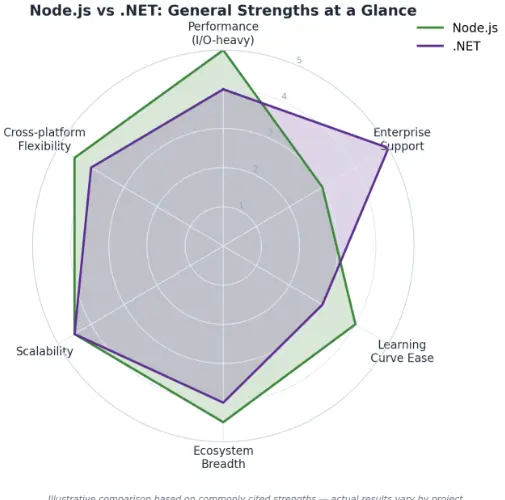
Node.js vs .NET: Key Differences
1. Performance and Scalability
- Node.js excels at handling I/O-heavy, real-time workloads thanks to its non-blocking event loop, making it a strong choice for applications with many concurrent, lightweight requests.
- .NET delivers excellent raw computational performance and scales well for CPU-intensive, enterprise-grade workloads, especially with the performance gains introduced in recent .NET versions.
2. Language and Learning Curve
- Node.js uses JavaScript/TypeScript, which is familiar to most front-end developers, shortening onboarding time for full-stack teams.
- .NET uses C#, a strongly typed language that enforces structure and can reduce runtime errors, though it typically requires more formal training.
3. Ecosystem and Tooling
- Node.js benefits from npm, the largest package registry in the world, giving teams access to a vast range of libraries and frameworks like Express, NestJS, and Fastify.
- .NET offers a tightly integrated tooling experience through Visual Studio, NuGet packages, and seamless Azure integration for enterprises already invested in Microsoft technologies.
4. Enterprise Readiness and Support
- .NET has long been favored by large enterprises for its strong backward compatibility, built-in security features, and dedicated long-term support (LTS) from Microsoft.
- Node.js has matured significantly and is now trusted by companies like Netflix, PayPal, and LinkedIn for large-scale production systems.
5. Cost of Development
- Node.js projects can sometimes be delivered faster due to code reuse across front end and back end, and a large pool of freely available open-source packages.
- .NET licensing itself is free and open source, though enterprise tooling (like certain Visual Studio editions or Azure services) can add to overall costs.
| _Also read: Top Offshore Software Development Trends in 2026_
When Should You Hire Node.js Developer Talent?
Consider Node.js and look to hire Node.js developer resources — if your business needs:
A real-time application such as messaging, live notifications, or collaborative tools.
- Fast time-to-market with a lean, JavaScript-first engineering team.
- A microservices architecture with many lightweight, independently deployable services.
- Seamless integration between front-end and back-end teams using a shared language.
- A startup-friendly stack with a large, active open-source community.
When Should You Hire .NET Developer Talent?
Consider .NET and look to hire .NET developer resources — if your business needs:
- An enterprise-grade application with complex business rules and long-term maintainability.
- Strong type safety to reduce bugs in large, multi-team codebases.
- Deep integration with Microsoft products such as Azure, SQL Server, or Office 365.
- Strict compliance and security standards common in finance, healthcare, or government sectors.
- A stable, well-supported framework backed by Microsoft's long-term roadmap.
Cost Considerations When Hiring
Whether you hire Node.js developer specialists or hire .NET developer specialists, project cost depends on several factors beyond the framework itself:
- Developer experience level (junior, mid, senior) and regional hiring market.
- Project complexity, including third-party integrations and compliance requirements.
- Whether you hire in-house, through an agency, or engage freelance/contract developers.
- Ongoing maintenance, hosting, and infrastructure costs after launch.
In general, Node.js developers can be marginally more affordable to hire due to a larger global talent pool, while .NET developers often command a premium in enterprise settings where deep domain expertise is required.
Making the Right Choice for Your Business
There is no universally 'better' framework — only the framework that better fits your specific business goals, technical requirements, and team capabilities. Here's a simplified way to think about it:
- Speed and flexibility: Choose Node.js if you prioritize speed, real-time functionality, and flexibility with a JavaScript-centric team.
- Enterprise stability: Choose .NET if you prioritize enterprise-grade stability, strict typing, and deep Microsoft ecosystem integration.
Many growing businesses even adopt a hybrid approach using Node.js for customer-facing, real-time services and .NET for core enterprise systems leveraging the strengths of both. Whichever direction you choose, the most important step is partnering with the right talent. Take time to evaluate technical portfolios, past project experience, and communication skills before you hire Node.js developer or hire .NET developer resources for your team.
| _Also read: Node.js vs .NET vs. PHP: Choosing the Right Stack for Software Development_
Conclusion
Both Node.js and .NET are powerful, production-proven technologies capable of supporting businesses of every size. Node.js shines in real-time, I/O-heavy, and rapidly evolving projects, while .NET remains a go-to choice for large, complex, enterprise-grade systems. By clearly defining your project requirements, budget, and long-term scalability needs, you'll be well positioned to decide whether to hire Node.js developer expertise, hire .NET developer expertise, or build a team that brings together the best of both worlds.