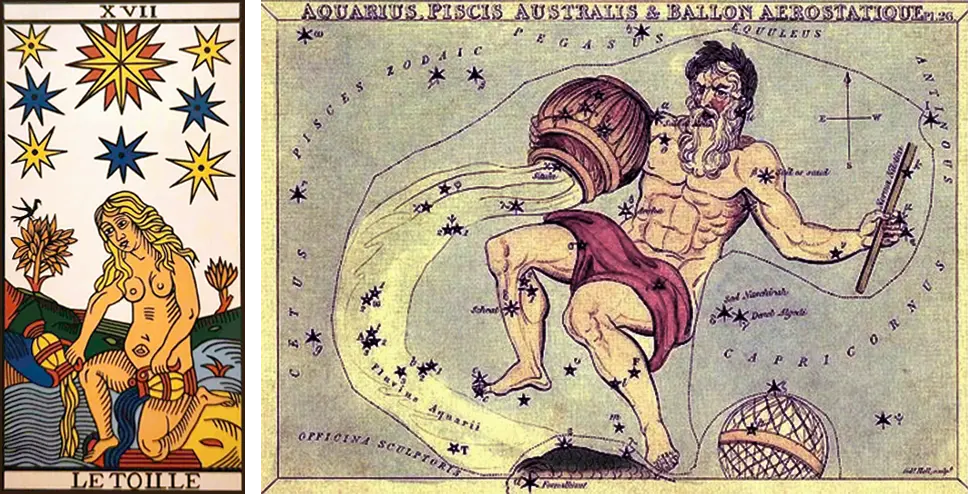
In this article, I address the psychological unveiling that we will all encounter over the coming epoch, where turning inward may be our main saving grace during unstable times. This is a significant component and feature of the Aquarius astrological sign, namely, the water pourer or bearer, which symbolically is akin to holding your own jar of water. Looking at depth psychology, water is a prominent symbol for the unconscious, so in this age, it would symbolise the handling of one's own unconscious material and being tasked to work on the outpouring of energy and creativity coming from within. The jar itself is the mixing vessel in alchemy, this allows material to be transformed. What is interesting here is that this symbol of the act of pouring out implies an emptying of contents, to perhaps free up the vessel or to consider from the Greek, kenosis, ‘to empty, self emptying’, or to humble oneself.
In order to get into the psychological analysis and the aim of the article, I first acknowledge a woman's biological condition and how the physical and biological manifest as a melting pot of unattended material within our psychological state of being, acting as a barometer. Whether that is through weight loss/gain, illness, menopause or general malaise in life, these conditions do not exist as a stand-alone attribute. In the examples I share over the course of the article, my aim is to provide the early developments to recognise the pattern of when the journey spirals without resolution, that it is the call to action necessary for change and renewal. Where the libido or active energy works towards creation of self-knowledge, or wholeness, and does so in spite of one's will, and this must be paid attention to.
As women, not only have we been relegated to all sorts of boxes, as history informs, but it seems we have continually ignored our own psychological material, which is what will be the focus here. Sure, there are changes in the zeitgeist about conscious living and conception, awakened parenting, awareness of stress archetypes, personality theory, and even shadow work, which often include efforts to break cycles of abuse and trauma. These are all mostly positive developments; however, as far as individuation goes, recognition of the unconscious seems to be where there has not been a lot of progress as a human endeavour. What is needed in this next stage is a humbled self-reflection on our unconscious symbols, and these can be retrieved via dreams, synchronicity, active imagination, and the arts.
There are deep questions to be asked and profound ideas to be had, about the future of where we find ourselves as women who are contemplating, undergoing and rejecting ideas of these preconceived boxes and definitions. It is a collective problem and effort, and hopefully, with more truthful, authentic voices and experiences laced with wisdom to surface, we can begin to constellate a better picture of what all that is, and carve out new forms and language with it. Unfortunately, within modern society, we are continually bombarded with mixed messages, unchecked neuroticism or unprocessed trauma touted as truth and revelations.
Which leads me to attempt to provide insight into some female-led works that centre around the wider topics of womanhood, ageing, motherhood and childbirth. Ultimately, the works of these women elucidate some aspects of the personal and collective unconscious. And with the understanding of them, it allows for the opportunity to prepare for the oncoming deluge of unheard, unique female voices and their journey into the depths of creation, as this will certainly continue to come to light; this is the outpouring of water. I approach these qualms from a psychological perspective, focusing on what is arising; yet not unique to females, but appears to be breaking grounds progressively. It is the renewal of the self through the archetype of the child, and I will use examples across art, film and internet culture, to present this new perspective on what appears to be anti-natalist at worst, and raw and exposing at best.
I am to paint broadly a picture of a particular type of woman, who yearns to be free from her condition, who is adamant she does not want children. Who may see the conflation of matrescence or “mother in becoming” as stifling, diminishing, or even patriarchal oppression. Yet she is unsatisfied with her life or is in a state of limbo. This type of woman may typically understand she must create or give birth to something from the spiritual womb — in lieu of a real childbirth, and potentially in spite of one
What is a psychological truism and archetypal presence within the personal and collective unconscious is the birth and presence of the divine child within.
“The archetypes are the imperishable elements of the unconscious, but they change their shape continually.”
(Essays on a Science of Mythology, Carl G. Jung & Karl Kerényi, pg. 136)
There are many aspects of the timelessness of the child to consider, as both beginning and end, or life seed after death, including its godlike, invincible or hermaphroditic aspect. However, for this article, I will keep to the general definition: that the archetype of the (divine) child is the renewal and the future of the personality, and a symbol for the self in becoming.
“The child, is all that is abandoned and exposed and at the same time divinely powerful; the insignificant, dubious beginning, and the triumphal end. The "eternal child" in man is an indescribable experience, an incongruity, a disadvantage, and a divine prerogative; an imponderable that determines the ultimate worth or worthlessness of a personality.”
(ibid., pg. 135)
The awareness and nurture of the divine child in the unconscious is a prominent early stage of individuation, as it marks the personality for refinement, to be made anew, or course-corrected: it signifies where the potent energy is manifesting and how one must be attentive to it. To further clarify this distinction of the child-motif, or the divine child, it is a psychic reality, regardless of there being a living child and the unconscious may use a real or mythological one as a symbol where need be.
“... the clearest and most significant manifestation of the child-motif in the therapy of neuroses is in the maturation process of personality induced by the analysis of the unconscious, which I have termed the process of individuation.”
(ibid., pg. 108)
It’s elementary Dear!
However, to tackle such a topic, we have to ask ourselves the most basic question: What is a woman? A question that has plagued the internet and political discourse in recent times. A question I have scoffed at in its height, and then pondered myself. I considered the womb as the genesis of the description, a woman has the ultimate potential within the womb to gestate a new life. However, some women cannot hold the egg or seed, nor be mothers either. Whether by choice or fate, what kind of womanhood does she have then? Is she less so a woman? There is also a discourse around childless mature-aged females, who lack certain life experiences and perspectives, especially in the absence of biological initiations — more on that later. I’ve seen it called ‘Kittenhood’, but it is also akin to the maiden/Kore, with a negative animus (judgemental, critical, poisoned), or could be described as a life not yet started, an unlived life or provisional life (puer, puella) in depth psychology.
The role of biological motherhood adds and changes one dynamically, physiologically, psychologically, absolutely irrevocably. It is not just a new identity, it is a ground-up felt incubation, gestation and level of responsibility that is both terrifying and incredible. There is a certain weight to woman’s words whose experience and knowledge are embodied and can usually be felt, seen and emanate from her, especially if wisdom and maturity are gained in the emotional fluctuations of the motherhood experience.
“Motherhood, with its intense physical and emotional extremes, is a crucible in which we are tested and altered. In the alchemical vessel of motherhood, the heat is turned up high. Outdated parts of our personality are melted away, and new structures are forged. Motherhood is a dizzying high-wire act, a masquerade, and a communion with mortality. It is a falling from and finding of grace, a falling in and out of love, and heartache by the hour.” (Motherhood, Lisa Marchiano)
The outward strive for ambition, education or qualification on one dimension of life, such as achieving pinnacles of success (CEO, stardom, major artist, etc.), does not equal the culminative inner and outer experience of biological initiation, namely when it comes to matrescence (becoming mother).
I feel this is an important distinction to stress, since we cannot dismiss or think lightly of the importance or profound undertaking of a biological milestone that motherhood is for a woman. So to simply write it off is dangerous and disappointing.
"The critical transition period which has been missed is MATRESCENCE, the time of mother-becoming,’ writes Raphael. ‘During this process, this rite of passage, changes occur in a woman’s physical state, in her status within the group, in her emotional life, in her focus of daily activity, in her own identity, and in her relationships with all those around her'... we still barely acknowledge the psychological and physiological significance of becoming a mother: how it affects the brain, the endocrine system, cognition, immunity, the psyche, the microbiome, the sense of self." (Matrescence, Lucy Jones)
"...in a synthesis of literature on working mothers ... matrescence was associated with enhanced knowledge, skills and capacity. They found evidence that it ‘strengthened women’s mindset, willpower, and overall emotional intelligence"
(ibid., part 5)
That being said, and coming back to the question, Judith Butler, an American philosopher, expresses the scale of these surface dilemmas, and fundamentally, on principle, leaves the question open-ended, as to the definition of a woman in accordance with the tenets of feminism:
“It’s been about contesting received ideas of what a woman is … it’s actually nothing specific about the biology that alone defines you as a woman. It’s part of the picture but, how you live that, what you do with that is a question of history, it’s a question of freedom. It’s how you negotiate your situation which is an historically complicated one where, there are established norms and roles, so feminism has always kept the question open… and refused to answer it… on principle because we don’t know all the things women can be and do and, we’re not about to say in advance: ‘This is who you are — stay within your limits, stay within this category’. We’ve decided this is what a woman is, and you have to live there. It’s like no! We don’t do that, we’re a freedom struggle, right? We’re an emancipatory struggle, we are in the process…”1
As we can see, it’s intensely complicated – there are immense gifts that come with an embodied motherhood experience that cannot be ignored, yet it is almost unfair to imply a woman is less-than for not undertaking that role, since it is ultimately fate or personal choice, and completely wrapped in morality and ethics (think topics such as abortion, child-free and anti-natalism). Let’s, for now, keep the significant takeaway, which I have emphasised in bold, and I think that’s an important line to keep in mind.
A Seasonal Life
The way we have managed and perceived a female’s menstrual cycle in society has been shamelessly put to one corner, with attempts to hide, reduce felt bodily senses with medication or stop with implants where possible, when they are a useful barometer of our health and well-being. However, it alone does not define us as women — but is absolutely the elephant in the room. At least it feels that way growing up in modern society, work-life and in my personal experience, culturally too.
For brevity and to switch to a more positive outlook, Jane Hardwicke Collings, a grandmother and former midwife, is paving a movement that is sorely needed. She is leading a resurgence of something like a great remembering of this ancient feminine knowledge that, through the ages and patriarchal society, has been systematically stamped down, pathologised and medicalised at every biological stage. Whether it leans too much into placing matriarchal ways of being on a pedestal, such as the goddess cults of the past, is a discussion for another time. For now, I feel the work she is doing fills a nice gap in grounded and embodied knowledge for all girls and women alike.
Her seasonal wheel (now also an app) is a great way to visualise the fractal quality of our lives within Mother Earth’s own womb, and moon cycles.
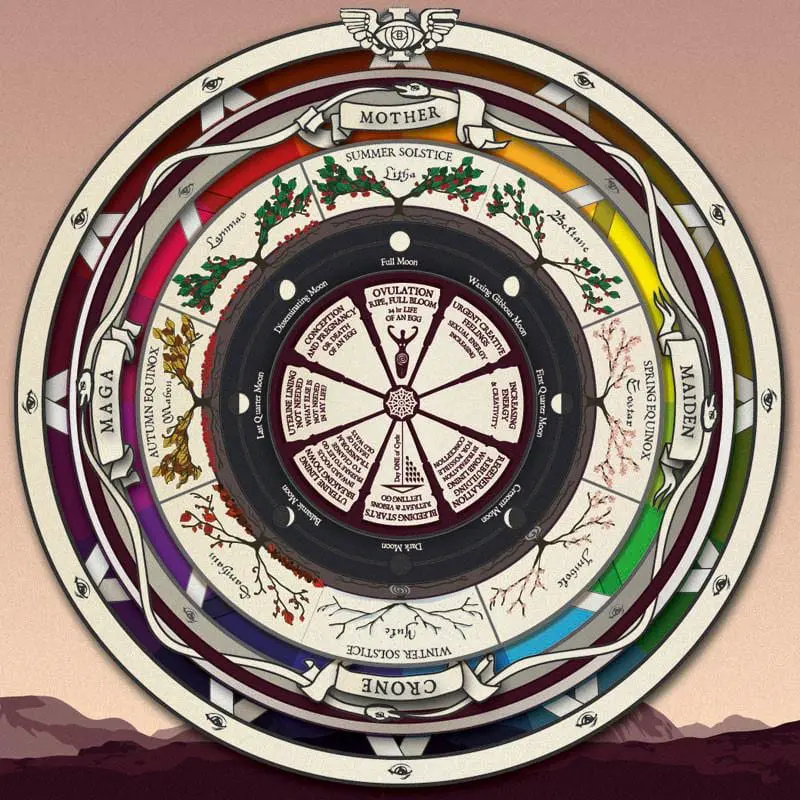
A menstrual cycle is a microcosm of seasons within a month, and in the macrocosm, it mirrors the stages of a woman’s growth over the course of her life: Spring as Maiden, Summer as Mother, Autumn as Maga or Witch, and Winter as Crone. Just as they are seasonal, biological stages, they are also psychological archetypes within the greater context of the unconscious.
Feminine intuition, trust in our bodies, inner knowing and neutral or even ritual practice in observance of our monthly cycles — these are just some of the factors to acknowledge if one is not already doing so to heal, embody and integrate these birth rites and mysteries. Essentially, it is incumbent on every female to better use and take care during these month-to-month cycles, and effectively ride those ebbs and flows in her life, as a supporting element to her creative, active and incubating potential.
From the menarche experience and how that was responded to by our mothers, fathers and wider family, leaves an imprint on our tender psyches, and foretells the next stages to come. In how they will be lived by us, whether we felt safe and proud or humiliated and ostracised; likewise, this imprinted message follows on to the first sexual experience, to pregnancy, birth and so on, until conscious recognition can rewrite the internal messages that were negative or disempowering.
When autumn does not come
In certain traditions, the Grandmother or Crone is viewed as a second Spring, which denotes a beautiful reverence and welcoming that is sadly not a common practice in the West; thus, we are deeply troubled by the lack of elders and bestowment of wisdom and guidance.
It feels like the majority of women view ageing as largely negative and will spend the majority of their time staving off the effects and appearance of it. Sadly, this superficial society and its tenets have placed a restrictive bind on our psyches, as well as our perceptions of value.
“In the Book of Wisdom, Solomon the Wise provides the clue to finding the balance of the heart. "Seek Wisdom," is his plea. Wisdom combines experience with knowledge. Experience is lived through the passions of body; knowledge is learned through the discipline of mind. Wisdom connects body and spirit in soul.”
(Dancing in the Flames, Marion Woodman and Elinor Dickson, pg. 61)
To be against ageing in general, to me, assumes a denial of growth, and opportunity for gifts and insight that could come with maturity of experience, self-acceptance and comfort in being and embodiment. Perhaps we need better 'propaganda' in favour to it, since this allergic response to biological and psychological progression disrespects life stages in favour of stagnation or artificial clocks.
An example I’ve come across is the comparison of mature-aged actresses to their former youthful acting selves and exclaim, “How did she get so old?”, almost as though we forget about our own ephemeral bodies; it is no wonder surgery is endemic, and pills are mandatory. Furthermore, we have movies like The Substance(2024) (check out my analysis here) where, disregarding the psychological interpretation for a moment, the audience and even the director herself would shockingly take the drug to make one’s body youthful and accept the Faustian bargain offered, knowing it has a destructive and futile end.
The psychological unconscious drive here is the desire to update the self and to renew the personality — really the entire premise of my subject matter. Unfortunately, as with most drives, compulsions or psychic epidemics, the energy or libido is focused externally and superficially, without alchemising these all-consuming drives inward for what is really needed for the individual. Death is placed far from sight and uncontended; the present is perceived as the only reality worth dealing in.
“If we remain in the ego world, the externalized world of concrete reality, death in any form is unthinkable.
(ibid., pg. 61)
We should view each transitional stage as like a portal that opens and closes, from one to the next, a death and rebirth; that would be the natural course of action and transformation, with powerful opportunities at the ready for those in submission, relinquishing ego demands in the process. Each season over the course of a woman’s life is, in fact, a birthright towards growth, wisdom and self-understanding. From the microcosm to macrocosm, individual to collective, and our roles and responsibilities to respect the maternal and paternal lineage of the cultural past, and their place as inner realities within us all, for their net positives and psychological importance, to pave something symbiotic forward.
Far along in this future will be the seed that grows feminine conscious and unconscious-led creation of a new type of womanhood.
“These are not the old devouring matriarchal energy or the tyrannical, one-sided patriarchal energy. The evolutionary imperative within the collective unconscious is pushing us toward a new level of consciousness."
(ibid., pg. 43)
”Evolution at this point is no longer in terms of the material body; it seems to be moving toward a greater interiority, and, paradoxically, a greater sense of all.”
(ibid., pg. 44)
Each transition and each milestone demand an update or a renewal of identity — a letting go of old notions, ideas and thoughts. This is an inner alchemy — shedding and burning what no longer serves, and allowing space for a new seed to bloom from the ashes. Wherever we are in this journey, this process of becoming, whether woman, mother, or creatrix, requires soul recognition, a healthy animus relationship, the revival of intuition, and guidance of one's core self within the unconscious, all while acknowledging the intelligence of the heart and body.
“Whether we like it or not, one of our tasks on this earth is to work with the opposites through different levels of consciousness until body, soul and spirit resonate together. Initiation rites, experienced at the appropriate times in our lives, burn off what is no longer relevant, opening our eyes to new possibilities of our own uniqueness. They tear off the protective veils of illusion until at last we are strong enough to stand in our own naked truth.”
(The Pregnant Virgin, Marion Woodman, Ch. 3)
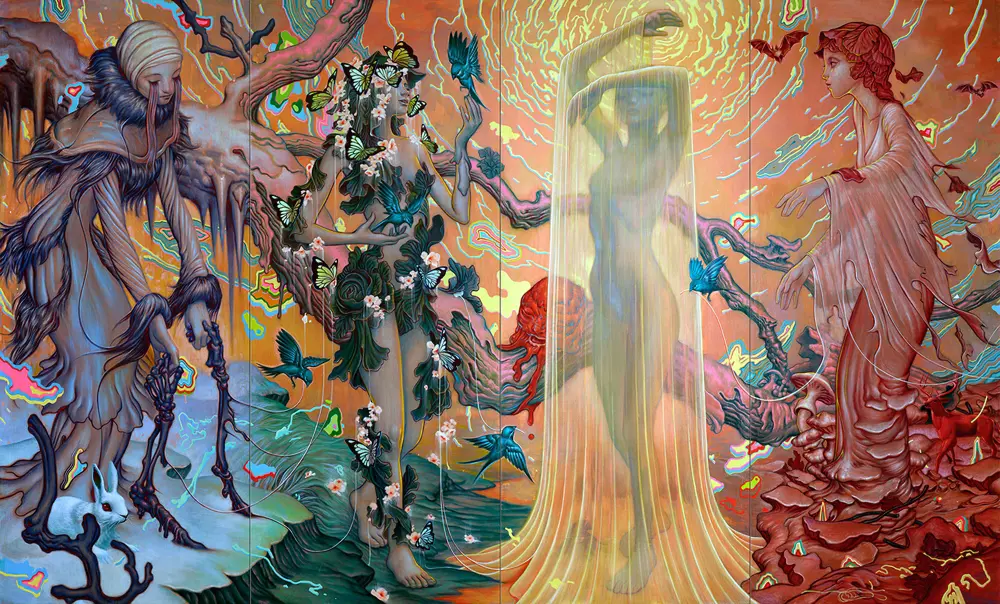
The Journey within and without
If we consciously work towards this new societal make-up, where ‘we are in the process’ of new women in becoming and can afford to forgo these biological initiations, then what’s left is to work with the psychological ones. Understanding the profundity of a woman’s choice to go against biological imperatives regarding the birth of children; with all sorts of valid and rational reasons to go with it. We are then left with the pieces of childless women, and to put a number on it, usually over the age of 45, who struggle with their new identities regardless of their successes or failures in life.
Whether the phenomenon of peri-menopause is to blame, or simply we just do not understand enough about subsequent physiological conditions over time, is another question, since there is dispute that such an interim stage exists at all, between fertility and menopause. I would hazard that the term is being co-adopted by post-millennial women in order to label or explain away their condition, which may have a psychological root, just as there could be a physiological or biological one, this is something Collings does address in her ‘Red Thread’ work.
These women are forced to re-discover themselves in their post-Maidenhood and into autumn or Maga/Witch stage, which, depending on the woman, will be a veritable upheaval of layers upon layers, of unacknowledged parts of themselves that have been repressed, masked or wounded. Buried under the progressive weight of life’s extrinsic societal expectations, like one’s career, beauty standards, fitness, family and relationships, etc. Caught up in life’s whirlwind and pressure to fit in, to provide extrinsic value, with the ever-growing fear of fading into nothingness. While I prefaced that it is a childless phenomenon, it is actually not exclusive to it. Since one can get caught up in the opposite end and become serial birthers, in absence of soul/self expression.
Often this is known as the midlife crisis, which is akin to a depression that would ideally lead to a self-discovery, since the energy forces you to go inward into core feelings and emotions. What appears to happen is that the character or façade that has been built up over decades to face the world must now be acknowledged as having been an array of masks, or personas, that we adjust situationally. Essentially, not our true self, and that modus operandi is no longer viable anymore — in fact, it is draining life-force energy exponentially. This can be viewed as the liquefaction stage of a caterpillar inside the chrysalis, or solutio. This operation is completely unconscious and enacted by the self of the individual to facilitate a rebirth: the emergence of the butterfly (coagulatio).
"The descent is undertaken either voluntarily, in search of a deeper goal, or involuntarily, when the abyss unexpectedly opens... The midlife descent often requires a whole reorientation of identity. In the first half of life we live mainly in terms of doing. We find out who we are through going to school, pursuing a career, marrying, having children and raising them. In the second half of life, we are pushed toward a deeper consciousness of who we are, an identity in terms of being, an identity based not on the ego but on the soul. The gap we pass through, sometimes lasting several years, is what is commonly known as the midlife crisis."
(Dancing in the Flames, Marion Woodman and Emily Dickinson, pg. 37)
In this stage, reality must be contended with, and time is seen as short, and the end feels near – so the next chapter of one’s life is right on the precipice; however, there is major confusion and impotence. So the women at this transition arrives here knowing and feeling different to their former selves and have to discover why that is, what is important in life, what is truly of value and meaningful.
This leads us to where the unconscious will certainly have a say in the matter, if one pays attention – here is where deeply rooted urges are thrown up from the depths, from the self, and specifically for the childless, this may actually take precedence over the human survival instinct in continuum as procreation. This deep feeling may get confused with more noise or ego desires— like starting another home business, taking an online course, adopting a pet or taking up a new political fight, even opening up a marriage. However, it doesn’t get at the true calling from the soul.2
“The Goddess [or the unconscious] is the life force in matter. She has laws that have now to be learned and obeyed. Her indwelling presence is the sacred energy, energy on which our egos have no legitimate claim. Confronted with this reality—a reality that is a confrontation with our own threatened survival—we realize that like Earth, nature, our bodies, we too are the vessels of an energy far greater than anything that tries to contain it. We realize that we, like the rest of nature, are participating members in the vast community of life, whose sacredness we must embrace if we are to survive. If we are ever to arrive at this expanded consciousness we will have to surrender our ego desires to the wisdom of the Self.”
(ibid., pg. 3)
If not mother, then what?
What could be, in some cases, an articulated and recognised solid rational stance against children, and catastrophically after the fact — like the feeling of entrapment when one is already knee-deep in diapers and wet wipes. I’m really speaking of the woman who feels she wants more than motherhood, that it is a life-ender, and she is right. It does end a life, but it also begins a new one. Is she then afraid of life-death-rebirth cycles, this deeply profound intuitive feminine mystery?
Motherhood is not a half-task, and I would not begrudge the choice against it. It’s a full-time deal; women are struggling with all that comes with it and more, and those stories can be found anywhere, everywhere.
However, the woman who chooses to go without, or rationalises away the concept of children, who has deep-seated emotion and feeling either way, I tentatively suggest, may have a greater responsibility towards the non-trivial weight of individuation. Especially if this woman feels a life purpose, an instinct that comes from within, and just feels or knows it is not about children, and whether she knows it or not, this task of individuation and any progress towards it benefits the collective and humanity.
To answer the title question, creation can absolutely come from the spiritual womb in absence of children, fished up from the deep waters of the unconscious, through into conscious action via the healthy animus (the workhorse helper) – however mysterious or ghastly the result may be. It makes itself known through creative outlet; bares itself and marks a place in the world, and usually has a timeless quality that affects other souls. This woman can then be acknowledged and met at her depth. However, understanding the art or having a revelatory inner knowledge, or a step towards wholeness or individuation, are different stages to the mystery and require taking a scalpel to the symbols in the work and mirroring it back to oneself. It is not enough to have the art, the painting, the novel, etc., it needs to be understood and interpreted to get the message, healing and truth from it.
“That meaning only lives when we experience it in and through ourselves. In so far as our actual life, the life we live here and now, is something essentially new and not just a continuation of the past, the main value of a work of art does not lie in its causal development but in its living effect upon ourselves.”
(CW4, Carl Jung, para 398)
Funeral for the identity
These women who create have been initiated into the non-biological rite of passage, namely through the unconscious, and suffer with the traditional concept of motherhood, child and childlessness on one hand, and aggressive internal monologues, whether be negative animus, instinct-injured, poisoned creative life, or complex on the other.
How she manages the new identity will amplify the mourning of a previous version of herself and fight with the present reality. Postpartum depression is, in all likelihood, an example of a relevant and tumultuous mourning, a psyche that has not caught up to, and rejects or is unable to process, the new identity that is motherhood and all that comes with it. Including the further loss of varying autonomy for each subsequent birth — as it appears and unravels what should be joyous and a satisfying milestone.
These questions are still the topic of much deep contemplation, emotion and tragedy. From women who cannot conceive, to women who do so, but scornfully or mournfully. With some who wonder if there is something fundamentally wrong with them, to others who will seek and point at the problem or lack of preparation, or feminine initiation rites (as per Matrescence, Lucy Jones), or others who will prefer to medicate and suppress their anxiety, or feelings, instead of seriously getting to the bottom of a complicated, likely vintage interplay of a psyche winterland.
The divine child in dreams
We finally arrive at the heart of the article, which is the stage of psychological Matrescence or, becoming mother to the child in the unconscious. What does it mean to give birth to one’s self anew? What does it look like?
This becoming aspect is both important for the birth of the self, and for the tumultuous changes up ahead for the world and for the rise of self-knowledge.
The child is a significant archetype, and the divine child is one that typically has miraculous and unusual origins, or atypical features compared to a human child. Think of Jesus, Dionysus, or Ganesha, to name a few; they are the symbolic representations of the psychological archetype of the divine child, as it holds the potential and future of the personality. An example in one’s dreams would be quite literally a baby, or child that appears as a key character within one’s dream, and usually coincides with major conscious shifts occurring in real life.
I recently came across this 43 year-old woman’s dream on the “This Jungian Life” podcast, and it provides a good representation of how it can first appear. You can watch the podcast hosts’ interpretation of it here or show notes here.
“I was walking in an urban area, it felt a bit like the edge of a town. There were some industrial buildings below so I must have been on a bit of a hill. I was walking with a friend when I looked up and saw a feathery orb. It took a while, and some blinking in disbelief to realize that it was in fact an owl. I kept wanting to take a photo but didn’t want to miss a second of seeing it by taking the time to pull my phone from my pocket. I was trying to determine if it was a special kind of owl, or if it was just flying in a curled up manner. Then we noticed a faded red string, or piece of material dangling from it. My friend grabbed it and pulled. Down came the owl and with it a human baby. The owl was surprisingly friendly and willing to be petted and touched. The owl and the baby were on a curb, and the baby was kind of half falling off it. The baby was very grubby, and partially wrapped in a dirty white cloth. My friend wanted to keep it but I was adamant we must call the police because someone must be missing their baby. I think I did call in the report, but we took the baby home with us in the meantime. I was walking all around with her, smelling her sweet warm head and feeling her soft baby cheeks on my cheeks. I had walked off on my own with her and was on my way out of town when I looked back and saw there was an Indian woman in a sari beckoning me back. I turned and started walking back”.
Context for the woman:
"I'm in a major transition period in my life. One year out of a 5-year co-dependent relationship, learning how to enjoy my own company and practicing self care for the first time in my life. I have two children, aged 13 and 11, on the threshold of starting a new business and building a house. My mom is in late stage Alzheimer's and I am currently examining the correlation between my intense histamine, skin, gut issues, and anger. But also feeling more freedom, peace, and happiness than I have ever felt. Feelings in the dream were awe, responsibility, and tenderness. And she says, "The people and the place in the dream were unfamiliar, so no associations."
What appears to jump out here in the dream, for brevity, is the owl, the baby, the faded red string, the grubbiness of the baby, and that she has taken it home, even with the reluctance she feels that it is not hers. And perhaps, the most significant aspect of the whole dream is how it ends, with a mysterious Indian woman (whether wise woman or exotic mother), that is either calling her back to pay attention elsewhere, or who may have ideas about how to care for the baby.
The dream elucidates a poignant precipice for the woman, that she is 'in transition' both emotionally (single), physically (pre/peri-menopause) and psychologically (edge of town/liminal space).
The feathered orb, a representation of the self, transforms into an owl and descends from above, holding human baby. The baby or divine child is revealed to be in a dirty condition. I feel the implication is that the baby needs to be attended to by the dreamer. After taking her home, she is smitten and perhaps focuses on the touch and positive sensation of its return, rather than the nurture, and perhaps this may be why she is called back after trying to leave town by the Indian woman, as there is more work to do, or that she is not tending to it correctly. The baby needs to be cleansed, and even though the divine child is hers (her self in becoming), it may be overtaken by another attitude (hasty ego). This could be represented contextually by the entrepreneurial work that the dreamer undertakes — new business and building a house. What seems to be more apt for the dreamer, given the relationship ending, is that she is finding herself again in self-care, yet must temper her ability and not rush into these other endeavours. The faded red string symbolises something that has waned over time, a libido or activity of meaning. Even beginning dream work and paying attention to the unconscious can cause this 'reunion' or birth of the new self within, and why the string is offered to pull down the owl and baby.
In my personal experience within the unconscious, it is important to remember the nature of the symbolism and not be overtaken by the emotional affect of the situations that take place — not to be confused with feeling, since that is important to decipher the overall context of the dream. There can be some rather intense or graphic scenes, just as there will be normal day-to-day symbols. For example, the child can be bathed, clothed, fed and cared for in one’s dream, can be nurtured to wellbeing or can die to neglect, or reinvigorated in ways that may disturb human sensibilities.
What also reoccurs for me in my dreams is a need to wash my children, find them, or follow them. As long as they are with me, it seems I am on the right track; if I am neglectful of them in the dream, or not looking out for them, then a part of me in real life must not be operating authentically to the guidance of the unconscious.
It is absolutely fundamental to understand that in dream work, we should interpret from the symbolic and not from the literal meaning of the nightly images that we receive. Which bears repeating again: the divine child is a psychological truism for the psyche even without the existence of a biological child, but the unconscious can also map that archetype onto figure(s) in real life.
Returning to the question of reluctant, avoidant or yearning mothers, could there be an unarticulated felt intuitive sense that a real child is not life’s completion. That there is ‘something else’ to care for, that the maternal instinct may be a proximal hook for the unconscious to use, to get at the profound rebirth process of the self through the divine child within. Just as we have read in the owl-baby delivery dream.
This is a speculative, deep and almost unknowable question, since by nature these are unconscious internal stages, individual and have an element of kairos (divine/opportune timing) to them.
Having said that, what we have on our hands and where we can begin to review ourselves within the collective is careful consideration of the arts, media, personalities, and so on, to help illustrate these points and open the question further, because the divide between the anti-natalists, pro-natalists, child and childless has a bridge, and that one is psychological, the embarkment of individuation, the newborn child within.
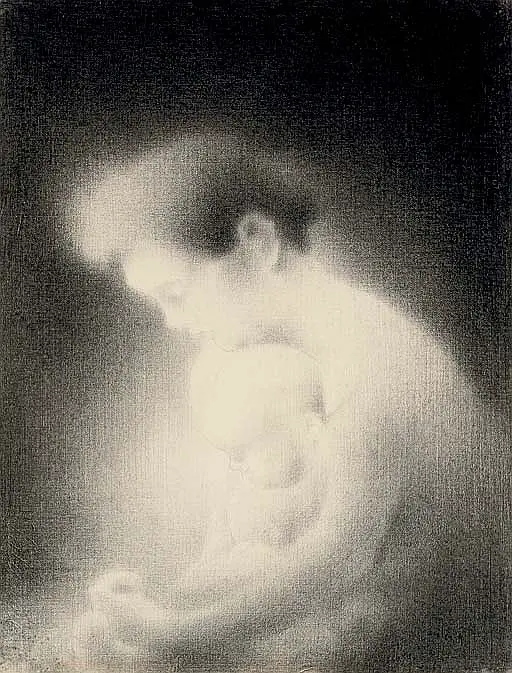
Conclusion of Part One
To wrap up, my aim for the article which will be divided in parts, is to use examples across media to discuss and expand a topic that has yet to my knowledge, been connected with at the depth psychology angle. In my view, this is a profound journey of individuation for a unique subset of women who will undertake this task, yet may stop at the aesthetic, or trauma healing level, and continue to work at their craft or art, without honing in on the self-knowledge or grappling with the unconscious, since there is a lot more ‘work’ to do there, and it eventually will be of benefit for all.
In order to get at what’s lost, we must restore the body, mind and spirit with soul. This means we must acknowledge all parts that make the whole, to do away with negative concepts that make us diminish what is actually of value. Among many things, is our physical embodiment, our grounded connection to Earth and our seasonal fractal nature, our heart awareness, as well as our capacity for creation at almost every level. These ideas may very well be locked in our ancient past, as part of the mysteries that have long been forgotten or suppressed, speaking of Life/Death/Rebirth cycles.
My sense on top of this predicament, is that motherhood, will be misconstrued and stay at this surface level of understanding or artistic works made for emotional catharsis. When the archetype in relation to the divine child has a depth of process and self in becoming, as something that has yet to be envisioned for the personal and the collective. This includes the update of the feminine or womanhood as we know it.
Finally, the divine child as the crux of the article, is one that can be witnessed across myth and history, but what we have yet to quite grasp is that this is a psychological truism for anyone that embarks on this work. That the calling may be there within the unconscious of an individual to recognise its presence, waiting on the sidelines to be called into awareness, attention and care, it is the shining acknowledgement that a new mode of being, a new self, ready to guide one’s outer life into soul work.
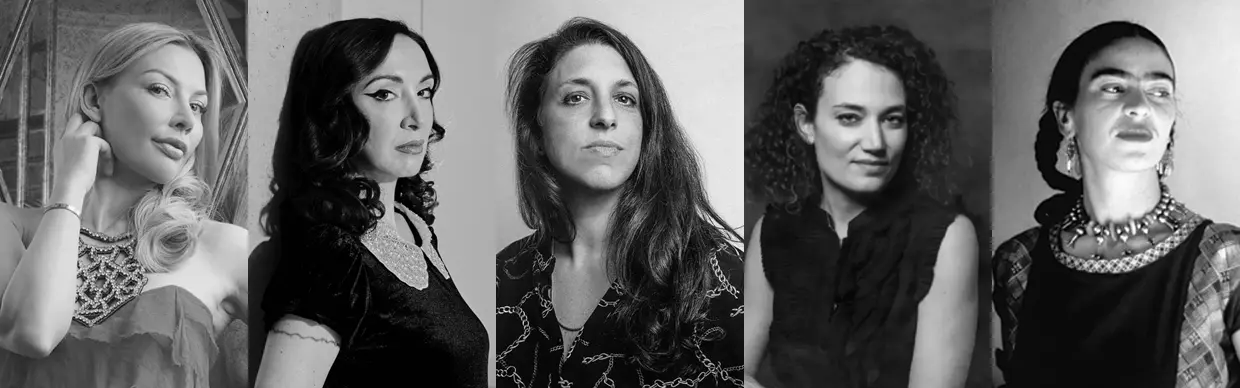
In Part Two, I will discuss the following women and their works/predicaments: Anna Bey (influencer), Coralie Fargeat (director, The Substance), Anna Harwicz (author, Die My Love, film of the same name directed by Lynne Ramsay), Mary Bronstein (director, If I Had Legs I’d Kick You) and Frida Kahlo (artist).
If you enjoyed this article or have found it useful, consider sharing, commenting or even donating. Many thanks!