
NASA Image of the Day: Centaurus A · July 30, 2026 (NASA only updates this feature on weekdays; this is the latest confirmed edition)
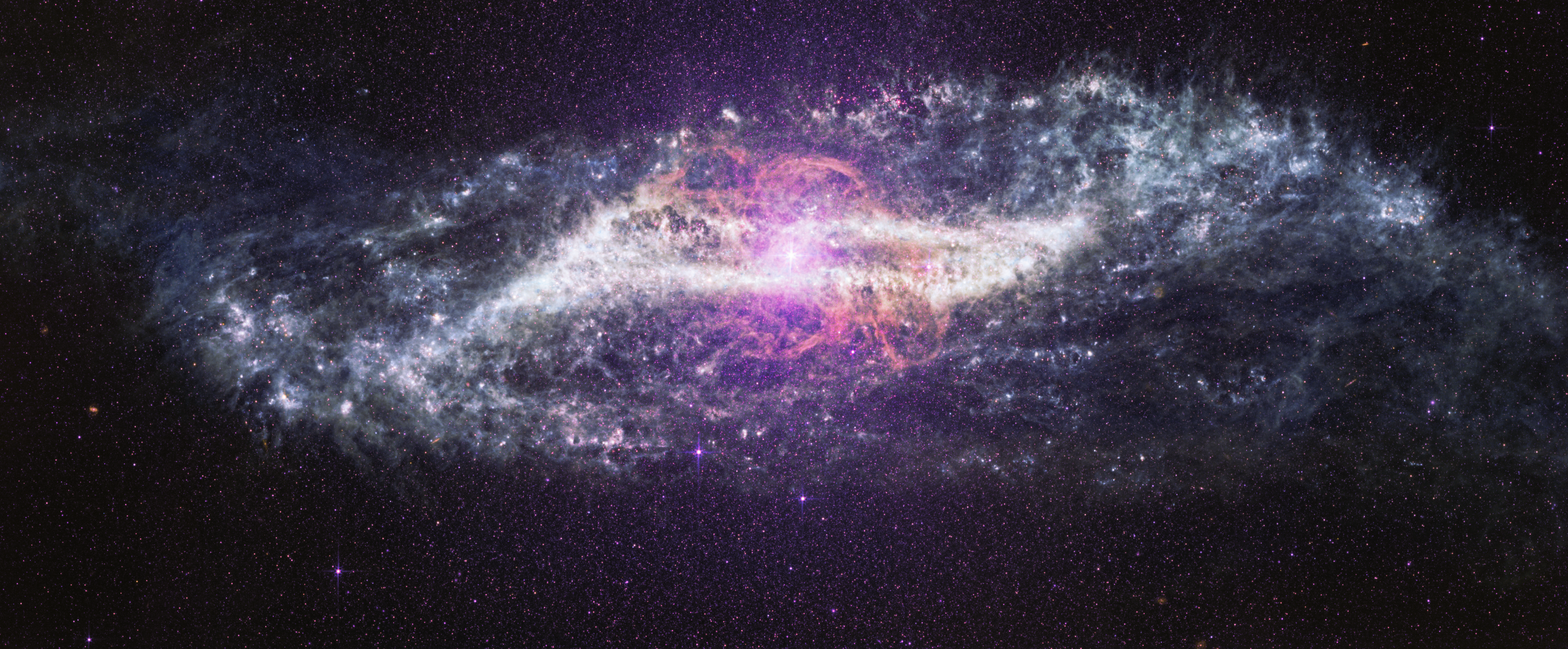
Image: NASA Image of the Day · Image credit: NASA, ESA, CSA, STScI; Image Processing: Alyssa Pagan (STScI), Joseph DePasquale (STScI), Macarena Garcia Marin (ESA Office at STScI) · Image page.
Some galaxies spin along quietly. Others clearly have a history.
Centaurus A is the latter. The day before, NASA picked a new portrait of it for "Image of the Day"—captured by the James Webb Space Telescope's Mid-Infrared Instrument (MIRI).
At the center of the image, everything blazes into a mass of white tinged with pale pink, light radiating outward, eight sharp diffraction spikes piercing from the core (Webb's signature—every extremely bright point source gets them). A grayish-white dust lane slashes diagonally across the galaxy's midsection, mottled with patches and bright knots. Above and below the center, pink-purple filaments and ribbons each curve into an arc, together resembling a crooked S.
"Close" by astronomical standards
Centaurus A is about 11 million light-years from Earth. In astronomy, that counts as a neighbor—but it also means the light we see today left there 11 million years ago.
Neighbors are usually quiet. This one isn't. At its center sits a supermassive black hole that's actively "feeding," blazing so brightly that it makes this galaxy a prime laboratory for studying how galaxies and black holes grow together.
It's also dusty—and that's a compliment. In visible light, a thick dust lane obscures most of the galaxy, like a tightly drawn curtain. But mid-infrared sees "heat": warm dust glows on its own. So this look from Webb isn't peering behind the curtain—it's making the curtain the star of the show. What once blocked the view becomes the most information-rich part of the image—tangled filaments, looping rings, glowing patches of warm dust clouds.
The red bright spots in the image, according to NASA, are dust-rich stars: some are aging stars shedding material back into space, others are newborn stars just taking shape in their stellar nurseries. Dust is both the ashes of the previous generation of stars and the raw material for the next generation of stars and planets.
Who wrote that S
That S-shaped structure is the most striking—and most puzzling—feature in this image.
NASA lays the questions out honestly: What created this shape? How big a role did the black hole play? Could it be a remnant of star formation ignited by that galactic collision? The answers require more research. Long ago, Centaurus A collided with another galaxy, and the complex structures near its center today are most likely aftershocks of that event.
There's something else the resolution reveals. In Webb's near-infrared view, parts of the galaxy look heavily "grainy," like image noise—except each grain is an individual star. With this level of clarity, astronomers can count them one by one, read them one by one, because each star's composition and age record what it has been through. They call this galactic archaeology.
The image itself was released on July 6 alongside Webb's "Year Four science results"; NASA waited more than three weeks before selecting it for Image of the Day. Some images deserve to be seen twice.
The S we're looking at is a crime-scene photo from an accident we can never arrive at in person. The collision ended long ago, but the dust is still slowly settling into shape, following the force of that impact.
Sources: NASA Image of the Day page, NASA Science "Webb Reveals an Unusual Galaxy Shaped by Cosmic Collision," ESA/Webb image description and official image caption.