
NASA Astronomy Picture of the Day (APOD): NGC 4372 and the Dark Doodad · July 31, 2026
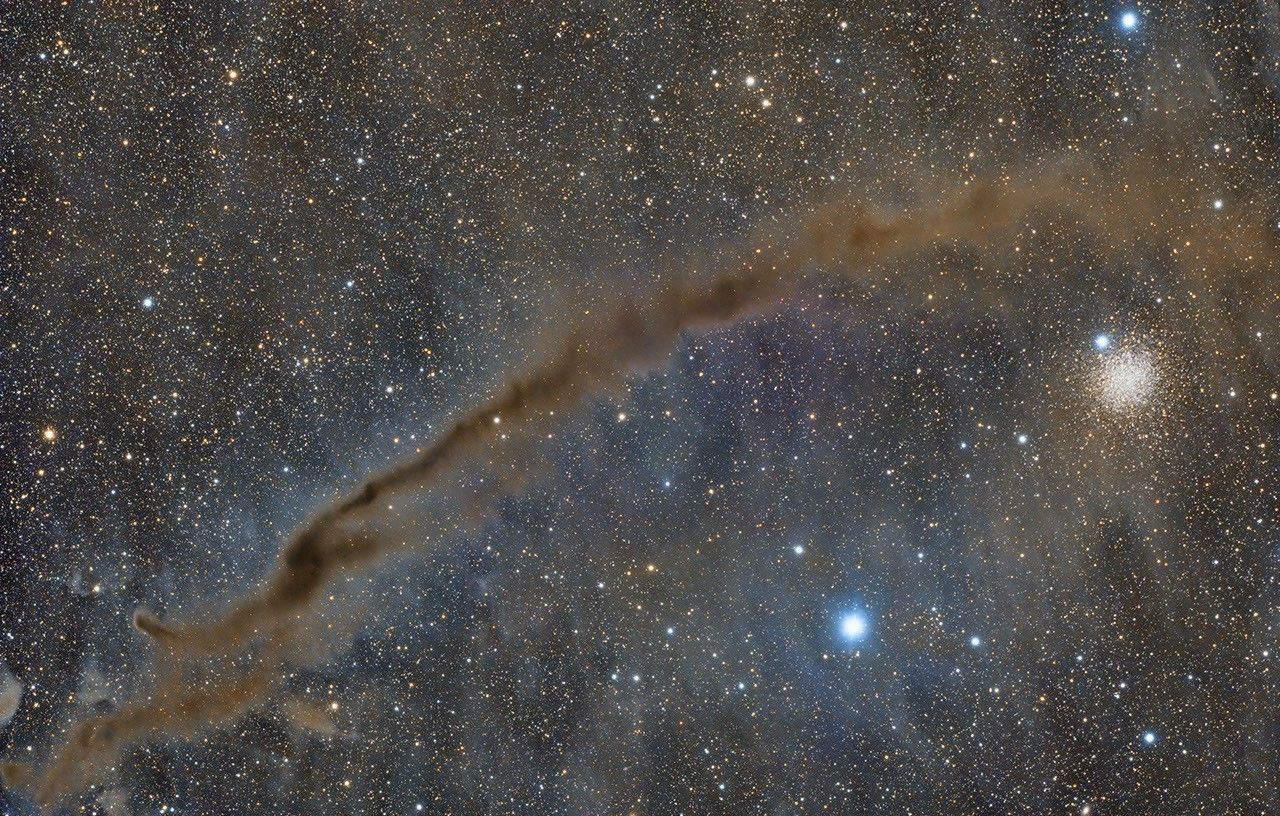
Image: NASA Astronomy Picture of the Day (APOD) · Image Credit & Copyright: Alessandro Cipolat Bares · Today's page (NASA Science mirror). Credit includes Copyright; all rights belong to the photographer. This article provides links for reference only.
Today's NASA Astronomy Picture of the Day looks, at first glance, like something went wrong.
The frame is packed wall-to-wall with stars—so many they seem to glow as one. But right through the middle runs a dark streak, thin and sharp-edged, slicing the starfield in two. It's not a scratch on the negative, and it's not an area the camera missed—something is actually there: a thick, cold cloud of dust, blocking all the starlight behind it.
Astronomers call this region the Musca molecular cloud. But among enthusiasts, it goes by another name: the Dark Doodad.
Six Full Moons in a Row
This dark streak spans about 3 degrees across the sky. How much is 3 degrees? Line up full moons side by side, and you'd need roughly six to cover that distance. You can find it with binoculars, located in the southern constellation Musca (the Fly), right next to the Coalsack Nebula and the Southern Cross.
What's interesting is its "tail." At the southern end of this dark band sits a yellowish globular cluster, catalogued as NGC 4372, looking like a bead tied to the end of a thin string.
But that bead isn't actually on the string.
The dark streak lies about 700 light-years from us and stretches more than 30 light-years long. NGC 4372, meanwhile, wanders in the Milky Way's halo, roughly 20,000 light-years away—nearly thirty times farther. They appear close together purely because they happen to line up along the same line of sight. It's like holding up your finger to block a distant tower: in the photo, finger and tower look pressed together, but in reality they're kilometers apart.
Images of the cosmos have no depth. Depth has to be calculated.
It's Dark Because It's Packed with Material
Strangely enough, this great swath of darkness is one of the most promising places out there.
A dust cloud blocks light because the material inside it is abundant and dense. And stars are born precisely in these cold, thick environments—gravity slowly squeezes gas and dust into clumps until the core ignites. Research suggests this Musca molecular cloud has the potential to form stars.
So it isn't a void in the sky. It's more like a delivery room where the lights haven't been switched on yet.
As for the name—in 1986, astrophotographer and writer Dennis di Cicco was observing Halley's Comet in the Australian outback and casually dubbed this dark streak the Dark Doodad. Halley's Comet returns only about once every seventy-six years; 1986 was its most recent visit, and stargazers worldwide flocked to the Southern Hemisphere. He probably never intended it as a formal designation—"doodad" in English just means "that thing"—a little something you can't quite name.
And yet this offhand name is still in use forty years later.
Today's image is by astrophotographer Alessandro Cipolat Bares; copyright belongs to him, and we provide links for reference only.
A side note: "Doodad" and "Doodle"—the subject we write about daily in this column—differ by just two letters. One is that temporarily swapped-out logo on Google's homepage; the other is a seven-hundred-light-year-long dark streak at the edge of the southern Milky Way. Both became memorable thanks to a not-entirely-serious name.
Sources: APOD July 31, 2026 page description (by Robert Nemiroff, Jerry Bonnell, et al.), Wikipedia entry "Dark Doodad Nebula."