
Something that happens twice a day, yet almost no one ever looks up to notice.
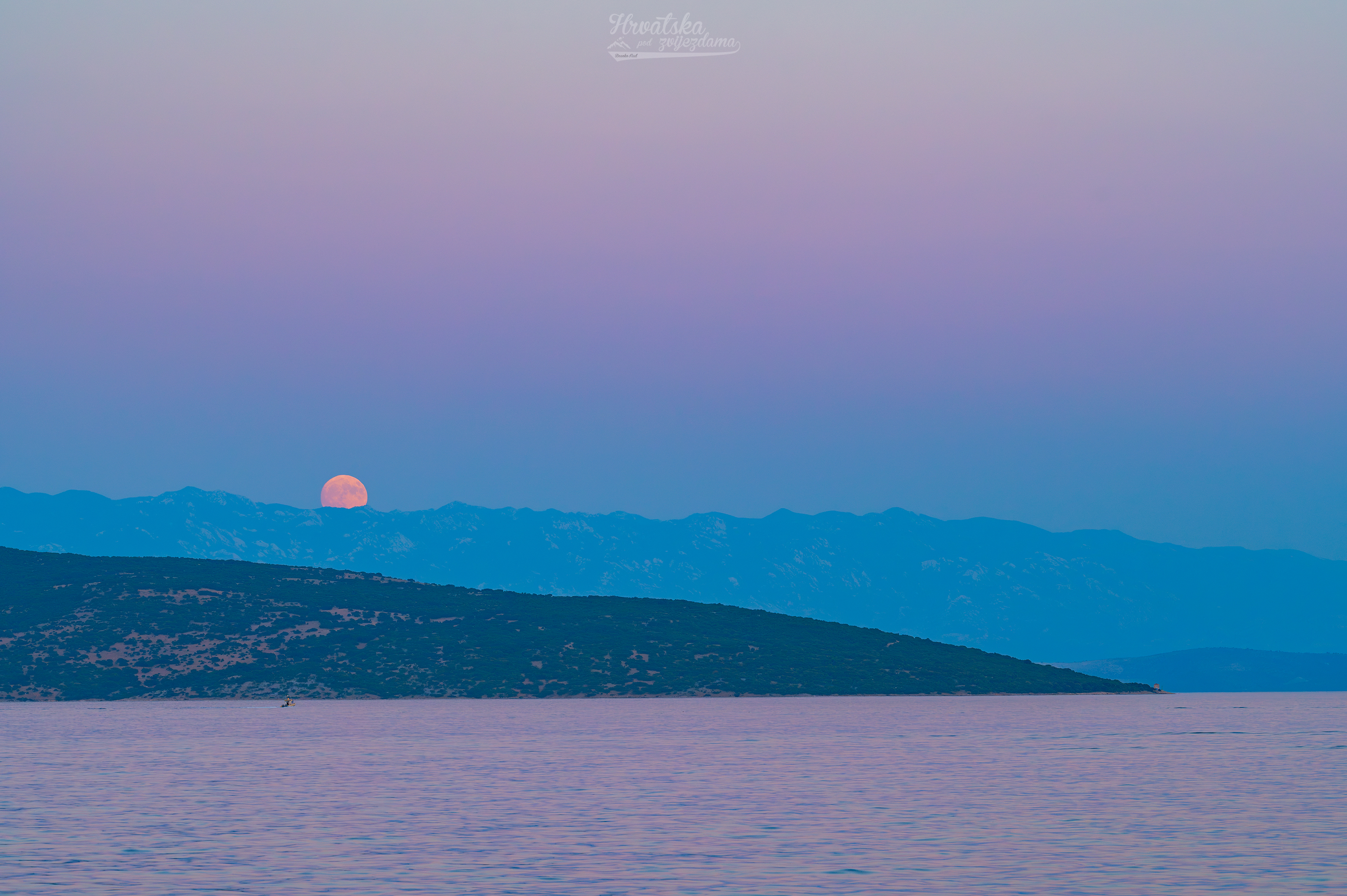
Image: NASA Astronomy Picture of the Day (APOD) · Image Credit & Copyright: Branko Nadj · Page for the day.
On the evening of July 28, on the island of Krk off the Croatian coast, someone stood with a camera aimed at the eastern sea.
The sun was setting behind him. And in front of him, July's full moon had just peeked above a distant ridge, laying a shimmering path of light across the Adriatic.
This is the photo NASA's Astronomy Picture of the Day chose today. But the real thing worth seeing isn't that moon—it's the two horizontal bands below it, the kind you'd almost dismiss as just "the color of the sky."
There are three layers of sky in this image
At the bottom, hugging the ridge, is a diffuse gray band.
Above the gray band is a faint pink strip.
Above that, normal twilight blue.
That gray band is the Earth's own shadow. That pink strip has a beautiful name: the Belt of Venus.
Why you can always see Earth's shadow when the full moon rises
There's a coincidence here so simple it feels almost sly.
A full moon is full because it sits directly opposite the sun. So at the moment the full moon rises, the sun must be setting. And when you face the full moon, you have your back to the sun, gazing toward the antisolar point in the sky—exactly where Earth's shadow is cast.
When we normally talk about "Earth's shadow," we usually mean a lunar eclipse: the moon drifting into that dark cone behind the Earth and going dim. That shadow cone is far longer than most people realize—about 1.37 million kilometers, roughly three and a half times the Earth–Moon distance. The moon fits entirely inside it, which is why total lunar eclipses happen.
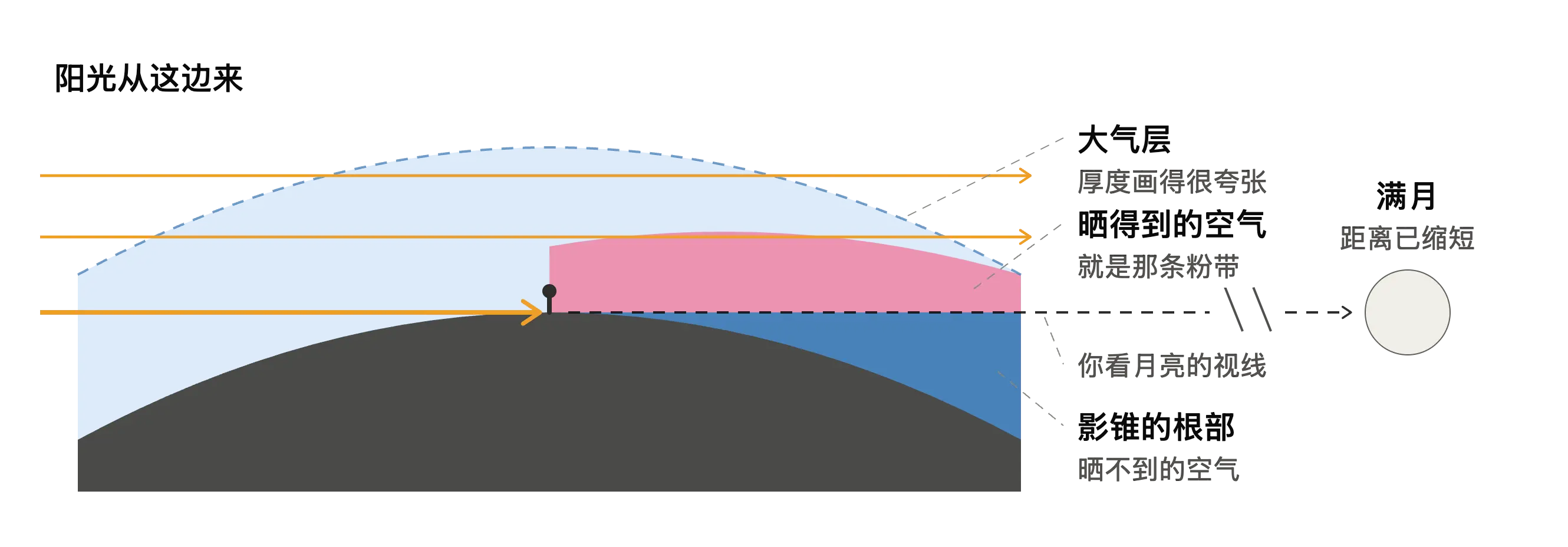
But the very beginning of that cone is always right above our heads. After sunset, sunlight can no longer reach the lower atmosphere near the eastern horizon; that unlit air looks slightly darker and bluer than its surroundings. The gray band you see is the base of this enormous shadow cone, painted on our own atmosphere.
It appears twice every day: before sunrise in the west, after sunset in the east. It's just so quiet that most people have never recognized it for what it is.
The pink one has nothing much to do with Venus
The formal name for the Belt of Venus is the "anti-twilight arch."
Its pink color comes from a long detour. The sun has already dropped below the horizon, and its light can only cut obliquely through the thick lower atmosphere. Along the way, blue light is scattered out, leaving the reddish remainder to travel onward until it reaches the upper atmosphere overhead, where air molecules and fine particles bounce it back toward the observer's eyes.
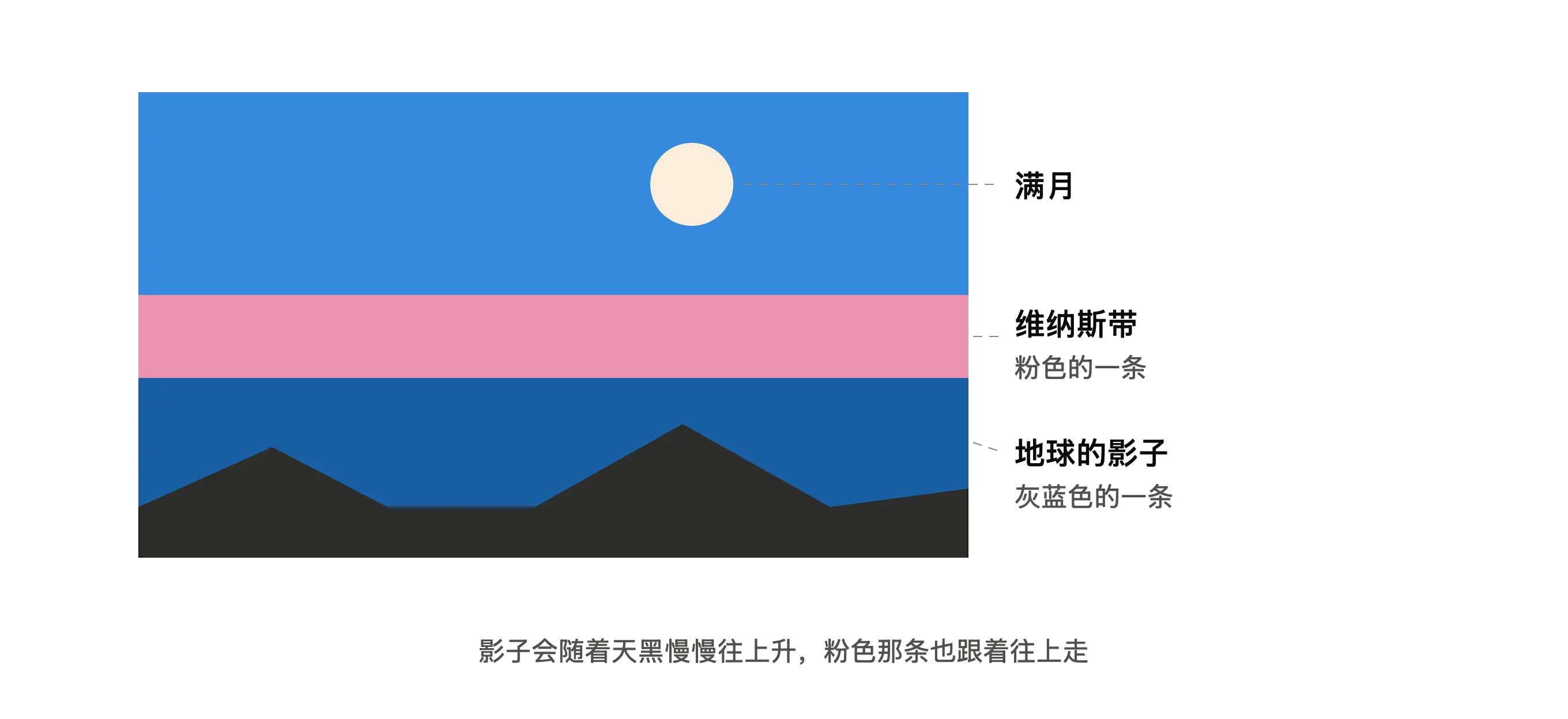
So that pink strip is sunset red, backscattered. It typically hovers 10 to 20 degrees above the horizon, gradually separating from the horizon as Earth's shadow rises, arching into a low, wide band—hence the word "belt."
As for why it's called the Belt of Venus: it has nothing to do with the planet Venus. It's simply a romantic name later observers gave to this pale pink sash in the sky.
Incidentally, July's full moon is called the "Buck Moon"
The name comes from North American observation. Each summer, male deer begin growing a new set of antlers sheathed in a vascular soft skin called velvet. By July, these new antlers are at their most conspicuous. Algonquian-speaking tribes of North America named the month's full moon after them. In the 1930s, the Maine Farmer's Almanac compiled and published this set of twelve monthly moon names, and they've been in wide circulation ever since.
It goes by other names too: the Thunder Moon (for early summer storms), the Hay Moon, the Salmon Moon, the Berry Moon. Each one is simply people in a particular place looking up at the moon and pointing at whatever was happening around them at the time.
Why NASA chose this photo today
Because it's a preview.
The astronomer who wrote the description pointed out a symmetry: tonight, beside this full moon, Earth is casting its shadow on its own atmosphere; and 11 days from now, on August 12, it will be the moon's turn to cast its shadow on the Earth—a total solar eclipse.
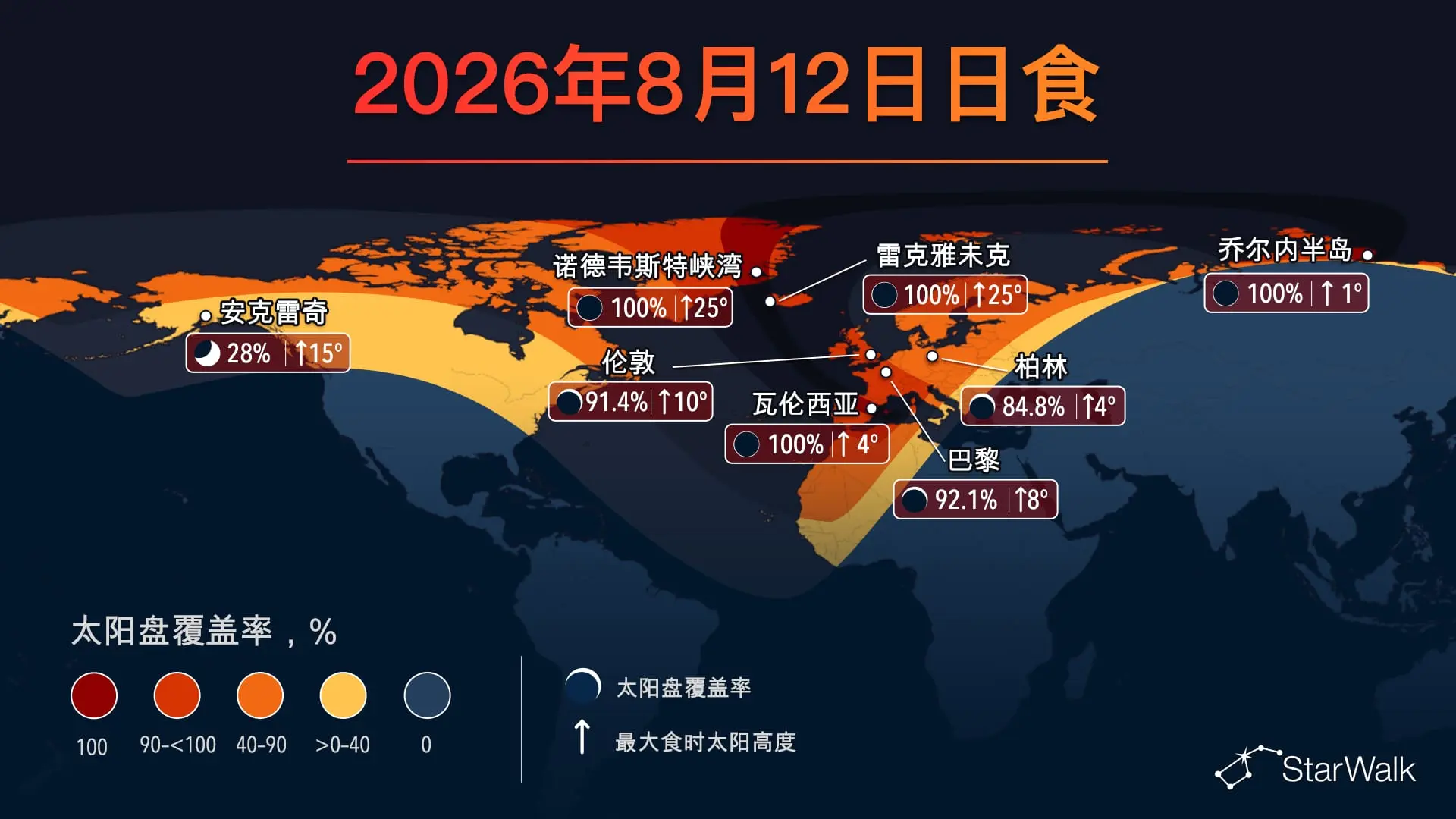
The map shows the path of the total solar eclipse on August 12, 2026. Totality will pass over the Arctic Ocean, northern Russia, Greenland, Iceland, a small area of northeastern Portugal, northern Spain, and the Balearic Islands. The numbers on the map indicate the sun's altitude at maximum eclipse. © Vito Technology, Inc.
The eclipse path starts from the Arctic, skims the east coast of Greenland and western Iceland, crosses the Atlantic, and finally sweeps across northern Spain before sunset, continuing to the Balearic Islands; a small corner of northeastern Portugal and a strip of northern Russia also fall within the path. The longest totality occurs near Iceland, about 2 minutes and 18 seconds; by the time it reaches Spain, the sun is already near the horizon, with totality happening in the final minutes before sunset.
Its significance lies in how long it's been: for mainland Europe, this is the first total solar eclipse since 1999; for Iceland, the first since 1954; for mainland Spain, you have to go all the way back to 1905.
What makes it even more remarkable is that August 12 is also the peak of the Perseid meteor shower. On the same night, two celestial events are lined up one after the other.
NASA will livestream this eclipse across multiple platforms, providing views from Iceland and Spain: https://www.nasa.gov/live
Interested readers can tune in. NASA's eclipse coverage is as follows (all times Eastern):
Wednesday, August 12
- 1:15 p.m.: Eclipse livestream begins
- 1:45 p.m.: Totality begins in Iceland
- 2:28 p.m.: Totality begins in Spain
To close
The photo was taken by photographer Branko Nadj on the island of Krk.
What I like about this image is that it captures something that happens every single day, yet requires someone to deliberately turn around to see it. The Earth is constantly casting a shadow into its own atmosphere—it's just so faint that it takes someone willing to turn away from the sunset and look in the opposite direction.
Tonight after sunset, you can try it yourself. Find a spot with a clear view to the east, and don't rush back inside.
Sources: NASA APOD page for August 1, 2026; NASA's explanation of traditional full moon names; European Space Agency (ESA) page on the August 12, 2026 total solar eclipse; Spain's National Geographic Institute (IGN) eclipse data.