
The same Moon, the same Sun, fourteen years apart delivering two different endings—the only difference being the 50,000 kilometers beneath the Moon's feet.
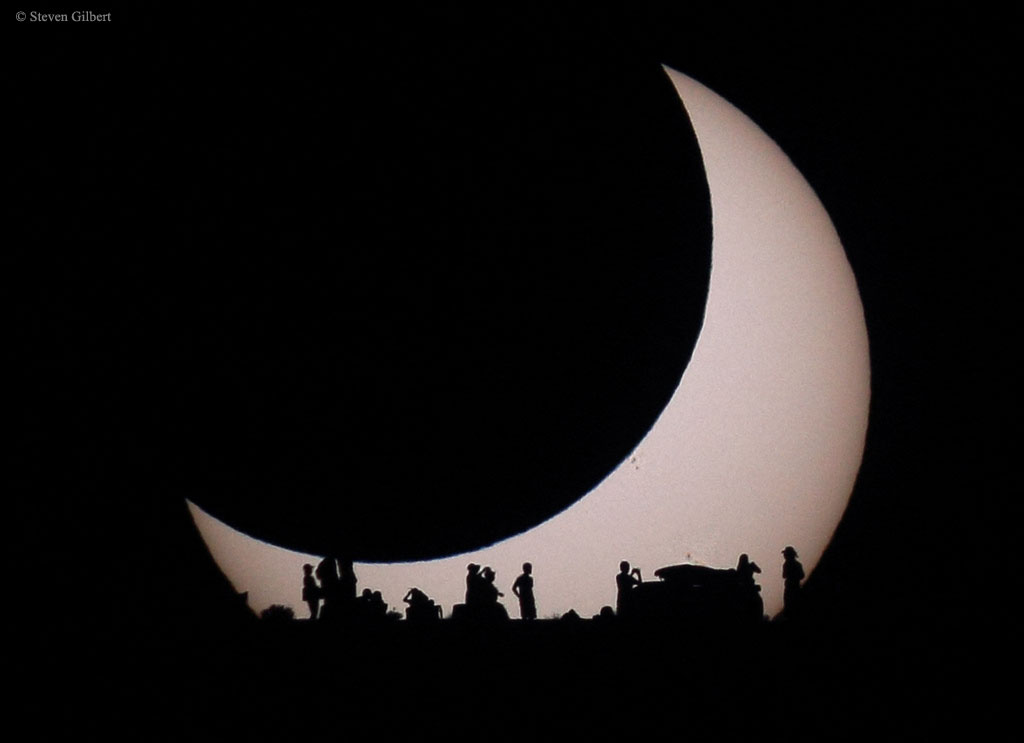
Image: NASA Astronomy Picture of the Day (APOD) · Image Credit & Copyright: Steven Gilbert · Page for the day
Today's APOD opens with a question: have you taken a good look at your home star lately?
Then it gives us this photograph. A ridge cuts across the bottom of the frame, and along it stands a row of people, all rendered as silhouettes: some tilt their heads back, some bend down to adjust telescopes, others simply sit. Above them, the Sun has a large chunk bitten out by the Moon. APOD quips that this Sun was actually blocked twice—from above by the Moon, and from below by the Earthlings watching it.
That Row of Silhouettes from Fourteen Years Ago
The photo was taken in 2012, at Glen Canyon National Recreation Area near Page, Arizona, USA. The date was May 20, 2012, when a solar eclipse swept across the American Southwest. Park rangers and astronomers set up telescopes at the overlook, explaining to the gathered public what was happening overhead—photographer Steven Gilbert stood at a distance and fit the entire row of people and the Sun into a single frame.
Look closely at the solar disk: just to the lower right of the Moon's dark limb, you can make out a small cluster of sunspots—the Sun's own "freckles," caught in the shot as a bonus.
No Darkness That Day, Just a Golden Ring
Here's the interesting thing: the climax of that eclipse wasn't darkness.
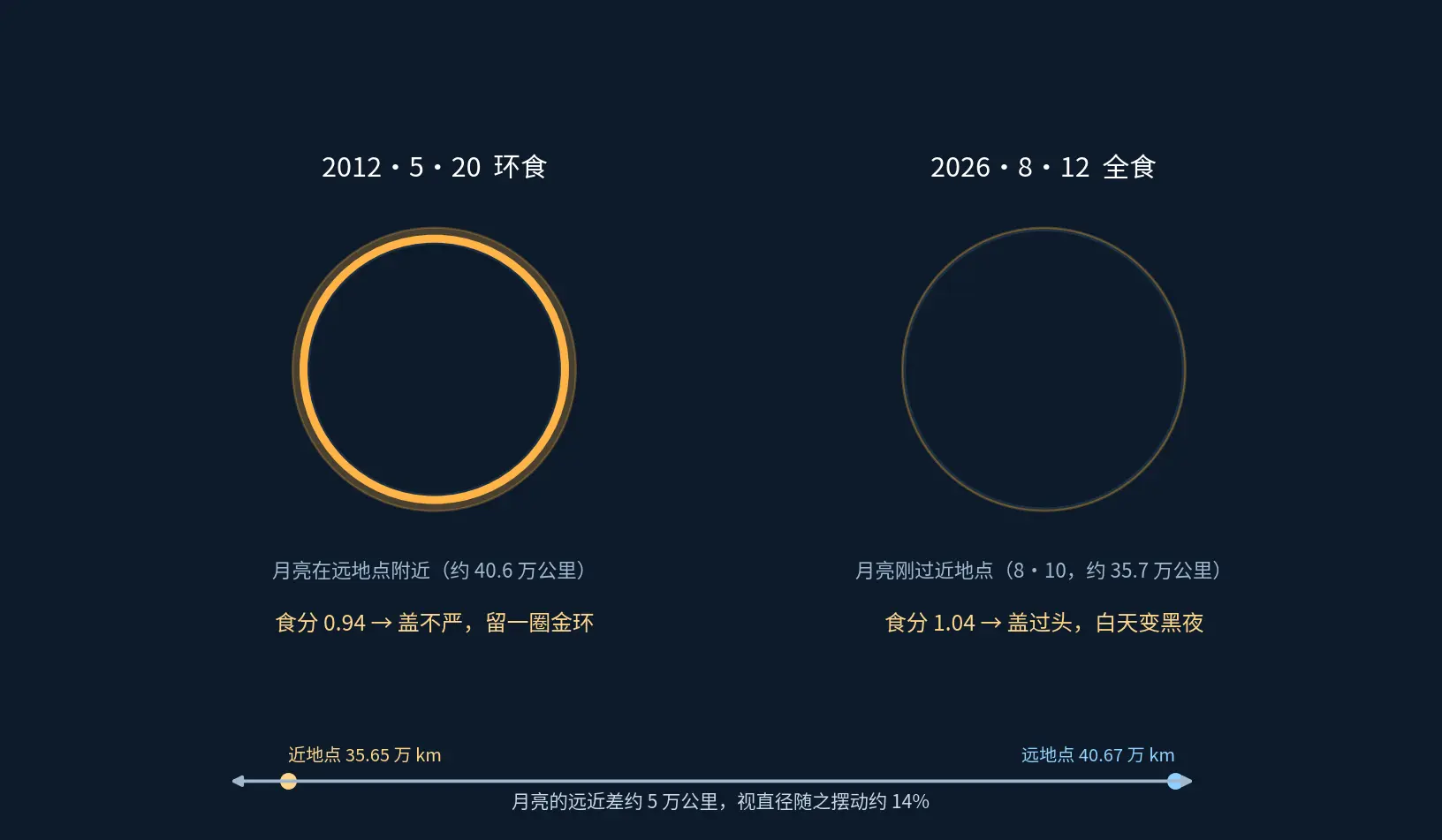
On May 20, 2012, the Moon had passed apogee just over a day earlier—according to one on-site observer's record, it was the farthest apogee of the year, placing the Moon about 406,000 kilometers from Earth. Farther away means it looks smaller: its disk could only cover 94% of the Sun's diameter, no matter how perfectly aligned. So at maximum eclipse, the sky didn't go dark—instead, a blindingly bright golden ring appeared overhead. People call it the "ring of fire." In Page, that ring lasted about four minutes, with the Sun already hugging the horizon.
What the photograph captures is the partial phase before or after the ring: the Sun missing a large chunk, but the sky still bright—so bright that people could only view it through filters or projection.
It All Comes Down to the Moon's Distance
Why do some eclipses produce a golden ring while others bring darkness?
The answer is satisfyingly simple: the Moon's orbit around Earth isn't a perfect circle—it's an ellipse. At its closest, about 356,000 kilometers; at its farthest, about 407,000 kilometers. That back-and-forth difference of roughly 50,000 kilometers swings its apparent size by about 14%. Meanwhile, the Sun's apparent size barely changes—Earth's orbit around the Sun is far more circular.
So the same Moon appears larger and smaller as it goes around, while the Sun's disk stays essentially fixed. When the Moon is far away, it can't fill the Sun's disk, light leaks around the edges, and you get a golden ring. When it's close, it more than covers the Sun, and daytime briefly becomes night.
One sentence says it all: whether an eclipse gives you a golden ring or darkness isn't up to the Sun—it's up to those 50,000 kilometers of the Moon's varying distance.
This Wednesday's eclipse catches the Moon just two days after its August 10 perigee: its apparent diameter exceeds the Sun's by about 4%, more than enough. Compared to the 2012 event, the Moon's apparent size relative to the Sun differs by only about a tenth—but that tenth is what turns a golden ring into darkness.
Three Days from Now, Another Group Will Stand as Silhouettes
This Wednesday, August 12, 2026, there will be a total solar eclipse.
The path of totality sweeps down from the Arctic Circle, crosses Greenland and Iceland, traverses the North Atlantic, and before sunset grazes northern Spain and a corner of northeastern Portugal. Outside the path, northern North America, all of Europe, and northwestern Africa will see a partial eclipse—the same kind of view those 2012 observers in the photo had: a Sun with a bite taken out. The eclipse won't be visible anywhere in China, but you can watch it via livestream.
How to Watch (August 12, Wednesday)
- Path of totality: Greenland, Iceland, the Atlantic, northern Spain, and a corner of northeastern Portugal; maximum totality lasts 2 minutes 18 seconds, occurring over the ocean west of Iceland
- Greatest eclipse: UTC August 12 at 17:47, i.e. Beijing time August 13 at 1:47 AM
- Reykjavik, Iceland: totality at approximately local time 17:48 (Iceland uses no daylight saving time year-round, same as UTC), i.e. Beijing time August 13 at 1:48 AM
- Northern Spain: totality occurs around local sunset, with the Sun very low on the horizon
- NASA official livestream: starts at U.S. Eastern time August 12 at 13:15, i.e. Beijing time August 13 at 1:15 AM, at nasa.gov/live
- Safety reminder: only during the roughly two minutes of totality—when the Moon completely covers the Sun—can you look with the naked eye; during all other phases you must use eclipse glasses or dedicated filters that meet the ISO 12312-2 standard, and never look through a telescope or binoculars while wearing eclipse glasses
The Eclipse Hands the Meteor Shower a Gift
This eclipse comes with a bonus—and this bonus is one that readers in China can see with their own eyes.
That same night—the night of August 12 into the early morning of August 13—is the peak of the Perseid meteor shower. Here's what makes it perfect: a total solar eclipse can only happen during a new moon, because the Moon must be positioned directly between Earth and the Sun, with only its far side illuminated. So whenever an eclipse coincides with a meteor shower peak, the shower automatically gets a gift: an entire night of moonless dark sky. This year is exactly that case. NASA calls the viewing conditions "ideal"—under good conditions, you could see 50 to 100 meteors per hour.
The Perseids are also one of the oldest recorded meteor showers. The earliest account dates to 36 AD—the early Eastern Han dynasty—in Chinese historical chronicles, describing over a hundred meteors streaming across the sky at dawn. Nearly two thousand years later, this shower still arrives every August without fail. Its "raindrops" are grains of sand left along the orbit by Comet Swift-Tuttle, slamming into the atmosphere at about 59 kilometers per second and burning into streaks of light—at that speed, the straight-line distance from Beijing to Shanghai takes just 18 seconds.
APOD leaves one tantalizing question at the end: during those two-odd minutes of darkness within the path of totality, could observers spot Perseid meteors streaking across the daytime sky? Nobody can guarantee it—and that's exactly what makes it fun.
How to Watch the Perseid Meteor Shower (applicable across all of China)
- Peak: the night of August 12 through pre-dawn August 13 (local time); best after midnight
- Direction: no need to hunt for a specific constellation—just lie down and watch the whole sky; the radiant point is in Perseus in the northeast, rising higher as the night goes on
- Conditions: the peak coincides with a new moon, meaning zero moonlight interference all night—one of the best years in recent memory; in dark rural areas you could see dozens per hour, and even in cities you have a chance of catching the brightest fireballs
- Adaptation: give your eyes 20 to 30 minutes to adjust to the dark, and don't look at your phone in between
- NASA meteor night livestream: starts at U.S. Eastern time August 13 at 0:00, i.e. Beijing time August 13 at noon (12:00 PM), on NASA's YouTube channel
Wednesday Night, Save Yourself a Spot
The launchpad for this piece's exploration is written on the calendar three days from now.
Wednesday night, find a spot with an open view to the northeast and as little light pollution as possible—a rooftop, a riverbank, the countryside, anything works. Head out after 11 PM; after midnight is even better. Lie flat, don't rush, give your eyes half an hour. Every streak of light that crosses the sky is a grain of sand shed by a comet years ago, burning up tonight just for you.
If you can stay up, at 1:15 AM you can also have NASA's livestream running: watch the black Sun over Greenland and Iceland first, then look up and wait for your own meteors overhead. Two celestial events, one single night.
Fourteen years ago, a row of silhouettes stood on a ridge in Arizona. This Wednesday, it's the turn of people in Greenland, Iceland, and Spain to stand as silhouettes. And those of us outside the eclipse path have our own spot, too—right beneath the falling stars.
Sources: APOD August 9, 2026, NASA Science: Total Solar Eclipse on August 12, 2026, NASA "Watch the Skies" blog: Watch the Perseids with NASA, Wikipedia: Solar eclipse of August 12, 2026, Wikipedia: Solar eclipse of May 20, 2012, EclipseWise: Annular Eclipse of May 20, 2012, U.S. National Park Service: Eclipse viewing at Glen Canyon, On-site observation record: Page 2012 annular eclipse, National Radio Astronomy Observatory: Ages of the Perseid meteor shower, Wikipedia: Perseids