
Two meteors cross the Swedish coast, and one leaves its reflection on the water.
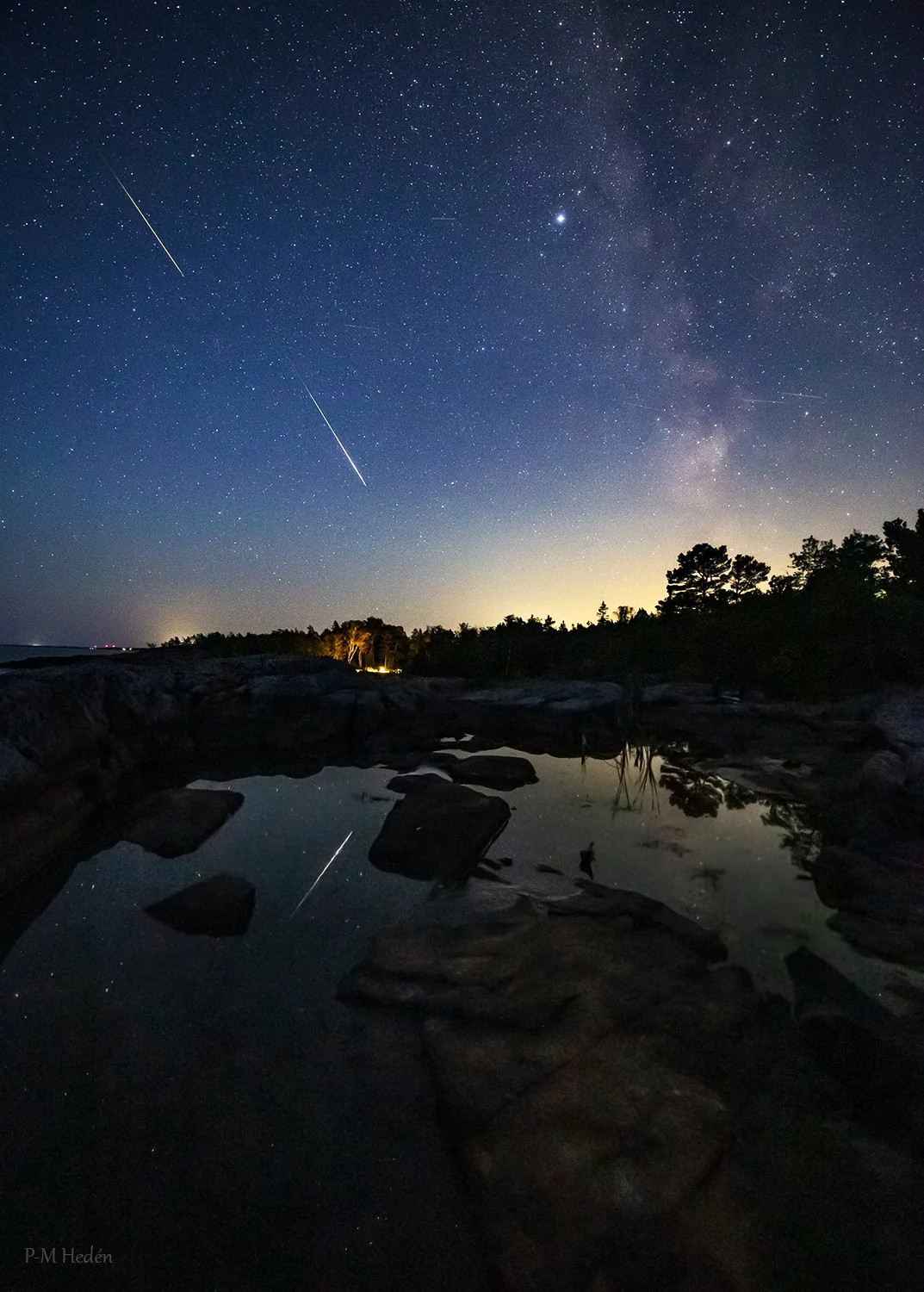
Image: NASA Astronomy Picture of the Day (APOD) · Image Credit & Copyright: P-M Hedén (Clear Skies, TWAN) · Today's page
Today's NASA Astronomy Picture of the Day comes from Grisslehamn, a small village on Sweden's east coast. It shows two bright Perseid meteors and something rarer: one of them is reflected in the water.
The photographer is P-M Hedén, or Per-Magnus Hedén. Born in 1971, he lives in Vallentuna, 30 kilometers north of Stockholm, and has photographed the night sky since 1999. "Clear Skies," included in his credit, is the name of his website. He is also a member of TWAN, The World At Night, an international nightscape photography project founded by Babak Tafreshi in 2007. UNESCO and the International Astronomical Union selected it as the first Special Project of the International Year of Astronomy 2009.
The photograph was made on the night of August 12, around the peak of the Perseid meteor shower. At 60 degrees north, that night presents a difficulty most readers in China would never think to expect.
Three Steps of Arithmetic: The Sky Never Became Fully Dark
Grisslehamn lies at 60.10 degrees north.
Darkness is not a switch but a slope. When the Sun is less than 6 degrees below the horizon, it is civil twilight and there is still enough light to read. From 6 to 12 degrees is nautical twilight, when the horizon remains visible; from 12 to 18 degrees is astronomical twilight. Only after the Sun drops more than 18 degrees below the horizon does scattered sunlight finally become fainter than natural starlight, and the sky becomes fully dark. These thresholds come from the US Naval Observatory. Royal Museums Greenwich puts the last one more plainly: beyond 18 degrees, the Sun's lingering glow is no longer visible.
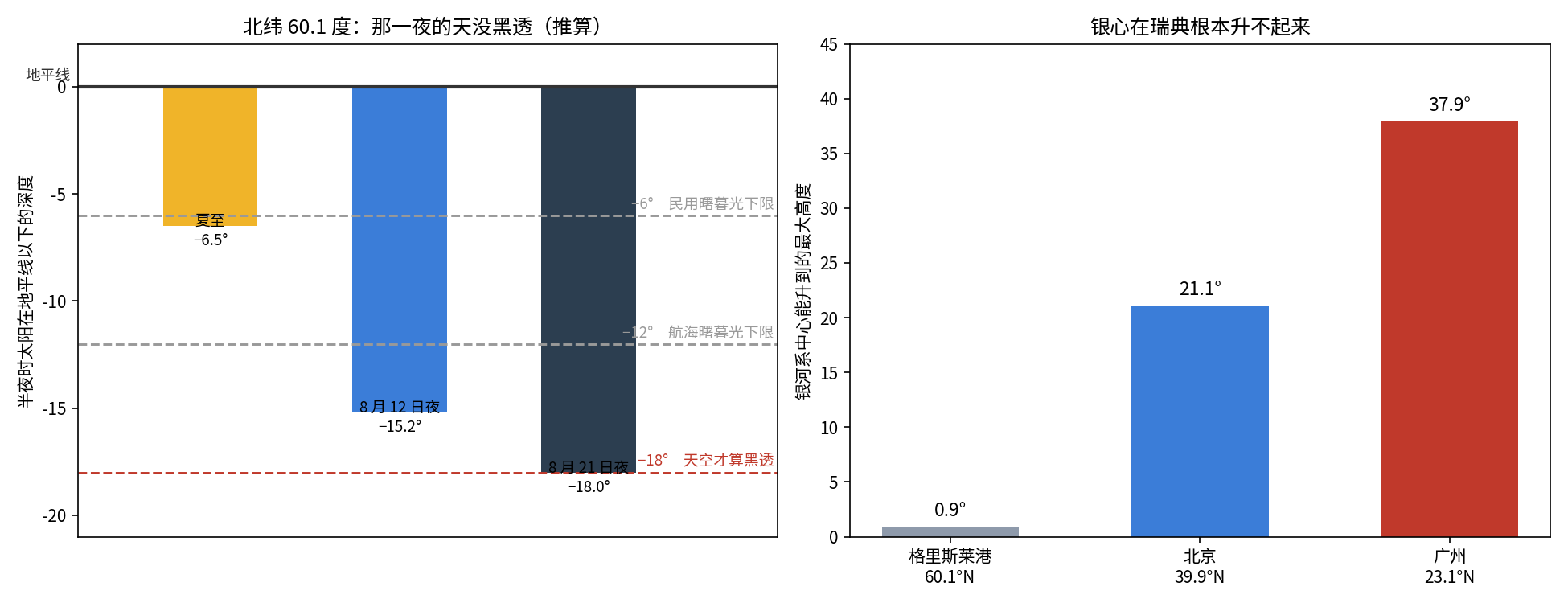
Now for one subtraction. In summer, the Sun's depth below the horizon at midnight is approximately solar declination plus local latitude minus 90 degrees.
- At the summer solstice, the Sun's declination is about 23.4 degrees, putting its lowest altitude at Grisslehamn at about -6.5 degrees - only just beyond the threshold for the midnight sun.
- On the night of August 12, its declination is about 14.7 degrees and its lowest altitude about -15.2 degrees.
- Full darkness requires -18 degrees.
The difference is 2.8 degrees. All night long, Grisslehamn remained in astronomical twilight. The sky never became truly dark. The darkest moment came at about 12:50 a.m. local time, when the Sun was due north. The interference was therefore not uniform. It formed a luminous arc pressed against the northern horizon, lingering through the night.
(These altitudes were calculated minute by minute using the standard solar-position method without atmospheric refraction. As a cross-check, the August 2026 table for Stockholm at sunrise-sunset.org leaves the "astronomical twilight" field blank until August 19. The night of August 19-20 is the first to contain a true astronomical-night window, about one hour long. Slightly farther north in Grisslehamn, astronomical night returns on August 21, a Friday.)
Four months. From late April to late August, central Sweden has no truly dark night. The Perseid peak falls near the end of those four months every year.
And the Center of the Milky Way Never Rises There
APOD calls the Milky Way in the picture "a diffuse and faint background." That is not modesty. It is geometry.
The center of the Milky Way lies at a declination of about -29 degrees. The highest altitude an object can reach from a given location equals 90 degrees minus the observer's latitude, minus the object's angular distance from the celestial equator. Put in the numbers:
- Grisslehamn (60.10 degrees N): 0.9 degrees. The galactic center perpetually grazes the horizon and, in practice, never rises.
- Beijing (39.90 degrees N): 21.1 degrees.
- Guangzhou (23.13 degrees N): 37.9 degrees.
The sky is not dark enough, and the galactic center never clears the horizon. Two independent pieces of geometry fully explain one adjective.
And here is the point this story most wants readers in China to know: their view of the Milky Way can be grander than the one available to this world-class night-sky photographer in Sweden. Anyone who can escape the city lights already has something he cannot buy at any price: a galactic center that can climb 20, 30 or nearly 40 degrees into the sky.
Popular science need not be snobbish. Sometimes the truth is simply this: the place beneath your feet is better.
NASA Made Him Use the Word "Composite"
APOD's description explicitly calls this a composite image. Some readers recoil at the word. Does the picture still count as real?
Start with the rules. APOD's submission page says it accepts composites and digitally manipulated images, but requires the technique to be disclosed plainly, honestly and completely.
So the word is not a disclaimer. It is mandatory disclosure.
A meteor composite works like this: mount the camera on a tripod, keep the composition fixed and expose continuously through the night, perhaps making a thousand frames. Later, select each frame that caught a meteor and place the meteor back onto a single sky background in its true position relative to the stars. The process compresses time, not space. It is the sky over four hours played back in fast-forward.
The test is therefore clear, without requiring cynicism:
- An honest composite uses the same camera, the same night and the same fixed composition, keeps each meteor in its true position against the stars, and says what was done.
- A dishonest composite mixes nights, pastes in a Milky Way or Moon from another place or time, shifts meteors to make them point more neatly toward the radiant or, worst of all, says nothing.
The Royal Observatory Greenwich's Astronomy Photographer of the Year competition takes the same position: composites may be entered, but the processing must be declared or the entry is disqualified. Artificially generated celestial objects, weather effects or any other non-observational data are prohibited altogether.
Three rulebooks, three institutions, one conclusion: the test of truth is not whether an image was edited, but whether the editing was disclosed. That may be one of the most necessary skills in 2026, hidden inside a single adjective.
The Reflection Is the Hardest Part of This Composite to Fake
Now return to the reflection on the water.
Water is not a mirror, or rather, its reflectivity depends strongly on angle. Using the Fresnel equations for light passing from air to water, with a refractive index of about 1.333, the reflected share is:
- From directly overhead (90 degrees): just 2%.
- At 40 degrees: 3.4%.
- At 20 degrees: 13.4%.
- At 10 degrees: 34.8%.
- At 5 degrees: 58.4%.
A water surface behaves like a mirror only toward the horizon. This explains something familiar that is easy to overlook: reflections on a lake begin at the far shore. It also explains why meteor reflections are so rare. They belong almost exclusively to meteors low in the sky.
After photographing the reflection of an Orionid meteor, one nightscape photographer wrote that meteors are so brief that they are often missed even directly; capturing one on a moving water surface was a rare gift. He also offered a rule of thumb: the reflection is at most about one-eighth as bright as the meteor itself.
Compare that estimate with the table above. One-eighth is about 13%, corresponding almost exactly to an altitude of around 20 degrees. A photographer's estimate by eye lands on the same number as a textbook formula.
There is one further point, offered as an inference rather than a sourced conclusion. Ripples, wind and tide change continuously across four hours; moving a reflection from one frame into another would almost immediately betray itself. The meteor and its reflection therefore most likely come from the same exposure. In a photograph labeled a composite, the reflection may be the single hardest element to fabricate.
Four Days From Now Is Qixi
APOD uses a clever yardstick for the meteors' brightness: nearly as bright as Altair.
Altair, or Alpha Aquilae, has an apparent magnitude of 0.76. It is the 12th-brightest star in the sky and, at 16.7 light-years away, one of the closest bright stars. It also has a startling trait: one rotation takes less than eight hours. Its equator travels at 242 kilometers per second, distorting the star into a flattened sphere whose equatorial radius is about 25% greater than its polar radius. In 2007, astronomers used an interferometer to image details on its surface. It was the first surface image ever made of a main-sequence star other than the Sun.
No magnitude chart, no instrument - simply point to a star everyone recognizes and say, "about that bright." It is good science communication, and worth noticing.
For Chinese readers, the yardstick arrives at an apt moment: four days from now, Wednesday, August 19, is Qixi. August 13, 2026, is the first day of the seventh lunar month, so its seventh day falls on August 19; the date is calculated according to the Purple Mountain Observatory's Chinese Astronomical Almanac.
There is another coincidence that needs no processing. The highest star in the Summer Triangle is known in the traditional Chinese sky as Tianjin Four, or Deneb. Tianjin means the celestial ford across the Milky Way. Grisslehamn, where this photograph was taken, is itself a crossing point. Its name first appears in a 1376 document about the postal route between Sweden and Finland. For centuries, local people rowed mail across the Sea of Åland; today, ferries leave three times a day and reach the Åland Islands in two hours.
In the night sky above a Swedish crossing, the Chinese name for the highest star means "crossing."
Sources: NASA Astronomy Picture of the Day for August 15, 2026, and the APOD submission rules; The World At Night website, including its About page and profile of P-M Hedén; the US Naval Observatory's definitions of twilight; Royal Museums Greenwich on twilight; sunrise-sunset.org's August 2026 solar table for Stockholm; the Royal Observatory Greenwich's Astronomy Photographer of the Year rules; the International Meteor Organization's 2026 Perseid observing guide; eMeteorNews and the American Meteor Society's meteor activity outlook for August 15-21, 2026; Jeff Sullivan's account of photographing a meteor reflected in water; Monnier et al.'s 2007 Science paper on imaging Altair's surface; and Wikipedia entries for Grisslehamn and the Sea of Åland.